 |
[ Outlaw Genealogy | Bruce
History | Lost Chords ] [ Projects | News | FAQ | Suggestions | Search | HotLinks | Resources | Ufo ] |
|
[ Outlaw Genealogy | Bruce
History | Lost Chords ] [ Projects | News | FAQ | Suggestions | Search | HotLinks | Resources | Ufo ] |

1259 -
A pitched
battle was fought in Syria, between the
Templars and Hospitallers. The Templars were defeated
1260 - Witness
Richard le Utlawe - Essex - Grant of Rent
William de Wateville to John de Vallibus and his heirs of land in Hempstead,
Essex witnessed by Sir Nicholas Peche, Sir
Andrew de Helyun, Sir Simon Peche, Philip de Codree, John de
Bosco,
Richard de Kanne, Richard le Utlawe, Hugh de Sanford, Roger de Reymes,
Geoffrey de Bello, Simon Clericus - 44 Henry III
1285 - Hospitaller Charter of Ida daughter of the late Richard Utlaw of the five acres of land and half an acre of meadow, with appurtenances. - Roger [ son of Richard ] Outlaw ( of Bumpstead Helion ), Ida daughter of Richard
Some questions might be : Why are all these (important) people gathered
together for this occasion of a rental agreement?
How does Richard Utlawe fit into this? Whose man was he with? John Vaux?
The Pecche's? or Waterville?
I'm thinking with the Julian Glanville connection and a Cambridge Baron of
Bourn, it would be the Peche's. But it could easily be John Vaux with the
Essex/Norfolk connection . It is also likely that Richard Utlawe was together
with Roger de Reymes if he was related to the Hinderingham
Robert de Utlagh connection. Also there is the Crusading connections.
So many possibilities.
Generally the witnesses to the agreement would be people who worked for or were friends involved with the principals, and acted as Notaries of the agreement, they maybe neighbors of in this case William de Waterville.
Facts we know for sure are:
Found these supporting records that seem to be the same reference:
Essex, Hempstead.- Grant of a rent
Essex, Hempstead.- Grant of a rent and quitclaim for the release of annual payment, William de Watevile to John de Vallibus, his wife Alice and his heirs by her: grant of four shillings rent in Hempstead to be taken from a half-virgate of land in Hempstead which William de Estone held of Watevile, and quitclaim of two shillings rent from the tenement in Hempstead of Alan Lovesone, to hold of Watevile for a pound of pepper on 25 December for all services, in return for a release by John and Alice of an annual payment of a buck and a doe and ten cartloads of wood which he is bound to make to them and their heirs from his park of Hempstead, witnesses: Sir Nicholas Peche, Sir Andrew de Helyun, Hugh de Sanford and others, manuscript in Latin, on vellum, 16 lines, green wax seal appended showing a mounted knight with raised sword leaping a star with the legend "Sigill' Willelmi de [Watevi]le", some wear, chipped, docket on verso: "this is a dede of honnor to rattewell", folds, a little creased and planet, 102 x 178mm., [c. 1260].Found:
Lot 275 Essex. A fine and very early medieval charter - Dominic Winter Book Auctions Artfact
Description: *Essex. A fine and very early medieval charter made during the reign of Henry III, (c. 1260), being a grant of a rent and quitclaim for the release of an annual payment, William de Watevile to John de Vallibus, his wife Alice and his heirs by her, 1/ Four shillings rent in Hempstead (Hamstede) to be taken from a half-virgate of land in Hempstead which William de Estone held of William de Watevile, saving the customs which are owed to him, 2/ Two shillings rent from the tenement in Hempstead of Alan Lovesone to hold of William de Watavile gor a pound of pepper on 25th December for all services, William de Watevile grants 1 above and quitclaims 2 above in return for a release by John and Alice of an annual payment of a buck and a doe and ten cartloads of wood which he is bound to make to them and their heirs from his park in Hempstead, witnessed by Sir Nicholas Peche, Sir Andrew de Helyun, Sir Simon Peche, Philip de Codree, John de Bosco, Richard de Kanne, Richard le Utlawe, Hugh de Sanford, Roger de Reymes, Geoffrey de Bello, Simon Clericus, [this document without a trace of a seal, so would appear to be a contemporary copy issued with the original at that time] (1)
Found: Bloomsbury_725 Auction_July_2010
45. Essex, Hempstead.- Grant of a rent and quitclaim for the release of annual payment,
William de Watevile to John
de Vallibus, his wife Alice and his heirs by her: grant of four shillings rent in Hempstead to be taken from a
half-virgate of land
in Hempstead which William de Estone held of Watevile, and quitclaim of two shillings rent from the tenement in Hempstead of
Alan Lovesone, to hold of Watevile for a pound of pepper on 25 December for all services, in return for a release by John and Alice
of an annual payment of a buck and a doe and ten cartloads of wood which he is bound to make to them and their heirs from
his park of
Hempstead, witnesses: Sir Nicholas Peche, Sir Andrew de Helyun, Hugh de Sanford and others, manuscript in Latin, on vellum, 16
lines, green wax seal appended showing a mounted knight with raised sword leaping a star with the legend “Sigill’ Willelmi de
[Watevi]le”, some wear, chipped, docket on verso: “this is a dede of honnor to
rattewell”, folds, a little creased and planet, 102 x
178mm., [c. 1260].
1169 - Bromholm Priory - House of Glanville - Charter of Bartholomew de Glanville To Bromholme Priory - Walter Utlage " And two thirds of the tithes of my men: that is, of my uncle by the mother, Roger de Bertuna: And of Geoffrey, priest of Honinges: and Turstan despensatoris: Warini de Torp, Ricardi Hurel, Walteri Utlage: et Roberti de Buskevill: And the tenth of the whole Ricardi filii Ketel. " - An Essay Towards a Topographical History of the County of Norfolk: Tunstede ... By Francis Blomefield, Charles Parkin (All the people highlighted in this Charter were involved with the Crusades or their relatives were - except for Walter Utlage , for which there is no information available to document )
1207 - Hubert de Burgh purchased of Roger de Burnham and Julian, his wife, William de Noiers, Robert Fitz Ralph, and Alice his wife, and Robert de Utlagh, their several nine parts of two knights fees in Runton and Beeston and Hinderingham, for which they paid castle guard to Dover. 9th of King John purchased of Roger de Burnham and Julian, his wife, William de Noiers, Robert Fitz Ralph, and Alice his wife, and Robert de Utlagh, their several nine parts of two knights fees in Runton and Beeston and Hinderingham, for which they paid castle guard to Dover. 9th of King John * The Norfolk antiquarian miscellany - West Runton - Beeston Regis - Hindringham - "Hindringham Outlagh Manor"
1240 - Adam
fil' Symon v. Warin le Utlag, in Qeywode. (Bishop of Norwich app. clam.).
Diss
Hundred 24th Henry III -
Possible Peche connection: Pecche's Manor, now called Heywood Hall - Sir Gilbert Pecche, Knt. lord of Brunne, in Cambridgeshire,
upon whose death it descended to Sir Hammond Pecche, Knt. his son, who died in 1240, leaving, by Eva his wife, several children; Gilbert was his eldest son
and heir, but this was given to Robert Pecche, his fourth son, who held it in 1286, in which year he claimed view of frankpledge, and assize of bread and ale of all his tenants.
1259 - A
pitched battle was fought in Syria, between the Templars and Hospitallers. The
Templars were defeated - Not much known was the division of the
Hospitallers and Templars that occurred up to 1259 . The result was that for a
time the Templars were either killed or ejected from the holy land by the
Hospitallers, A new recruitment drive was then made for replacements.
1260 - Witness
Richard le Utlawe - Essex - Grant of Rent
William de Wateville to John de Vallibus and his heirs of land in Hempstead,
Essex witnessed by Sir Nicholas Peche, Sir
Andrew de Helyun, Sir Simon Peche, Philip de Codree, John de
Bosco,
Richard de Kanne, Richard le Utlawe, Hugh de Sanford, Roger de Reymes,
Geoffrey de Bello, Simon Clericus
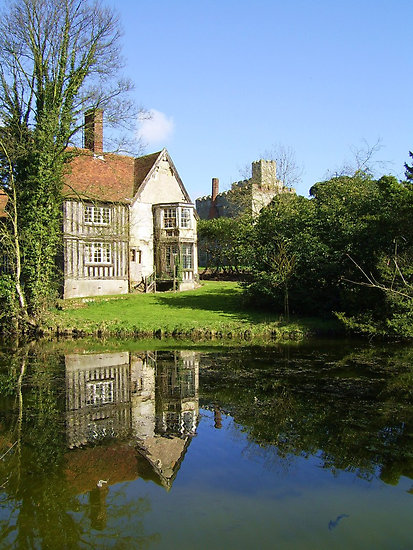
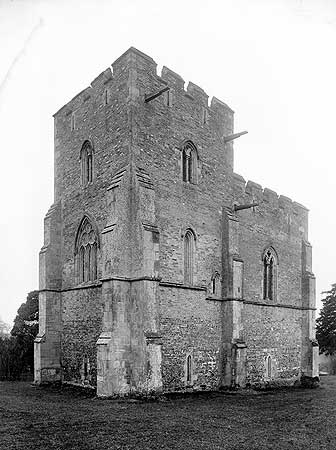
1260 - Little Wenham Castle - Suffolk - circa 1260-1290 for Sir John de Vallibus - Fortified House, now used as a private museum.... The house is of great importance as it represents one of the earliest uses of home made brick in England and it was built as a house, not a keep. The hall came to the Holbrooks & Debenhams - - -
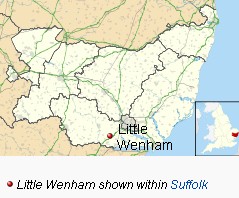 Little Wenham
- is a small village in Suffolk,
England. It
is part of the civil
parish of Wenham
Parva (the ancient name for Little Wenham) within Babergh
district.
Little Wenham
- is a small village in Suffolk,
England. It
is part of the civil
parish of Wenham
Parva (the ancient name for Little Wenham) within Babergh
district.
1270 - Eighth Crusade - 20 August Edward sailed from Dover for France, brought with him around 225 knights and all together 1000 men
1273 - Richard Utlawe, County Bedford, (taken from the Hundred Rolls).
8/1274, King Edward and the English [likely including Simon] returned from the crusade.
Over a Hundred years later:
1399 - Richard
Outlawe,
58, on that day went with master Ivo la Zouch, chancellor of Cambridge
University, to the church
So where is Hempstead Essex?
Hempstead, Essex - is a village near Saffron Walden, in Essex. It is situated on a relatively quiet road, from Saffron Walden to Steeple Bumpstead. The village is the birthplace of Dick Turpin, and is also the final resting place of Doctor William Harvey, who discovered the circulation of blood.
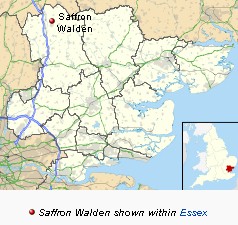 Saffron Walden
- It is located 12 miles (19 km) north of Bishop's
Stortford, 15 miles (24 km) south of Cambridge
and approx 35 miles (56 km) north of London...The
town retains a rural appearance and many very old buildings dating from the medieval
period onwards...
Saffron Walden
- It is located 12 miles (19 km) north of Bishop's
Stortford, 15 miles (24 km) south of Cambridge
and approx 35 miles (56 km) north of London...The
town retains a rural appearance and many very old buildings dating from the medieval
period onwards...
With the Norman
invasion of 1066, a stone church was built. The castle
was constructed c.1116[citation
needed] A Priory, later to become Walden Abbey, was also
founded under the patronage of Geoffrey
de Mandeville, first Earl of Essex around 1136
In the medieval period the primary trade in Saffron Walden was in wool. However, in the 16th century and 17th century the saffron crocus (crocus sativus) became widely grown in the area. The flower was precious, as extract from the stigmas, the saffron, was used in medicines, as a condiment, as a perfume, as an aphrodisiac, and as an expensive yellow dye. This industry gave its name to the town and Chipping Walden became Saffron Walden.
Pedigree John de VAUX - High Sheriff of Norfolk & Suffolk Born: ? Died: 1288
Baron John de Vaux - Vallibus - Mini Biographies
~1230, John born in Dalston, England, s/o 9994996. Sir Oliver de Vaux & 9994997. Petronill de Croun.
Amazing a Glanville connection Julian Glanville is Symon Peche's wife:
Sir Simon de Pecche &. Julian de Glanville Mini Biographies
~1225, Simon born in England, s/o §Sir Gilbert Peche & Maud Leach.
~1225, Julian born in England, d/o 11817222. Sir Geoffrey de Glanville & 11817223. Margaret de la Haye.
Julian coheir [with her sister Alianore married to Lord Almuric Peche] of her brother
Sir Geoffrey de Glanville.
1246, Royal grant to Simon Pecche. (S) Magna Britannia, V5, Derbyshire, 1817.
1255, Simon Pecche of Brandeston had free warren in his manor, William Pecche his son. (S) History and Antiquities of the County of Norfolk, Armstrong, 1781, P96.
3/1256, Simon Peche has paid in the king’s Wardrobe to Arcald de St. Romano etc. at Norwich five marks of gold to be bought
there from for having a charter of warren and acquitting it. (S) Fine Rolls of Henry III.
7/10/1270, … Protection with clause volumus, for four years from Easter, for Robert de Ufford, crusader, who is going with the King and with Edward the king’s son to the Holy land.
The like for the following crusaders … Simon Peche … (S) Fine Rolls of Henry III. [Simon’s son William also went on crusade.]
8/1270, Simon left on the 8th crusade with Lord Edward.
11/10/1270, Simon, with Edward, arrived in Tunis.
8/1274, King Edward and the English [likely including Simon] returned from the crusade.
8/3/1279, Commission … where by danger might arise by lapse of time to Simon Pecche and Julianan his wife, touching the advowson of the church of Rollesby, co. Norfolk, now long void. (S) Calendar of Patent Rolls.
1281, Simon de Peche and Julian his wife granted lands here to Clement, son of Edmund de Paston, by fine, and also to Laurence de Repp.
1281, Nicholas de Castello v. Symon Peche and Juliana his wife in
Cringelford. (S) Feet of Fines for Norfolk, V1.
1286, William de Rollesby v. Juliana the wife of Symon Pecche, of the advowson of Rollesby. (S) Feet of Fines for Norfolk, V1.
6/18/1289, To Roger Lestrange (Extraneo), justice of the Forest this side Trent. Order to deliver on bail Simon Pecche of Mundene, imprisoned at Colchester for trespass of venison in the forest of Essex. (S) Calendar of the Close Rolls.
2/5/1290, Licence for the alienation in mortmain to the prior and convent of Norwich of … 7.5 acres of land in Marcham by Juliana Pecche, … (S) CPRs.
(S) Norfolk Archaeology, V4, 1855, PP11.
Family notes:
• 1222-3, The grant of a Wednesday market to Simon Peche at Castleton.
• 1234, Symon Peche held 3 parts of a fee of the king in Gukenton, Norfolk.
• 1242-3, Gilbert Pecche held three knight’s fees in Kingston, Wimpole, and Eversden; held by Hamon Pecche in 1166. (S) County of Cambridge and the Isle of Ely, V5, 1973.
Child of Simon and Julian:
i. Cecily de Peche (2954305), born ~1245 in England. [Heir]
Posted by Bond0007 at 10:38 PM
House of Glanville from A.D. 1050 to 1880 - Pages 1 to 20
In the year 1240 Sir Geoffrey held one Knight's fee of the Lordship of Castle Acre, which, with his other extensive possessions, on his death went to his daughters and coheirs on the decease of his son Geoffrey. In the same year he conveys by fine to Thomas the son of Richard de Backeton free lands in his Lordship of Bacton.
Sir Geoffrey de Glanville married Margaret daughter of Sir Geoffrey de-la-Haye, and by her had issue:-
(1.) Geofrey de Glanville, who dying without issue, his property descended
to his five sisters and coheirs. [fn 19]
Margaret de Glanville, married Edmund, Earl of Cornwall.By the death, of Geoffrey de Glanville, the elder line of the Glanvilles failed, and a part of the lands of that branch went into the families of his sisters, which will be seen under the account of the following manors. [fn 20]
Alianore de Glanville, married Lord Almuric Pecche.
Agnes de Glanville, married Baldwin, a Norman.
Emma de Glanville, married Sir John de Grey.
Basilia de Glanville, married Sir William Boville.
Julian de Glanville, married Sir Simon Pecche.
Alianore de Glanville, first daughter and coheiress, brought her portion of Lordship of Bacton to her husband Lord Almuric Peche.
Edmund Earl of Cornwall granted, in 24 Edw. I., the wardship of William de Leach to John de Walcot, which belonged to him on account of the custody of Thomas son and heir of Sir Edmund Peche Kt., and of Richard Leche his brother, if William died under age. Julian fifth daughter and coheiress, married Symon Peche, brother to Almuric.
In 9 Edward I. Simon de Peche and Julian his wife granted lands here to Clement, son of Edmund de Paston, by fine, and also to Laurence de Repp.
In 30 Edward I William Peche and Rose his wife and John their son were seised of a manor in Bacton, which had been afore granted by Julian Peche and held of the honour of Eye by the service of 6d. every 32 weeks; it was valued at £7 12s. 8d. This manor then came to the Pastons by the marriage of Cecily, daughter and heiress of Sir Simon Peche, with Walter de Paston. A park is mentioned at Bacton in ancient times, and there is a place called to this day Bacton Wood.
Also the Peche's were "Lord's of Bourn" Cambridge:
The early history of Caldecote church - CHAPTER ONE
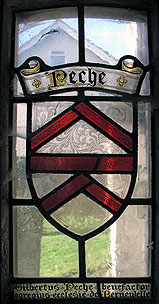 When Pain Peverel died in 1121 he was buried at Barnwell Priory. William
Peverel of Shropshire succeeded to the barony of Bourn and to the
patronage of the Priory. When he in turn died on the Second Crusade (in 1148)
the Peverel fief was partitioned among his sisters, with Bourn and the patronage
of Barnwell Priory falling to Matilda Peverel, wife of Hugh of Dover.
Matilda, however, died without issue in 1185 and the honour of Bourn and the
patronage passed to her nephew Geoffrey Pecche, lord of Great Thurlow,
Sugolk and Kingston, Cambs. In 1190 Geoffrey Pecche was succeeded by his
brother Gilbert Pecche.
When Pain Peverel died in 1121 he was buried at Barnwell Priory. William
Peverel of Shropshire succeeded to the barony of Bourn and to the
patronage of the Priory. When he in turn died on the Second Crusade (in 1148)
the Peverel fief was partitioned among his sisters, with Bourn and the patronage
of Barnwell Priory falling to Matilda Peverel, wife of Hugh of Dover.
Matilda, however, died without issue in 1185 and the honour of Bourn and the
patronage passed to her nephew Geoffrey Pecche, lord of Great Thurlow,
Sugolk and Kingston, Cambs. In 1190 Geoffrey Pecche was succeeded by his
brother Gilbert Pecche.
Cambridge Journals Online - Abstract - Frilsham
Berkshire Documents - Frilsham
803 Gift in free alms by Matilda Peche (Peche), lady of Frilsham (Fridlesham), widow, for the health of her soul and for the souls of Sir Nicholas Peche her
father, Alice Peche her mother, Sir Oliver Deyncort and Sir Walter de Rideware her husbands
deceased, Sir Ralph Peche, Hawise his wife, Nicholas and John the donor's sons, Alice her daughter, Roger de Rideware and Alice his wife, Richard le Wales, and all her ancestors [etc.], to
Reading Abbey of all the land which she had in the vill of Frilsham called La
Hide, which she bought from Nicholas Butler (le Boteler) of Reading and Juliana his wife and John Flawel of Chichester (Cicestr'), which they had bought from Roger Willard; saving to herself a parcel [of land] which she bought from Margery, widow of Walter Wilard, for the term of Margery's life. To be held with all appurtenances and the homage and service of Robert Black (Niger) and whatever belonged to her from the said Robert or his heirs, by rendering annually to her and her heirs a root of ginger and a rose at the nativity of St John Baptist for all service, suits of court, secular exaction and demand, saving hidage, scutage and all other foreign service which is due from the said land. Warranty. For this the monks have received Matilda, her ancestors, successors and children in all benefits of the conventual church of Reading in perpetuity. Sealing
[1270]
So who was: William de Wateville ?
Well they seem to be related to the Lords of Bourn/Cambridge again and related to the Pverel's:
 Roger
III de TORPEL , & Bourn b: ABT 1175 in Bourn, Caxton,
Cambridgeshire, England
Roger
III de TORPEL , & Bourn b: ABT 1175 in Bourn, Caxton,
Cambridgeshire, EnglandMaybe this is Roger de Torp I've seen records of?
TORPEL FAMILY OF NORTHAMPTONSHIRE
But this does not show any male William de Waterville descendants.. hmmmm
Waterville
- [WATE301] William I de Waterville (born c.1025). He possibly fought
with William at the Battle of Hastings (1066), for which service he would be
rewarded with lands in England. At the Domesday Survey (1086), William held
land as sub-tenant to the Chertsey Abbey (Surrey), for example in Cobham, Esher
and Old Malden. In addition "William de Vatteville" held land in
Suffolk, including Hargrave Manor and Lidgate Manor, as tenant-in-chief to
the King, and had one house at Colchester, held of Swein, which [ESSE341] Robert
FitzWymarc (Swein's father) held prior to the Conquest.
...
Roger I had a son Roger II who m. by c1160 to Ascelina, dau. of Geoffrey de
Waterville and his wife Ascelina (dau. or sister of Payn) Peverel. (Geoffrey was
son of Ascelin de Waterville).
They had a son Roger III who succ. his mother in 1220. This last Roger was said to have been of Girton, Cambridgeshire.
That Roger (III) m. Mabel ___ and had a son William and a
dau. Asceline who m. Ralph Camoys.
So this would be "the" William de Wateville , but no dates and may have also been known as William de Torpel but he seems to have died in 1242 - so that's a dead end....
Maybe this William was unknown because it all points to Bourn and Cambridge area , when the people involved are the Pecche's and Vallibus - Vaux....
1066 A Medieval Mosaic (Medieval Mosaic)
Wateuil :
"from the village of Vatteville-sur-Seine, of which the Earl of Mellent was chief lord, and where he had a castle.
Willielmus de Watevilla is a witness to a charter of Robert de Mellent to the Abbey of Jumieges, about the time of the Norman survey; and he himself gave to that monastery, with the consent of his wife, the church, fair, and tithes of Croixman, in the Pays de Caux."—Gage's Suffolk. It is apparent, from the accompts of the Norman Exchequer Rolls, that
in 1195, Vatteville was a Royal residence, when the King hunted in the forest of
Vatteville. Among the items furnished by its custodian, Robert d'Appeville, are "four nets to catch wild boars, two tunics for the use of two dog-keepers," &c, &c.
Three De Watevilles are entered in Domesday: William, who held of the King in Essex and
Suffolk, and Percinges (Perching) of William de Warrenne, with two other manors—one of which was Brighton—in Sussex; Robert, who held de capite in Surrey, with five manors in other counties, under Richard de Tonbridge; and Richard, an under-tenant in Surrey.
William de Wateville—in all probability the same William who was a benefactor of Jumieges, and the head of the family, held High Rodinges and Hanningfield in
Essex; and some of his descendants, "from their abode at Hanningfield, took their denomination from thence, being in old evidences written promiscuously De Hanningfield and De Wateville. Robert was probably either brother or son of that William."—Morant's Essex.
According to the same authority, he was the progenitor of the Essex family. He appears as a witness to two deeds in the Bishopric of Durham in the time of Ralph Flambard (1099-1133): and has left his name to the manor of Biddic-Watervile, or South Biddic, in the parish of Houghton-le-Spring; but this would appear to have been his only connection with the North of England.
His posterity was seated at Hempstead, one of the two Essex manors that he held of the Honour of Tunbridge, in which Henry III. granted Sir William de Wateville a charter of free warren in
1253.
This can scarcely have been the Sir William de Waterville mentioned by Thomas of Gloucester, who, sixty-two years before, went with Coeur de Lion to the Holy
Land, and was one of the six knights through whom he sent his challenge to the Soudan. (See Brande.) Both he and his son married heiresses; the latter a daughter of Sir Robert Roos of Radwinter, who bore the uncommon name of Thorema, and was the grandmother of the last of the line, Sir John, and his sister Joan. "Upon his dying without issue, she became the sole heir, and brought with her a considerable estate in marriage to Richard de Mutford, her first husband, about the year 1330. Having no issue by him, she was again married to Sir William Langham, about 1341.
"Of the same family were no less than three Knights Bannerets, all living at the same time in this county in the reign of Edward I., bearing these arms: Sir John de Wateville, Argent three chevrons Gules; Sir Robert de Wateville, the same, within a bordure indented Sable; Sir Roger de Wateville, the same, with a martlet Sable."—Morant's Essex. Sir Roger and Sir Robert were among the famous tilters at the great tournament at Stebenhithe (Stepney) in 1308, with another of the name, Sir Geoffrey Wauteville, who bore for arms: Sable semee of cross crosslets a lion rampant Argent langued Gules.
In Surrey, we find William de Waterville, in 1144, gave the manor of Warlingham, with the consent of Robert, William, and Otwell, his sons, to the convent of Bermondsey; on which either he or his son of the same name bestowed further benefactions
in 1158. Hugh de Wateville was Sheriff of Surrey and Sussex in 1155; and in the same year William de Wateville, one of the King's chaplains, was elected Abbot of
Peterborough. It is recorded of him that he added three stories to the central tower of his church, furnished the choir, and founded a chapel to St. Thomas of Canterbury—"a bold thing for a chaplain of Henry II. to do."
Another William was among the "forty knights and good men" summoned in 1292 by the Sheriff of Surrey "to be at Lambeth to enquire after the malefactors who lately broke into the King's Treasury, and carried away the King's Treasure to the value of,10,000." Two of their manors, Chelsham-Watvyle and Esher-Waterville, are still called by their name in Surrey: and Manning and Bray, in their county history, suggest that it is highly probable the Robert de Merton who founded Merton College in 1264 was of this family. "The Watteviles had large possessions in Northamptonshire and Surrey. The surname of De Merton was an assumed one, probably from his having been educated at that place, which seems to have been the case with his father also.
How the Watteviles of Surrey and those of Northampton were connected does not appear." The three chevrons of Merton College were certainly borne on the coat of the Watevilles, but differenced in tincture.
"Thorp Watervile Castelle upon Avon, sumwhat lower than Wndale," as Leland describes it, in Northamptonshire, was most probably built by
Azelin de Wateville, "who," says Bridges, "first possessed the lordship." No traces of it are now remaining. It passed in the time of Henry III. to the sisters of
Richard de Wateville, who, in 1234, had obtained a grant of free warren in Thorp and Marham. Richard's widow held Marham in dower, and it was transferred by purchase to Reginald de Wateville in 1240. Reginald, again, had no son, and left three co-heiresses, Joan, married to Robert de Vere; Elizabeth, or Petronella, married to John Wykham; and Margaret, married to Henry de Tichmarsh. In 17 Ed. II. Marham belonged to Robert de Wateville."—Bridge's Northamptonshire. Was this—as seems likely—the same Robert who received license of pardon for having been concerned in the death of Piers Gaveston, "the Ganymede of Edward II.," and was a commissioner of array in Hampshire in 1324? Two years afterwards, he "had summons to attend a parliament at Westminster, inter caeteros proceres et magnates regni; and in the 1st, 2nd, and 4th Ed. III., had the like summons with the nobility of the realm. In the 32 Ed. I. (if he be the same person) he had a charter for free-warren at Overton-Waterville, in the co. of Huntingdon: and in the 9th Ed. II. fined forty shillings for license, to give certain lands at
Overton-Waterville, and Ashele, in Huntingdonshire, to found a chantry at St. Mary's, at Ashele."—Banks. Nothing is said of his posterity: and no other summons to parliament was ever issued to the family. Several other members of it are incidentally mentioned:—such as Berenger, "one of those great men on the part of the rebel barons, who were taken prisoners by the Royal army at Northampton" and Geoffrey, who in the previous century married Ascelina, the youngest co-heiress of William Peverell of Brune and Dover. He died in 1162, and was, according to Banks, the father of Roger, of Thorp, who had issue. Bridges, on the other hand, declares that his son was Ralph de Wateville, who died s. p. in 1185, leaving as his heirs two sisters, Ascelina, married to—Torpel, and Maud, the wife of William de Diva. In Warwickshire Dugdale speaks of a Roger de Wateville, who held Bramcote under the Earl of Leicester that founded a monastery at Leicester, and bestowed some lands there on the new Abbey. His grant was confirmed by Henry II.
Who was - Sir Andrew de Helyun ? - Helion -
Sir Andrew de Helion is similar in character to the others, and the copy of
it in the Book of Fees comes between copies of documents which clearly belong
to the year 1236. The reply of Robert de Beauchamp of Somerset, which is not
entered in the Book of Fees, will be found in the Appendix.
...
SUFFOLK. A list of tenants in chief of the king within the Liberty of St.
Edmund's enumerates not only those who held single fees and fractions of fees
and one man holding by serjeanty, but also some who held several fees, to whom,
however, the king had not written separately for information. Although the
name of Andrew de Helion figures in it, his own reply shows that he had actually
received one of the king's letters, presumably through the sheriff of Essex,
where the chief place of the Honour of Helion was situate. His reply that all
his military tenants had answered to the king direct accords with the statement
that the Honour of Helion was in the king's hand. [1]
It has been seen above that, in 1218, William de Helion had little or no authority over his tenants. [2] The Honour of Helion had apparently ceased to exist except in name. Some of the entries in this list may be compared with those dealing with the same places in the list of tenants of the Honour of Lancaster immediately preceding it.
Who was Roger de Reymes ? Well he seems to be from Norfolk - Overstrand or Oxstrand: - 44 HENRY III - 1260
But like a lot of the Norman conquerors, they also had other lands, in this case in Essex:
"had the honour and barony of Raines, Reynes, consisting of 10 knight's fees in Essex"
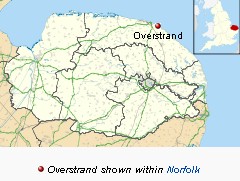 Again this is
where the Utlagh's come from the area of Holt: Overstrand
- is a village
(population 1,101[1])
on the north coast of Norfolk
in England, two miles east of Cromer.
Again this is
where the Utlagh's come from the area of Holt: Overstrand
- is a village
(population 1,101[1])
on the north coast of Norfolk
in England, two miles east of Cromer.
1207 - Hubert
de Burgh purchased of Roger de Burnham and Julian, his wife, William de
Noiers, Robert Fitz Ralph, and Alice his wife, and Robert de Utlagh, their
several nine parts of two knights fees in Runton and Beeston and Hinderingham,
for which they paid castle guard to Dover. 9th of King John * The
Norfolk antiquarian miscellany - West
Runton - Beeston
Regis - Hindringham
- "Hindringham
Outlagh Manor"
An Essay Towards a Topographical History of the County of Norfolk: Clavering
Vol 8 - Google Books
North Erpingham Hundred - Oxstrand British History Online
The town takes its name from its site, on the strand by the water; that is by the sea shore, being contiguous to it. Soon after the survey, probably on the decease of Berner,
it came to the Earl Warren, and was held of him by the family of de Reymes. Geffrey, son of Herlewin, owed 20 marks of silver, in the 5th of King Stephen, to have his land of Robert de
Reymes
...
This family seems to be descended from Roger de Reymes, or Reynes, who came into England with the Conqueror, and had the honour and barony of Raines, Reynes, consisting of 10 knight's fees in Essex, given to
him.
...
Agnes de Ratlesden, wife of Adam de Ratlesden, in the 34th of Henry III. impleaded Richer de Reymes, for a fourth part of a fee in this town, (then wrote Overstrand,) and in North Repps: Richer had released it to Roger de Herleberge for 80 marks of silver; Roger was called to warrant it, and a duel, or combat of trial, was fought on this account between the said Roger, and a freeman of Simon, son of Hugh, in the behalf and right of Agnes, and after that they came to an agreement.
...
In the 3d of Edward I. [ 1275 ] Hugh de Reymes, as lord, claimed wreck at sea, and in the 19th of that King, sold lands here; about the same time, John de Reymes, and Agnes his
wife, were living, and John his son; in the 33d of that King [1305], Roger de Reymes, and Alice, his wife, settled in trust a moiety of this
manor.
Overstrand Village and Parish Council - Lords of the Manor of Overstrand
Othestranda was held for de Warenne by Roger de Reymes a norman knight who fought in the Conquest and who was later honoured with a barony in Essex.
The de Reymes (also recorded as Raimes, Reynes, Raines, Rames) held the 'lordship' until the late 1600's, but not without incident it seems.
By 1268 it seems the lordship had become known as Overstrand. In this year a Richer de Reymes sold the lordship to Roger de Herleberge for 80 marks of silver. His (probably) cousin Agnes pleaded for a fourth part of the lordship as one of the co-heirs. It seems that a duel or combat of trial was fought between Roger de Herleberge and, acting for Agnes, a freeman called Simon son of Hugh. The result of which ended in agreement being reached by both parties.
orton waterville peterborough - Map
Thorpe Waterville Castle (south west of Peterborough and near Barnwell Castle)
Castle crenellated in 1301 by Walter de Langton, Bishop of Lichfield. The existing building, early 14th century and now used as a barn, was the great hall of the castle and originally two storys. The upper room floor has gone but the open roof displays magnificent timber work of tie-bean construction. The building has a stone exterior. (Pastscape)
A hamlet in the parish of Abchurch, on the W. of the county, and close to the river Nene. In several records mention is made of a castle, which perhaps was originally founded by Argeline de Waterville, a Norman knight, who at Domesday owned lands here, and who also obtained church fees from the abbot of Burgh, to defend him against Hereward the Wake. The place continued in his family till the reign of Edward I., when we find, in 1299, a Sir William de Tochet possessed of Thorpe; but three years after the castle and manor had passed into the hands of Walter Langton, Bishop of Lichfield and Coventry, at a time when probably the old fortress had become somewhat obsolete, according to the requirements of the day, and the bishop erected a large mansion upon ground now part of the Exeter property, .where a site called Castle Hill may be found, with traces of foundations.Thorpe Waterville
Castle Castle Barn Thorpe Achurch Thrapston Northamptonshire England English
- Thorpe Waterville Castle was originally a 12th century fortified manor house, founded by the de Waterville family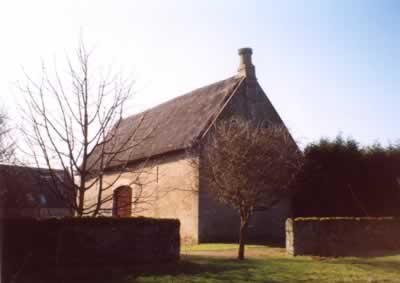 The castles of England their story
- Thorpe Waterville
The castles of England their story
- Thorpe Waterville
So who was "Philip de Codree" - "Coudree" Maybe a Norman from Sciez, France ?
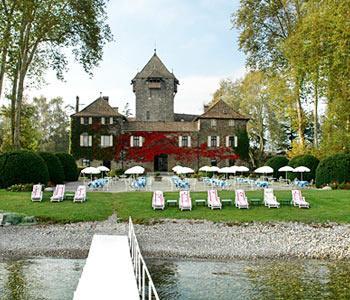 There
is a Chateau de Coudree (Sciez, France) - Castle Reviews
There
is a Chateau de Coudree (Sciez, France) - Castle Reviews
Chateau de Coudree - Sciez-Bonnatrait - France
Château de Coudree, enchanting 12th Century Chateau, with its fairy tale turrets and pinnacles, surrounded by a vast private estate.
Sciez France - is a commune in the Haute-Savoie department in the Rhône-Alpes region in south-eastern France.
Rôno-Arpes; Occitan: Ròse-Aups) is one of the 27 regions of France, located on the eastern border of the country, towards the south. The region was named after the Rhône River and the Alps mountain range. Its capital, Lyon, is the second-largest metropolitan area in France after Paris. Rhône-Alpes has the sixth-largest economy of any European region.
Patent Rolls of the Reign of Henry III - 4 Henry III - Philip de Codree - 1220 - Latin and I don't recognize any other names
Who was Richard de Kanne ?
Looking for a place doesn't help much unless Richard de Kanne was Dutch/Belgian
Kanne - is a small town in the southeastern part of the Belgian province of Limburg right on the border with the city of Maastricht in the Dutch province of Limburg. The town has 1156 inhabitants of which a significant part have the Dutch nationality.
Panoramio - Photo of Chateau de kanne et la frontière
History
On the place where there was, according to the tradition, a kind of fortress of the Romans to defend the galleries under-terraines, which were under ground, one built later, on the western slope of the valley, strong Agimont. One does not know exactly when that took place,
nor from which the name Agimont comes precisely. All that one knows it is that there was, with the Middle Ages, a Agimont family.
The first positive data on Neercanne goes back only to 1353. At that time there was certain Bertram van Liers which named itself: lord of the village.
So who was Hugh de Sanford - possibly Sandford or Saunford???
Hugh de Sandford was born in 1177 in N. Moreton,Berkshire,England. He died in 1233. He married Joan de Noers.
Joan de Noers [Parents] was born in 1180 in Great Missenden,Buckinghamshire,England. She married Hugh de
Sandford.
They had the following children:
F i Christina de Sandford
Fine Rolls Henry III 18 HENRY III (28 October 1233–27 October 1234)
Oxfordshire. Concerning respite. Order to the sheriff of Oxfordshire to place in respite the demand of £10 that he makes from Brother Robert de Sandford, Master of the Knights of the Temple in England, by summons of the Exchequer for the market of Walshford in Yorkshire, until the king orders otherwise.
Church of St. Andrew, Sandford on Thames
Sandford Manor and the Knights Templars
Robert de Sandford’s descendent, Thomas de Sandford, was a Knight Templar and Chamberlain to King John.
The Templars had been founded in 1119 as one of the spiritual Orders of Chivalry, dedicated to prayer and poverty. By 1200 they had
become a league of rich and powerful warriors with ‘Temple Courts’ or Preceptorys
all across Southern Christendom. About 1240, the Manor of Sandford was handed
over by Thomas de Sandford to his fellow-Templars who established their
headquarters, the Preceptory of the Templars of Oxfordshire, Hampshire and Berkshire there. They thereby became patrons of
Littlemore Priory and took over right of presentation of the curacy.
‘The good Queen Maud, wife to King Stephen, gave the manor of Temple Covele or Cowley in this county to the Knights Templars. who made it a house of their Order, and placed a preceptor there, who was afterwards removed to Saunford; which manor these knights got possessed of by the bounty of Sir Thomas de Saunford knt... and soon after fixed here, as upon their dissolution did the Knights Hospitallers, this being the chief residence of a preceptor & brethren that had under their management most of the estates in Oxfordshire, Berkshire, Wiltshire &c. belonging to that Order.’ (Tanner, Notitia Monastica, ed. Nasmyth, Cambridge, 1787)
Sandford-on-Thames - is a village and Parish Council beside the River Thames in Oxfordshire just south of Oxford.
...
In 1239 Sir Thomas de Sandford gave land to the Knights
Templar enclave in Oxford's Temple
Cowley. In the reign of Edward
II the Templars were suppressed and in 1324 the Knights
Hospitaller took over. In 1541 Henry
VIII dissolved the order, and the land passed to Cardinal Sir Thomas
Wolsey.
Westmorland - Sandford - Sandford History
...
We shall find the question of the lordship of Sandford cropping up for the next
hundred years. For the moment however it is sufficient to say that William de
Sandford (the grantor of the wood at Sandford to de Veteripont) had done
something whereby his son-in-law Thomas de Musgrave claimed and appears to have
been in possession at the manor of Sandford and of a portion of the Sandford
lands, but his (William's) son Robert de Sandford was still looked on by his
overlords the Veteriponts as Lord at Sandford. This Robert de Sandford (who as
we have seen bought back Sandford wood from the Veteriponts) witnessed a deed
about Barton Mill in 1252 (36 Henry III) (b) In 1255/6 he held, or claimed,
as did also Thomas de Musgrave, common pasture in Dufton, be1onging to the lands
they held in Morton. (c)
Between the years 1250 and 1278 he granted to his eldest son Richard de Sandford 2 bovates of land in Morton which William de Brampton had held; Richard to hold them of his father for life paying 1d. at Christmas, and after his death to hold them of the chief lords. (d)
...
Robert de Sandford also seems to have had a brother John, for in 18 Edward I
(1290) is a grant of lands in Sandford from John, son of John de Sandford, to
John de Helton, two of the witnesses being Richard de Warthecop and Henry his
son. (a) This same John de Sandford is a witness to a chancery Inquisition
taken at Westmorland by the King's orders at Michaelmas 1275, to enquire into an
incident when Robert le Chamberlain, servant of Roger de Clifford the younger
and Isabel his wife, was wounded by Thomas le Breton in the left hand so that he
lost his hand, and was also wounded in the head with a shovel by the said Thomas
le Breton, and also wounded by Ellis Rybill, and then beaten and left for dead.
(b)
Robert de Sandford was succeeded by his eldest son Richard de Sandford, who as we have seen, was granted lands in Norton by his father and who is given as mesne lord of Sandford and part of Smardale in 1284.
Who was John de Bosco - de Bois - De Boys ? - possibly John Robert De Bosco... a relative of the Waterville's
John Robert De Bosco (b. 1245, d. 1298)
John Robert De Bosco was born 1245 in Thorpe, Arnold Leicestershire, England, and died 1298 in
Fersfield, Norfolk,
England.
Children of John Robert De Bosco are: +William de Boys, b. 1270, Thorpe Arnold, England Arnold, England, d. date unknown.
Pedigree John de BOYS - Interesting he was a cousin to the Waterville's:
/ -- Robert de WATERVILLE (BOYS) (1103? - ?)
/ -- Ernald I BOYS (1129? - ?)
/ -- Ernald II BOYS (1159? - 1222+)
/ \ -- Emma le CHAMBERLAYNE + ====> [ 1]
/ -- Ernald (III; de) BOYS (Suffolk 1190? - by 1255)
/ \ -- Emma de HEDENTON (1161? - ?)
/ -- Ernald (IV?; of Thorpe Ernald) de BOIS (? - 1277)
John de BOYS
Sir Robert de Bois
- 1268, Robert born in England, s/o 11820292. Robert de Bois.
Thorpe, Arnold Leicestershire, England - Google Maps - a suburb of Melton Mowbray near Nottingham and Leicester
Waltham on the Wolds - a village located in the civil parish of Waltham and Thorpe Arnold, in the Melton borough of Leicestershire, England, about 5 miles (8.0 km) northeast of Melton Mowbray and 11 miles (17.7 km) south-west of Grantham on the A607 road.
Thorpe Arnold - is a village in the English county of Leicestershire. Situated on the top of a hill close to the town of Melton Mowbray, Thorpe Arnold is a small farming village with roots going back to before its first recorded mention in the Domesday Book of 1086. At this time, the village and surrounding lands were in the possession of Hugo de Gentlemaisnell, whose successors were the Earls of Leicester , Thorpe (or Torp) was eventually settled on an Earl of Leicester’s steward named Ernauld de Bosco, four further generations of his family took the name Ernauld and this, it is widely believed, it how Thorpe Arnold got its name
Update:
The patronage of the Templars and of the Order of St. Lazarus in England
in the twelfth and thirteenth centuries
Authors: Walker, John - University of St Andrews
The main focus of this study is the patronage of the Templars and of the Order of St.Lazarus, two of the Holy Land orders who came to England in the twelfth century.
They were thought to be connected, and afford interesting comparisons in terms of their size, function, importance and geographical distribution. Although this thesis considers the nature of the patronage and the patrons of both orders, the main aim is to assess the motivations behind the benefactions that they received during the twelfth and thirteenth centuries. It is generally accepted that there was a basic spiritual motive behind the patronage of religious orders in the Middle Ages. Nevertheless, the motivations behind donations made to specific orders are not always clear. It is true that changing fashions in patronage towards particular types of order are of some importance. However, in order to explain the reasons why the Templars and Order of St.Lazarus specifically benefitted, it is necessary to consider factors relating to their own particular nature, as well as factors relating to the backgrounds of their patrons.
The introductory part of the thesis considers the background of the two orders, their origins and development in the Holy Land, and their establishment in Europe and England. The rest of the thesis examines in detail the specific motivations of patrons. In this respect, the importance of the crusading background of the two orders is evaluated, and attention is paid to the numbers of patrons who went on crusade or who referred to the Holy Land in their charters of donation. In addition, the membership of both orders is considered in relation to the patronage of such members and their families. In particular, an assessment is made of the role of leper members of the Order of St.Lazarus, and lay associates of the Templars.
In the final three chapters, the main concern is with the backgrounds of the orders' patrons. In this section a study is made of the patronage of large family grouping s for both orders. In addition, an examination of the significance of royal and baronial lordship on their patronage is carried out.
Finally, the social and geographical associations of the patrons of both orders are considered, and particular note is made of the value of such ties for the Order of St.Lazarus in eastern Leicestershire. In conclusion, the various motivations to patronage for both the Templars and the Order of St.Lazarus are contrasted and evaluated.
| - - - -
Sandford Cartulary - The Sandford cartulary - Templars. England. Sandford (Preceptory), Agnes Moncrieff Sandys Leys
Knights Templar Archaeology of East Oxford
The Knights Templar in Temple Cowley - Research carried out by Caroline Morrell
The Knights Templar were present in Temple Cowley from 1139 to 1240, just
over a hundred years. They held extensive lands and presumably a number of
buildings. However, although there are a number of charters documenting their
land holdings, there is little evidence of any buildings or their physical
presence in the area.
...
The main sources referred to are the Victoria County History of Oxfordshire, the
Inquest of Templars lands in England of 1185 and the Sandford Cartulary,
compiled in the latter half of the 13th century. The last two, which are both
held in the Bodleian Library, are collections of charters, primarily of grants
of land and written in Latin - which I can’t read - but there is a very full
introduction to the Inquest written in English by Beatrice Lees in 1935.
...
The Inquest was undertaken in 1185 on the occasion of the appointment of
Geoffrey Fitz Stephen to the Mastership of the bailia, or bailiwick, of the
English Templars. It is primarily a terrier (register of a landed estate) and a
rental, rather than an inventory, and like the Domesday Book, evidence was
collected from sworn jurors and collated centrally. It covers a large number of
scattered estates and, according to Lees, it is the most important record of the
English branch of the Templars and its development into a land-owning power (vii).The
subjects of enquiry fall under seven headings: the donors of the land; the
possessors of the land; churches; mills; assessed lands (lands assessed for rent
as opposed to demesne); demesne lands [land set aside for the lord’s use] and
assised rents, or rents fixed by agreement (xxx). It contains 24 charters
relating to Oxfordshire, beginning with the Feofamentum M Regine de Manierio de
Couele dated January 1139 - presumably Queen Matilda’s original gift of
land to the Templars in Cowley. Lees points out that the records of the English
Templars have largely been dispersed and destroyed, but that there are many
valuable charters transcribed in the 13th century Cartulary of Sandford
Preceptory in Oxfordshire.
The Sandford Cartulary was compiled in the second half of the 13th
century, by order of Robert le Eascropp, Preceptor of the Sandford Templars in
this period. It was transcribed by Agnes M Leys in 1938 for the Oxfordshire
Record Society and she describes it in her introduction as ‘the only
complete record of the estates of any house of the Templars in England’
(vi).
...
Sandford
The Cowley Preceptory fell into disuse after 1240 when the community moved two
miles south to Sandford, following a gift of land there from Robert de Sandford
in 1239. The Sandford Preceptory became one of the largest outside London
(as is reflected in the long list of their holdings in the Sandford Cartulary)
and Cowley seems to have been reduced to the status of a camera or cell (Tull,
2000, p.71).
After the dissolution of the Templars order in 1312, a farm house was built on the site of the Templars Manor, known as Temple Farm, later converted into a country club and in the 1990s into the Four Pillars Hotel. The Templars chapel, which was used as a barn in the time of the farm, still remains there, and over the front door of the farmhouse is a shield bearing the cross of the Templars.
On the Templars suppression all their land was probably temporarily held by Queen Margaret [wife of Henry III], but soon went to the Knights Hospitaller, themselves dissolved in 1541 (VCH p.80)
...
Templars in Oxfordshire Sandford Preceptory The Fearless Knights
In 1239-40, a local landowner, Thomas de Sandford Jr. gave all of his lands at Sandford, just south of Oxford on the Thames, to the Temple at Cowley, in free alms. “Further gifts followed and Thomas himself became a Templar, completing his oblation to the Order. ” Shortly thereafter, the Preceptory moved from Cowley to Sandford, which was only a few miles away to the south.
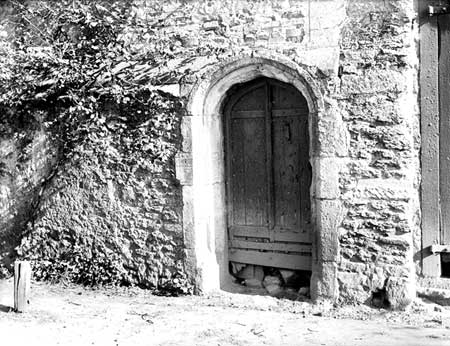
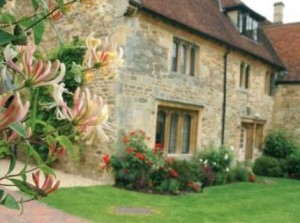
The doorway to the former 13th-century chapel of the preceptory. After the dissolution of the Knights Templar and Knights Hospitallar, the later owners of the preceptory, the site was converted into a farm and the chapel was used as a barn.
Reference:
Gerry sent me some interesting information that connects to some interesting people:
Hi,
I am a collector of Medieval charters and documents and one of the documents I have in my collection concerns a Grant of a rent between
William de Wateville to John de Vallibus and his heirs of land in Hempstead, Essex,
England, among the many witnesses named in the document is one Richard le Outlawe, the date of the document is circa
1260.
The document has a wonderful green wax seal showing a mounted knight [William de Wateville]
Hope this helps with your family history.
Best Regards Gerry B
Update 04/2013
Finally I find another reference to Richard Utlawe in Essex and it also has a Hospitallers reference! He had a daughter named Ida. - looks like 1285 also a reference to a son named Roger - Possibly the famous Sir Roger Outlawe of Kilmainham priory? I have never found a genealogy of Rogers family but as a leading Hospitaller he had to be of Noble birth, and since the conquest of Ireland the reason Roger was used by the King to be the Justice of Ireland for so many years was he was trusted , possibly because he was more native to England then Ireland. If this Hospitaller connection to Richard Utlawe is correct , then that would explain why Roger ended up a Hospitaller and in Ireland and why he was so trusted by the King of England.
Also I have this Thomas Utlaghe associated with William Balliol a brother of John Balliol who was pushed to be King of Scotland and was at first close to the King of England, but also had lands in Hitchin.
Also in 1259 we have this battle between the Templars and the Hospitallers in Syria , this was ugly and the Templars lost. Was this 1260 meeting of Waterville and Vallibus (Vaux) a meeting of peace making between Templar and Hospitaller supporters?
1250 - Battle of Al Mansurah - Mansoura, Egypt - the Seventh Crusade, the Capetians were defeated and put to flight; between fifteen to thirty thousand of their men fell on the battlefield. Louis IX of France was captured - The Round Church at Little Maplestead, Essex - Among the chiefs who either fell in this battle, or were taken prisoners, were King Louis; Alphonsus, Count of Poitiers; Charles, Count of Anjou; Ralph de Cuscy; Hugh, Earl of Flanders; Hugh Brun, Earl of Marche; Robert de Vere; all the Knights Templars, except three; and all the Knights Hospitallers
1259 - A pitched
battle was fought in Syria, between the
Templars and Hospitallers. The Templars were defeated
1260 - William
de Baillol, Walter de Brandeby, and Thomas le Utlaghe unjustly
disseised William Yoll of his free tenement in Yarpestrop - 44 HENRY III -
Assize of York
1260 - Witness
Richard le Utlawe - Essex - Grant of Rent
William de Wateville to John de Vallibus and his heirs of land in Hempstead,
Essex witnessed by Sir Nicholas Peche, Sir
Andrew de Helyun, Sir Simon Peche, Philip de Codree, John de
Bosco,
Richard de Kanne, Richard le Utlawe, Hugh de Sanford, Roger de Reymes,
Geoffrey de Bello, Simon Clericus - 44 Henry III
1260 - Roger
Utlagh - or Roger Outlawe (c.1260-1341 ) was a born -
leading Irish statesman of the fourteenth century and held the office of Lord
Chancellor of Ireland.
1285 - Hospitaller Charter of Ida daughter of the late Richard Utlaw of the five acres of land and half an acre of meadow, with appurtenances. - Roger [ son of Richard ] Outlaw ( of Bumpstead Helion ), Ida daughter of Richard
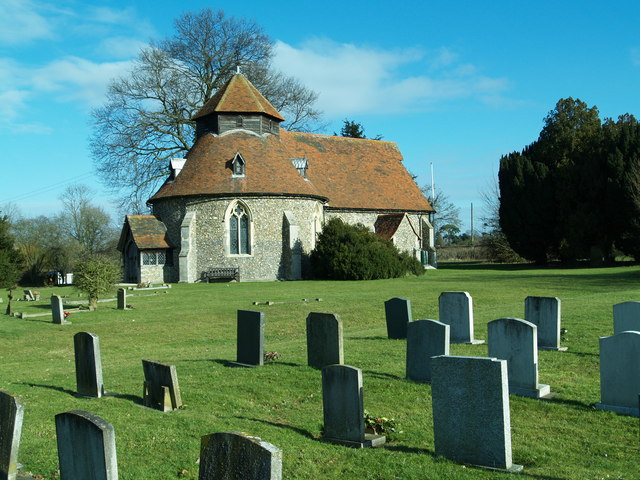
The history and antiquities of the round church at Little Maplestead Formerly belonging to The KNIGHTS HOSPITALLERS (Essex) - The charter of Ida daughter of the late Richard Utlaw of the five acres of land and half an acre of meadow, with appurtenances. Quitclaim said Ida of six pence rent and the rent of two capons. Claim may lead a quiet out of the five acres of land and half an acre of meadow of the aforesaid of the said Ida.
178
Register Munimentorum Nominum Magistrorum Prioratus Hospitalis Sancti Joan. Jerusalem in Anglia.
[ Register Fort names of Masters - Priory Hospital of Saint John. Jerusalem in England. ]
180 APPENDIX.
Folio 311.
Carta Jocelini de Enfelt de una acra terre in parochia de Tilburi.
Carta Cristine quondam vxoris Gilberti de Londonio de novem denarijs redditus in eadem villa.
Carta Phillippi filij Acceline de terra in eadem villa.
Carta Ide quondam filie Ricardi Utlaw de quinque acris terre et dimidia acra prati cum
pertinentijs.
Quieta clamacio dicte Ide de sex denarijs redditus et redditu duorum caponum.
Quieta clamacio dicte Ide de quinque acris terre et dimidia acra prati
predicti.
Carta Ricardi Burre de Selewe de sex denarijs annui redditus in villa de Selewe.
translation:
The charter of the late Ida daughter of Richard Utlaw of the five acres of land and half an acre of meadow, with appurtenances. Quitclaim said Ida of six pence rent and the rent of two capons. Claim may lead a quiet out of the five acres of land and half an acre of meadow of the aforesaid of the said Ida.
Notice how rare it is for a woman to be mentioned in such documents,
| - - - - - -
Page 59
Parish Bumpstead Helion Families: Ida Daughter of Richard Outlaw of Dates: 1285
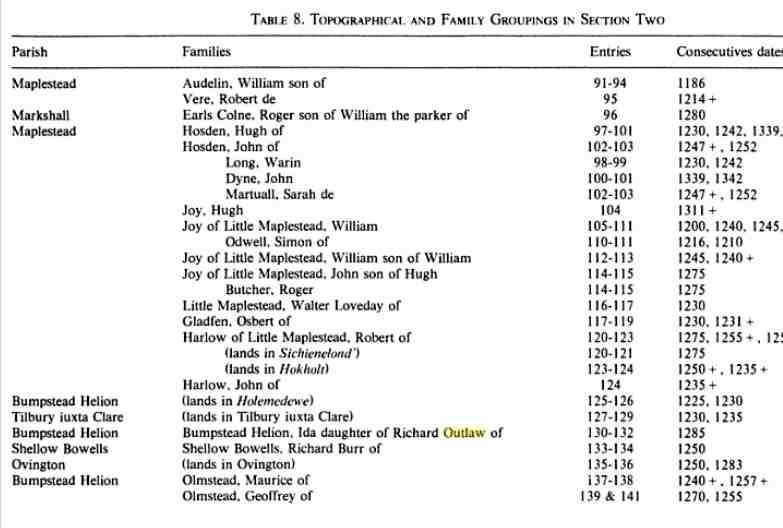
Page 350
Ida daughter of Richard Outlaw of , 59
Page 359
Roger [ son of Richard ] Outlaw ( of Bumpstead Helion ), Ida daughter of Richard, see Bumpstead Helion.
| - - - - - - - - - - - - - -
Little Maplestead - has a school and once had a Knights Hospitaller establishment called Little Maplestead Preceptory.[1]
The round parish church, dedicated to St John the Baptist, is a Grade II listed building dating from around 1335 the 13th century. It is one of only four round churches now surviving and was built by the Knights of St John
HOUSE OF KNIGHTS HOSPITALLERS
29. THE PRECEPTORY OF LITTLE MAPLESTEAD
The charters under the heading of Maplestead fill about a fifth of the great chartulary (fn. 1) of the Hospital of St. John of Jerusalem in England, and those relating to other possessions of the Hospitallers and Templars in Essex about the same space. This large proportion was no doubt partly due to the accident of preservation, but it is clear that the grants made to the Hospital in Essex considerably outnumbered those in any other county. Moreover,
the chief house of the Hospital at Clerkenwell was itself founded, probably in the first half of the reign of Stephen, by an Essex man, Jordan Briset. (fn. 2)
The town and church of Little Maplestead were granted to the Knights Hospitallers by Juliana the daughter of Robert Dosnel. Her husband, William FitzAudelin, the dapifer of Henry II, confirmed the grant, and he also made another grant to them of the church by a later charter, apparently after the death of Juliana, dated 16 March, 1186. The establishment of the preceptory probably took place somewhere about this date; it may have been any time after the first grant of the town.
History - The preceptory was close by on the site of what is now Maplestead Hall, which can be seen on the other side of the road from the present church. Although no trace of the Knight's Hospitaller's church or domestic buildings remains today, it is however supposed with reasonable certainty that the present church stands on the site of the church built by the Knights Hospitaller in around 1186.
The present church was probably built around 1335 and is the latest of the
four round churches still in use in England.
...
One theory is that the circular aisle and walls of the chancel probably date
from the late 12th century and the hexagonal arcade within the round dates from
a later period. However there is no sign of work earlier than the 14th century
so it may be that the circular form was simply influenced by an earlier round
church on the site.
Interesting one hundred years later: Chrishall - which is close to Saffron Waldon and Helions Bumpstead which was owned by the Earl of Oxford "De Vere" family hmmm....
Thus is interesting since Chisell or Chrishall is an important place.... Eustace of Boulogne was in charge of the crusades and when they get Jerusalem he makes his younger brother King there. Matilda marries Stephen (King of England 1135) and supports the Templars . Notice the connection to "the Holy Trinity" What is interesting, Joan Outlawe as Widow retains the land of her husband in these documents:
1360 - John
Outelagh and Joan his wife,
def. 1 messuage and 1 carucate of land in GreatChisell, Little Chisell,
Heyden and Crishale - Essex - Crishall
- Cristeshalla, or "nook of land dedicated to Christ". -
William
atte Wode of Crishale
and Walter Pytee of Chisell, pi. John Outelagh and Joan his wife,
def. 1 messuage and 1 carucate of land in Great Chisell, Little Chisell,
Heyden and Crishale. PI. and the heirs of William to hold of the chief
lords. Cons 100 marks. - 34 EDWARD III
1372 - Chishall - It was holden in 1372 by William Cardon, under Geofrey de Magnaville; and under Humphrey de Bohun, earl of Hereford and Essex, by the heirs of ... John Outlaw
1376 - Widow of John Outelagh , Joan his wife, def. 1 messuage and 1 carucate of land in GreatChisell, Little Chisell, Heyden and Crishale - Essex - John Rydere, parson of Heyden. and Nicholas son of Hugh Parys of Heyden, pi. by John Heyden. William Manewod of Heyden and Alice his wife, def. 2 messuages, 2 tofts, 76 acres of land, 3 acres of wood and 2s. rent in Heyden, Cristeshale, Elmedon and Great Chyshull. PI. and the heirs of Nicholas to hold a moiety of the chief lords, with the homages and services of John Upstret, Katharine Arneys, Richard Curteys and Joan Outlawe and their heirs, and also the remainder of the other moiety, which John atte More of Heyden holds for life by the law of England. Cons. 20 marks. - 49 Edward III
1 carucate of land is about 120 acres of land or what eight oxens could plow in a season "8 hides",
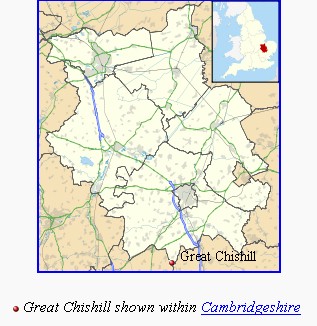 Great
Chishill - The highest point of Essex,
Chrishall
Common and the triple
point of Cambridgeshire, Essex and Hertfordshire
lie close to each other and about 2 kilometres (1 mi) south of Great
Chishill.... St. Swithun’s Church, situated on high ground at the
crossroads was founded in 1136 by Geffrey de Magnaville under the Monastery of (Saffron)
Walden....Little Chishill has the Church of St. Nicholas,
probably founded around the same time, its first recorded vicar was John Martyn
in 1333.... Until 1895, Chishill was in Essex but then the boundary was changed
and it became Cambridgeshire.
Great
Chishill - The highest point of Essex,
Chrishall
Common and the triple
point of Cambridgeshire, Essex and Hertfordshire
lie close to each other and about 2 kilometres (1 mi) south of Great
Chishill.... St. Swithun’s Church, situated on high ground at the
crossroads was founded in 1136 by Geffrey de Magnaville under the Monastery of (Saffron)
Walden....Little Chishill has the Church of St. Nicholas,
probably founded around the same time, its first recorded vicar was John Martyn
in 1333.... Until 1895, Chishill was in Essex but then the boundary was changed
and it became Cambridgeshire.
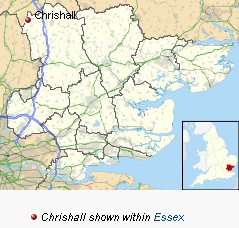 Chrishall
- The Icknield
Way, a Neolithic track, passes through the parish
Chrishall
- The Icknield
Way, a Neolithic track, passes through the parish
Following the Norman Conquest the area around Chrishall was given to Eustace of Boulogne who built and occupied a house on a hill to the south of the current church. He named the house "Flanders" and it was there that his daughter Matilda of Boulogne, later wife of King Stephen was raised. A letter survives that the queen wrote to Hubert the Chamberlain ordering that the residents of Chrishall be looked after. The house survived until the 15th century, and is believed to have stood on the site of Chiswick Hall
Matilda of
Boulogne - In 1125, Matilda married Stephen
of Blois, Count of Mortain, who possessed a large honour
in England.
...
Matilda was a supporter of the Knights Templar. She founded Cressing
Temple in 1137 and Temple
Cowley in 1139.[2]
Like her predecessor, Matilda
of Scotland, she had a close relationship with the Holy
Trinity Priory at Aldgate. She took the prior as her confessor and two
of her children were buried ... Matilda died of a fever at Hedingham
Castle, Essex,
England, and is buried at Faversham
Abbey, which was founded by her and her husband
Found: 1360 - 1376 - Outlawe (Outelagh), Joan wife of John - Essex:
Full text of Feet of fines for Essex. Edited by R.E.G. Kirk -
34 EDWARD III. - 1360 COUNTY OF ESSEX. .
1239. Quin. of Hil. William atte Wode of Crishale and Walter Pytee of Chisell, pl. John Outelagh and Joan his wife, def. 1 messuage and 1 carucate of land in Great Chisell, Little Chisell, Heyden and Crishale. Pl. and the heirs of William to hold of the chief lords. Cons 100 marks.
49 EDWARD III - 1376 - COUNTY OF ESSEX
1376- 1793. Mich, and Oct. of Hil. John Rydere, parson of Heyden. and Nicholas son of Hugh Parys of Heyden, pl. by John Heyden. William Manewod of Heyden and Alice his wife, def. 2 messuages, 2 tofts, 76 acres of land, 3 acres of wood and 2s. rent in Heyden, Cristeshale, Elmedon and Great Chyshull. Pl. and the heirs of Nicholas to hold a moiety of the chief lords, with the homages and services of John Upstret, Katharine Arneys, Richard Curteys and Joan Outlawe and their heirs, and also the remainder of the other moiety, which John atte More of Heyden holds for life by the law of England. Cons. 20 marks.
Outlawe (Outelagh), Joan wife of John, 127, 175.
, John, 127.
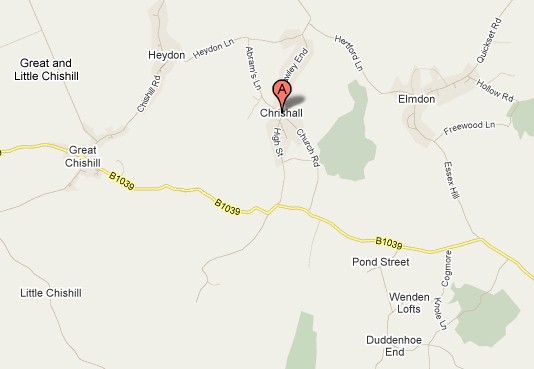 Heyden
= Haydon
Heyden
= Haydon
Elmedon = Elmdon
Great Chisell = Great Chishill
Little Chisell = Little Chishill
Crishale/Cristeshale = Chrishall - (pronounced krishul or krishawl) is a small village in the English county of Essex. It is located 20 kilometres (12 mi) south of Cambridge and lies equidistant [10 kilometres (6 mi)] between the two medieval market towns of Saffron Walden and Royston. Although in Essex, Chrishall lies close to its borders with Hertfordshire and Cambridgeshire and has a 'Hertfordshire' postcode (SG8).
The village was listed in the Domesday Book as Cristeshalla, or "nook of land dedicated to Christ". It is one of only two English settlements whose name contains the word "Christ". The Icknield Way, a Neolithic track, passes through the parish.
Chrishall's location is key to its character; as the village sits at the highest point in Essex, at 147 metres (482 ft) above sea level, road construction has avoided this high ground and therefore Chrishall is off the beaten track...Chrishall's population has remained largely unchanged over the last 170 years. In 1841 it totalled 518 and today about 450 people live in the village... The village has been home to a church for over a thousand years. Prior to the Norman invasion a small church dedicated to the Virgin Mary was situated on the site of the present church...The church contains a number of brasses, including a notable one in memory of Sir John de la Pole and his wife, dating from 1380...Chrishall was given to Eustace of Boulogne who built and occupied a house on a hill to the south of the current church. He named the house "Flanders" and it was there that his daughter Matilda of Boulogne, later wife of King Stephen was raised.
Update 09/2013
More and earlier Richard Outlawe records found again in the Hospitaller Cart. with a Balliol connection
Also here we have a Roger Utlag that maybe the Father of the later Sir Roger Outlawe Hospitallar of Ireland
1150-1300 - Geoffrey Utlage witness and land in St. Giles parish - Hospital of St. Giles - Hospitaller Cartulary - Essex - St. Giles Maldon
1210 - Roger Utlag - Witness - Lease Steeple Bumpstead Essex - Sir Robert de Vere - Gilbert de Baillol - William de Watevill - Richard de Kann - Cartulary of the Knights of St John [ Notice William de Watevill and Richard de Kann compared to the 1260 record ]
1225-1233 - Richard le Utlage and William le Utlage - witness to Grant by Michael son of Ioce of Bumpstead to William fitz Ralph - Philip de Beauchamp, Robert fitz Ralph, William de Helion , Gilbert de Helion - Bumpstead Essex
1230-34 - Richard Utlage - William de Heliun - witness Grant to the hospital of the holy house of Jerusalem - one acre Bumpstead (Helions)
| - - -
1260 - Witness Richard le Utlawe - Essex - Grant of Rent William de Wateville to John de Vallibus and his heirs of land in Hempstead, Essex witnessed by Sir Nicholas Peche, Sir Andrew de Helyun, Sir Simon Peche, Philip de Codree, John de Bosco, Richard de Kanne, Richard le Utlawe, Hugh de Sanford, Roger de Reymes, Geoffrey de Bello, Simon Clericus - 44 Henry III
1285 - Hospitaller Charter of Ida daughter of the late Richard Utlaw of the five acres of land and half an acre of meadow, with appurtenances. - Roger [ son of Richard ] Outlaw ( of Bumpstead Helion ), Ida daughter of Richard
Oh Geoffrey de Bello maybe Beauchamp as in Bello Campo supposedly died 1254 though
1210 - Roger Utlag - Witness - Lease Steeple Bumpstead Essex - Sir Robert de Vere - Gilbert de Baillol - William de Watevill - Richard de Kann - Cartulary of the Knights of St John [ Notice William de Watevill and Richard de Kann compared to the 1260 record ]
Charter Document - 00880192 DEEDS
1210 - Roger Utlag - Witness - Lease Steeple Bumpstead Essex - Sir Robert de Vere - Gilbert de Baillol - William de Watevill - Richard de Kann - Cartulary of the Knights of St John
1210/09/29, BUMPSTEAD,STEEPLE ESSEX (ENGLAND)
Charter Number: 00880192
Cartulary Title: Cartulary of the Knights of St John of Jerusalem Secunda
Charter Language: Latin
Charter Type(s): Agreement, Lease
Date: 1210
Date Type: Internal, Feast, Regnal
Hec est convencio facta inter Walterum filium David de Hermested et Galfridum de
Heliun scilicet quod predictus Walterus dimisit eidem Galfrido ad firmam sedecim
acras terre et unam acram prati cum pertinentiis in Hormested et mesuagium quod
fuit Galfridi Dewy et servicium triginta denariorum quod Willelmus de Hoo et
Helewisa uxor eius tenentur ei reddere per annum de tercia parte terre que fuit
Galfridi Dewi quod tenementum pertinet ad predictas sedecim acras post decessum
predicte Helewise quondam uxoris Galfridi Dewy et servicium Willelmi filii
Radulphi scilicet de octo denariorum per annum cum omnibus pertinentiis suis
habend et tenend eidem Galfrido et heredibus suis vel cuicumque loco suo
assignare voluerit de Waltero de Herenested et heredibus suis a festo sancti
Michaelis anno regni regis Iohannis duodecimo et ciclo tertio decimo usque in
tredecim annos reddendo inde annuatim capitalibus dominis fundi scilicet
fratribus hospitalis Ierusalem per attornatum ipsius Walteri septem solidos et
sex denarios ad duos terminos scilicet ad Pascha tres solidos et novem denarios
et ad festum sancti Michaelis tres solidos et novem denarios pro omnibus
serviciis et exaccionibus hanc prenominatam terram predictus Galfridus recepit
nudam sine domibus instauris vel bladis et eodem modo ad finem predictum
tredecim annorum predicta terra quieta in manu predicti Walteri et heredum
suorum debet reverti Predictus vero Walterus et heredes sui totam predictam
terram cum pertinentiis predicto Galfrido et heredibus suis vel cuicumque loco
suo assignare voluerit quietam de omnibus demandis debitis releviis et querelis
contra omnes homines et omnes feminas per prenominatum servicium warantizabunt
et acquietabunt Si vero contigerit quod infra predictum terminum predictus
Walterus vel Helewisa ab Helewisa matre sua vel eius viro vel aliquo Christiano
vel Iudeo inplicitentur [et] quod predictam terram vel eius vestitus per
iudicium curie domini regis debeat amittere predictus Walterus et heredes sui
predicto Galfrido et heredibus suis vel cuicumque loco suo assignare voluerit
totum certum suum in terra vel in placito predictum dampnum eciam et detrimentum
per visum proborum hominum computatum resolvent et antequam de illa
dissaisientur ponent predictus Walterus et heredes sui predictum Galfridum vel
heredes suos vel quemcumque loco suo assignaverit in plenariam seisinam de tota
terra sua de Hernested ut illa habeant et teneant et omnimodos exitus recipiant
donec predictus Walterus et heredes sui eidem Galfrido et heredibus suis vel
cuicumque loco suo assignaverit de omnimodo dampno et detrimento occasione
illius terre habitis et ut predictum computato satisfecerint Concedit eciam
predictus Walterus pro se et heredibus suis ut hec predicta terra liberum
tenementum sit ipsius Galfridi et eius heredum usque ad predictum terminum et ut
eam ut liberum tenementum suum ubique defendant Pro hac convencione firmiter
tenend predictus Galfridus dedit eidem Waltero quindecim solidos premanibus et
ut hec firmiter in omnibus teneatur uterque pro se et suis affidavit et sigillo
suo confirmavit Hiis testibus domino Roberto de Ver Willelmo de Heliun
Willelmo de Watevill Mauricio de Olmested Thoma filio Abrahe Gilberto de
Baillol et Waltero fratribus Willelmo de Heliun et Gilberto fratribus Rogero
filio Bernardi Rogero de Heure Michaele filio Ioici Ricardo kann Rogero
Utlag et aliis
This is the agreement made between Walter
the son of David de Hermested and Geoffrey of Heliun
wit, that the aforesaid Geoffrey sent away Walter to the farm of sixteen acres
of land to the same and an acre of meadow with the appurtenances in Hormested
and the messuage which was of Geoffrey the thirty pieces of Devy and service
that William of Hoo, and Helewise throughout the year and they are bound to pay
it to him , his wife, of a third part of the land which belonged to the said
Geoffrey Dewi that the tenement belongs to the sixteen acres of formerly wife of
Geoffrey the Helewisa Devy after the death of the aforesaid William son of Ralph
and service that is one of the eight pence per year with all its appurtenances
to have and to hold to the same Geoffrey and his heirs or to any of the
Herenested from Walter and his heirs to his place, he shall wish to assign from
the feast of Saint Michael the cicle in the thirteenth year of the reign of king
John, as far as the twelfth and of the chief lords of the farm in the thirteen
years , paying therefor yearly, that is to say to the brethren of the Hospital
of Jerusalem, by the attorney of the said Walter, seven shillings and namely,
the two terms of six pence to three shillings and nine pence at Easter , and the
feast of St Michael for all services and exactions three shillings and nine
pence of the said Geoffrey, this received the aforenamed land without houses
instauris or naked grain and of thirteen -year-old in the same way to the end of
the aforesaid the said land in the hand of the said Walter and his heirs ought
to be quiet , however, to return the said Walter and his heirs all the said land
with its appurtenances to the said Geoffrey and his heirs , or to whomsoever he
wishes to assign his place, at peace from all demands, debts , and reliefs of
complaint, and on the other hand , by the aforesaid service for all men and all
the women that warrant the If, however, happen to be that which is below , and
will acquit the said term the said Walter to her husband or his or her mother,
or is in any Helewise Helewise from the possession of the Jew or the Christian
inplicitentur [ and ] that the aforesaid land by judgment of the court of the
lord king or his clothing ought to lose the said Walter and his heirs to the
said Geoffrey and their heirs , or to whomsoever he wishes to assign his place
receives a fixed damage of the aforesaid also and suffered the loss of his own
in the earth in a dream or in a plea of honest men out of her, if computed,
dissaisientur be dissolved, and they shall lay before the said Walter and his
heirs whomsoever of the said Geoffrey for his place, or his heirs or assigned
the right to full Hernested of the seisin of the whole of his land so that the
former shall have and hold the said Walter and his heirs and all manner until
they receive the results of the same Geoffrey and his heirs or assigned to any
of their place on the occasion of that land , and the loss of some damage done
when he has learned , and every way as we said, I also concede to compute the
satisfaction for the aforesaid Walter on behalf of himself and his heirs the
aforesaid land so that this is a free tenement of the heirs of the said Geoffrey
and his followers to the same as far as the border of all places, and that he
might defend it as his free tenement in favor of this agreement to the same
firmly to hold the aforesaid Geoffrey Walter gave fifteen shillings in all
things may be held firmly down, and in order that this both for himself and his
pledged himself and his seal witnesses
confirmed to Sir Robert de Vere , William de
Heliun , William de Watevill , Mauritius de
Olmested , Thomas, the son of Abraham, Gilbert de Baillol , and
brothers Walter de Heliun, William de heliun and Gilbert
brothers, Roger son of Bernard, Roger de Heure, Michel son of Ioici, Richard
de Kann, Roger Utlag and others
Robert de Vere, 3rd Earl of Oxford - (c. 1164 – before 25 October 1221), hereditary Master Chamberlain of England,[1] was the second surviving son of Aubrey de Vere, 1st Earl of Oxford, and Agnes of Essex. He succeeded his brother as Earl of Oxford, and was one of the guarantors of Magna Carta.
1066 A Medieval Mosaic (Medieval Mosaic) - ... His posterity was seated at Hempstead, one of the two Essex manors that he held of the Honour of Tunbridge, in which Henry III. granted Sir William de Wateville a charter of free warren in 1253.
...
This can scarcely have been the Sir William de Waterville mentioned by Thomas
of Gloucester, who, sixty-two years before, went with Coeur de Lion to the Holy
Land, and was one of the six knights through whom he sent his challenge to
the Soudan.
...
"Thorp Watervile Castelle upon Avon, sumwhat lower than Wndale," as Leland describes it, in Northamptonshire, was most probably built by Azelin de Wateville, "who," says Bridges, "first possessed the lordship." No traces of it are now remaining. It passed in the time of Henry III. to the sisters of Richard de Wateville, who, in 1234, had obtained a grant of free warren in Thorp and Marham. Richard's widow held Marham in dower, and it was transferred by purchase to Reginald de Wateville in 1240. Reginald, again, had no son, and left three co-heiresses, Joan, married to Robert de Vere (NOT earl of Oxford); Elizabeth, or Petronella, married to John Wykham; and Margaret, married to Henry de Tichmarsh
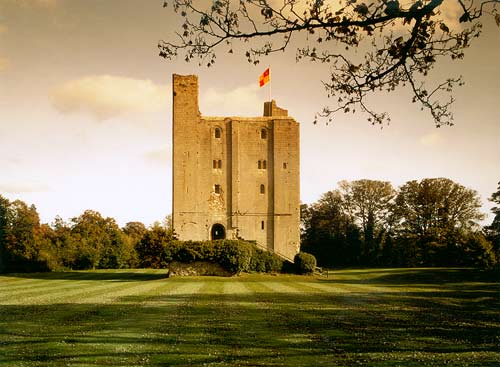 Hedingham-Castle
- The family name of de Vere is believed to have come from the small
town of Ver, near Bayeaux in Normandy and their roots trace back to the early
tenth century and Danish origins. Other suggestions say they are decended from a
Breton family from Vair, near Nantes, although their early history is surrounded
in mystery and nobody is really certain.
Hedingham-Castle
- The family name of de Vere is believed to have come from the small
town of Ver, near Bayeaux in Normandy and their roots trace back to the early
tenth century and Danish origins. Other suggestions say they are decended from a
Breton family from Vair, near Nantes, although their early history is surrounded
in mystery and nobody is really certain.
...
Aubrey II took part in the First Crusade in 1098. There is a legend
that while Aubrey was engaged in the fierce battle for Antioch against the
Sultan of Persia's troops, darkness was starting to fall and there was great
confusion on the battlefield.
...
Aubrey II married Alice FitzRichard of Clare, (daughter of Gilbet
FitzRichard, feudal lord of Clare) and in 1125 Aubrey was made joint Sheriff of
London. ... Aubery II was killed in a riot in London in 1141
...
Aubrey de Vere, the third, was another Crusader who was known as Aubrey the
Grim on account of his height and stern appearance. He was made an earl by the
Empress Matilda and was offered a choice of title from either Cambridge, '
Provided the King of the Scots had it not ', Oxford, Berkshire, Wiltshire or
Dorset. He chose Oxford and became the 1st earl of Oxford.
...
Robert, 3rd earl of Oxford was also a Crusader in the Holy
Wars, but in the 15th year of King John's reign he took up arms
against the King and with 25 other Barons, ' In the defence of England ' forced
John to sign the Magna Carta. De Vere, like the others involved were
excommunicated by the Pope for their actions.
Chambers Papers for the People Vol 3
The papal censure was disregarded by the Templars ; and though they professed
obedience to the legate of the pope in 1219, when he headed the
expedition
into Egypt, it was they who really directed the legate. In this expedition, and
particularly in the siege of Damietta, the knights greatly
distinguished
themselves ; but when the Emperor Frederick II. undertook the crusade in 1228,
they gave him all the opposition in their power, and
wrote to the sultan of
Egypt to inform him of the emperor's plans. The sultan sent the letter to
Frederick, who, on his return to Europe, revenged
himself upon the order by
seizing all its possessions throughout Italy and Sicily. In attacking the
Templars, and defending this confiscation of
their property, the emperor made
it an important charge against them, that they were friendly to the Moslems. '
We know on good authority,' said
he, ' that sultans and their trains are
received with pompous alacrity within the gates of the temple, and that the
Templars suffer them to cele
brate secular plays, and to perform their
superstitious rites with invocation of Mohammed.' The Templars retaliated by
dispossessing the Teutonic
knights of all their possessions in Syria, and
entered into an alliance with the emir of Damascus against the Hospitallers. The
invasion of the Turks
compelled the rival orders to unite for their common
safety ; but they suffered a severe defeat near Damascus, in which the master
and 300 knights
were slain. Only Acre now remained in possession of the
Christians, and the Templars appear at this time to have meditated a complete
retreat
from the East ; but the animosity which had been long gathering
between this order and that of the Hospitallers at length burst into a flame,
and in 1259 a pitched battle was fought between them, in which the Templars were
completely routed. From this period no event of import
ance in the annals of
the order occurred until 1291, when Acre was taken by storm by the Moslems, and
the remnant of the Templars sought refuge
in the island of Cyprus .