 |
[ Outlaw Genealogy | Bruce
History | Lost Chords ] [ Projects | News | FAQ | Suggestions | Search | HotLinks | Resources | Ufo ] |
|
[ Outlaw Genealogy | Bruce
History | Lost Chords ] [ Projects | News | FAQ | Suggestions | Search | HotLinks | Resources | Ufo ] |

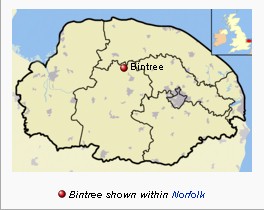
Sometimes spelt Bintry, you will find this village 8 miles north east of Dereham and 9 miles south east of Fakenham.
It has a pretty church, St Swithin, with a 14th century tower and beautiful
stained glass windows.
BINTREE (St. Swithin), a parish, in the union of Mitford and Launditch, hundred of Eynsford, E. division of Norfolk, 2 miles (S. E. by S.) from Guist; containing 409 inhabitants. This parish, which is bounded on the west by the river Wensum, and situated on the road from Norwich to Fakenham, comprises 1443a. 3r. 11p., of which 1117 acres are arable, 247 pasture, and 26 plantation: some of it is good wheat land, and other parts good turnip and barley soil. The living is a rectory, with that of Themelthorpe annexed, valued in the king's books at £10; net income, £462; patron, Lord Hastings.
The church is a handsome structure in the early and later English styles, with a square embattled tower, and a south transept, and contains a richly carved screen, and some other interesting details. The poor have twenty-five acres allotted on the inclosure of the parish in 1796, and now producing £50 per annum; and the half of £30, rent of land bequeathed by an unknown benefactor.
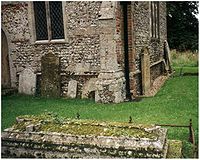 Revd
Richard Enraght's gravestone at St Swithun Church, Bintree
Revd
Richard Enraght's gravestone at St Swithun Church, Bintree
Bintree is a village and civil parish in the Breckland district of Norfolk, England, about nine miles south-east of Fakenham. According to the 2001 census it had a population of 300.
http://www.archive.org/stream/churchheraldryn03farrgoog/churchheraldryn03farrgoog_djvu.txt
The church heraldry of
Norfolk by Rev. Edmund Farrer Published in 1887, A.H. Goose and co. (Norwich)
...
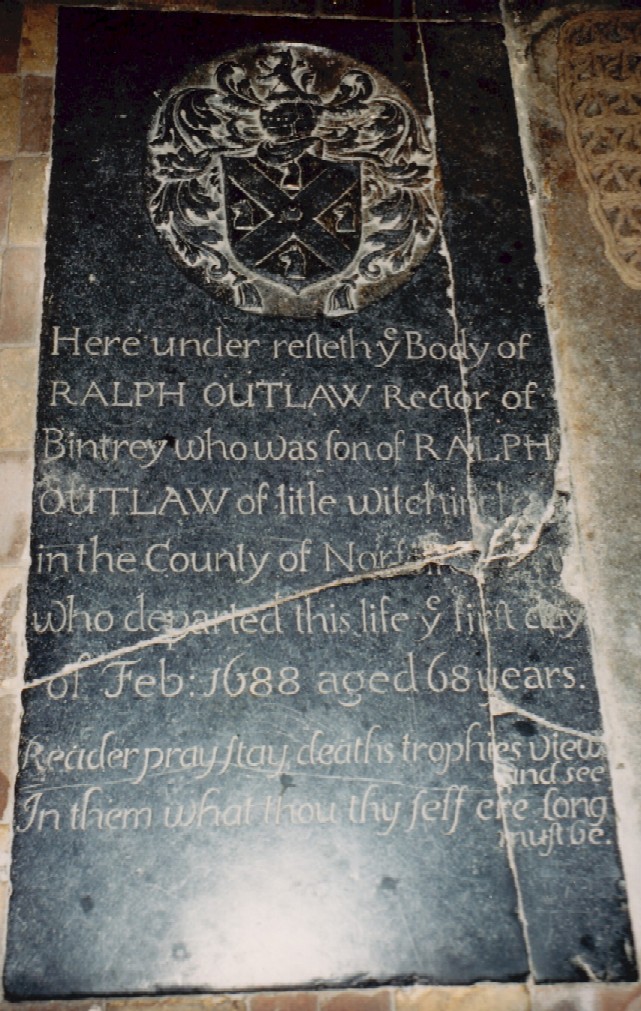
Slab at the West End - Bintry - St. Swithun Church:
On a saltire, between four wolves' heads couped, a crescent {Outlaw of Little Witchingham, co. Norfolk, granted 1613, Argent, a saltire gules between four wolves' heads, couped proper.) Crest: A demi-wolf, pierced through the side with an arrow, feathered and headed, the arrow lying sinister bend ways (Outlaw, A demi-wolf proper, pierced through the side with an arrow or, feathered and headed argent, the arrow lying sinister bendways.)
"Here under resteth ye body of Ralph Outlaw, Rector of Bintry, who was son of Ralph Outlaw, of Little Wichingham, in the county of Norfolk. He departed this life ye first day of February, 1688, aged 68 yeres. " Reader, pray stay, death's trophies view and see In them what thou thyself, ere long, must be. " [ So Ralph was born in 1620 ]
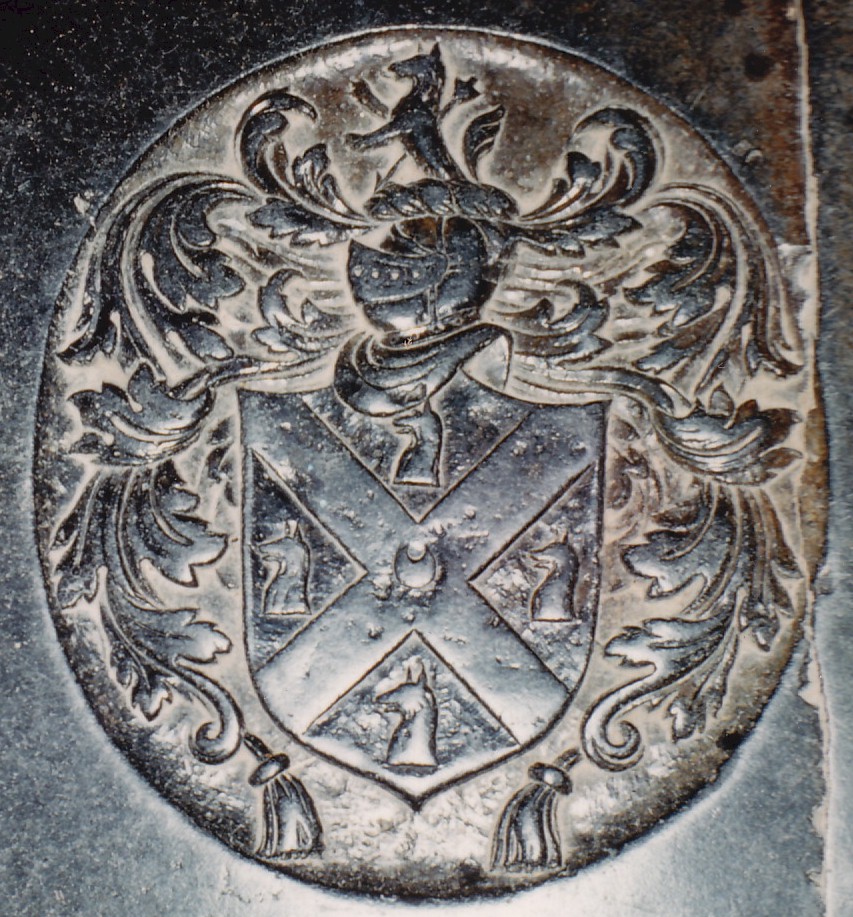
What is very interesting here is the Crescent signifying the cadet branch or second son , his older brother Thomas went to Lincoln's Inn (Business and Law) while Ralph went to Pembroke to later become a rector:
1615 - Elizabeth Kempe marries Ralph Outlaw a son Robert is born 1626 ( So what happened to this Robert if later Thomas becomes the heir? )
1620 - Ralph Outlawe was born in 1620
1637 - Ralph Outlawe of Witchingham, matriculated Pembroke College, 1637; B. A. 1642; M. A. 1645 - Pembroke College, Cambridge
1639 - Admission Lincoln's Inn - Thomas Outlawe, son and heir app. of Ralph Outlawe, Witchingham Parva, Norfolk - Lincoln's Inn
1646 - Ralph Outlawe Ordination as priest Norwich
1661-1684 - Ralph Outlaw, Rector/Vicar of Necton All Saints - Necton All Saints History - Necton All Saints Norfolk Churches
1684 - Ralph Outlawe becomes Rector of Bintree - Bintry - Ralph Outlaw
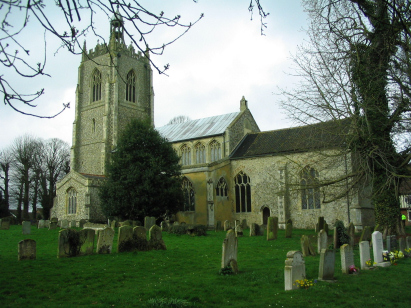 The parish of Necton lies in central Norfolk. The village is just off the main A47 road between Norwich & King's Lynn and a few miles east of the market town of
Swaffham. The village is substantial with most facilities still remaining and a well-defined centre. The village is just a half-mile south of the busy A47 yet is a peaceful spot; most houses are built along two major lanes one north-south the other heading east from the village centre and church.
The parish of Necton lies in central Norfolk. The village is just off the main A47 road between Norwich & King's Lynn and a few miles east of the market town of
Swaffham. The village is substantial with most facilities still remaining and a well-defined centre. The village is just a half-mile south of the busy A47 yet is a peaceful spot; most houses are built along two major lanes one north-south the other heading east from the village centre and church.
All Saints church is clearly visible from the main road; its distinctive tower with its lantern top is the first one sees.
Sadly most of this tower is Victorian added during an extensive series of makeovers in the 1850 - 1870
period. The basic fabric of the church, like most in Norfolk, is Perpendicular and
dates from the 14th century. In keeping with the size of the village, the church is a large structure with bays added for extra capacity. The hammerbeam roof internally is a fine example of this traditional Norfolk roofing method.
There seems to be a monument to Ralph Outlawe somewhere on the grounds:
Ralph Outlaw grave monument details
| Ralph Outlaw | first name on monument of Ralph Outlaw | Rector 1660 |
grave monument number 279359
| Image name: | 11 |
| GPR grave number: | 279359 |
| Cemetery: | All Saints’s Church |
| Location: | Necton, Norfolk, England |
| First name on the monument: | Ralph Outlaw |
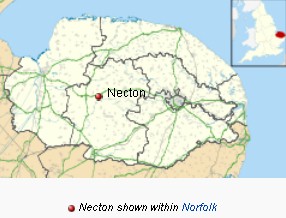 Necton
- commonly called Neeton, is a village situated on a turning off the A47
main road between Swaffham
and East
Dereham in the Breckland
district of mid-Norfolk.
As at the 2001 census it has a population of 1,865 residents and an area of
15.48 km2 (5.98 sq mi).[2]
It has a number of facilities including a primary school, playing field, garden
centre, garage, social club, pub, old people's home, post office, and a number
of shops.
Necton
- commonly called Neeton, is a village situated on a turning off the A47
main road between Swaffham
and East
Dereham in the Breckland
district of mid-Norfolk.
As at the 2001 census it has a population of 1,865 residents and an area of
15.48 km2 (5.98 sq mi).[2]
It has a number of facilities including a primary school, playing field, garden
centre, garage, social club, pub, old people's home, post office, and a number
of shops.
All Saints' church is at the centre of the village in the Benefice of Necton.
Panoramio - Photo of All Saints Church ~ Necton ~ Norfolk
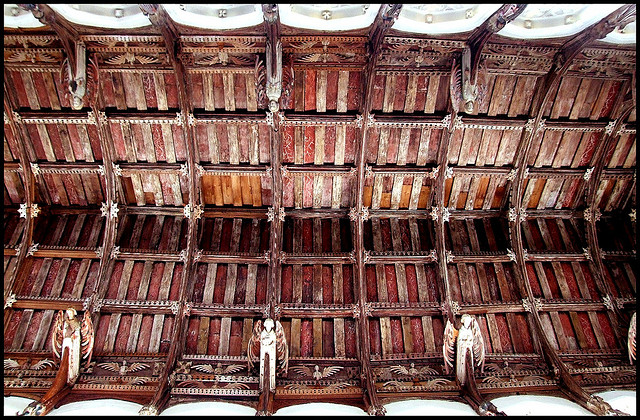
The great angel roof, one of Norfolk's best, gazes down in mute gloriousness....
What is the meaning of a crescent moon in the horn position in European Heraldry - Yahoo! Answers
In English heraldry - It usually denotes a cadet
branch of the family - not the main line.
The crescent indicates a line from a second son.
Cadency -
The English system of cadency involves the addition of these brisures to the plain coat:
Born: circa 800
Bishop of Winchester
Died: 2nd July 862 at Winchetser (Hampshire)
St. Swithun had been Prior of the
monastery attached to the cathedral, before he was made Bishop of
Winchester in AD 852. He was, say the chroniclers, a diligent builder of
churches in places where there were none before and a repairer of those that had
been destroyed or ruined. He also built a bridge on the east side of the city
and, during the work he made a practice of sitting there to watch the workmen,
that his presence might stimulate their industry. One of his most edifying
miracles is said to have been performed at this bridge where he restored an old
woman's basket of eggs, which the workmen had maliciously broken.
It is more certain that Swithun was one of the
most learned men of his time and the tutor, successively, of King Aethelwulf
of Wessex and of his son, the illustrious Alfred. He died on 2nd July AD 862
and was buried, according to his own desire, in the churchyard of the Old
Minster (Cathedral) at Winchester, where "passers by might tread on his
grave and where the rain from the eaves might fall on it." His reputation
as a weather saint is said to have arisen from the translation of his body from
this lowly grave to its golden shrine within the Cathedral, having been delayed
by incessant rain. Hence the weather on the festival of his translation (15th
July) indicated, according to the old rhyme, what it would be for the next forty
days:
"St. Swithun's day, if thou dost rain,
For forty days it will remain;
St. Swithun's day, if thou be fair,
For forty days 'twill rain na mair."
June and July, however, have their weather saints in the calendars of France and
of Belgium, as well as in those of other parts of Europe:
"Quand il pleut a la Saint Gervais (19th July)
Il pleut quarante jours apres."
Is the old French proverb, while Wedermaend, the 'month of storms' wa sthe old
Flemish name for July.
http://www.norfolkchurches.co.uk/bintree/bintree.htm
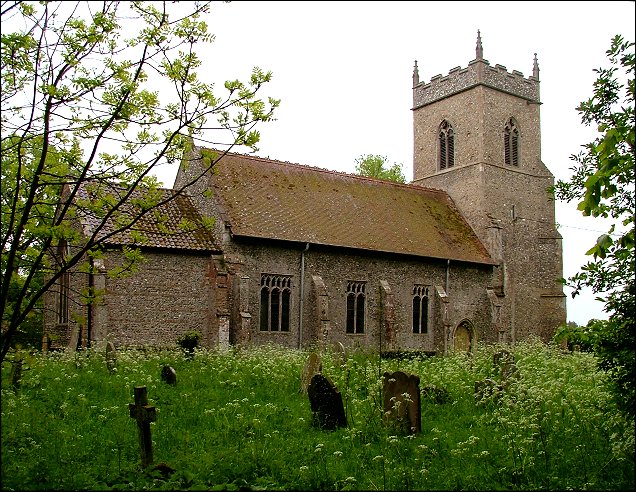
Central Norfolk's churches were awash in a sea of cow parsley. The image at the top of the page is typical of May 2006, but in fact this is an unusual view, taken from the far corner of the graveyard in a place nowhere ever goes - or, at least, no one had been for a while. There wasn't even a churchcrawler trail to follow, and so I had to battle my way through the undergrowth.
The result is a fairly typical Norfolk church with a 14th century tower and some late Perpendicular windows, but in fact this does not show St Swithin in its true light at all.