 |
[ Outlaw Genealogy | Bruce
History | Lost Chords ] [ Projects | News | FAQ | Suggestions | Search | HotLinks | Resources | Ufo ] |
|
[ Outlaw Genealogy | Bruce
History | Lost Chords ] [ Projects | News | FAQ | Suggestions | Search | HotLinks | Resources | Ufo ] |

The Fens - also known as the Fenland(s), are a naturally marshy region in eastern England. Most of the fens were drained several centuries ago, resulting in a flat, damp, low-lying agricultural region.
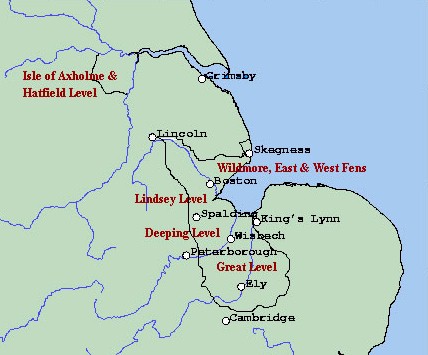 A
fen is the local
name for an individual area of marshland or former marshland and also designates
the type of marsh typical of the area.
A
fen is the local
name for an individual area of marshland or former marshland and also designates
the type of marsh typical of the area.
Most of the Fenland lies within a few metres of sea-level. As with similar areas in the Netherlands, much of the Fenland originally consisted of fresh or saltwater wetlands which have been artificially drained and continue to be protected from floods by drainage banks and pumps. With the support of this drainage system, the Fenland has become a major arable agricultural region in Britain for grains and vegetables. The Fens are particularly fertile, containing around half of the grade 1 agricultural land in England.
After the end of Roman Britain, there is a break in written records. It is thought some of the Iceni may have moved west in to the Fens to avoid the Angles who were migrating across the North Sea from Angeln (modern Schleswig) and settling what would become East Anglia.
The Fens formed a comparative 'safe zone', surrounded by water and marshes, and were easily defended, as well as being not particularly desirable to invading Anglo-Saxons with more important places to control
In the early Christian period of Anglo-Saxon England, a number of Christian individuals sought the isolation that could be found among the wilderness that the Fens had become. These saints, often with close royal links, include Guthlac, Etheldreda, Pega, and Wendreda. Hermitages on the islands became centres of communities which later became monasteries with massive estates.
Some Terms:
Norfolk - North folk ; Suffolk - South folk ;
Wessex - West Saxons ; Sussex - South Saxons ; Essex - East Saxons ; Middlesex -
Middle Saxons
East Anglia - Land of East Angles
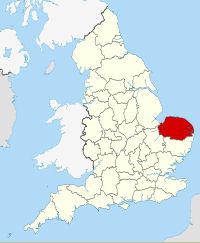
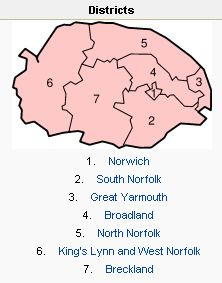 Norfolk
- is a low-lying county
in the East of England.
It has borders with Lincolnshire
to the west, Cambridgeshire
to the west and southwest and
Suffolk
to the south. Its northern and eastern boundaries are the North
Sea coast and to the north-west the county is bordered by The
Wash. The county town
is Norwich....Norfolk has
about one-thirtieth the population
density of Central
London, the tenth lowest density county in the country, with 38% of the
county’s population living in the three major built up areas of Norwich
(259,100), Great Yarmouth
(71,700) and King's Lynn
(43,100).[2]
The Broads, a well known
network of rivers and lakes, is located towards the county's east coast,
bordering Suffolk
Norfolk
- is a low-lying county
in the East of England.
It has borders with Lincolnshire
to the west, Cambridgeshire
to the west and southwest and
Suffolk
to the south. Its northern and eastern boundaries are the North
Sea coast and to the north-west the county is bordered by The
Wash. The county town
is Norwich....Norfolk has
about one-thirtieth the population
density of Central
London, the tenth lowest density county in the country, with 38% of the
county’s population living in the three major built up areas of Norwich
(259,100), Great Yarmouth
(71,700) and King's Lynn
(43,100).[2]
The Broads, a well known
network of rivers and lakes, is located towards the county's east coast,
bordering Suffolk
Norfolk was settled in pre-Roman times, with camps along the higher land in the west where flints could be quarried.[4] A Brythonic tribe, the Iceni, inhabited the county from the first century BC, to the end of the first century (AD). The Iceni revolted against the Roman invasion in 47 AD, and again in 60 AD led by Boudica. The crushing of the second rebellion opened the county to the Romans. During the Roman era in Norfolk roads and ports were constructed throughout the county and farming took place.
Situated on the east coast, Norfolk was vulnerable to invasions from Scandinavia and northern Europe, and forts were built to defend against the Angles and Saxons. By the 5th century the Angles, after whom East Anglia and England itself are named, had established control of the region and later became the "north folk" and the "south folk", hence, "Norfolk" and "Suffolk". Norfolk, and several adjacent areas, became the kingdom of East Anglia, later merging with Mercia and then Wessex.
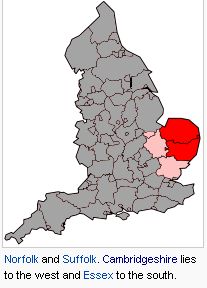 East Anglia -
is a traditional name for a region of eastern England,
named after an ancient Anglo-Saxon
kingdom,
the Kingdom
of the East Angles.
East Anglia -
is a traditional name for a region of eastern England,
named after an ancient Anglo-Saxon
kingdom,
the Kingdom
of the East Angles.
The Angles took their name from their homeland Angeln,
in northern Germany.
East Anglia initially consisted of Norfolk
and Suffolk,
but upon the marriage of the East Anglian princess Etheldreda,
the Isle
of Ely also became part of the kingdom
....
The Kingdom
of the East Angles, formed about the year 520 by the merging of the
North and the South Folk (Angles who had settled in the former lands of the Iceni
during the previous century)
...
On 20 November 869 the Danes
killed King
Edmund and took the kingdom, which they named East Anglia (see Ivar
the Boneless). The Anglo-Saxons retook the area in 920, only to lose it
again in 1015–1017, when it was conquered by Canute
the Great and given as a fiefdom
to Thorkell
the Tall, who was made Jarl
of East Anglia in 1017. ...Much of East Anglia (including parts of Lincolnshire)
consisted of marshland
and bogs
until the 17th century, despite the construction of early sea barriers by
the Roman
Empire.
Norfolk and East Anglia are the earliest and most likely origin of the Outlawe family. They're origins maybe Brythonic , Angle , Wuffing , Scandinavian , Danish Vikings or Saxon. Other than the ~950AD family legend there are no pre-conquest records of the family.
The earliest records of the Outlaw's - "Utlage's" are 1170-1210 AD in East Anglia (King Lynn) , North Norfolk, Kent (a Saxon stronghold) and Bristol (Saxon and involved with the Irish invasion in 1169)
Along the way, let's look at some of the post conquest rebels and "Outlaw's"
of the area in history and show that the "Outlaw family" ARE NOT
related to them, but maybe "connected" to them.
(i.e. Hereward "the Outlaw", Edgar Atheling "the Outlaw" and
Geoffrey
de Mandeville, 1st Earl of Essex
Outlaw and a bandit in the fen-country
) Note: "The Utlage's" are directly connected to the
Glanville's later in 1169 with Bromholm Priory.
Now it seems that a first name used by native pre-conquest Danish/Saxon people in England was "Utlag" and the most likely scenario is that soon after the conquest and surnames came into fashion, the children were "christened" with Christian names like "Walter" and referred to themselves as "Walter son of (fil fitz de) Utlag" and then "Walter the Utlag" etc...
It is interesting to speculate that "The Utlage story" and the returning crusader `Robin (Ralph/Roger/Robert) "The Outlaw" Hood legend' may very well be one in the same or at least very similar...
To review - who were the Saxons
?
The Saxons are made up of three peoples from different parts of Germany. Saxons
are people from north west Germany or Old Saxony as it is sometimes known.
Some of the other ancestors of the land of England:
Angles
are people from the Germany/Denmark border.
Jutes are believed to
originate from areas of Jutland and
Frisian coast. - they finally settled in Kent
Breton's - are
an ethnic
group located in the region of Brittany
in France. They
trace much of their heritage to groups of Brythonic
speakers who emigrated from southwestern Great
Britain in waves from the 3rd to 6th century into the Armorican
peninsula, subsequently named Brittany
after them. ...Brittany
and its people are included as one of the six Celtic
nations. Ethnically, along with the Cornish
and Welsh, the Bretons
are the last vestiges of the ancient British.
Danes - ethnic
group that is native to Denmark,
and who speak Danish.
Picts - Early
Mediaeval people living in what is now eastern and northern Scotland
"Normans" derives from "Northmen" or "Norsemen", after the Vikings from Scandinavia who founded Normandy.
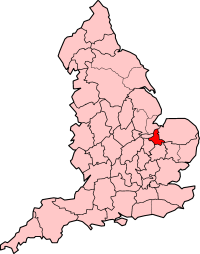 The Isle of Ely (pronounced /ˈiːli/)
is an historic region around the city of Ely
now in Cambridgeshire,
England but
previously a county in its own right.
The Isle of Ely (pronounced /ˈiːli/)
is an historic region around the city of Ely
now in Cambridgeshire,
England but
previously a county in its own right.
Its name is said to mean "island of eels", a reference to the creatures that were often caught in the local rivers for food. This etymology was first recorded by the Venerable Bede.[1]
History - Until the 17th Century, the area was literally an island surrounded by a large area of Fen land, a type of swamp. The Fens were ultimately drained using a network of canals designed by Dutch experts.
The area's natural defences led to it playing a role in the military history of England. Following the Norman Conquest, the Isle became a refuge for Saxon forces under Earl Morcar, Bishop Aethelwine of Durham and Hereward the Wake in 1071.[2] The area was taken by William only after a prolonged struggle.
[3] In 1139 civil war broke between the forces of King Stephen and the Empress Matilda. Bishop Nigel of Ely, a supporter of Matilda, unsuccessfully tried to hold the Isle. In 1143 Geoffrey de Mandeville rebelled against Stephen, and made his base in the Isle. Geoffrey was mortally wounded at Burwell in 1144. [4]
1143-1144 - Geoffrey de Mandeville, 1st Earl of Essex - Geoffrey maintained himself as an Outlaw and a bandit in the fen-country, using the Isle of Ely and Ramsey Abbey as his headquarters. He was besieged by King Stephen and met his death in September 1144 in consequence of an arrow wound received in a skirmish. Denied burial because he died excommunicate, his body was wrapped in lead. Eventually it was taken to the Templar community in London. He was buried in the Temple Church in London. His son arranged for an effigy to be placed on the floor, where it still can be seen today.
In 1216, during the First Barons' War, the Isle was unsuccessfully defended against the army of King John. Ely took part in the Peasants' Revolt of 1381.
Administration: From 1107 until 1837 the Isle was under the jurisdiction of the Bishop of Ely, who appointed a Chief Justice of Ely and exercised temporal powers within the Liberty of Ely.
This temporal jurisdiction originated in a charter granted by King Edgar in 970, and confirmed by Edward the Confessor and Henry I to the abbot of Ely.
The latter monarch established Ely as the seat of a bishop in 1107, creating the Isle of Ely a county palatine under the bishop. An act of parliament in 1535/6 ended the palatine status of the Isle, with all justices of the peace to be appointed by letters patent issued under the great seal and warrants to be issued in the king's name. However, the bishop retained exclusive jurisdiction in civil and criminal matters, and was custos rotulorum. A chief bailiff was appointed for life by the bishop, and performed the functions of high sheriff within the liberty, who also headed the government of the city of Ely[5].
1314 - John
Outlawe
v. Henry le Pescour of Cantebrigg' & Joan his wife in Gransete - Cambridge-
7 Edw II. 79
1317 - Simon
de Everesdon and Margaret his wife v. John le Utlawe junior and Alice
his wife in Brunne - Cambridge 10 Edw II 83 ( Brunne (Bourne,
Lincolnshire), ) - Bourne is a market
town on the western edge of the Fens
- Bourne is reputedly the birthplace of Hereward
the Wake (in about 1035), although the 12th century source of this
information, De Gestis Herwardi Saxonis,[58]
refers in this connection only to his father as being 'of Bourne' - Robert
Mannyng (1264–1340) is perhaps the most notable of the town's past citizens.
He is credited with putting the speech of the ordinary people of his time into
recognisable form. He is better known as Robert de Brunne because of his long
time residence as a canon
at Bourne Abbey. Great Eversden
is a village
south-west of Cambridgeshire,
England
( Brunne - BOURN, anciently "Brunne" or "Burne," is a village, a parish in the hundred of LONGSTOW, county of CAMBRIDGE, 1¾ mile (S.E by E.) from Caxton - Bourn
Hereward the Wake - the Outlaw (follow link for in depth research)
1070- 1072? - Thurcytel AND Utlamhe "the Exile" - with Hereward the Wake - Utlamhe The Exile
Hereward the Wake - (c. 1035 – 1072), known in his own times as Hereward the Outlaw or Hereward the Exile, was an 11th-century Anglo-Danish leader (cited by author Peter Rex- hence the rebel leader's ability to call upon Scandinavian aid in 1069) involved in resistance to the Norman conquest of England. ... It is thought that he had already rebelled against Edward the Confessor before 1066, whom he saw as already aligning England with the Normans, and that he was declared an outlaw as a result. It has been suggested that, at the time of the Norman invasion of England, he was in exile in Europe, working as a successful mercenary for the Count of Flanders, Baldwin V, and that he then returned to England.
The name Hereward is composed of Old English roots here = army, and weard = guard[1], and is cognate with Old High German Heriwart and modern German Heerwart. The title "the Wake" (meaning "watcher") was popularly assigned to him many years after his death.
Hereward the Outlaw (Wake) ...
Herward the Wake was a Saxon Thegn. A thegn was a Saxon nobleman. In service to the King they were indispensable to law and order. Until the Norman conquest of 1066, of course. Hereward came back from exile in around 1070 to stand up to William. For nearly a year he held the isles. To the victor comes the writing of history. Little is known of this man, Hereward. Centuries before 'Robin Hood' he stood up to oppression.
The Wake
He is associated with a region in present-day Huntingdonshire and Northamptonshire.
Hereward is said to have escaped with some of his followers into the wild fenland, and to have continued his resistance.
The 12th century chronicle, Gesta Herewardi, (of unknown authorship: first published by Thomas Wright in 1839 and translated by W. Sweeting for the 1895 edition), says Hereward was eventually pardoned by William and lived the rest of his life in relative peace. The other possibility is Hereward received no such pardon and went into exile never to be heard from again. As this was the fate of a lot of prominent English men after the Conquest it is a distinct possibility.
The Golden Falcon - Hereward the Wake
Hereward was described as short, stout but agile with long golden hair and light eyes which did not quite
match. His first wife was Torfrida, a Fleming and reputedly a witch who took the veil when he later abandoned her for Dolfin's daughter.
Bourne Archive FNQ Hereward English
- he was driven forth by his father and country ; whence
he was surnamed “The Outlaw". ...
For he was a boy remarkable for his
figure, and comely in aspect, very beautiful from his yellow hair, and with
large grey eyes, the right eye slightly different in colour to the left
; but he was stern of feature, and somewhat stout, from the great
sturdiness of his limbs, but very active for his moderate stature, and in all
his limbs was found a complete vigour... his father begged King Edward that
he might be banished, making known everything he had done against his father and
parents, and against the country people. And this was done. Whence
forthwith he acquired the surname of the Outlaw, being driven from his father
and country in the 18th year of his age.
The rebellion of Ely which occurred in 1072 - Hereward's revolt took place in 1071 ( Differing dates as to the rebellion) - Flanders was the traditional refuge for the Saxon royalty of England. The Flemings were Saxons who fled to the Netherlands (called Fleanderland or the "land of those who fled") and its Counts were descended from King Alfred the Great.
Hereward the Wake - Translated by Michael Swanton Originally Published in Robin Hood and Other Outlaw Tales
1070- 1072? - Thurcytel AND Utlamhe "the Exile" - with Hereward the Wake - Utlamhe The Exile
Cum quibus nec non et alii in militia probatissimi adhus computati sunt, Lefricus Diaconus et Villicus de Draitone, atque
Turkillus et Utlamhe, id est Exhulis, cocus Herewardii, Hogor cognatus Herwardi, Winter et Liueret duo praecleri et Rapenaldus dapifer de Ramesis."
Turkillus was Thorkill of Ardern, sheriff of Warwickshire, a pre-Conquest Norman. Thorkill possessed vast lands in Warwickshire in
1086, part of which had been seized from other Englishmen. The property was valued at more than £120 (increased by a third between 1066 and 1086), assessed at over 35 hides for the geld and consisting of nearly 220 ploughs. The major part of Thorkill's lands passed to Roger of Beaumont, Earl of Warwick and Leicester
[ Torquil -
The boy's name Torquil is of Scottish
and Gaelic origin,
and the meaning of Torquil is "Thor's helmet".
From Torcall,
which is derived from an Old
Norse name that also
is the source form of the Swedish
name Torkel.
Also possibly (Old Norse)
"Thor's kettle", referring to a cauldron
used in sacrifice.
In Norse mythology,
Thor is the god of thunder.
- variant forms: Thirkell
(or Thur-Ketel )
Arden family - Alwin (Æthelwine), nephew of Leofric, Earl of Mercia, was Sheriff of Warwickshire at the time of the Norman Conquest. He was succeeded by his son, Thorkell of Arden (variously spelt Thorkill, Turchil etc.) ]
Medieval outlaws- twelve tales in modern English translation - Hereward, now eminent in all military matters, returned to England together with his two nephews and his loving wife Turfrida....
And in addition to these must be numbered
others also very experienced in warfare: Leofric the Deacon, the Bailiff of
Drayton;
Thurcytel AND Utlamhe -- that is to say, "the Outlaw";
So here we have "The Outlaw" with Hereward
in the fens!
One Hundred years later we have a reconnection of Outlaw
and Ketel back at the Fens :
1169 - Bromholm Priory - House of Glanville - Charter of Bartholomew de Glanville To Bromholme Priory - Walteri Utlage " And two thirds of the tithes of my men: that is, of my uncle by the mother, Roger de Bertuna: And of Geoffrey, priest of Honinges: and Turstan despensatoris: Warini de Torp, Ricardi Hurel, Walteri Utlage: et Roberti de Buskevill: And the tenth of the whole Ricardi filii Ketel. " - An Essay Towards a Topographical History of the County of Norfolk: Tunstede ... By Francis Blomefield, Charles Parkin (All the people highlighted in this Charter were involved with the Crusades or their relatives were - except for Walter Utlage , for which there is no information available to document )
[ So we see that "de Utlage" "the/of/from Outlaw" could be connected with Hereward "the Outlaw" "the Utlamhe". Notice that the Vtlage's are directly connected to the Glanville's later in 1169 with Bromholm Priory.
It is very interesting that these "Rebel's and Outlaw's" , Robin Hood legend and others, come from the same area as the first Utlage's surface in records 1170-1210 AD. ]
[ One of the goals is to show connections between England and Ireland with the Outlawe family. It seems the men from Ely were involved with the invasion/Norman conquest of Ireland. So we want to find the connecitons they might have of lands and family both in Ireland and England.
Dublin becomes a colony of Bristol early on and Ely appears to have connections to Kilkenny and Wexford Ireland via the Norman Conquest (and Templars?) and the church.
Later they return to England and begin buying into more influential properties in Herfordshire, Essex and the like. It is interesting that many Templar knights "retire" to Ireland and were cared for by the Hospitaller's, and that later Sir Roger Outlawe appears as the head of of Hospitaller's in Ireland (after the 1308 dissolution of the Templars) with his brother William who was a "banker" and his son later, mayor of Kilkenny. ]
Lives of the Lord Chancellors - The early Irish Records are very defective. Many were burned in the Castle of Trim and in St. Mary's Abbey; others were carried out of the country, and are met with in the State Paper Office, the Rolls' Chapel, Record Office, and British Museum, in London; others are at Oxford. Several cities on the Continent possess valuable Irish documents, while many are stored in private houses,
All the places in Hichin which were not in Harold's hands in 1066 were held BY HIS 'MEN'
[ Speculation: What we see is a possible history of two families, one Wuffing/Anglo-Danish "le Utlagh" family , in Norfolk, few in number, powerful early after the conquest and other "Outlawe" families, many in number, displaced by the conquest, These would be Saxons who had lost everything (see Temple Dinlsey - Earl Harold's home) with no home to go back to, their choice manors and strongholds had been taken by the Normans. Another term for Outlaw is simply a landless noble without position. These men would probably have simply stayed where they lost, in Ely. ]
I have yet to find a Norman connection to the name Utlagh. The name/word itself is Saxon / Wuffing / Danish in origin.
The other origin of Utlagh is from the Old Norse Utlagi : the Old Norse word UTLAGI which became the Middle English OUTLAWE - Utlac - Utlach - Uthlach - Uthlac - It would seem to be connected with the Old Norse Utlagi, an outlaw, which appears as Ulage or hulague in Wace - Which sort of goes back to the connection to the (?Saxon?) Wuffings - Wulfings (Goths) of Geats (Sweden)
They would call themselves the Outlaw's and find positions in the church or work for the Normans with the invasion in Ireland or the crusades (Templars? or Hospitaller's). Also, for the time period oral history is very strong.
No one would want to be confused with "an outlaw" without good reason, unless the people around them understood and admired the significance. A hundred years after the conquest there seems to be many "Outlawe's" all around Norfolk and early after the conquest. This may simply be due to the records left to us, but it seems to be an indication that the origin of a whole clan of people were based there.
There is an interesting description of the famous Howard family: Howard Family Genealogy :
The Howard family can definitely trace their ancestry back to Sir William Howard living under the first of two Edwards from 1297 to 1308. It was in the stirring days of Edward I that the first Howard made his home at East Wynch (Near King's Lynn). This was Master William Howard, afterwards to become Chief Justice of the Common Pleas and a knight. Of his parentage we know nothing, although the probabilities are that he belonged either to a burgess family of Lynn, or else to some substantial yeoman stock of the neighborhood.
He may have been either of Danish or of English descent. Northwest
Norfolk was as much a district of the Danes as it was of the Angles ; "and
both races sought refuge in its marshy fastnesses after the Norman conquest,
gradually emerging from their hiding places as the laws of the invader grew less
rigorous.
...
"For his support of Richard III's claim to the throne,
John
Howard, the son of Thomas Mowbray's elder daughter Margaret, was created 1st
Duke of Norfolk in 1483, in the title's third creation. From this point to
the present, the title has remained in the hands of the descendants of John
Howard."
This bringss us back to where the Outlaw's and the
Howard's paths cross
(Oh and the Mowbray's were big in Ireland too!) :
1463 - list
of the retainers who accompanied Sir John Howard to Wales - Crew of
the Mary Talbot of Lynne - Rechard
Owtlawe mayster - John Owtlawe.
Also a Utlage - Mowbray connection - Crusades/Order of St. Lazarus: :
The
"Master of Burton" originally was Roger de Mowbray
1086 - Domesday Book
- the survey was to determine who held what and what taxes had been liable under
Edward
the Confessor; the judgment of the Domesday assessors was final
[ No record of Utlage or Outlagh has yet to be found documented in the Domesday
Book ] - The Domesday[2]
Book is really two independent works. One, known as Little Domesday,
covers Norfolk,
Suffolk and Essex.
The other, Great Domesday, covers the rest of England
... There are also no surveys of London,
Winchester
and some other towns ... Durham; parts of the north east of England were covered
by the 1183 Boldon
Book, ... Search
and read more about Domesday book
Twenty years after the conquest we have no records of any Utlage's in Domesday. All the Utlage men of note may have died at Battle of Hastings or Battle of Stamford Bridge , more likely since surnames were not in use, they were just "men of" Harold Godwin or Edward Atheling or ?.
So we have a legend of ? Utlage's ? people "banished for political offences" in 950 AD by King Edwy and returned with King Edgar, but we really don't know if they were "his" men or someone else's. Just that they as a clan, from now on, would be known as "THE Outlaws" .
We just have no reliable or sufficient targets to investigate further. The one thread is the Utlag connection to the Ulf or Wolves , which seems to point towards an early wolf cult - "East Anglia"- Geatish Wuffing - "Beowolf" Swedish origins.
Also, why would a family in 1613 tell a Saxon legend if they were originally Norman's? How or why would they "make up" such a story?
| - - - - - -
1169 - Bromholm Priory - House of Glanville - Charter of Bartholomew de Glanville To Bromholme Priory - Walteri Utlage - Et duas partes decimarum meorum hominum: scilicet avunculi mei Rogeri de Bertuna: Et Galfridi presbiteri de Honinges: et Turstani despensatoris: et Warini de Torp: Et Ricardi Hurel: et Walteri Utlage: et Roberti de Buskevill: et decimam totam Ricardi filii Ketel. - An Essay Towards a Topographical History of the County of Norfolk: Tunstede ... By Francis Blomefield, Charles Parkin (All the people highlighted in this Charter were involved with the Crusades or their relatives were - except for Walter Utlage , for which there is no information available to document )
And the next noteworthy date is 1207 - (besides the 1169 date which I
just found recently! )
1207 - Hubert
de Burgh purchased of Roger de Burnham and Julian, his wife, William de
Noiers, Robert Fitz Ralph, and Alice his wife, and Robert de
Utlagh (Notice the Utlagh's are SELLING there interest in
Norfolk and BUYING where? Ireland now?
[ So between 950AD - 1086 AD and 1169-1207 AD something happens to change the fortunes of these Utlage men. That seems to be the Norman invasion of Ireland in 1167-1175 and it seems to follow that's where William Outlawe and Roger Outlawe come from and explains the many connections to the powerful Norman families of the Irish invasion, like the De Burgh's and De Clare's and the Howard's. Gilbert de Clare Earl Gloucester and Hertford (and Hereford) giving the later 15th century Simon Outlawe a connection to Bristol (Gloucester) and Baas Manor Broxborne. That is to say, after the suppression on the Templar's in 1308, and by the 1330's there seems to have been a migration back to England to Norfolk, Bristol, London and Essex of these "elite" Outlawe's. This opens up the slight possibility that this elite group (from the Bromholm Priory) were late comers of the Norman Conquest "Outlaw" Normans or Breton's without land or title. ]
Walter Utlage - Bromholm Priory - Glanville- 1169
1114 - the
Fraternity of the Holy Sepulchre on land given by Abbot
Reinald of Ramsey between 1114 and 1130 - Cambridge Round Church
1130 - The
Round Church of Cambridge was built in about 1130 and was
originally a wayfarers' chapel - but soon became a parish church, served by
the Austin Friars from the nearby Hospital of St. John (now St. John's
College)
1147 - On May 19, 1147, the first contingents of crusaders left from Dartmouth in England, consisting of Flemish, Frisian, Norman, English, and Scottish crusaders, and some from Cologne,[4] who collectively considered themselves "Franks".[5] No prince or king led this part of the crusade, England at the time being in the midst of The Anarchy. The fleet was commanded by "Hervey" Henry Glanville, Constable of Suffolk.[6][7] Other crusader captains included Arnold III of Aerschot, Christian of Ghistelles, "the men of Kent under" Simon of Dover, Andrew of London, and Saher of Archelle.[8] - Fall of Lisbon - The siege began on July 1. The Christians soon captured the surrounding territories and besieged the walls of Lisbon itself. After four months, the Moorish rulers agreed to surrender (October 21), because the Crusaders' siege tower reached their wall (thus causing a one day standstill) and because of hunger within the city, which was sheltering populations displaced from Santarém as well as "the leading citizens of Sintra, Almada, and Palmela."[11] - Some of the crusaders set sail and continued to the Holy Land.[6] Most of the crusaders however settled in the newly captured city, and Gilbert of Hastings was elected bishop - Frank Leslie's popular monthly
1150-1169 - Bromholm Priory - House of Glanville - Charter of Bartholomew de Glanville To Bromholme Priory - Walteri Utlage - Et duas partes decimarum meorum hominum: scilicet avunculi mei Rogeri de Bertuna: Et Galfridi presbiteri de Honinges: et Turstani despensatoris: et Warini de Torp: Et Ricardi Hurel: et Walteri Utlage: et Roberti de Buskevill: et decimam totam Ricardi filii Ketel. - An Essay Towards a Topographical History of the County of Norfolk: Tunstede ... By Francis Blomefield, Charles Parkin - [C. 1150.] Bartholomew de Glanville. Confirmation of his father's grants to Bactun or Bromholme monastery (co. Norfolk). - Crawford collection of early charters
1166 - Sir Hervey DE GLANVILLE of Bawdsey died 1166
1195 - Bartholomew de GLANVILLE Sheriff of Suffolk was born 1145 in Stratford, Suffolk, England. He died 1195 in Bromholme, Suffolk, England.
" And two thirds of the tithes of my men: that is, of
my uncle by the mother of Roger de Bertuna: And of Geoffrey, priest of
Honinges: and Turstan despensatoris: Warini
de Torp, Ricardi Hurel, Walteri Utlage: et Roberti de Buskevill: And the tenth of the whole
Ricardi filii Ketel. "
Notice he is referring to Walter Utlage as among HIS MEN. Despensatoris
refers to Dispensation's,
Fighting men relied on Dispensations from Priests to keep on the right side of
God.
Notice Bromholm is in Bacton and Bacton is
only 15 miles from Runton/Beeston Regis and 27 miles from Hindringham that
Robert de Utlagh is associated with.
This is the earliest Utlage record found and Ricardi filii (
son of ) Ketel may be an early form of Keteller or Kyteler also included in this
charter are the de Burgs and other notables. This creates a link between before
the Norman invasion of Ireland and post ) - BENEFACTORS TO BROMHOLM PRIORY. King Henry I., after
1113; Stephen, Earl of Morton afterwards King; Bartholomew de Glanville, Baron de Bromholm, son of the founder, 1169
( so his father the founder in 1113 - William, Earl Glanville)
Note : It seems every benefactor in the charter of this priory is associated with, or relatives of, those that went on the English Crusades.
1169 - By this deed Bartholomew grants the Monks of Acra [Castle Acre], at Baketon [Bacton], where his father William de Glanville lies buried, the land of Stanard the priest, and the Church of Casewic, and all the appurtenances in Bromholm, the Church of Delham with its appurtenances, the whole of his Lordship of Baketon, and two parts of the tithe of Stringes of Horham and Alreton, of Langho and Brug, belonging to his Lordships; also of Sneseling, with all the tithe of his mills in Baketon and Wileford; two parts of the tithe of the mill of Honing, and one mill at Munisle in demesne, with the land of Herfrid the priest, and part of his wood in the mill-way to Takesgate, two parts of the tithe of the men or tenants of Roger de Beketon[Bacton ?], Geffrey the priest of Honing, Walter Utlage, etc., all the tithe of Richard, son of Ketel, and the whole tithe of the paunage of Baketon and Horham and of the turbage of Swathefield two parts, and at his death he bequeaths to this Priory, Geishorm, and all that he possessed in the fields there, with his villians, to be free and quit from all customs, except the King's Dane-gelt.
Sir Robert de Glanville was succeeded in these Lordships by
William de Glanville, who in the reigns of William Rufus and Henry I. held a high position among the Norfolk and Suffolk Barons. His possessions in lands were extensive, as
he not only founded a Priory but left his eldest son to inherit considerable
property.
In the year 1113 A.D. he founded Bromholm Priory, in the county of Norfolk, and made it
subordinate to the Cluniac Monastery of Castle-Acre, and dedicated it to
St. Andrew. He endowed it with lands here, and in his Lordships of Bacton and Ceswick. At the same place, says Weever, was also a priory of Black Monks (Cluniacs), dedicated , to St. Sepulchre, founded by
G. de Glanville, and value, at [pound sterling]149 19s. 0 1/2d. per annum
In 1171, when King Henry II. went over to Ireland, Bartholomew de Glanville, Wimar the chaplain, and William Bardul render their account for 320 hogs sent to the army in Ireland £26 16s. 5d., 15 days' pay to 36 masters and 468 equippers £33 13s. 0d., making bridges, hurdles, and other ship's apparel £6 5s. 5d., 6 handmills and their appendages 14s. 4d. This account was paid to them by the King's Writ. (Pipe, 17 H. II., Bot. 1.)
Baldwin, so long as he carried this crosse with him to battle, had ever the upper hand of his enemies, but forgetting it he was forthwith slain, upon which his chaplaine Hugh stole secretly away with the said box and crosse - came to this Monastery of Bromholm, and bestowed them both here upon the monks, for which so inestimable a gift he, with his two sons (which he had by his wife before he entered into Holy Orders) were kept of the monks with all things necessary untilI the death of Hugh the father, and the preferment of both his sonnes
Little appears to have been known of this place previous to the Norman Conquest. It seems, however, to have been in a state of cultivation during the period of the Saxons, and came early into the possession of Edric, a noted Dane, who, in the reign of Edward the Confessor, invaded and seized on this and other lands in the neighbourhood. At the Conquest, Edric was deprived of them by William I. This Edric was a Thane of the first rank; after the custom of the Normans, he assumed the name of Edrio de Laxfield, from a town of that name in Suffolk. In the time of Edward the Confessor, William, Earl Warren, held sixteen acres in Bacton, valued at 2s.
William the Conqueror, on his accession to the English Throne, granted, amongst other divers lands, the Village and Manor of Bacton to Robert Mallet, Lord of the Honor of Eye in Suffolk, who held it as a tenant of the Crown ( We see the name Robert Malle come up again with Sir Adam Outlawe Priest )
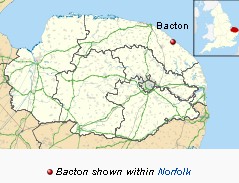
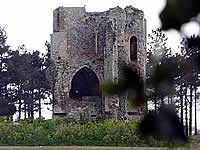
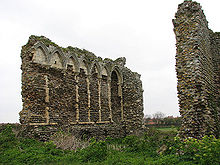 Bromholm Priory
- was a Cluniac
priory,
situated in a coastal location near the village of Bacton,
Norfolk, England
. Bromholm Priory, also known as Bacton Abbey[1],
was founded in 1113
by William
de Glanville, Lord of Bacton, and was originally subordinate to Castle
Acre Priory. The priory was suppressed
in 1536. All that
now remains are the ruins of the gatehouse, Chapter House, and the northern
transept of the Priory Church.[1]
It was an important object of pilgrimage as it claimed to possess a piece of
the True Cross, mentioned as the 'holy cross of Bromeholme' [2]
in Chaucer's The
Reeve's Tale and William
Langland's Vision of Piers
Plowman. It was a benefice of the Paston family and is featured
in their letters.
Bromholm Priory
- was a Cluniac
priory,
situated in a coastal location near the village of Bacton,
Norfolk, England
. Bromholm Priory, also known as Bacton Abbey[1],
was founded in 1113
by William
de Glanville, Lord of Bacton, and was originally subordinate to Castle
Acre Priory. The priory was suppressed
in 1536. All that
now remains are the ruins of the gatehouse, Chapter House, and the northern
transept of the Priory Church.[1]
It was an important object of pilgrimage as it claimed to possess a piece of
the True Cross, mentioned as the 'holy cross of Bromeholme' [2]
in Chaucer's The
Reeve's Tale and William
Langland's Vision of Piers
Plowman. It was a benefice of the Paston family and is featured
in their letters.
Cluny Abbey - There were no official English Cluniac priories until that of Lewes in Sussex, founded by the Anglo-Norman earl William de Warenne c 1077. The best-preserved Cluniac houses in England are Castle Acre Priory, Norfolk, and Much Wenlock Priory, Shropshire.
= = = == = = = = =
The Holy Rood
1202-04 - Fourth Crusade - Crusaders sack Constantinople (so we soon see the appearance of the Holy Rood at Bronholm)
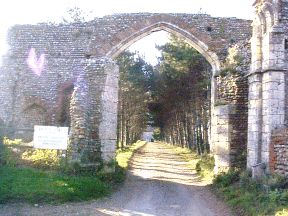 Bromholm
Priory On the village boundary, through the ruined gatehouse on Abbey
Street, stand the remains of Bromholm Priory, once one of the most holy
places in Europe. The priory was destitute until its Cluniac monks
purchased what they believed to be a piece of the original crucifix from a
priest who had, wandered Europe trying to find a buyer for this valuable piece
of merchandise.
Bromholm
Priory On the village boundary, through the ruined gatehouse on Abbey
Street, stand the remains of Bromholm Priory, once one of the most holy
places in Europe. The priory was destitute until its Cluniac monks
purchased what they believed to be a piece of the original crucifix from a
priest who had, wandered Europe trying to find a buyer for this valuable piece
of merchandise.
Once in their hands, the monks promptly used It to cure all kinds of diseases - even to raise people from the dead! Its fame attracted pilgrims from all over Europe, including Henry III, and its name was immortalised in Chaucer's 'Canterbury Tales."
Crusader art in the Holy Land: from the Third Crusade to the fall ..., Volume 1 By Jaroslav Folda - The Holy Rood of Bromholm apparently arrive in England before 1223 ( 1204 - see above) from Constantinople by an English chaplain of the Latin emperor Baldwin I. ... it is clearly a double-armed cross , an image of the True Cross as the crusaders had celebrated it in the Twelfth century prior to the battle at Hattin. 1226 Henry III made his first pilgrimage to Bromholm.
= = = == = = = = =
Ranulf de Glanville
- His father was
William
de Glanville, of whom he was a younger son, though eventually, on the death of
an elder brother, he inherited the family
estates and honours...
1173 - he became Sheriff of Lancashire...
1176 - we find Glanville a justice
itinerant
1180 - he became Chief
Justiciar
of England.
1188 - Walter Hubert
founds West Dereham Abbey for Premonstratensian
house of canons
-
The canons were to pray for the souls of the founder and his parents,
his brothers and sisters and all his relatives and friends, as well as for
the souls of Ralph de Glanville, justiciary of England, and Bertha his wife.
Hundreds of years later, in 1392 - we have - John
de Bernewelle whose personal name was Outlawe; possibly a canon of West Dereham,
and one of the three brothers of that name - Ralph de Glanville was Walter
Hubert's Uncle!!!!
1189
- Henry II
died. At the coronation
of his
successor
, Richard I, the same
year, Chief
Justiciar
Glanville was present, and when that prince took the
cross
, Glanville joined him, contributing a large sum towards the crusade.
1190 - In the autumn, he died at the siege of
Acre, a victim to the unwholesomeness of the climate.
1147 - Leaders of the English Second Crusade - Hervey of Glanvill - Hervey DE GLANVILLE
1169 - Roberti de Buskevill : Robert of Baskerville
Here we see Robert a descendant (grandson) of the FitzGerald's (Windsor's) who were in charge of the invasion of Ireland. Agnes brothers were David and Maurice Fitz Gerald who led the first invasion.
RootsWeb's WorldConnect Project Lindas Family Tree
| ii. | Agnes FitzGerald WINDSOR was born ABT 1092. She married Robert BASKERVILLE, son of Geoffrey Martel DE BACQUEVILLE and Miss DE BACQUEVILLE. He was born ABT 1090. |
Ralph de Baskerville - Ralph II, Robert, Walter - Robert de Baskerville 1149 - Eardisley Herfordshire - 1166 Carta Hugh de lacy - died 1176 - son Ralph died 1186
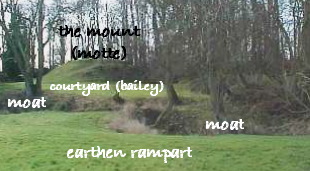 brucehassan
Eardisley Castle - Edwi was an Anglo-Saxon earl who had held
Eardisley before the conquest
brucehassan
Eardisley Castle - Edwi was an Anglo-Saxon earl who had held
Eardisley before the conquest
1109 - Crusades - Robert of Baskerville - Crusades connection
Michael de Baskervile, Last Preceptor of the London Temple, 1310's - Michael de Baskervile was recorded as the Preceptor (something like a chief administrator and estate manager) of the New Temple of the Order of the Knights Templar in Fleet Street, London in 1303 and again at the suppression of the Order in 1308.Ricardi Hurel - Richard Hurel
1144 - Order of Citeaux - Cistercians - it had four benefactors Richard Hurel and his sons - Notre Dame de la Trappe - Trappists
Warini de Torp - Warren de Torp - Warin of Thorp
1086 - Nigel de Torp, …" witnessed the charter dated to [1086] which notified a plea held by William I King of England concerning "William de Braiose" and Fécamp abbey
Thorp, Matilda of Seal design: Oval, a fleur-de-lys. Inscription: ✠ SIGILL MATILDIS FILIE GODEFRID D'TORP
1080 - Robert
de torp - Descendants had Estates in Lincoln, York and Norfolk
1165 - Sir William de Torp
Rogeri de Bertuna - Roger de Barton ? - Bakatunia = Bacton Bertuna = Barton ?
In Search of the Knights Templar - Michael de Baskerville, the preceptor; and Ralph de Barton, a priest
Reference England and the Crusades, 1095-1588
Ricardi filii Ketel. - Richard son of Ketel - Richard de Ketel - Richard Fitz Ketel
1186 - Grant of lands by Richard Fitz Ketel ... to the Abbey of Byland in company - Byland Abbey - in the Ryedale district of North Yorkshire, England - was absorbed by the Cistercian order in 1147
It is interesting that the Domesday of 1086 it mentions many times "Ketel the Dane" (and various other ketel's Ulfketel ) example:
KETERINGHAM - The chief manor of this town, belonged to Olf the Dane in the Confessor's time...The other manor belonged to Ketel the Dane, at the Confessor's survey, and was held of Ralf Peverell by Warine, at the Conqueror's had a faldcourse,
or
Carleton - Under the parish of "Carleton," it is there stated the manor belonged in 1011 to one Ketel,* a Dane, subsequently to Edward the Confessor, who gave it to Harold, and that then it was seized by William the Conqueror - Query, Turkel or Turketel, who in 1011 took possession of all Norfolk, and held it till Swejne's death in 1014.
or
Beeston Priory Manor - William de Scohies or Escois (who also held Wichingham), had a lordship which Ingulf held under him at the survey, of which Turkel, lord in the Confessor's time, had been deprived ...
So it is likely that "Richard son of Ketel" is Danish and possibly of the original Ketel's of Norfolk....
By association Walter de Utlage is possibly an Norfolk Danish/Saxon? native.
| -- - - - - -- - - - - -
The Glanvill - Ketel - Kendal connection:
Kendal - is a market town and civil parish within the South Lakeland District of Cumbria, England. It is 40 miles (64 km) south of Carlisle, on the River Kent, and has a total resident population of 27,505,[1] making it the third largest settlement in Cumbria (behind Carlisle and Barrow). ... Historically a part of Westmorland,
The Barony of Kendal - The Kendal region of Westmorland was only conquered in 1092, by William Rufus, and at the time of the Domesday survey was in crown hands. The first Norman baron was Ivo de Tailbois. Upon his death the barony went to Eldred and his successors, Ketel and Gilbert. William, the fifth Baron took the surname of de Lancaster, probably from his chief residence at Lancaster castle.
Eldred married Adgitha [Aldgytha]. Alternately he married Beatrice [Beatrix], the daughter and heir of Ivo de Taillebois. This was her second marriage. She had earlier been married to Ribald. Eldred had a son, (2) Ketel FitzEldred (c1050)
Ketel died after 1120 - from "Register of St. Bees" by Canon James
Wilson. Ketel had, perhaps, three sons,
(3) William fitz Ketel (c1085) (3)
Gilbert de Lancaster (c1080) (3) Orme fitz Ketel
(c1080), of Workington ( No Richard )
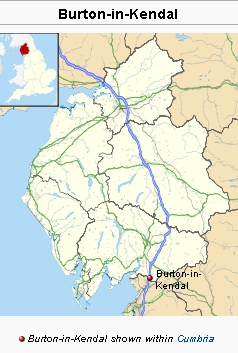 Rogeri de
Bertuna may be Roger de Burton and this maybe related the the land of KENDAL and
the Glanvill connection :
Rogeri de
Bertuna may be Roger de Burton and this maybe related the the land of KENDAL and
the Glanvill connection :
Burton in Kendale - There appears to be no record as to the means whereby the manor of Burton came into the possession of Roger de Burton, younger son of Roger de Aston of Ashton under Lyne, co. Lancaster. Some indication may be derived from the arms of Burton, which differ entirely from those of Assheton; they were Argent, a chief indented azure.
These arms were borne by the family of Glanville, and the same charge on a field Or was the arms of the Butlers of Ireland and the lords of Middleham. The adoption of these arms of affection by the Burtons points to some feudal connexion with the house of Glanvill. This connexion may be traced to the Northern Rebellion of 1174 when Hugh de Morevill lost Westmorland and Roger de Mowbray probably lost his feudal lordship over Kendale and some part of Lonsdale.
In 1177 Ranulf de Glanvill accounted at the Exchequer for three years' farm and issues of
Westmorland, that is of the barony of Appleby ...
Ranulf de Glanvill died in the autumn of 1190 in Palestine, but on the accession of Richard
I the lands of Westmorland and those in Kendal had been taken into the king's hands. At Easter, 1190, the lands in Kendal were delivered to Gilbert Fitz-Reinfrid, in accordance with the grant made to him, to which frequent reference will be
made .
The parish of Burton in Kendal - The parish of Burton lies entirely within Westmorland with the exception of Dalton, which belongs historically to Lancashire.
| -----------
Hubert Walter - Archbishop of Canterbury (1193-1205); died 13 July, 1205; son of Hervey (Herveus) Walter and Matilda de Valoines, whose sister married the celebrated Ranulf de Glanville. The family, which was of Norman descent, held lands in Lancashire and Norfolk . Hubert's elder brother, Theobald Fitz-Walter, accompanied Henry II and John to Ireland, and became ancestor of the Butlers of Ormonde. We first hear of the archbishop as a chaplain in the household of Ranulf de Glanville,
Geoffrey, priest of Honinges: and Turstan - Honinges - Honing, Norfolk
Honing has an entry in the Domesday Book of 1085 where its, its population, land ownership and productive resources were extensively detailed[4] In the survey Honing is recorded by the name of Haninga. The main tenants being the Robert Malet from the abbot of Holme who had held the land before and after 1066, Robert de Glanville from Robert Malet, and Ranulf brother of Ilger.
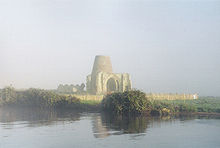 St Benet's Abbey
- It is also known as St Benet's at Holme or Hulme. situated on the River
Bure within The
Broads in Norfolk
England - St
Benet's, according to abbey
tradition, was founded on the site of a ninth-century monastery
where the hermit
Suneman was martyred by the Danes. About the end of the tenth century it was
rebuilt by one Wulfric. A generation later, c. 1022, its estates of Horning,
Ludham and Neatishead were confirmed by King Canute.
Other early benefactors included Edith
Swannesha, concubine to Harold
Godwinson, and Earl
Ralf II of
East Anglia.
St Benet's Abbey
- It is also known as St Benet's at Holme or Hulme. situated on the River
Bure within The
Broads in Norfolk
England - St
Benet's, according to abbey
tradition, was founded on the site of a ninth-century monastery
where the hermit
Suneman was martyred by the Danes. About the end of the tenth century it was
rebuilt by one Wulfric. A generation later, c. 1022, its estates of Horning,
Ludham and Neatishead were confirmed by King Canute.
Other early benefactors included Edith
Swannesha, concubine to Harold
Godwinson, and Earl
Ralf II of
East Anglia.
At the time of the Norman Conquest Harold Godwinson put the abbot of St Benet's, Aelfwold, in charge of defending the coast against invasion. After the Conquest, Aelfwold fled to Denmark, and the abbey's estates suffered encroachments by neighbouring landowners. The site was enclosed by a wall with battlements in 1327. ...St Benet's is the only religious house not closed down by Henry VIII during the Dissolution of the Monasteries.
Earl of East Anglia - The earldom of East Anglia was then assigned to Gyrth, one of Harold's younger brothers, who held it until his death at the Battle of Hastings in 1066. Following the Norman Conquest of England, William the Conqueror appointed Ralph the Staller, an aristocrat of Breton ancestry born in Norfolk, to the earldom. On his death in 1069 he was replaced by his son Ralph Guader, who was one of the leaders of a rebellion against William, known as the Revolt of the Earls, in 1075. With the failure of this uprising Ralph fled to his lands in Britanny and no successor was appointed.
Notice here how we have a Outlaw - Thurkill - Ketel and St. Bennet Holme Abbey connection:
1069 - Three
sons of King Swein came from Denmark, with two hundred and forty ships into
the Humber, together with Earl Osbeorn and Earl Thorkil.
1070 - Thurcytel
Utlamhe "the Outlaw" - with Hereward the Wake
1086 - Thurkil
the White
and his wife Leofflæd are mentioned in the Domesday book, Thurkil as
pre-Conquest holder of Wellington
10?? - Here in this document it is made known how I, Thurketel,
grant my possessions after my day. First, I grant that land at Caister and at Thorpe
with meadow and with marsh, with ingress and with egress, to God and St
Benedict and St Edmund at Bury and at Holme, for the
redemption of my soul. And my wife's portion is to be for ever uncontested, for
her to hold or to give where she pleases. And to my lord his due heriot.
And my daughter Ælgwyn is to have the estate at Ormesby witht the proviso that
she may not forfeit it; and after her time the estate is to goto Holme for my
soul and for hers, except that land which Omund had; that my nephew Ketel
is to have. And my nephew's children, the sons of Swegn and of Ealhmund, are to
have the estate at Scratby.
And the Abbot of Holme is to have a pound and the Abbot of Bury
another. And my men are to be free, those who will work for it (?). And
whosoever wishes to despoil this will, may God deprive him of the kingdom of
heaven, unless he repent it here.
There are three of these documents: one is at Holme and the second at
Bury; the third with Thurketel himself.
Source: The
will of Thurketel Heyng
Records of the Anglo-Norman house
of Glanville from A.D. 1050 to 1880 ... By William Urmston Searle Glanville Richards
At
Orford, twenty miles from Ipswich, there was a royal castle in the time of Henry
III., who granted a charter to the town, which was previously a borough by prescription; it is now a mere village. Only the keep of the castle remains; it is a polygon of eighteen sides, with walls ninety feet high, and has square towers in its circuit, which overtop the rest of the building; the architecture is Norman, and it was erected by
Glanville; [fn 14] and
in the year 1167, when he was residing there, the fishermen took in their nets a wild man, having the human shape complete, with hair on his head and a long and sharp beard and a large amount of shaggy hair on his breasts. The fishermen were not able to keep him long, as he stole away to sea privately, and was never seen
afterwards. [fn 15]
1167 - Norman
Invasion of Ireland Begins - 1169 main body of Norman, Welsh
and Flemish
forces landed in Wexford
1170 -
Knights Hospitaller of St. John of
Jerusalem established
1175 - Treaty
of Windsor , This Treaty resulted in large scale emigration from England
to Ireland
1177 - Maurice fitzGerald, who led the second band of Anglo-Norman invaders of
Ireland, died 1st September, 1177, is said by Lodge to have had four sons-Gerald, William, Alexander, and
Maurice
1191 - Hospitallers
Order of St Thomas of Canterbury at Acre established
1170 - The Preceptory of Denny - Cambridgshire - Knights Hospitaller of St. John of Jerusalem established
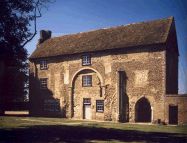 (There is no direct Outlaw connection. The Preceptory was originally the
home of the Benedictine Monks of Ely then taken over by the Knights Templar in
1169. (Speculation: Saxon "Outlawe" knight joins the Knights
Templar or a monk like "John de Bernewelle - Outlawe" joins the Hospitaller's
) Very much in the
neighborhood...)
(There is no direct Outlaw connection. The Preceptory was originally the
home of the Benedictine Monks of Ely then taken over by the Knights Templar in
1169. (Speculation: Saxon "Outlawe" knight joins the Knights
Templar or a monk like "John de Bernewelle - Outlawe" joins the Hospitaller's
) Very much in the
neighborhood...)
There has been a religious house of sorts on this spot since eight hundred years ago, and most of the remains are of the Norman period, when a settlement of 232 THE CAMBRIDGE ROAD Black Monks from Ely settled here. In succession to them came the Knights Templars, who made it a Preceptory, and when their Order was suppressed and ceased out of the land, in consequence of its corruption and viciousness, the nuns of St. Clare were given a home in these deserted halls. Close upon four hundred years have gone since they, too, were thrust forth, and it has for centuries past been a farmhouse.
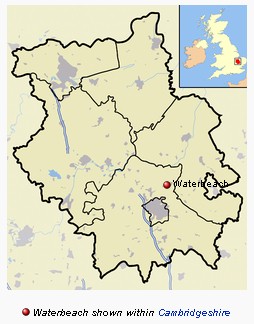
Denny Abbey is a former abbey near Waterbeach, six miles (10 km) north of Cambridge in Cambridgeshire, England. The site, on an ancient road between Cambridge and Ely, was settled by farmers as early as the Roman period. The Domesday Book said that it was owned by Eddeva in 1066, and subsequently by Alan, 1st Earl of Richmond.[1]
A group of Benedictine monks, governed from Ely, moved here from their waterlogged monastery at Elmeney (a vanished settlement about a mile to the northeast) in the 1150s, at the suggestion of Duke Conan IV of Britanny. They built a church, Denny Priory, which opened in 1159. The crossing and transepts are the only parts of the original Priory that remain today. In 1169 the monks returned to Ely and the site was handed to the Knights Templar. The Templars built a number of additions, including a large Norman-style arched doorway and a Refectory. By the 1290s the Knights had lost their power, and in 1308 King Edward II had the entire order arrested and imprisoned, confiscating their property. Denny was given to the Knights Hospitallers, who took no active interest in the property.
In 1324 it was taken over by the Crown. [ Same year as the war in Aquitaine ]
1194-1212 - Haghenild Utlaghe - Hildith, Philip and Henry and Richard and William and Jordan, sons of Vtlag , Simon, and Adam, and Henry and Roger son of Thomas - The Outlaw clan in Kent
Remember criminals don't have land. The "Outlaw's" are pleading to the Norman's to KEEP their lands...
1200-1212 - De Helia Vtlagh
(Vtlagh from Elim [ Elham?] )
- The rents which is due to the court of St. Augustine about the Mildelton
- (Milton
Kent)
1215 - Haghenild
Vtlaghe - lands of Newton and Newington -
Heirs One part to
Hildith married to a Norman William , two parts to Simon, and Adam, and Henry and Roger son of Thomas and his
heirs -
The register of St. Augustine's abbey,
Canterbury, commonly called the Black book - Hubert
de Burgh, the justice of England
| ----------
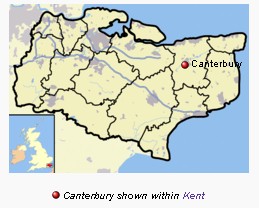
Canterbury - its English name Canterbury, itself derived from the Old English Cantwareburh ("Kent people's stronghold"). After the Kingdom of Kent's conversion to Christianity in 597, St Augustine founded an episcopal see in the city and became the first Archbishop of Canterbury,...the inhabitants of Canterbury did not resist William the Conqueror's invasion in 1066
St Augustine's Abbey - Canterbury, England - is a ruined monastery originally founded in 598 AD by Augustine, a Roman abbot who was sent by the pope to convert the Anglo-Saxons. Rebuilt in the Norman era and almost completely destroyed at the Dissolution of the Monasteries, the ruins of the abbey are not substantial.
The Anglo-Saxon buildings were completely reconstructed in the Romanesque style following the Norman Conquest of England (1066), when it took on the form of a typical Norman Benedictine monastery. An Almonry was added in 1154 and some rebuilding was done in 1168 after a fire.
St Augustine's Abbey - In 978 a new larger building was dedicated by Archbishop Dunstan, to the Saints Peter, Paul, and Augustine. ... By 1100 all remains of the original Anglo Saxon building had disappeared under a massive romanesque edifice
Rochester Cathedral - The bishopric is second oldest in England: only Canterbury is older....It was badly damaged by fires again in 1137 and 1179. It was looted in 1215 by the forces of King John and again in 1264 by Simon de Montfort, during sieges of the city and its castle.... William of Normandy in 1066, he gave the church and its estates to his brother, Odo of Bayeux...Gundulf, the Norman Bishop of Rochester
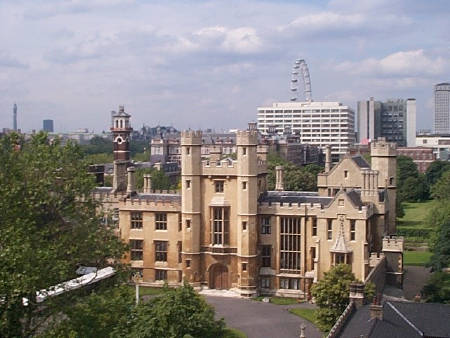
Lambeth Palace - London residence of the Archbishop of Canterbury for more than 800 years.
The Hospitallers of St Thomas of Canterbury at Acre - The Hospitallers of St Thomas of Canterbury at Acre, was established in 1191 (during the Third Crusade, 1189-92) at the seaport city of Acre, following its capture from the Saracens by Richard I (1157-1199) (Richard Coeur de Lion) of England and Philip II (1165-1223) of France.
Canterbury History - Eastbridge Hospital
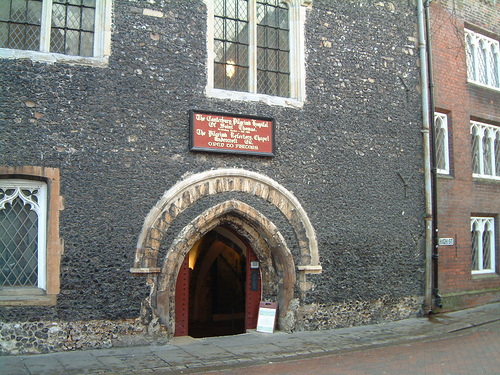 History of Eastbridge Hospital
St. Thomas Becket was murdered on December 29, 1170 in Canterbury Cathedral. Almost immediately,
pilgrims came to visit his tomb and the city had to provide accommodation for them.
In 1190, Edward FitzOdbold founded a hospital on the bridge in the High Street and Becket's nephew Ralph was probably the first Master. The hospital initially prospered but declined after 150 years .
It was refounded in 1342 by Archbishop Stratford, and was probably at its peak in the 1380s when Chaucer was writing his Canterbury Tales. In Chaucer's words pilgrims 'from every shire end of England to Canterbury they wend, the holy blissful martyr for to seek'.
IV. RALPH OUTLAW, born ca. 1595. Married Elizabeth
Kempe ca. 1615-16. He died July 4, 1671.
Children: (1) Thomas; (2) Rev. Ralph Outlaw; (3) Elizabeth; (4) Mary; (5)
Robert, Sec. V; (6) Charles; (7) Edward
V. ROBERT OUTLAW, (IV-III-II-I) our prime suspect as being a father of Capt. John and
Edward.
1324 - William
Outlawe
nephew of Sir Roger Outlaw is ordered to make pilgrimage to the Shrine
of St. Thomas at Canterbury
An earlier and famous Kempe lady is Margery Kempe and she is
from the neighborhood King's Lynn! And she visits Hospital of St
Thomas of Canterbury in Rome!
1413 - Margery
Kempe settled debts, and sets off for pilgrimage of the Holy Land
Margery Kempe (c. 1373 – after 1438) is known for writing The Book of Margery Kempe, a work considered by some to be the first autobiography in the English language. This book chronicles, to some extent, her extensive pilgrimages to various holy sites in Europe and Asia.
She was born Margery Brunham in King's Lynn (then Bishop's Lynn), Norfolk, Kingdom of England and married at the age of 20 to a local man named John Kempe, with whom she had 14 children. Her father, John Brunham, was a merchant in Lynn, five-time mayor, Member of Parliament and merchant whose fortunes may have been negatively affected by downturns in the economy, especially in the wool trades, of the 1390s.
Some interesting links about Margery Kemp:
SparkNotes The Book of Margery Kempe Context
The Book of Margery Kempe Introduction
Years of Pilgrimage and Ecclesiastical Investigation, 1413–1418 -Charity Scott Stokes
see complete analysis : Laurence Outlaw - Lynn - Hospital of Mary Magdalen Len
This early Laurence Outlaw had to be an important man at the time. This may have been his way of supporting the crusades and the returning Templar knights or someone close to him was a victim of leprosy.
1204-1220 - Deed
of grant, Lynn - 1d annual rent from a certain [piece of land] 4 feet wide in
Dam[p]gate held by Peter Strac
Grant by Laurence Outlaw (utlator) of Len to the
Hospital of the Blessed Mary Magdalen of Len and to the infirm brothers
there for the souls of his parents and his benefactors, the 1d to come from his
purse during his lifetime Anglo-Norman Studies Proceedings of ...
-
There was an epidemic of leprosy in Europe from 1000 to 1200 A.D., which
was probably started by the returning soldiers of the Crusades. Leprosy
occurred in Britain from 625 to 1798, and at one time there were 326 lazar
houses (leprosaria) in Great Britain.
Witnesses: Robert the mayor of Len, Ralph Kelloc, Adam de Gernemut, William clerk of Gernemut, Robert the son of David, Richard de Brecha., William son of Aelld., William son of Milon, John de Geywdia, Michael de Beaw., Yvone de Lincoln, William the son of Richard, John the son of Astin and many others Endorsed as relating to Lenne. Gernemut = (Great Yarmouth),
Hospitals - Hospitals in Lynn - THE HOSPITAL OF ST. MARY MAGDALEN, LYNN - The hospital of St. Mary Magdalen was founded on the causeway leading to Gaywood, in the year 1145, by one Peter the chaplain. It consisted of a prior and twelve brethren and sisters; of these ten, the prior or chaplain being one, were to be sound, and the other three infirm or leprous. From the foundation deed it appears that this was a reconstruction of a yet older hospital, for the opening clause provides that the brethren were to dress after a decent fashion, like their predecessors (' secundum morem fratrum antecessorum domus '). ... St. Mary Magdalen Feast day - July 22
Robert de Utlagh and Alan his son - Norfolk - 1199 - 1207
The earliest records of Outlaw (Utlage/Utlagh) after the conquest where we see Robert de Utlagh trading with the influential Hubert de Burgh and shows the Ireland connection after the conquest since de Burgh's brother was the Governor of Limerick, Ireland We also see the early connection to the "White Canon's" with Robert Fitz Ralph. Then there is William de Noirs, a Norman who basically owned Norfolk after the conquest.
So who was Robert de/le Utlagh/Utlage ? Clearly he was a man with land and position. He may have been a non-Norman that retained some situation after the conquest. Most importantly, I have yet to find a Norman connection to the name Utlagh. This also may relate to Saxons that assisted the Norman's with the invasion and conquest of Ireland (1167 - 1175) See Bromholm Abbey and Glanvill's above. This also fits later with Roger Outlawe as the head of Ireland 1311-1340.
I haven't found anything on Roger de Burnham but there is Burnham
Market on the coast near King's Lynn, so he may have been another
Saxon vassel that retained some authority after the conquest.
Speculation: The white canons may have been intended to replace Saxon
priests with Normans. They are associated with Hubert Walter, the crusades and
the order is of Norman origin (France). Normans would not wish to give
confession to Saxon priests, for example.
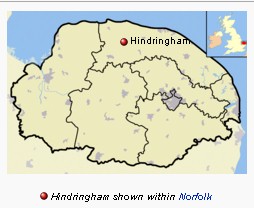
1086 - Hindringham - Ulf; Wulfnoth, free man of Archbishop Stigand ; Saewulf reeve of Bishop William; Aethelwine, Free Man, Alwine cild, free man; O., free man of Bishop Aethelmaer (Wolfs and Outlaw's?) - Also I have found a reference for "Outlagh" in "Hindringham Outlagh Manor" An essay towards a topographical history of the county of Norfolk - (no date to connect with)
1199 - IBER
FEODORUM - Norfolk - Robert Utlag - Roger de Nuiers for Robert Utlag
1199 - IBER
FEODORUM - Alanus Utlage, iij. quarteria in Hindringham et Homeresfeld
NOMINA FEODORUM MILITUM TENENCIUM DE HONORE DE WORMEGEYE.
THE
NAMES OF THE holding
of the
knights' fees Honore
De WORMEGEYE.
( Wormegay Castle Watlington Norfolk East Anglia England)
- Norfolk Heritage Explorer -Wormegay
Alan
Utlage,
three
quarters,
Hindringham
and
Homeresfeld.
[ So who or what was Wormegeye ? ]
The Honor of Wormegay :
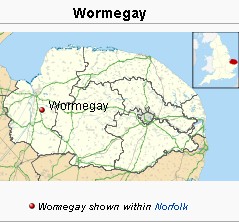 Wormegay
- is a civil
parish in the English
county of Norfolk.
The village is situated some 9 kilometres (5.6 mi) south of King's
Lynn and 60 km (37 mi) west of Norwich.
For the purposes of local government, it falls within the district
of King's
Lynn and West Norfolk.
Wormegay
- is a civil
parish in the English
county of Norfolk.
The village is situated some 9 kilometres (5.6 mi) south of King's
Lynn and 60 km (37 mi) west of Norwich.
For the purposes of local government, it falls within the district
of King's
Lynn and West Norfolk.
The place-name 'Wormegay' is first attested in the Domesday Book of 1086, and means 'the island of Wyrm's people'.[3]
Just to the west of the village centre lies Wormegay Castle, a motte and bailey earthwork.
 Wormegay
Castle was originally a late Saxon manorial complex, which was
fortified in the 11th century, by Hermer de Ferrers. In the 12th century,
Reginald de Warenne modified the fortification and founded the earthwork
motte and bailey castle.... Wormegay Castle is located in the village
centre, off Front Street. 7 miles south of King's Lynn,
Wormegay
Castle was originally a late Saxon manorial complex, which was
fortified in the 11th century, by Hermer de Ferrers. In the 12th century,
Reginald de Warenne modified the fortification and founded the earthwork
motte and bailey castle.... Wormegay Castle is located in the village
centre, off Front Street. 7 miles south of King's Lynn,
Wormegay Castle is a motte and bailey earthwork, located next to the village of Wormegay in the English county of Norfolk. - The castle was probably built by Hermer de Ferrers after the Norman Conquest, and remained in the de Ferrers family until 1166.[1] Wormegay Castle is located in the village centre, off Front Street. 7 miles south of King's Lynn, on the A10-A134.
The motte is 5 metres high and 77 metres by 62 metres wide at the base.[2] The motte is surrounded on three sides by a ditch up to 15 metres wide and 2 metres deep.[2] The bailey is 150 metres by 88 metres across, and raised about 1 metre from the ground.[2] The castle would have been highly visible in early medieval times, more so than in the 21st century, and would have formed a local landmark as well as controlling the local causeway across the Fens.[3]
Wormegay formed the centre, or the caput, for an honour of feudal properties across East Anglia.[4] As the centre of a major estate, Wormegay provided castle-guard duties to Norwich Castle
| - - - - -
Hermer de Ferrariis 22
Manors - Conspicuous as being by far the largest unlawful invader on the lands of the freemen of the
county, and was probably one of the most violent and tyrannical of the powerful Norman
barons' (Munford). Said to be ancestor of the de Wormegay family.
Homersfield - South
Elmham St Mary, known as Homersfield, is a small village
and civil
parish located on the banks of the River
Waveney in Suffolk, UK,
on the border with Norfolk.
It is one of The
Saints.
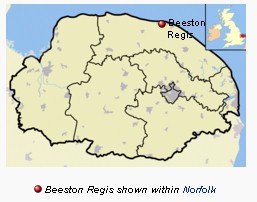
1207 - Hubert de Burgh purchased of Roger de Burnham and Julian, his wife, William de Noiers, Robert Fitz Ralph, and Alice his wife, and Robert de Utlagh, their several nine parts of two knights fees in Runton and Beeston and Hinderingham, for which they paid castle gaurd to Dover. 9th of King John *The Norfolk antiquarian miscellany - Google Books - West Runton - Beeston Regis - Hindringham
1207 - BEESTON REGIS. - In the 9th of King John, Robert de Utlaghe granted by fine, to Hubert de Burgh, the 3d part of a knight's fee, in this town and Runton, and the 3d part of 2 carucates of land in Hindringham; and in the 11th of that King, Hubert purchased of Robert Fitz-Hugh, the 3d part of a fee in Beeston, and Runton, and the land in Hindringham, that is his right in them; this Hubert was after created Earl of Norfolk, and held them in capite of the castle of Dover.
1207 - Alan the son of Robert de Vtlage, granted the land of Beston and Runton to the Prior of Walsingham by deed , sans date, bounded as there. - (The Saxons would give land to a friendly church in order to keep from having to sell (give) it to the Normans , this ploy often didn't work)
1218 - Alan le Ultage - 21 Aug. Winchester. Suffolk. Alan Outlaw gives the king 20s. for having a writ to attaint the jurors of novel disseisin before the justices at Westminster at Michaelmas three weeks, as last above . Order to the sheriff to take security from Alan for rendering those 20s. to the king for this writ. 1 Witness the earl. - 2 Henry III
1230 - Alan le
Utlage in the Tax Rolls 'Feet of Fines' for the county of Essex
1232
- Emma who was
wife of
Alan Le Vtlage v. Bartholomew de Brancestr of Ilketshal - Suffolk
- 16 HENRY III
Ilketshall St. Andrew
belongs to The
Saints, Suffolk, a group of villages near the border with Norfolk.
| - - - - -
Bartholomew de Brancestr = Bartholomew de Brancaster - So who was he?
Ilketsal Parish
- There are four parishes so called, namely: St. Andrew, St. John, St.
Lawrence, and St. Margaret; which are here noticed generally, and collectively.
These with the foregoing parishes, of Bungay St. Mary and Trinity, with
Mettingham, which follows, are commonly termed "The seven parishes of
Ilketshal."
...
The Abbot of West Dereham, in Norfolk, had a lordship at Ilketsal, called
Lion's; of the gift of Bartholomew, son of Peter de Brancaster, of Barton, in
Norfolk. [ See later how Outlaw brothers were from West Dereham ]
BRANCASTER HALL.
THE ancient family of Brancaster gave name to it; Robert de Brancaster was living, and lord, [e] in the reign of Henry II. Bartholomew* son of Peter de Brancaster, gave by deed, fans date* (with his body) the chapel of St. John Baptist, in Barton Eastmore, to the abbey of West Derham, and Adam, son of Thomas de Brancaster, by deed, s. d. gave to Adam de Fincham, and Annabel his wife, one messuage, with the appertenances in Berton, called Brancaster Hall crofts, and y. rent per ann. of free tenants; 2 villains, with all their goods and chattels, with 2 acres of land, all the homages, wards, escheats, &c. of the free tenants.
John, son of Adam de Brancaster, by deed, on Thursday after the decollation of St. John Baptist, in the 17th of Edward II. released to Adam, son of Thomas de Brancaster all his right in land, rent, the moiety of a messuage; and Christiana, late wife of Thomas, in the said year, quit-claimed to Adam her son, all her right therein.
John Fincham and John Codington were found, by in inquisition, to hold in the 3d of Henry IV. one fee of the Honor of Wirmegay; in the family of Fincham, (of whom fee in Fincham) it remained till William Fincham, Esq: in the 12th of Elizabeth, conveyed it to Thomas Heigham, Gent, and he to Edmund Guybon and John Mundeford, Gents, in the 32d of that queen; and after came to sergeant Gawdy, and so to the Berneys, as in Lovell manor.
The contents of Brancaster Hall Bonhams (Firm 2001) - The contents of Brancaster Hall, Norfolk, to be sold on the premises: Monday 9 September 2002
Brancaster Hall, Norfolk - D. B. Gray - Google Books
Ilketeshale's Manor - Was that which Harold's freemen abovementioned held, and were ejected, and the Ilketeshalls possessed it after Ralph. Sir Gilbert de Ilketeshale was lord of this manor, with that of Hedenham in Norfolk, and of Ilketeshale in Suffolk, from whence they assumed their name; and Sir Thomas was his son and heir, as appears from the register of Holm abbey, and a fine levied in the 7th of Henry III. Gilbert was son and heir of Sir Thomas, and had a charter for freewarren in Kelling, Salthouse and Hedingham, and Ilketeshale, in the 32d of that King.
Hubert de Burgh - Hubert de Burgh (before 1180 – before 5 May 1243) was Earl of Kent, Justiciar of England and Ireland, and one of the most influential men in England during the reigns of John and Henry III. ... De Burgh came from a minor gentry family about which little is known. He was a brother of William de Burgh, Governor of Limerick. ... 1202 de Burgh was appointed Constable of Dover Castle,... Chinon was besieged for a year, and finally fell in June, 1205, Hubert being badly wounded while trying to evade capture. During the year he was trapped in Chinon, and the two following years when he was a prisoner of the French, de Burgh lost most of his estates and posts. The reasons are much debated. After his return to England in 1207, he acquired new and different lands and offices. These included the castles of Lafford and Sleaford, and the shrievalty of Lincolnshire. Probably, however, de Burgh spent most of his time in the English holdings in France, where he was seneschal of Poitou.
Not the William de Noirs of 1207 but an earlier William de Noiers at the
time of the conquest 1066, the assumption is that they are related :
William de
Noiers - he was the Steward of King William. This position was
the sixth highest-ranking position in the English kingdom, after the King
himself. William de Noers received 33 manors from William the Conqueror,
King of England, probably as a result of his service during the Battle of
Hastings.. William de Noers also held a manor in Suffolk County (where his name
was spelled Willielmus de Noers) and in Cambridge County (spelled Willielmus de
Nouueres). ... As much of William de Noers holdings were in Norfolk, it
is possible, although almost impossible to prove, that the “Nurses” found
in the King’s Lynn area are descendants of William de Noers.
Robert Fitz Ralph - Coverham Abbey - This Abbey was built by Radulphus, son of Robert Fitz Ralph, for white Canons of the Praemonstrantensian order, about the year 1213, who endowed it with several lands and tenements. He died in 1251, and was buried here. Premonstratensian canons, established in Coverdale 1212
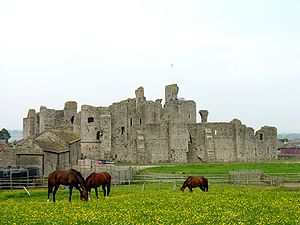 Robert
Fitz Ralph was Lord of Middleham
- He had Middleham
castle in Wensleydale,
in the county of North
Yorkshire, was built by Robert
Fitzrandolph, 3rd Lord
of Middleham
and Spennithorne,
commencing in 1190.
Robert
Fitz Ralph was Lord of Middleham
- He had Middleham
castle in Wensleydale,
in the county of North
Yorkshire, was built by Robert
Fitzrandolph, 3rd Lord
of Middleham
and Spennithorne,
commencing in 1190.
The Premonstratensian order was founded in 1121 by St.Norbert at Prémontré near Laon in Northern France. Premonstratensians followed a strict version of the rule of St.Augustine and were closely related to the Cistercians in their lifestyle and choice of isolated sites for their monasteries. Their first English abbey was founded at Newsham in Lincolnshire (near Grimsby), in 1143. The canons (as Premonstratensian monks were known) wore a white habit and cap and were often called 'the white canons'. Unlike ordinary monks, they did not always stay within the cloisters of the abbey, but served as village priests and missionaries in the local community.
West Runton - West Runton is a village in North Norfolk,[1] England, approximately ¼ of a mile from the North Sea coast. Evidence of early antiquity[1] in West Runton is scant. However, evidence of Roman habitation were found just south of the village up on Beeston Regis Heath in 1859, when a complete set of quern-stones were found dating from Roman times. Quern-stones were used to grind materials, the most important of which was usually grain to make flour for bread-making. Up on Beeston Regis Heath there can be found circular pits called "Hills and Holes" (from the 1st edition of the Ordnance Survey map of the area), which are thought to date from prehistoric times. During the Saxon-Norman to Medieval periods these pits were dug to obtain iron ore, which was then smelted in a furnace to produce iron. In the Domesday book, the settlement of Runton is given the name of Rugutune and Runetune.
Beeston Regis - Beeston Regis is a village and civil parish in the North Norfolk district of Norfolk, England[2]. It is about a mile (2 km) east of Sheringham, Norfolk and near the coast. Evidence of early antiquity in Beeston Regis are few. However, evidence of Roman habitation was found on Beeston Regis Heath in 1859 when a complete set of quern-stones were found dating from Roman times. Quern-stones were used to grind materials, the most important of which was usually grain to make flour for bread.
Up on Beeston Regis Heath there can be found circular pits called 'Hills and Holes' (from the first edition of the Ordnance Survey map of the area). They are thought to date from prehistoric times. During the Saxon-Norman to Medieval periods these pits were dug to obtain iron ore, which was then smelted in a furnace to produce iron[5].
Burnham Market - Burnham Market is a village and civil parish near the north coast of Norfolk, England. Burnham Market is one of the Burnhams, a group of adjacent villages in North Norfolk. It is the result of the merger of three of the original Burnham villages, namely Burnham Sutton, Burnham Ulph and Burnham Westgate.
Domesday Book - Beeston Regis is mentioned in the Domesday Book of 1086, and within this survey it is called Besetune and Besetuna/tune.[6]. The main landholders of the parish were William d’Ecouis and Hugh de Montfort. The main tenant was Ingulf, The survey also lists ½ a mill. In the Domesday survey fractions[7] were used to indicate that the entry, in this case a mill, was on an estate that lay within more than one parish.
Beeston Regis has the remains of an Augustinian priory known as Beeston Regis Priory[8] (St. Mary's). Founded in 1216, in 1535 it had only a prior and four canons, who served as parish priests for nearby churches, six boys and seven servants. The boys were in effect the boarders at the canons' school, and their number was increased by day boys.
Hindringham - Hindringham is a village and a civil parish in the English county of Norfolk.[2]. The village is 8.5 miles north east of the town of Fakenham, 16.4 miles west of Cromer The name Hindringham means "The land of the people living behind the hills".Hindringham is mentioned in the Domesday Book of 1086 were it is listed with the names of Hidringham, Hindringaham, and Indregeham[3].
Also I have found a reference for "De Outlagh" in "Hindringham Outlagh Manor" An essay towards a topographical history of the county of Norfolk
The National Archives Domesday Search results for Hindringham - 1086 - Ulf; Wulfnoth, free man of Archbishop Stigand TRE
Stigand served King Cnut as a chaplain at a royal foundation at Ashingdon in 1020, and as an advisor then and later. He continued in his role of advisor during the reigns of Cnut's sons, Harold Harefoot and Harthacnut. When Cnut's stepson Edward the Confessor succeeded Harthacnut, Stigand likely became England's main administrator...Stigand was present at the deathbed of King Edward and at the coronation of Harold Godwinson as king of England in 1066.[1] ... By 1066, the only estates richer than Stigand's were the royal estates and those of Harold Godwinson... After Harold's death, Stigand submitted to William the Conqueror.
The fees held of the Bishop of Norwich, were the manors of Ringsted Magna, Holkham Wake, Cockthorp, Sniterle, Glanford, Sniterle-Morley, South Birlingham Rightwise, Boyton South Birlingham, Hindringham Outlagh , ... in Norfolk The Norfolk antiquarian miscellany - Speaks more about this deal...
North Greehow Hundred - Hindringham - The capital lordship of this town belonged to the Bishop of Elmham; and Ailmer the Bishop held it with 4 carucates of land in King Edward's reign. Nower's Manor. In the reign of King John, William de Nuers, Roger de Burnham, and Julian his wife, Robert Fitz Ralph, and Alice his wife, and Robert de Utlage, held 9 parts of 2 fees here, in Beeston, &c. and in the reign of Henry III. Alan de Noers, had a quarter of a fee of Hugh Lord Bardolf, and he of the Bishop of Norwich, and at the said time William de Noers, a quarter of a fee also.
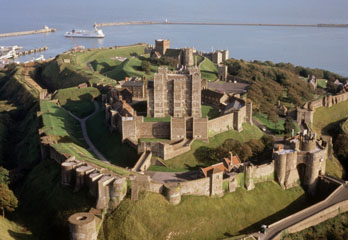 Dover Castle
- Dover Castle is a medieval castle in Dover,
Kent, England. It
was founded in the 12th century and has been described as the "Key to
England" due to its defensive significance throughout history.[
Dover Castle
- Dover Castle is a medieval castle in Dover,
Kent, England. It
was founded in the 12th century and has been described as the "Key to
England" due to its defensive significance throughout history.[
In 1216, the French laid siege to the Castle with a large army and great siege engines that could hurl rocks against the walls. Hubert de Burgh only had 150 men to defend the castle with. Part of the outer curtain wall of the castle was undermined by the French and collapsed. But Hubert and his heroic defenders were able to plug the breach and fight off the attackers. With the death of King John, and the accession of his infant son Henry III, the French withdrew. In 1221 he married, as his third wife, Margaret, sister of King Alexander II of Scotland, and four years later was created Earl of Kent
Beeston Regis
- Hugh de Montfort, a Norman, (assistant justiciary of England, with Odo Bishop of
Baieux, the Conqueror's brother, and William Fitz-Osborn Earl of Hereford,) was lord of a
manor, out of which Bund, a freeman, was ejected; there belonged to it one carucate of land, with 8 borderers, one carucate in demean, half a one amongst the tenants, pannage for 5 swine, one acre of meadow, one
runcus, 2 cows, &c. 20 goats; and 3 socmen held 12 acres of land, and the moiety of a borderer, with half a
carucate, then valued at 20s. at the survey at 30s. (fn. 1)
In the 9th of King John, Robert de Utlaghe granted by fine, to Hubert de Burgh, the 3d part of a knight's fee, in this town and
Runton, and the 3d part of 2 carucates of land in Hindringham; and in the 11th of that King, Hubert purchased of Robert
Fitz-Hugh, the 3d part of a fee in Beeston, and Runton, and the land in
Hindringham, that is his right in them; this Hubert was after created Earl of Norfolk, and held them in capite of the castle of
Dover.
1051 - In October Godwin and the rest of his sons were declared outlaws and given five days to leave the country. The men of Dover were left unpunished. Godwin, his wife Gytha, and his sons Swein, Tosti and Gyrth boarded ship at Bosham and left for Flanders. Harold and Leofwine Godwinson sailed from Bristol for the Norse stronghold of Dublin in Ireland.
1171 - The people of Bristol were given Dublin as a colony by the king and many Bristolians settled there. Charter was issued by Henry II in 1171-1172, giving the men of Bristol the right to live in the City of Dublin. Later charters contain grants to the city of rights, privileges and property
1170-1183 -William, earl of Glocester died AD 1183 ... One of his Deeds,
which conveys land in Lewins-mead and
Broad-mead, ...:
1170-1183 - No.
174. Grant by Adam de Hel', clerk of the Earl of Gloucester, to Robert,
son of Swein, of various lands and houses held by Blakcman, Lewinus
Lari, and Hugo Margan, from the market of Bristol, and a long house and land
next to the house of William Traine in the market, etc.
There are no exact dates to these contracts
but the first had to be when Alan was abbot of Tewkesbury 1186-1202:
Cartae et alia munimenta quae ad dominium de Glamorgancia pertinent - page 256
Before 1186 - John,
son of Ralph Outlawe.
Leowini the whole of that
land in the meadow. Ralph
his father had bought from the
Ailwardo weaver.
1186~1202 - Confirmation
by the Prior of St. James's, Bristol, to John, son of Ralph
Utlage, of land in Lewin's Mead
1200~1210 - Grant by the
Prior of St. James's, Bristol, to Margam Abbey, of land in Lewin's Mead,
Bristol, Formerly held by John, son of Ralph le Utlage
1210~ - Margam Abbey - John, son of Ralph Utlage, of the land in the meadow of Leowine, known as Lewin's-mead, near to St. James' Church, Bristol. - dated in the early years of the thirteenth century.
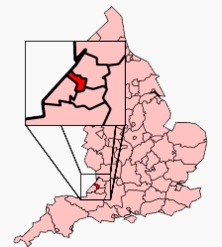 So at the same time period, we have a Robert Utlage at Hindringham
and his son Alan Utlage (plus Alan's wife Emma), here we have John Utlage,
and his son Ralph Utlage at Bristol !
So at the same time period, we have a Robert Utlage at Hindringham
and his son Alan Utlage (plus Alan's wife Emma), here we have John Utlage,
and his son Ralph Utlage at Bristol !
It is interesting that Lewin is a another name for Leofwine and that later the Outlaw's donates "Lewin's Mead " in Bristol to Margam Abbey. It was from Bristol in 1051 that Leofwine and Harold Godwinson left for Dublin Ireland during their Banishment. What is also significant is that often lands were "donated" when men went on crusade in return to taking care of their affairs at home.
Lewin's Mead is named after the original holder Lewinus Lari and the Land was initially given to Robert fitz Swein from Earl of Gloucester who died 1183, So sometime between 1183 and 1200 some of this land comes to Robert Utlage ... from his father Ralph that was purchased from Ailward Textor, or the Weaver
| - - - - - -
St James Priory - IS THE OLDEST BUILDING IN BRISTOL.(1129)
St
John's Bridge Sugar House, and Lewins Mead area of Bristol, 1799.
Line drawing of 1799 plan of Lewins Mead & St John's Bridge area of Bristol
[BRO 36772 Box 12] 
Full
text of Journal of the British Archaeological Association
...
No. 174. Grant by Adam de Hel', clerk of the Earl of Gloucester, to
Robert, son of Swein, of various lands and houses held by
Blakeman, Lewinus Lari, and Hugo Margan, from the market of Bristol, and
a long house and land next to the house of William Traine in the market,
etc.
So Lewin's Mead is named after the original holder Lewinus Lari and the Land was initially given to Robert fitz Swein from Earl of Gloucester who died 1183 , So sometime between 1183 and 1200 some of this land comes to Robert Utlage... from his father Ralph purchased of Ailward Textor, or the Weaver
Robert
Fitz Suein married GUNNOR
BIGOD
Son : HENRY2
FITZ SUEIN, b. in Essex,
England, United Kingdom;
Daughter: AGNES3
FITZ SUEIN (Henry2,
Robert1),
daughter of (2) Henry2
and Cicely (_____) FITZ SUEIN, was
born between 1109 and 1149, and died between 1164 and 1259. She married in
1162/3, (AQB-4) AUBREY
DE VERE, 1ST
EARL OF OXFORD,
son of (AQB-2) Aubrey
II and (O-7) Alice
(de CLARE), who died on 26 Dec. 1194
Child: See (AQB-4) Aubrey
de VERE, 1st Earl of Oxford
| - - - - -
1051 - In October Godwin and the rest of his sons were declared outlaws and given five days to leave the country. The men of Dover were left unpunished. Godwin, his wife Gytha, and his sons Swein, Tosti and Gyrth boarded ship at Bosham and left for Flanders. Harold and Leofwine Godwinson sailed from Bristol for the Norse stronghold of Dublin in Ireland.
Margam Abbey - was a Cistercian monastery, located in the village of Margam, a suburb of modern Port Talbot in Wales.
The abbey was founded in 1147 as a daughter house of Clairvaux by Robert, Earl of Gloucester and was dedicated to the Blessed Virgin Mary
A history of Margam Abbey - Possessions of the Abbey in the towns of Bristol and Cardiff
IN addition to the early gifts of house property in Bristol which were, as we have already observed, granted by several owners, and confirmed by Pope and King, to the Abbey, it will be convenient in this place to group together a small collection of charters which relate to that town, and must be dated in the early years of the thirteenth century.
A confirmation (T. 290 .16; C. DCCLXXI ) by W , prior of St. James, Bristol, by assent of Alan, Abbot of Tewkesbury ( A.D. 1186-1293,), to John, son of Ralph Utlage, of the land in the meadow of Leowine, which the said Ralph purchased of Ailward Textor, or the Weaver; at the yearly rent of twelve pence, and the heriot of one pound of pepper.
The land is now known as Lewin's-mead, near to St. James' Church, Bristol. To this deed belongs the confirmation (T. 290. 15 ; C. DCCLX), by the same prior, to Margam Abbey, of the above land, which John, son of Ralph de Utlage, held of the Priory, and which the Priory held of the gift of Henry Cumin.
Rent as before stated. In the Abbey Rolls is the record of an undertaking closely connected with the above (T. 290.32 ; C. MLXV), by William de Bellomonte, to pay six shillings yearly to the Abbey for tenements which he holds in fee-farm in the town of Bristol, viz. : four shillings in the meadow of Lewin, which the Abbey has of the gift of John Utlage ; and two shillings for land between St. Peter's Church and the Castle ; and to pay twelve pence yearly to the Prior of St. James, and sixpence to Walter Cumin, for the said land in the meadow of Leuuin. He is not to give, sell, or exchange the land without consent of the abbot.
Margam Abbey charters - City and County of Swansea
1147 - Margam Abbey founded when Robert of Gloucester, Lord of Glamorgan granted land at Margam to St.Bernard's Abbey, Clairevaux, Normandy for the founding of a Cistercian Monastery - Same year as the Second Crusade begins
1147 - Margam Abbey was founded in 1147 by Robert Consul (died 1147), Earl of Gloucester, as a Cistercian house. The foundation gift consisted of lands between the rivers Afan and Kenfig. The abbey later received the manor of Resolven, and many other lands, making it the richest religious house in Wales. - Grant By William De Bonville to Margam Abbey of land held by the Templars in the time of his father - Robert Consul = Robert Fitz Roy - illegitimate son ot Henry I and Nesta (Wales) - William Fitz Robert - Son of Robert Consul - Nest ferch Rhys - (died after 1136) was a Welsh princess of Deheubarth who was renowned for her beauty - After her father's death in 1093, Deheubarth was conquered by the Normans and King Henry I of England appointed himself her protector. Nest is thought to have borne him a son, Henry FitzRoy (1103-1158). -Around 1095 King Henry decided to marry Nest to one of his followers, Gerald de Windsor, whom he appointed Constable of Pembroke. Consequently, Nest is the maternal progenitor of the FitzGerald dynasty - Robert, 1st Earl of Gloucester
St James' Priory, Bristol
- It was founded in 1129 as a Benedictine
priory by Robert,
Earl
of Gloucester, the illegitimate son of Henry
I.
The nave survives from 1129 but the tower was added around 1374
1147-49 - Second
Crusade
1147 - On
May 19, 1147, the first contingents of crusaders left from Dartmouth
in England, consisting of Flemish,
Frisian,
Norman, English,
and Scottish
crusaders, and some from Cologne,[4]
who collectively considered themselves "Franks".[5]
No prince or king led this part of the crusade, England at the time being in the
midst of The
Anarchy. The fleet was commanded by "Hervey"
Henry
Glanville, Constable of Suffolk.[6][7]
Other crusader captains included Arnold
III of Aerschot, Christian of Ghistelles, "the
men of Kent under" Simon of Dover, Andrew of London, and
Saher of Archelle.[8]
- Fall of Lisbon
- The siege began on July 1. The Christians soon captured the
surrounding territories and besieged the walls of Lisbon itself. After four
months, the Moorish
rulers agreed to surrender (October 21), because the Crusaders' siege
tower reached their wall (thus causing a one day standstill) and because of
hunger within the city, which was sheltering populations displaced from Santarém
as well as "the leading citizens of Sintra,
Almada, and Palmela."[11]
- Some of the crusaders set sail and continued to the Holy Land.[6]
Most of the crusaders however settled in the newly captured city, and Gilbert
of Hastings was elected bishop
- Frank
Leslie's popular monthly
1210~ - Margam
Abbey - John, son of Ralph Utlage, of
the land in the meadow of Leowine, known as Lewin's-mead, near to St.
James' Church, Bristol. - dated in the early years of the
thirteenth century.
1313 - Willielmus Outlagh
- The Tallage of 6 Edward II - Bristollia Bristol - Tallage
- Bristollia or, memoirs of the city ...
(Possibly William Outlaw from Ireland? )
1392
- Simon
Outelawe, Michael Brailes plaintiffs - 1392 Sept. 29.-Oct. 5] York - Premises:
9 messuages, 18 shops in Bristol and suburbs
1420 - Lease
for life of 2 - Johanna Outlawe widow of John Outlawe sen. peautner (sic)
Premises: parcel of land in churchyard 30ft long and 14ft broad which John
Outlawe held - 8 Hy.V (1420) 12 May - Bristol Record Office
 Bristol
- The town of Brycgstow (Old
English, "the place at the bridge")[15]
appears to have been founded in c.1000... The area around the original
junction of the River
Frome with the River
Avon, adjacent to the original Bristol
Bridge and just outside the town walls, was where the port began to
develop in the 11th century. By the 12th century Bristol was an important port,
handling much of England's trade with Ireland. In 1247 a new stone bridge was
built...
Bristol
- The town of Brycgstow (Old
English, "the place at the bridge")[15]
appears to have been founded in c.1000... The area around the original
junction of the River
Frome with the River
Avon, adjacent to the original Bristol
Bridge and just outside the town walls, was where the port began to
develop in the 11th century. By the 12th century Bristol was an important port,
handling much of England's trade with Ireland. In 1247 a new stone bridge was
built...
Golden Gallery - Swansea Parklands - Margam Park 2007
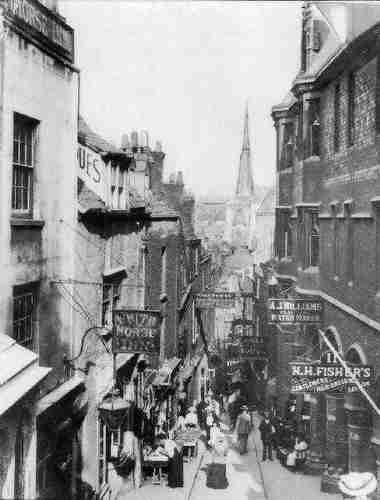 1899
Lewins Mead Bristol BS1 - A crowded Christmas Steps in the Victorian era with straw boaters
mixing with flat caps.
1899
Lewins Mead Bristol BS1 - A crowded Christmas Steps in the Victorian era with straw boaters
mixing with flat caps.
This is one part of ancient Bristol that has survived,
virtually unchanged apart from the signs but the city beyond is very
different.
At one time sailing ships moored at the bottom of these steps
before the river Frome was covered over.
Lewin's Mead - is an area of Bristol, England, part of the city ward of Cabot, in the historic centre of the city, lying just outside of the former medieval town walls.... It is not known who the original Lewin was. The area was situated outside the medieval city walls and was partly occupied by the estate of St Bartholomew's Hospital and also by Greyfriars, Bristol.
St Bartholomew's Hospital, Bristol - is at the bottom of Christmas Steps, in Lewin's Mead, Bristol, England. ... This 12th century town house was incorporated into a monastery hospital founded in 1240 by Sir John la Warr, 2nd Baron De La Warr (c. 1277–1347) ( Notice the future owner of Delaware)
Greyfriars, Bristol - It was founded at some time before 1234, within the town walls and then moved to Lewin's Mead in 1250. The site included extensive gardens surrounded by a stone wall....Archaeological investigations have found graves with human remains, dating to the thirteenth to fifteenth century,[16] and a medieval conduit,[14] similar to one excavated at Saint Augustine's Abbey in Bristol
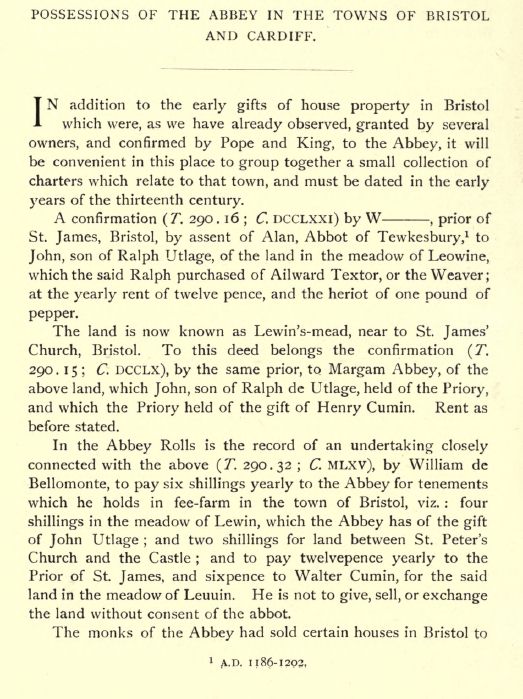
1225 - Warin
le Utlage- gives the king half a mark for having a pone before
the justices of the Bench against Thomas of Hereford and Isabella, his
mother, concerning 30 acres of land with appurtenances in Swanton and in
Hoe. Order to the sheriff of Norfolk to take etc - 8 April - 9 Henry III
1228 - Warin
le Utlagh v. Thomas de Hereford, in Swanetun. 12th Henry III.
1230 - Alan le
Utlage in the Tax Rolls 'Feet of Fines' for the county of Essex
1230 - Peter
- Petrus le Utlage de Depa (Dieppe) - leads the ship - Patent Rolls
of Henry III - Dieppe, Seine-Maritime
1232 - Emma who
was wife of Alan Le Vtlage v. Bartholomew de Brancestr of Ilketshal -
Suffolk
- 16 HENRY III
1234 - Walter
fil' Philip and Hughelina his wife, Warin fil' Roger and Isabella his wife
v. * Warin le Utlawe, in Ho. - Norfolk Fines - 18th Henry III
1240 - Adam
fil' Symon v. Warin le Utlag, in Qeywode. (Bishop of Norwich app. clam.).
24th Henry III
1241 - Isabel widow of William
Vtlage, their native in the vill of Fraistingthorp - GRANT by
Matilda Constable, Prioress of Swina - Priory of Bridlington in East
Riding of the county of York
1250 - (William) - Willelmum le Utlag -
Close
Rolls, January 1250 - Henry III
1270 -
(Hugh) Hugo le Utlagh - Close
Rolls, May 1270 - Henry III - Norfolk.
Hugh le Utlaghe de Bodeham gives half a mark for having a writ ad
terminum. Order to the sheriff of Norfolk. - Bodham
1272 - Norfolk.
Thomas le Utlaghe, Hugh le Tayllur, Olyva his wife and John le Bakun have
made fine with the king by 40s. for having a writ of appeal, concerning
which they have paid 20s. into the king’s Wardrobe for which they are
quit, and they are to pay the other 20s. at the king’s Exchequer. And
they have lands in Norfolk. 56 Henry III
1272 - witness:
Thomas Houtlawe - Cambridge St. Mary Deeds
1273 - Richard
Utlawe, County Bedford, (taken from the Hundred Rolls).
1282 - Pardon to
Ranulph le Mariner for the death of John Utlagh, as it appears by the testimony of Adam de Hoghton and his fellows, justices
appointed for the delivery of the gaol of Lancaster, that he killed him in
self-defence. - 10 EDWARD I.
1288 - Thomas
Utlagh - Close
Rolls, Edward I - September 1288
1294 - James
fil' Henry le Vaus (?) v. * Hugh le Utlawe, in Bodham and Westbekham. -
Norfolk fines - 22 Edward I. - Bodham
- West Beckham
1296 - 'Sussex subsidy of 1296:
The rape of Arundel',
Villat' de Madhurst, Tortingeton, et Bynstede - Willmo le Utlagh
- Madehurst - Tortington
- Binsted
1310 - Roger
le Utlaghe messuages in Burton-on-Trent - Nov 28 1310 - 4 Edward II
- Burton upon Trent
- Staffordshire,
England
1313 - Willielmus Outlagh
- The Tallage of 6 Edward II - Bristollia Bristol
- Tallage
- Bristollia or, memoirs of the city ...
Swanton Morley / Hoe - Warin le Utlage/Utlagh/Utlawe - 1230
1225 - Warin
le Utlage- gives the king half a mark for having a pone before the
justices of the Bench against Thomas of Hereford and Isabella, his mother,
concerning 30 acres of land with appurtenances in Swanton and in Hoe. Order to
the sheriff of Norfolk to take etc - 8 April - 9 Henry III
1228 - Warin
le Utlagh v. Thomas de Hereford, in Swanetun. 12th Henry III.
[ Swanetun is probably, Swanton
Morley , a picturesque village situated in the heart of Norfolk.
It is a village steeped in history documented back to the Domesday
Book. Today the village exists as a tranquil village community of about
2,500 people ]
1240 - Adam fil' Symon v. Warin le Utlag, in Qeywode. (Bishop of Norwich app. clam.). - Diss Hundred - 24th Henry III
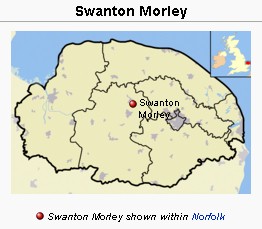 Swanton Morley - Hoe, Norfolk
- 1.5 miles west of Swanton
Morley
Swanton Morley - Hoe, Norfolk
- 1.5 miles west of Swanton
Morley
Hereford Hall - Thomas de Hereford was lord in 1277 ; and Warin de Hereford and Margaret his wife, had frank pledge, assise of bread and beer, &c. in the 3th of Edward I. in right, as is said, of the dower Margaret, of the inheritance of Richard de Boyland. In the 20th of Edward III. William Attechirch held the fourth part of a fee of Hugh de Hastings, which Sampson de Hoo formerly held. After this, Hereford Hall was held by the Ferrours, in King Edward's reign, Sic. as in Gressenhale.
1403 - Hereford or Hertford's Manor - Thomas de Harford held, in the 4th of Henry IV. the sixth part of a fee of the Lord Morley, which John de Hoo formerly held. - By this it appears to be a large and valuable manor: the town seems to take its name, as seated near the joining of two streams or rivulets, called probably Suan, Swin, or Swan;
The name "Hereford" is said to come from the Anglo
Saxon "here", an army or formation of soldiers, and the
"ford", a place for crossing a river.
 Norfolk Churches
- All Saints - Swanton Morley
Norfolk Churches
- All Saints - Swanton Morley
1230 - Peter - Petrus le Utlage de Depa (Dieppe) - leads the ship - Patent Rolls of Henry III - Dieppe, Seine-Maritime
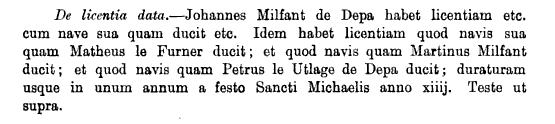
 The
arms of Dieppe are blazoned :
The
arms of Dieppe are blazoned :
Per pale azure and gules, a 3-masted ship sails furled argent.
De Licentia data. Joahnnes Milfant de Depa habet licentiam etc. cum nave sua quam ducit etc. Idem habet licentiam quod navis sua quam Matheus le Furner ducit; et quod navis quam Martinus Milfant ducit; et quod navis quam Petrus le Utlage de Depa ducit; duraturam usque in unum annum a festo Sancti Michaelis anno x. Teste ut supra.
... the ship which Peter the Utlage from Dieppe leads, will continue for as far as for a single year, from the feast of Saint Michael in the year X.
On the feast of St. John the Apostle [27 Dec. 1236], a man named Roger [sic] was found by night in Candlewick Street so badly beaten and ill-treated that he could not speak. Richard Tyllebrigge, Elias son of William Goday,
William Utlaghe, Richard son of Richard Nog', and Robert of Berkhampstead, watchmen,
found him thus in the street and carried him to the house of Thomas le Pipere, where he died very early next morning of that beating.
Afterwards the watchmen went from their ward to that of Roger Blund, then alderman, because they believed the dead man to belong to that ward, to see if they could learn the truth about how the affair had happened. The watchmen of that ward, asked if they knew anything about the above-named John [sic] said that he was their companion in keeping watch that night, and as they were all going together to keep watch, they chanced to meet a man carrying an unlighted lantern, whom they pursued as far as opposite Consel's shop. There they found a number of unknown men standing in the street, armed with swords and other weapons, who, when they attempted to arrest them, assaulted them, and so beat Roger [sic] that he died. The other members of the watch they badly wounded, and then fled. Asked then whether they recognized any of the malefactors or suspected anyone,
the watch said that they suspected William le Large, 'coureur', who fled for the deed and could never afterwards be found. Gerard of St. Edmunds, one of the watchmen who was wounded by the malefactors, comes, and asked if he suspects anyone, says that he knows nothing more than has been said above. The mayor and aldermen, asked whom they suspect of the said death and wounds, say that they suspect the same Walter [sic] le Large and no one else, because the others were unknown. Therefore he is to be put in exigent and outlawed according etc.
His chattels are worth 2s., for which the sheriffs are to answer. He was in frankpledge. Therefore [his pledges] are in
mercy.
1236 - Utlaghe, William, watchman
1240 - Adam fil' Symon v. Warin le Utlag, in Qeywode. (Bishop of Norwich app. clam.). Diss Hundred 24th Henry III
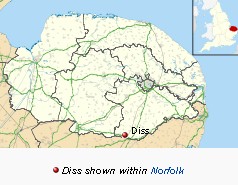 Qeywode
- THE TOWN of QEYWOOD - is probably Heywood - possibly
"Heywood" Diss is a town
(population 6742[1])
in Norfolk, England
close to the border with the neighbouring East
Anglian county of Suffolk.
The town lies in the valley of the River
Waveney, around a mere
(lake) that covers
6 acres. The
town may take its name from the Saxon
term for lake, or from an old Viking
word meaning 'village of the dancing horse'. Diss has a large number of
historic buildings, including the early 14th century parish
church.
Qeywode
- THE TOWN of QEYWOOD - is probably Heywood - possibly
"Heywood" Diss is a town
(population 6742[1])
in Norfolk, England
close to the border with the neighbouring East
Anglian county of Suffolk.
The town lies in the valley of the River
Waveney, around a mere
(lake) that covers
6 acres. The
town may take its name from the Saxon
term for lake, or from an old Viking
word meaning 'village of the dancing horse'. Diss has a large number of
historic buildings, including the early 14th century parish
church.
History of Norfolk-Volume
1-Diss - This hundred hath its name from the capital town, which is so called from the mere situate on its south side;
dice in the Saxon language signifying a standing water, lake, or ditch. It is bounded on the south by the river Waveny, which now divides Norfolk and Suffolk, on the west by the hundred of Giltcross, on the north by Depwade, and on the east by the half hundred of Earsham, which joined with the half hundred of Diss, makes up a whole hundred, or, according to the old division, two whole hundreds, and completes the deanery of Redenhall, in the archdeaconry of Norfolk, and diocese of Norwich; the fee of it wholly belonged to Edward the Confessor, as demean of the Crown, till he granted to Ulfiet and Stigand the soc of their own lands,[1] and to the Abbot of St. Edmund's Bury[2] the half part of the soc and sac of his lands, and of all his freemen.
But by the way, it will be necessary to observe, that what we now call Diss Hundred, in the Confessor's time was a hundred and half; the hundred was called Wineferthinc Hundred which Earl Ralph held, upon whose forfeiture it came to the Crown, and was added to the King's half hundred of Dice, and continued ever after as part of it, and this is the reason that the title in Domesday is, the hundred and half hundred of Dice; the fee of which, with all the jurisdiction thereof (except what belonged to the Abbot, to Ulfiet, and Stigand) came into the Conqueror's hands, and the soc and sac of all his freemen in the hundred, that held less than thirty acres, belonged to his manor of Fersfield, but of those that held thirty acres or more, the soc and sac belonged to the hundred of Wineferthinc, which Earl Ralph forfeited
...
[ A Peche Connection: ]
In 1179, as Stow in his Annals tells us, Richard de Lucy, Chief Justice of England, deceased, and was buried in the quire of the abbey church at Lesnes in Kent, which he had founded, and where he had taken upon him the habit of a canon regular the year before. From this Richard the manor came to
Sir Walter Fitz-Robert, son of Robert de Tonnebrigge, the fifth son of Richard Fitz-Gilbert,
surnamed de Tonebrigge, the first Earl of Clare, who came in with the Conqueror, of whose gift he had the castle and town of Clare in Suffolk, with Tunbridge in Kent, and divers other great lordships in
England. This Earl was son of Gilbert, sirnamed Crispin, Earl of Brion in Normandy, and son of Jeffery, natural son to Richard I. of that name, Duke of Normandy: he bare, as the Fitz-Walters ever after did, the Earl of Clare's shield varied, which is or, three chevrons gul. The Fitz-Walters being or, a fess between two chevrons gul. He had two wives, Maud de Bocham, (as Mr. Weaver,) or rather Margaret de Bohun, (as Mr. Dugdale,) and Maud, daughter of Sir Richard de Lucy, as aforesaid, in whose right he had this manor, to which he first obtained a charter for a fair, on the eve, day, and morrow after the feast of St. Simon and Jude, and three days following. He was Justice itinerant in Norfolk and Suffolk, and died in 1198, being buried in the midst of the quire of the priory church of Little Dunmow in Essex, of which Robert de Tonebrigge, his father, was first founder; he was sometimes called
Walter of Clare, sometimes Robert Fitz-Walter, but mostly Walter Fitz-Robert; he left Robert the Valiant his heir.
Sir Robert Fitz-Walter, Knt. son of Sir Walter Fitz-Robert, commonly called Robert the Valiant, had two wives, Gunnora, daughter and heiress of Philip de Valoines, and Rohesia or Rose, who survived him, and had the manor of Diss, Hemenhale, (which always went with Diss,) Theye, and Diss hundred in dower. He it was that first divided this manor, by
giving a moiety of the two parts which he possessed to Sir Gilbert Pecche, Knt. with his daughter Alice (some say sister) in free marriage, with the third part of the hundred and market, and so there branched a third manor, which was called Pecche's Fee. This Robert was leader of those barons that rose against King John, the beginning of which was on this occasion, as the book of Dunmow informs us.
...
Pecche's Manor, now called Heywood Hall
Had its rise out of the capital manor; Sir Robert Fitz-Walter, who held two thirds of the hundred and town of Diss, granted one third thereof with his daughter (some say sister) Alice, in marriage, to
Sir Gilbert Pecche, Knt. lord of Brunne, in Cambridgeshire, upon whose death it descended to
Sir Hammond Pecche, Knt. his son, who died in 1240, leaving, by Eva his wife, several children; Gilbert was his eldest son and
heir, but this was given to Robert Pecche, his fourth son, who held it in 1286, in which year he claimed view of frankpledge, and assize of bread and ale of all his tenants. It was this Gilbert, and Agnes his wife, that
in 1292 conveyed two third parts of this manor to Sir Robert Fitz-Walter, so that it was again joined to the great manor, all but
one third part, which they in 1285 had conveyed by fine to Sir Richard de Boyland, and Maud his
wife, together with a third part of the demeans, and 28s. per annum quitrent; and
this part constituted that manor here, which is now called Heywood-Hall
Of which I find a fine levied in 1289, by Sir Richard de Boyland, and Maud his wife, to Stephen Fitz-Walter, lord (in trust) of the great
manor, who designed to join this, as his predecessor had done the other parts to that manor, in order to make it more complete, but it proved of no force, for in 1314
Richard, son of Richard de Boyland, sued Robert Fitz-Walter for it, and recovered it, it having been settled on his mother before the fine was sued, to which he was not a party; and soon after he settled it upon John de Mortimer, in trust for himself and his heirs, which John is said to hold it in 1327.
...
One Hundred years after 1207 Robert de Utlagh (of Hindringham), we still have Utlagh's around Holt.
(Notice Thomas Le Utlagh may have gone on Crusade and Hugh (brother?) wants his land , he seems to return in 1272 and tries to get it back... ) Eighth Crusade was 1270 and the Ninth Crusade began 1271
1270 - Eighth Crusade
- 20 August Edward sailed from Dover
for France, brought with him around 225 knights and all together 1000 men
1270 - Hugo
le Utlagh - Close Rolls, May 1270 - Henry III - Hugh le Utlagh is
come before the king and asked for the land of Thomas le Utlagh to the
same Thomas in Bodeham released on pledges, etc.
1270 -
(Hugh) Hugo le Utlagh - Close Rolls, May 1270 - Henry III - Norfolk.
Hugh le Utlaghe de Bodeham gives half a mark for having a writ ad
terminum. Order to the sheriff of Norfolk. - Bodham
1272 - Norfolk. Thomas le Utlaghe, Hugh le Tayllur, Olyva his wife and John le Bakun have made fine with the king by 40s. for having a writ of appeal, concerning which they have paid 20s. into the king’s Wardrobe for which they are quit, and they are to pay the other 20s. at the king’s Exchequer. And they have lands in Norfolk.- 56 Henry III
1272 - Whereas Thomas le Utlagh of Bodham, by a writ obtained from the chancery in his name without the king's knowledge and will, is drawn into a plea before the justices of the Bench over a messuage and 50 acres of land in Bodham for this that these were said to be the king's escheats of the lands of Normans ; the king because he now knows for certain that they are not his escheats and that the said writ was obtained by enemies of the said Thomas to annoy him, being unwilling that he should be worried by reason of his suit contrary to justice, to provide for the discharge of his soul and of the souls of his heirs, at the instance of Augustin Auger, king's yeoman, remits to Thomas and his heirs his suit so far as regards any exaction or challenge of the messuage and land. - Westminster - May 8 1272 - 56 Henry III
1294 - James fil' Henry le Vaus (?) v. * Hugh le Utlawe, in Bodham and Westbekham. - Norfolk fines - 22 Edward I. - Bodham - West Beckham * Same neighborhood
West Beckham - The
village lies 4.1 miles (6.6 km) east of the town of Holt.
- The village is 6.1 miles (9.8 km) west south west of Cromer
Bodham is 6.4
miles west of Cromer
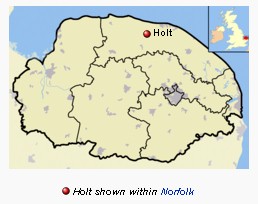 1302 - Soldiers
of DE HOLT , Norfolk , Jacobum Utlagh (James)
1302 - Soldiers
of DE HOLT , Norfolk , Jacobum Utlagh (James)
FEUDAL AIDS A.D. 1284 -1431. INQUISITIONS AND ASSESSMENTS
"The return for Norfolk, however, gives the names of all holders of
knights' fees, and also the names of the supposed mesne lords.
AD. 1302, NORFOLK. page 401
HUNDREDUM DE HOLT.
Inquisicio facta apud Holt de feodis militaribus in hundredo de Holt, per Rogeram de Perers, Reginaldum de Reppes, Simonem de Bosco,
Jacobum Utlagh, Radulfum Stubbard, Ricardum Pynceware, Clementem Chartres, Henricum Overmore, Adam Otewy, Radulfum le May, Petrum Pinkeneye et Johannem filium Thome, qui dicunt &c.
"Holt inquisition was made at the military out of the fees in the hundred of Holt, by Roger of Perers, Reginald of Reppes, Simon de Bosco, James Utlagh
1346 - Norfolk, HUNDREDUM DE HOLT. Juratores.—Johannes de Honeworth, Thomas Uthlagh
AD 1346 Norfolk, page 510
HUNDREDUM DE HOLT. Juratores.—Johannes de Honeworth, Thomas
Uthlagh
Index
Utlagh, Uthlagh, James, 401. ........., Thomas, 510.
1302 - Simon de Noers tenet in Swanton di. f. m.
hundredum = a hundred; a division of a shire; a hundred court; payment due from a hundred;
Holt, Norfolk
- is a market
town and parish
in the English
county
of Norfolk.
The town is 22.8 miles (36.7 km) north of the city of Norwich,
9.5 miles (15.3 km) west of Cromer
and 35 miles (56 km) east of King's
Lynn. The town is on the route of the A148
King's Lynn to Cromer road.
The name Holt is thought to derive from the Anglo-Saxon
word for woodland[2]
and Holt is located on wooded high ground of the Cromer-Holt
ridge at the crossing point of two ancient by-ways
and as such was a natural point for a settlement to grow. The town has a mention
in the great survey of 1086 known as the Domesday
Book. In the survey it is described as a market town and a port with the
nearby port of Cley
next the Sea being described as Holt’s port.
| - - - - - - - - - -
1270 - Hugh le Utlaghe de Bodeham gives half a mark for having a writ ad terminum. Order to the sheriff of Norfolk. Oct/1270-1
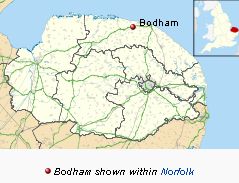 Bodham
- is a coastal village and a civil
parish in the English
county of Norfolk[1].The
village is 27.2 miles north north west of Norwich,...
In the great book Bodham is recorded by the names Bod(en)ham, and Botham.
The main landholders Hugh de Montfort and Walter Giffard. The main tenant
was said to be Ralph.
Bodham
- is a coastal village and a civil
parish in the English
county of Norfolk[1].The
village is 27.2 miles north north west of Norwich,...
In the great book Bodham is recorded by the names Bod(en)ham, and Botham.
The main landholders Hugh de Montfort and Walter Giffard. The main tenant
was said to be Ralph.
Holt hundred - Bodham or Bodenham
- At the survey Hugh de Montfort had the capital lordship, which Bund, a Saxon thane, was lord of, in the reign of the
Confessor ...
Ralph held it under his lord Hugh. ...The descendants of this Ralph, according to the custom of that age, assumed the name De Bodham, and De Bosco de Bodham, from some wood near their
seat.
HUGH DE MONTFORT
- second of that name, and son of Hugh "with the Beard," Lord of
Montfort-sur-RisIe, near Brionne, was the companion of the Conqueror at
Hastings.... For his services he received (before the completion of Domesday) sixteen manors in Essex, fifty-one in Suffolk, nineteen in Norfolk, and twenty-eight in
Kent, in addition to a large proportion of Romney Marsh, and was one of the barons
entrusted by the Conqueror withi the administration of justice throughout England, under Bishop Odo and William Fitz Osbern in 1067; and by the Bishop himself,
Hugh de Montfort was made Governor of the Castle of Dover, the chief fortress in Odo's own earldom, and the key of the kingdom.
His absence on other duties with the Bishop south of the Thames was taken advantage of by the Kentish malcontents, and led to the assault of the castle by the Count of
Boulogne, the failure of which has been already related.
Simon de Montfort and the de Montfort Family
The Domesday Book dated August 1086 reports Montfort, Hugh de also called Hugh Beard from Montfort-sur-Risle, Eure, Regent with Odo of Bayeux and Earl William FitzOsbern in 1067. Castle at Saltwood, with extensive Kent holdings to defend coast. Also holdings in Essex, Norfolk and Suffolk.
Simon de Montfort (Snr) c 1160-1218 or Simon IV de l'Amaury was created 5th Earl of Leicester by King John in 1206. He died in 1218 during the siege of Toulouse the capital of Haute-Garonne, on the river Garonne, SE of Bordeaux. The city has a fine 12th-13th-century Romanesque church (St Sernin), the church of the Jacobins (belonging to a monastery founded 1216). Toulouse was the cultural centre of medieval France in the 12th-13th centuries and was captured by Simon during the infamous Albigensian wars (1209-29). When a papal legate was assassinated in the territory of Count Raymond of Toulouse, Pope INNOCENT III called for a crusade against these heretics. Simon de Montfort's massacre (1209) of the inhabitants of Beziers stands out as an example of the crusaders' cruel conduct. Asked how to separate Christians from heretics, one leader is said to have replied: "Slay them all. God will know his own."
Simon de Montfort (Jnr), 6th Earl of Leicester c1208-1265 English politician and soldier. Born of an Anglo-French family in Normandy, France. In 1229 he came to England, where two years later Henry III, King of England, confirmed his title and estates. He married Princess Eleanor, the youngest sister of the king, on 7th January 1239. Princess Eleanor was a widow having been previously married to William Marshall, Earl of Pembroke who died in 1231. Eleanor and Simon had five sons, Henry b. 1238 who was killed in 1265, Simon b. 1240, Guy, Count of Nola b. 1243, Richard and Aymer, Conon of York. They also had a daughter who was named Eleanor b.1253. She married Llywelyn the Last of Wales, together they had a daughter Gwenllian who became a nun and died in 1337.
1309 - Ranulph
Galicien & Philip le Utlagh plaintiffs & Jordan Reynald &
Juliana his sister concerning the obstruction of a certain way - Rolls of the
Assizes -
Common pleas in Jersey
(This is one of the few early Outlawe records found outside England ( the other
Peter le Utlage de Dieppe Normandy)
 Jerripedia
- King John lost England's French territories in 1204 and the Channel Islands
split with Normandy,
Jerripedia
- King John lost England's French territories in 1204 and the Channel Islands
split with Normandy,
Jersey - Formerly under the control of Brittany and named Angia (also spelled Agna ),[16] Jersey was invaded by Vikings in the ninth century. The name of Jersey is believed to be derived from Viking heritage: the Norse suffix -ey for island can be found in many places around the Northern European coasts. The source of the first part of the toponym is unclear. Scholars surmise it derives from jarth (Old Norse for "earth") or jarl (earl), or perhaps a personal name, Geirr ("Geirr's Island").[17] Alternatively Celtic origin may relate to the Gaulish gar- (oak), or ceton (forest). Some believe "Jersey" is a corruption of the Latin Caesarea, the Roman name for the island, influenced by Old English suffix -ey for "island";[18][19] this is plausible if, in the regional pronunciation of Latin, Caesarea was not IPA: [kaisarea] but [tʃeːsarea].
The island was eventually annexed to the Duchy of Normandy by William Longsword, Duke of Normandy in 933 and it became one of the Norman Islands. When William's descendant, William the Conqueror, conquered England in 1066, the Duchy of Normandy and the kingdom of England were governed under one monarch.[20] The Dukes of Normandy owned considerable estates on the island, and Norman families living on their estates founded many of the historical Norman-French Jersey family names. King John lost all his territories in mainland Normandy in 1204 to King Philip II Augustus, but retained possession of Jersey, along with Guernsey and the other Channel Islands. The islands have been internally self-governing since. ... Until the 19th century, indigenous Jèrriais — a variety of Norman — was the language of the island, though French was used for official business.
Société Jersiaise - Genealogy Research - Genealogical records in Jersey differ somewhat from those in the U.K. because the island retains many Norman laws and institutions. Whilst always owing allegiance to the British Crown, many records are in French and you will need to become familiar with the commonly used words and terms.
WWW OPAC - Jersey Heritage Trust
See Outlawe History in Ireland - here is a summary:
The hypothesis is that these Utlagh's originated with the Glanville 's around 1170 (see Bromholm Priory above) who were involved with the invasion of Ireland:
1169 - Bromholm Priory
- House of Glanville
- Charter of Bartholomew de Glanville To Bromholme Priory - Walteri Utlage
1169 - Norman
Invasion of Ireland Begins - Norman, Welsh,
Flemish
forces landed in Wexford
- Strongbow
led the initial invasion of Ireland - 5/1169
1171 - King
Henry II lands in Ireland with a large fleet at Waterford,
becoming the first King
of England to set foot on Irish soil
1171 - The people of
Bristol were given Dublin as a colony by the king and many Bristolians
settled there. Charter
was issued by Henry II in 1171-1172, giving the men of Bristol the right to
live in the City of Dublin. Later charters contain grants to the city of
rights, privileges and property
1260 - Roger Utlagh - or Roger Outlawe (c.1260-1341 ) was a leading Irish statesman of the fourteenth century and held the office of Lord Chancellor of Ireland. Today he is remembered as the brother-in-law of the celebrated " Witch of KIlkenny " Alice Kyteler, and for his efforts to shield her from prosecution....Roger joined the order of the Hospitallers and served with the English army against the Scots
1298 - Dame
Alice Kyteler marries William Outlawe brother
of Sir Roger Outlawe, Chancellor of all Ireland
1311-1340 - Sir
Roger Outlawe - The Grand Prior - Hospital Of Saint John Of Jerusalem
In Ireland - Priory of Kilmainham - Lord Justice of Ireland
1311 - Hospital
Of Saint John Of Jerusalem
In Ireland - Priory of Kilmainham
1324 - William
Outlawe
nephew of Sir Roger Outlaw is ordered to make pilgrimage to the Shrine
of St. Thomas at Canterbury
1324 - Summons
to Thomas Fitz John Earl of Kildare to the war in Aquitane -
Similar summonses were sent to William Utlawe
of Kilkenny - 18 Edw. II 30 Oct. (Aquitane)
1326 - Margaret
Outlawe - William fitz Maurice
who married Margaret daughter of William Outlawe , the wealthy banker
of Kilkenny - William Fitz Maurice
- Williaim fitz Maurice, son and heir of Maurice fitz Maurice, succeeded
his father, and in the extent of the services due to Richard, Earl of
Gloucester and Hertford in the county Kilkenny,
taken in the year 1247 - they are later known as the "Maurice
Fitgerald"'s
[ So here we see the Earl of
Gloucester - Outlawe connection which leads later to Bristol - Hertfordshire
(Essex) and Norfolk ]
1330 - Exemption
for life, of William Utlawe from being put on assisce, juries or
recognisances, and from appointment as mayor, sheriff, coroner or other minister
of the king against his will. March 10 1330 - generally these exemptions
were given to injured / retiring soldiers
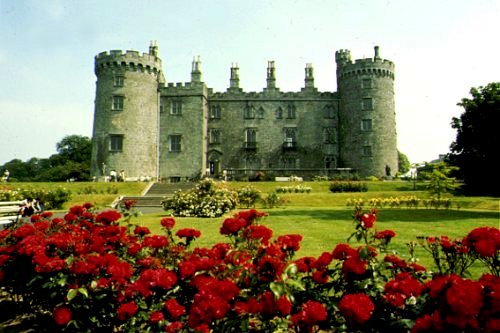 I add this to refer to and speculate on the connection of -
Sir
Roger Outlawe The Grand Prior - Hospital Of Saint John Of Jerusalem and his
brother William Outlawe, who was also a banker (ex-templar?).
I add this to refer to and speculate on the connection of -
Sir
Roger Outlawe The Grand Prior - Hospital Of Saint John Of Jerusalem and his
brother William Outlawe, who was also a banker (ex-templar?).
Where did they
come from? (Isle of Ely? ).
They were most likely part of the Norman invasion of Ireland around 1170.
As Saxons, they were not granted land (like the Norman's) but they acted as the bankers and had great influence,
William Outlawe's son William Outlawe in
1324 - William
Outlawe nephew of Sir Roger Outlawe is ordered to make pilgrimage to the Shrine
of St. Thomas at Canterbury .
So what happened to William Outlawe after his pilgrimage to the Shrine of St. Thomas at Canterbury a primary Hospitaller site ?
Sir Roger Outlawe and his brother William Outlawe are among the earliest documented Outlawe references.
Were they originally Saxon's from Ely? Did they join the Templars or Hospitaller's at the Preceptory of Denny in Cambridge - part of which, was a hospital for sick and superannuated brothers. Where did William Outlawe go after completing his pilgrimage, Cambridge?
1241 - Isabel widow of William Vtlage, their native in the vill of Fraistingthorp - GRANT by Matilda Constable, Prioress of Swina - Priory of Bridlington in East Riding of the county of York (possibly later up to ~1270)
Priory
of Bridlington in East Riding of the County of York.
The Augustinian Priory of Bridlington was established by Walter de Gaunt between the years
1114 and 1124
CHARTULARY OF BRIDLINGTON PRIOR
Walter de Grendale
...
GRANT by Matilda, Prioress of Swina, and the Convent of the same, to the
Prior and Convent of BRIDLINGTON of ten bovates of land and eight
tofts, in
the territory and vill of Fraistingthorp, which bovates and tofts they 1 had by
the gift of Ermeburga and confirmation of Robert Constable her son : of which bovates
Hubert, the native (nativus)
of the said Prioress and Convent, held one bovate and a toft, and John son of Hubert, their
native, held two bovates and a toft, and Hilda widow of Alan in-the-Corner (in
angulo), their
native, held three bovates and three tofts,
and Isabel widow of William Vtlage, their native, held two bovates and a
toft. 2 To have and to hold the said land with tofts and the
said natives and their families and chattels to the said Prior and Convent
or to whomsoever they desire to assign, in free, pure, and perpetual alms, with the meadows and pastures and turbaries and marshes belonging to the
said land and tofts, and all other appurt. and easements within and without the
vill, forever.
1277 - Matilda, Prioress for
Swine. These, appearing before the Justices in the Octave of St. Hilary, 55th Henry 3rd - 1277
Maud, occurs 1240-1 (fn. 53) From:
'Houses of Cistercians nuns: Priory of Swine', (Maud - Matilda)
Prioresses of Swine
...
Maud Constable joined them
Archaeologia
aeliana, or, Miscellaneous tracts relating to antiquity By Society of Antiquaries of Newcastle upon Tyne,
Matilda the prioress and the convent of Swine agree with
Sir Alexander de Hilton, knight, who gave them nine oxgangs in Swine if he
should die in 1241
Villeinage was only another term for
slavery. The villeius "were in a state of downright servitude, and employed in
labours of the most servile description: they, their children, and effects belonged to the lord of the
soil, like the cattle with which it was stocked. They could not leave their lord
without his permission, and in the event of their absconding, or being clandestinely
taken from him, might be claimed and recovered by action at law, like beasts, or other chattels.
Robert le
Constable, the eldest son of Ulbert and Erneburga -
Erneburga, the great Saxon heiress who gave her name to Erneburg-Burton in Holderness, was twice married, first to Gilbert de
Alost, and secondly to Ulbert le
Constable.
Burton passed to the descendants of Ulbert, "the name of Erenburg-Burton gradually yielding to that of Burton-Constable, and was held for many centuries as well in part of the Seigniory of Holderness, as of the Archbishop of York." Yet she must have had children by her first husband, for several De
Alosts, holding a share in the property, are mentioned in Yorkshire during the thirteenth century.
Ernaburga BURTON Birth: ABT
1080, Of Swine, Yrkshr, Engl
Partnership with: Ulbert CONSTABLE Marriage: ABT 1109
Child: Robert CONSTABLE Birth: ABT 1110, Of Burton, Constable, Yrkshr, Engl
Child: William CONSTABLE Birth: ABT 1112, Of Burton-Constable, Yrksr, Engl
Child: Richard CONSTABLE Birth: ABT 1114, Of Burton-Constable, Yrksr, Engl
In a charter of
Erenburgh, wife of Ulbert Constable, (fn. 2) the brothers and sisters serving God at Swine are alluded to, and in a charter of Edward I in
1305 is an inspeximus of an undated charter of Henry II to the brethren and nuns of the house of Swine, taking their house, lands, and possessions under his protection, and granting them certain
liberties From: 'Houses of Cistercians nuns: Priory of Swine', A History of the County of York: Volume 3 (1974), pp. 178-182.
William Utlage - 1340 - Durham
1241 - Isabel widow of William Vtlage, their native in the vill of Fraistingthorp - GRANT by Matilda Constable, Prioress of Swina - Priory of Bridlington in East Riding of the county of York (possibly later to ~1270)
1300 - William Outlawe (Junior) is born.
1321 - Robert of Durham - Master of Monkwearmouth
1332 - William
Outlawe is said to have been Prior of Kilmainham, and lieutenant of John
Lord Darcie, Lord Justice.
1340 - Seal
- William Utlage (?), - Used by Robert of Durham, merchant.-
Inscription: SIGILLVM WILELMI VTLAGE - Seal design: Round,
armorial, a lion rampant. - pdf
-
Robert
of Durham 1321 - Master of Monkwearmouth
1341 - Death of Roger
Utlagh - Outlaw - Roger Outlaw, still Prior, Chancellor and
Lord Justice of Ireland died at Any (Knockainy Co. Limerick)
It is interesting that this official seal ( a signature ) for William Utlage and
would use this symbol for his seal
How is it and Why was Robert of Durham using Utlage's seal?
Is this
the William Outlaw Jr. from Ireland ? Is this a Hospitallar connection?
 A
"lion rampant" is depicted in profile standing erect with forepaws
raised.[2]
The position of the hind legs varies according to local custom: the lion may
stand on both hind legs, braced wide apart, or on only one, with the other also
raised to strike; the word rampant is often omitted, especially in early
blazon, as this is the most usual position of a carnivorous quadruped;
A
"lion rampant" is depicted in profile standing erect with forepaws
raised.[2]
The position of the hind legs varies according to local custom: the lion may
stand on both hind legs, braced wide apart, or on only one, with the other also
raised to strike; the word rampant is often omitted, especially in early
blazon, as this is the most usual position of a carnivorous quadruped;
What is interesting is that this is also the
Seal of Scotland. :
The earliest recorded use of the Lion
rampant as a royal emblem in Scotland is by Alexander
II in 1222
 Blessed
Gerard (108? - c 1118)
Blessed
Gerard (108? - c 1118)
Master of the Hospital of Jerusalem.
(Notice the the William Utlage seal forms a shield around the lion)
See: Laurence Outlaw (Utlator) - Lynn - Mary Magdalen
1147/50 - The hospital of Burton Lazars was founded by Roger de Mowbray, who granted to the lepers of St. Lazarus of Jerusalem 2 carucates of land at Burton - The Knights Templar, had the policy for knights contracting leprosy to join the Order of Saint Lazarus with the Templars paying a pension for each affected knight’s admission.
 The
"Master of Burton" originally was Roger de Mowbray :
Roger de Mowbray was the son of Nigel d’Aubigny, one of Henry I’s leading
men, and Gundreda de Gournay. Roger took his surname from Robert de
Mowbray, earl of Northumberland..Robert had been married to Roger’s
stepmother, Maud de Laigle, and Robert’s Norman estate of Montbray had been
passed to Roger through this connection..... Roger gained and sustained a
high reputation for his prowess on the battlefield, attaining great honour on
the Second
Crusade, when he successfully defeated a Muslim in one-to-one combat...Roger
was one of the few great men of the kingdom to join the king of France on the
Second Crusade in 1147...Roger left for the Holy Land again in 1186, when
he was in his sixties. According to contemporary accounts he was never to
return to England, for he was captured at the Battle of Hattin in 1187 and
died soon after in Palestine, where he was buried...
The
"Master of Burton" originally was Roger de Mowbray :
Roger de Mowbray was the son of Nigel d’Aubigny, one of Henry I’s leading
men, and Gundreda de Gournay. Roger took his surname from Robert de
Mowbray, earl of Northumberland..Robert had been married to Roger’s
stepmother, Maud de Laigle, and Robert’s Norman estate of Montbray had been
passed to Roger through this connection..... Roger gained and sustained a
high reputation for his prowess on the battlefield, attaining great honour on
the Second
Crusade, when he successfully defeated a Muslim in one-to-one combat...Roger
was one of the few great men of the kingdom to join the king of France on the
Second Crusade in 1147...Roger left for the Holy Land again in 1186, when
he was in his sixties. According to contemporary accounts he was never to
return to England, for he was captured at the Battle of Hattin in 1187 and
died soon after in Palestine, where he was buried...
The Preceptory of Choseley, Norfolk, besides many others, were annexed to it, as cells containing fratres leprosos de Sancto Lazaro de Jerusalem ...“The masters of all the smaller Lazar-houses in England, were in some sort subject to the Master of Burton Lazars, as he himself was, to the Master of the Lazars in Jerusalem.”
 Raymond
du Puy (1157-1159)
Raymond
du Puy (1157-1159)
He followed Gerard de Martigues as head of the Order of Saint John of
Jerusalem. He allegedly contracted leprosy and became Master of Saint
Lazarus
 Adam
de Veau (... 1314 ...)
Adam
de Veau (... 1314 ...)
He bore: Or, a Lion rampant Azure
The Royal
Standard of Scotland, also known as the Banner of the King of Scots,[1]
or more commonly the Lion Rampant of Scotland,[2]
is the Scottish Royal Banner of Arms.[3]
Used historically by the King
of Scots, the Royal Standard of Scotland differs from Scotland's national
flag, the
Saltire, in that its correct use is restricted by an Act
of the Parliament
of Scotland to only a few Great
Officers of State who officially represent the
Sovereign in Scotland
Richard I (Richard
the Lionhearted) -- In 1198, his great seal bore a single rampant lion
Alisaundre de Welles, Preceptor of the Hospital of St. John of Jerusalem Seal : A lion rampant
We are interested in any links between the Licolnshire Welles and Alexander de Welles, Master/Prior of Torphichen and the Knights Hospitaller of the Order of St John of Jerusalem in Scotland. Alexander de Welles died in 1298 at the Battle of Falkirk where he fought with Adam de Welle(s) of Lincolnshire and Philip de Welle(s) (probably of Essex) against William Wallace.
1215 - Geoffrey de Marisco founded a Commandery of the Knights Hospitallers at Hospital - parish of Aney Ireland - Hospital, County Limerick
Their
[ Marisco ] coat of arms were "gules, a lion rampant, argent" and that
of William de Marisco "gules, a lion rampant sable, langued gules"
which may mean they were royal bastards (or alternatively descended from
Charlemagne).
[ An interesting idea but as shown the arms show a relationship with the
Templars and Hospitaller order. ]
 Durham
- is a city
in the North
East of England.
It is within the County
Durham - Durham is well known for its Norman
Cathedral
and 11th-century
castle,
Durham
- is a city
in the North
East of England.
It is within the County
Durham - Durham is well known for its Norman
Cathedral
and 11th-century
castle,
Durham’s geographical position has always given it an important position in the defence of England against the Scots.[8] The city has played an important part in the defence of the north and Durham Castle is the only Norman castle keep never to have suffered a breach.[9] The Battle of Neville's Cross which took place near the city on 17 October 1346 between the English and Scots is the most famous battle of the age.[1]
Owing to divine providence of the city’s founding, the Bishop of Durham has always enjoyed the title “Bishop by Divine Providence”[10] opposed to all other bishops who are “Bishop by Divine Right”.[1] However, as the north east was so far from Westminster the bishops of Durham enjoyed extraordinary powers such as the ability to hold their own parliament,[1] raise their own armies,[2] appoint their own sheriffs and Justices, administer their own laws, levy taxes and customs duties, create fairs and markets, issue charters,[3] salvage shipwrecks, collect revenue from mines, administer the forests and mint their own coins.[1] So far reaching were the bishop’s powers that the steward of Bishop Anthony Bek commented in 1299 AD: “There are two kings in England, namely the Lord King of England, wearing a crown in sign of his regality and the Lord Bishop of Durham wearing a mitre in place of a crown, in sign of his regality in the diocese of Durham.
Jarrow (Durham), St. Paul - The Durham Monks at Jarrow (and Wearmouth)
...
Robert
of Durham 1321 - Master of Monkwearmouth - Monkwearmouth-Jarrow Abbey
- Wearmouth-Jarrow is a twin-foundation
English monastery,
located on the River
Wear in Sunderland
and the River
Tyne at Jarrow
respectively, in the Kingdom
of Northumbria (now in the metropolitan
county of Tyne
and Wear). ...Jarrow became the center of Anglo-Saxon learning in the north
of England, producing the greatest Anglo-Saxon scholar, Bede.
... Jarrow was merely a minor cell of Durham, occupied by only one or two
monks under a magister
or master.
THE MONASTERIES OF WEARMOUTH AND JARROW
Masters of Jarrow - Robert of Durham, 1321
Masters Of Wearmouth - Robert of Durham, 1321
100 years earlier 1249 :
Appointment by William
[of Cowton] prior of Durham of Robert de Bywell chaplain, Thomas Surtais
and Robert of Durham clerk to appear in his place at Parliament. (1321 -
1341 )
Prior of Durham
| 1321 | died 1341 | William de Cowton |
Possibly unrelated but it seems William Utlage's seal was transferred to Prior of Durham in relation to the finances of The Order of St. John:
Cleadon,
Anciently Clivedon, a village about a mile and a half nearly West North-West of
Whitburn - The History and Antiquities of the County Palatine of
Durham: volume 2: Chester ward (1820), pp. 50-56 - Hatfield's Survey
materials evidently collected between 1377 and 1385
1385 - Exchequer Lands. —The tenants jointly hold the pasturage of a cottage called
Colynfield, and pay xls. John fil. Richard holds a plot and two acres of land called
Outlawe, once of Simon the Headborough, 2s..- Cleadon - Whitburn
- Durham
Whitacre, Nether - Whitechapel - Whitby (St. Mary) - According to tradition, Robin Hood and Little John paid a visit to Richard de Waterville, who was then abbot, and as a proof of their dexterity in archery, shot an arrow each from the summit of the tower to the distance of more than a mile; to commemorate which event, pillars were raised on the spots where the arrows fell, and the
enclosures are still called Robin Hood's and Little John's fields. About
six miles from the town is Robin Hood's bay, where that celebrated outlaw is said to have kept a small fleet to assist his escape in times of
emergency.
Jesus College and St. Johns are closely linked to Barnwall Priory:
St Radegund - She is the patron saint of Jesus College Cambridge, which was founded on the site of the twelfth-century nunnery of Saint Mary and Saint Radegund (the nunnery was next to Barnwell Priory).
St John's College, Cambridge - The college was founded on the site of the 13th century Hospital of St John in Cambridge by Lady Margaret Beaufort in 1511 (Land next to land belonging to Barnwell Priory).
1112 - Pain
Peverel "Lord of Bourn" founds Barnwell Priory at
age 30 moving the 6 canons from St Giles to 30 canon's and 13 acres
1121 - Pain Peverel
died in 1121 he was buried at Barnwell Priory.
1193 - Hubert Walter
becomes Archbishop of Canterbury - St.Andrew
- His home was West Dereham Abbey
1211 - The
Cambridge Fair was
granted by King John with the revenues from the fair going to the Priory of
Barnwell - one of the oldest fairs
in the UK
1264 - St.
Michael's Parish - Bernewelle - Grant to Robert son of Robert Hubert
of
all rents in Cambridge and outside for a yearly payment of a pair of white
gloves
About Gloves in Medieval times: The custom of presenting a pair of white gloves to the neophyte at the conclusion of an initiation ceremony has a long historical tradition, and it is recorded already in the 10th century. A chronicle relates that in the year 960, the monks of Saint Alban’s Monastery in Mainz (Germany), presented a pair of gloves to the bishop at his investiture. The prayer pronounced during the investiture ceremony included a phrase beseeching God to cloth with purity the hands of His servant. ... Similarly, the kings of France received a pair of gloves at their coronation. The consecrated hands of the king, like those of the bishop, should not be soiled by contact with impure things. After the ceremony, the Hospitaller's burned the gloves, to prevent their later use for profane purposes.
1279 - Peasants in Bourn with three or more holdings - Richard Houtclawe (Outlawe) 4 holdings - 29 acres
1314 - John
Outlawe
v. Henry le Pescour of Cantebrigg' & Joan his wife in Gransete - Cambridge-
EDWARD II. 79
1317 - Simon
de Everesdon and Margaret his wife v. John le Utlawe junior and Alice
his wife in Brunne - Cambridge * Edw II 83 ( Brunne (Bourne,
Lincolnshire), ) - Bourne is a market
town on the western edge of the Fens
- Bourne is reputedly the birthplace of Hereward
the Wake (in about 1035), although the 12th century source of this
information, De Gestis Herwardi Saxonis,[58]
refers in this connection only to his father as being 'of Bourne' - Robert
Mannyng (1264–1340) is perhaps the most notable of the town's past citizens.
He is credited with putting the speech of the ordinary people of his time into
recognisable form. He is better known as Robert de Brunne because of his long
time residence as a canon
at Bourne Abbey.
1329 - Bourn raiding party of Kingston - John Outlawe and others, rescue 2 horses for the "lord" Priory of Bernewelle - Pg 64/65
( Brunne - BOURN, anciently "Brunne" or "Burne," is a village, a parish in the hundred of LONGSTOW, county of CAMBRIDGE, 1¾ mile (S.E by E.) from Caxton - Bourn - The present Bourn Hall is built on the site of a wooden castle that was burnt down during the Peasants' Revolt. - Following the Norman Conquest, a wooden church at Bourn was given to the monks of Barnwell Priory by Picot, the Sheriff of Cambridgeshire, who built his wooden castle next to it.[5] The current stone church, dedicated to St Mary and St Helena, dates from the 12th century onwards and is built of field stones and ashlar, with dressings of limestone and clunch, in the Transition Norman, Early English and Later styles
1327 - Mayors and Bailiffs - Mayor Eudo de Helpringham - Bailiffs - John Outlawe, Alan de Badburgham - History of the town of Cambridge pg 138 - Edward III. (25 Jan. 1327) - Township and borough History of Cambridge
1339 - The parson of the church of Potton was robbed in 1339 of wheat, barley, beans, peas and other goods and chattels to the value of forty marks by William, son of William de Hurle of Potton, John Wymond of Potton and John Lettice of Potton, The same William de Hurle and another assaulted Reginald Outlawe, parson of the church of Esthattelee at Potton and wounded him, and William was presented as a common assaulter and disturber of the peace. - THE LANDS OF THE SCOTTISH KINGS IN ENGLAND - Potton - Wikipedia
1340 - Presentation of
Reginald le Outlawe, parson of the church of Esthattele, in the diocese of
Ely, to the church, of Risshenden, in the diocese of
Lincoln, in the king's gift by reason of the temporalities of the priory of Lenton being in his hands, oni an exchange of benefices with Hugh de
Luffenham.
[ Esthattele is connected to Barnwell Abbey - St
Michaels Cambridge - St John's Hospital - John de Hattele
- Estenhale:
its eastern extremity towards Barnwell Priory was called Estenhale]
Notice that Henry de Tangmere is associated with John Outlawe just prior to the Black Death and founding of Corpus Christi.:
1347 - Grant
to Henry de Tangmere and John de Bernewell (Outlawe), burgesses,
of a messuage as in 58, 60, and 61. Messuage
- Buildings and land
1349 - The guild
of Corpus
Christi was founded in Cambridge
in 1349 by William Horwode, Henry de Tangmere and John Hardy[4]
in response to the Black
Death.
1374 - Priory of St Mary and St Radegund - Licence for an easement - The prioress (unnamed) and the nuns to Geoffrey Castre and Margaret, his wife, for an eavesdropping from their house in Walls Lane upon Sarans Croft for the breadth of one foot of St Paul's. Witnesses: William de Horwode, Mayor of Cambridge, Stephen Morice, John de Norton, Robert de Brigham, Henry Outlawe et aliis. - 21 April 1374
This seems to be John Outlawe and his
"brothers" John Junior and Thomas from West Dereham and he goes on to
become John de Bernewelle Outlawe at Barnwell Priory....:
1387 - Manumission
of three nativi by licence from the Holy See : John Outelawe senr., John O.
junr., and Thomas. O., lay brethren of Norwich dioc. Bull addressed
to West Derham Abbey. They were born of a free mother, but their
father Nichs. O. / laicus was " servus " of the Bp. fo. 61. -
BISHOP ARUNDELL'S REGISTER. See: The
abbey of St. Albans from 1300 to the dissolution of the monasteries on the
freeing of Villiens (serfs) and the
Peasants Revolt. - Thomas
Arundel
1389 - Records of the Priory of St Mary and St Radegund - Gift with Royal licence - Witnesses: Robert Brigham, mayor of Cambridge, John Blankpayn, John Marchal, Richard Martyn, John Norton, Robert Martyn, Richard Outlaw et aliis. (regards Barnwell Priory)
1399 - Richard Outlawe, 58, on that day went with master Ivo la Zouch, chancellor of Cambridge University, to the church
Barnwell Priory was an Augustinian priory at Barnwell in Cambridgeshire, founded as a house of Canons Regular. It was home to the Barnwell Chronicler, an anonymous chronicler writing during and about the reign of John of England.
1334 - Witnesses: Edmund de Ovying'; John Breton; Richard le Smyth; William Mareys; Roger Outlawe of Barton (Barton, Cambridgeshire)
| Title | Grant to William de Saham, burgess of Cambridge, and Agnes
his wife, of half an acre of arable in Barton field between land
of the Prior of Barnwell and land of William de Brunne abutting on le
Rugganacreforelonges and on land of Stephen Cosyn
|
1347 - Robert Outelawe's land in Barton Cambridge - Madwefeld of Berton at ‘ le Cros '
1408 - Grant
to Richard Aunger, Thomas Fan and John Marchal of the same of 10 acres of
arable in the fields of Barton - half an acre lies next to land of
Robert Outlawe
1416 - Letters
of attorney for John Aleyn of Barton to deliver seisin to Richard and John
Aunger of Barton of 3 acres and 3 roods of arable scattered in Barton
fields. Creator John Outlawe of Barton
1417 - A. 10008. Feoffment by Henry Fullere of Berton, co. Cambridge, to Richard Aunger, Robert Outlawe, the younger, and Richard Freman of Hatteley, of all his lands, in Berton and Grancete. Berton, Thursday after the Beheading of St. John the Baptist, 5 Henry V. - Grantchester
1427 - Grant to Richard Dykes and Thomas Owtelawe, both of Barton, of a messuage with adjacent croft and 3 acres of arable scattered in the vills and fields of Barton and Whitwell - Half an acre of land lies in Barton field in Le Holyffeld between land of the Prior of Barton [sic, for Barnwell[] and land of William Fodreyngton and abuts on land of the said Prior ... Witnesses: Henry Aleyn; Robert Owtelawe; ... (Notice Barton - Barnwell connection)
1456 - Release
by Thomas Outlawe to John Marke of William Audley's former lands
in Grantchester, Barton, Coton, Whitwell and Cambridge.
1477 - Deeds
relating to Barton - 1 half acre next to land lately of Robert
Outlawe, now of Nicholas Cleve
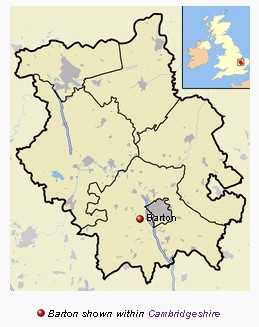 Cambridgeshire
Churches - Barton - St. Peters
Cambridgeshire
Churches - Barton - St. Peters
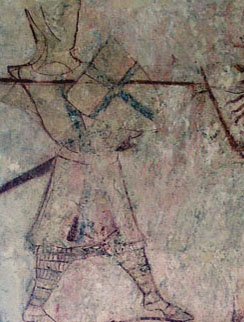
Needless to say the Outlawe's have a rich history in Lynn from 1200 on:
Two Ships:
1392 John Owtelawe's James of Lynne and 1463 Richard Owtlawe's Mary
Talbot of Lynne
1200-1250 - Deed
of grant, Lynn - 1d annual rent from a certain [piece of land] 4 feet wide in
Damgate held by Peter Strac
Grant by Laurence Outlaw (utlator) of Len to the
Hospital of the Blessed Mary Magdalen of Len and to the infirm brothers
there for the souls of his parents and his benefactors, the 1d to come from his
purse during his lifetime Anglo-Norman Studies Proceedings of ... - Google Books
-
There was an epidemic of leprosy in Europe from 1000 to 1200 A.D., which
was probably started by the returning soldiers of the Crusades. -
Leprosy
occurred in Britain from 625 to 1798, and at one time there were 326 lazar
houses (leprosaria) in Great Britain.
See also Barnwell Priory - John Outlaw (de BernewelIe) - Cambridgeshire - St. Mary Magdalene Leper Chapel, Cambridge ,the leper hospital had ceased to admit new lepers in 1279, and what few lepers remained were moved to a colony near Ely.
1347 - Ship James of Lynn - Edward III - Robert son of John Agnes is Master - Later this ship belongs to John Owtelawe
1374 - Adam OUTLAWE signed ordinances of the Guild of St John the Baptist in West Lynn (ref. BARDSLEY) - Adam Outelawe - Original Ordinances - The history of freemasonry Volume4 - Early British Freemasonry - Such guilds were everywhere under the patronage of the Holy Trinity, or of certain saints
1399 - Thomas
Outlawe purchased
the right of a little ferry boat for 13s. 4d. from the Gild of Corpus Christi
1399 - First
Henry IV, Robert Digges, rector of Clenchwarton, &c. confirmed to John
Outlaw, senior, of West Lenne, Edmund Baleset, burgess of Lenne, a messuage
and lands here; dated at West Lenn on the feast of St. Peter in Cathedra;
witnesses, Richard de Bellons, Richard de Well
1403 - Commission to Robert Outelawe and Adam Outelawe (and others) That no persons banished from the said realms nor sea-robbers be received in any ports or ships of the realm. Feb 17- Feb 24 - Henry IV Patent Rolls. - Reference is made of Robert & Adam OUTLAWE being appointed, with others, to take certain enemies of the King into custody.
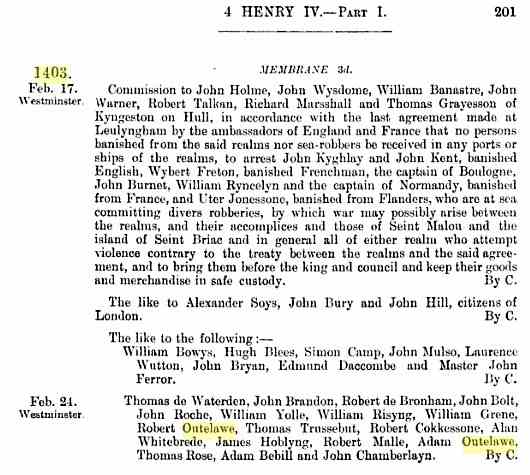 Notice that Robert Malle is also on this list and that a Robert Malle is
listed later as a benefactor for Sir Adam Outlawe in his will in 1501! So were
these two a father's and son's of Robert Malle's and Adam Outlawe's? And
who was this Robert Outlawe? Also in this time period no reference to Adam Outlawe.
Only this
regarding a Robert Outlawe (Did Adam go to Danzig? ) We see these
references to Robert (and the younger) at Barton and Berton:
Notice that Robert Malle is also on this list and that a Robert Malle is
listed later as a benefactor for Sir Adam Outlawe in his will in 1501! So were
these two a father's and son's of Robert Malle's and Adam Outlawe's? And
who was this Robert Outlawe? Also in this time period no reference to Adam Outlawe.
Only this
regarding a Robert Outlawe (Did Adam go to Danzig? ) We see these
references to Robert (and the younger) at Barton and Berton:
1404 - Robert Outlawe - Close Rolls, Henry IV - February 1404
1408 - Grant to Richard Aunger, Thomas Fan and John Marchal of the same of 10 acres of arable in the fields of Barton - half an acre lies next to land of Robert Outlawe - Barton, Cambridgeshire
1408 - William Asshebourne, Lynn’s town clerk received a letter from Lynn men in Danzig setting out their ordinances recently drawn up for “their company” there. - Lynn and the German Hanse. - Gdansk - (formerly Danzig; see Names below), is a city on the Baltic coast in northern Poland - Historically an important seaport and shipbuilding centre, Gdańsk was a member of the Hanseatic League. - Lübeck which was also the primary origin of many settlers
1417 - A. 10008. Feoffment by Henry Fullere of Berton, co. Cambridge, to Richard Aunger, Robert Outlawe, the younger, and Richard Freman of Hatteley, of all his lands, in Berton and Grancete. Berton, Thursday after the Beheading of St. John the Baptist, 5 Henry V. - Grantchester
1431 - The
son of Margery Kempe married a Prussian woman and both travelled to Lynn,
leaving their child in Danzig. Margery’s son died in Lynn and she escorted her
daughter-in-law back to Danzig - So Margery Kempe probably knew
Henry Outlawe or (Richard or John Outlawe)
1433 - Confirmation
of Grant: John Akeman of Clenchwardton, chaplain, to Wm. Herford, Wm. Pye,
butcher, burgesses of Lenn Episcopus, Henry Outlawe of Westlenn
and Thos. Dekone of Clenchwardton: 2 half acres of land in CLENCHWARDTON,
one of which lately purchased of Agnes Theversham and Katherine her sister
deceased, lie between the land of Thos. Bellezet', burgess of Lenn Episcopus,
on the west and the land of the heir of Jas. Akeman by villeinage and payment of
Kenewyk on the east, and extends in length from the land of said Thos. to the
north as far as the common way to the south, and the other half acre lies in the
same place between the land of Thos. Jekkysson, chaplain, on the east and
the said villein-held land or property of Kenewyk on the west, and
extends in length from the land of said Thos. to the north as far as the common
way to the south: to hold of chief lords: warranty and sealing clauses: given at
Clenchwardton: witn: John Bataill the elder; Roger Bataill; John Sutton the
younger; Henry Sutton, his brother; Thos. Bataill; Henry Wrych; Henry Akeman - 11
Hen. VI - Leicestershire, Leicester and Rutland Record Office
1454 - Protection
to John Owtelawe in the retinue of John earl of Worcester - Oct 23 - 33 Henry VI
- French Rolls - John
Tiptoft, Earl of Worcester - "the butcher of England" - in 1449 Lord
High Treasurer and then as Lord
Deputy of Ireland (1456–1457) - King
Henry VI's seizure with madness, in August 1453, supplied York with an
opportunity of getting control of the government without the use of force
against the King. ... the lords came up to London, early in 1454, with great
retinues
1456 - Kings
Lynn - John Outlawe, the son of Richard Outlawe, upon whom was
conferred the freedom of our burgh - Given The Keys to the City !!!
1456 - John Outelawe, son of Richard Outelawe, app. of Adam Okey (A.) - Freemen of Lynn
1468 - Robert Deryng of Lynne, maistre of the ship called the Marye of Lynne, wherof is owners Richard Outelawe and Aleyne Thomsone, satth, he sailed from the towne of Lynne towardes Pruce in Dantzike - DRÁP BJÖRNS. - VERZLUN - Kings Lynn and the Medieval Hanseatic League - Lübeck - The Hanseatic City of Lübeck
1481 - 1st
Duke of Norfolk - Lord John Howard, commanded the fleet in the war with
Scotland with great success - In
the late spring of 1481 John Lord Howard sailed into the Firth of Forth
destroying and capturing Scottish ships and burning Blackness - Mary
of Lynne -
take mariners for the said ship, as the king has ordered an armed force to
go to sea to resist his old enemy the king of Scots. - The
schippes that foloweth goeth to Scotland with the Lord Howard - The Mary of
Lynne
1481 - Feoffment
by Adam Outlawe of West Lynn, chaplain, to John
Dawson of Northlenn, chaplain, 1 September 1481 -
Thomas
de Acre's chantry and which were granted with other lands by William Walton,
esquire, to Adam Outlawe and John
Harold of North Lynn, shipmaster
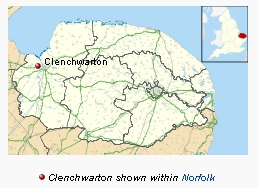 Clenchwarton
- It is located on the west side of the River
Great Ouse, about 2 km from the river and from the town of King's
Lynn on the east side of the river
Clenchwarton
- It is located on the west side of the River
Great Ouse, about 2 km from the river and from the town of King's
Lynn on the east side of the river
Len Episcopi = (Bishop's Lynn) - Kings Lynn
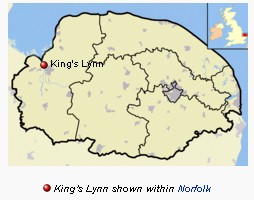 St.
Peters Church West Lynn St
Peter, West Lynn - St. Peters Rd, West Lynn, King's Lynn, Norfolk PE34 3JF
- A small part, known as West
Lynn, is on the west bank. Other districts of King's Lynn include the
town centre, North
Lynn, South
Lynn, Gaywood,
North
Wootton, South
Wootton, and Fairstead.
St.
Peters Church West Lynn St
Peter, West Lynn - St. Peters Rd, West Lynn, King's Lynn, Norfolk PE34 3JF
- A small part, known as West
Lynn, is on the west bank. Other districts of King's Lynn include the
town centre, North
Lynn, South
Lynn, Gaywood,
North
Wootton, South
Wootton, and Fairstead.
West Lynn, Norfolk - is the part of the town of King's Lynn that is west of the River Great Ouse. It is linked to the main part of King's Lynn by a direct passenger ferry or by a circuitous 4 km road journey
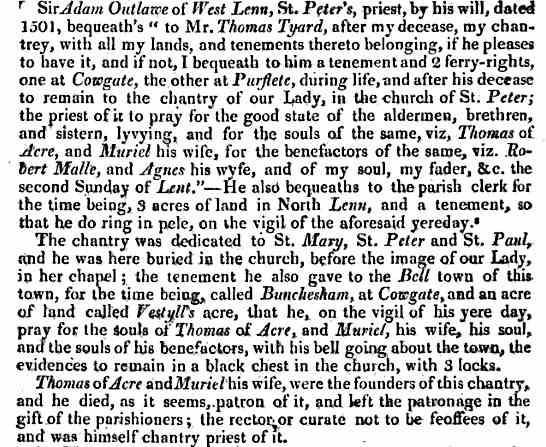 1501
- Sir ADAM OUTLAWE, of West Lynn,
St. Peters, priest, died 1501, leaving a Will, by which he bequeathed
his chantry, lands and tenements thereto belonging, to Thomas Tyard, and after
his decease to remain to the Chantry of "Our Lady" in the Church at
St. Peters, the priest of it to pray for the good state of the aldermen,
brethren, etc., and for the souls of the same, namely: Thomas of Acre and
Muriel, his wife, and for the benefactors, namely: Robert Malle and Agnes his
wife, and for his (Outlaw's) own soul, the second Sunday of Lent. To the parish
clerk he gave three acres of land in North Lynn and to the bellman of the town
he gave the tenement called Bunchesham, at Cowgate, and an acre called
Vestyll's Acre, that he pray for the souls mentioned. Thomas of Acre and
Muriel his wife, were the founders of this chantry, and he died, as it seems,
patron of it, and left the patronage in the gift of the parishioners, the rector
or curate not to be feoffee of it. He served it as chantry priest. Sir Adam
Outlawe, priest, is buried in the church. (Blomefield's History of Norfolk).
1501
- Sir ADAM OUTLAWE, of West Lynn,
St. Peters, priest, died 1501, leaving a Will, by which he bequeathed
his chantry, lands and tenements thereto belonging, to Thomas Tyard, and after
his decease to remain to the Chantry of "Our Lady" in the Church at
St. Peters, the priest of it to pray for the good state of the aldermen,
brethren, etc., and for the souls of the same, namely: Thomas of Acre and
Muriel, his wife, and for the benefactors, namely: Robert Malle and Agnes his
wife, and for his (Outlaw's) own soul, the second Sunday of Lent. To the parish
clerk he gave three acres of land in North Lynn and to the bellman of the town
he gave the tenement called Bunchesham, at Cowgate, and an acre called
Vestyll's Acre, that he pray for the souls mentioned. Thomas of Acre and
Muriel his wife, were the founders of this chantry, and he died, as it seems,
patron of it, and left the patronage in the gift of the parishioners, the rector
or curate not to be feoffee of it. He served it as chantry priest. Sir Adam
Outlawe, priest, is buried in the church. (Blomefield's History of Norfolk).
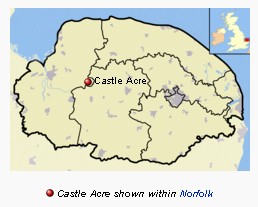 Thomas
of Acre probably refers to
Castle
Acre (Priory ) in Kings Lynn - It is 15 miles (24 km) east of the town of
- King's
Lynn - Home
of Castle Acre Priory
Thomas
of Acre probably refers to
Castle
Acre (Priory ) in Kings Lynn - It is 15 miles (24 km) east of the town of
- King's
Lynn - Home
of Castle Acre Priory
The Book of Margery Kempe also offers such a record, in which places serve as memorial sites on which events from her past can spread and stretch and live out their stories. Events in the Book take place; they occur in a town called N, which we eventually discover to be Kempe's home town of Lynn, an important seaport on England's North Sea, or in Norwich, or in York or London; even more specifically, they occur within churches in these cities, so that the Book offers a detailed map of East Anglian and Yorkshsire parishes and cathedrals in the 15th century. Even within parishes, cathedrals, and priories, Kempe locates her memories according to place, often telling us with great precision where particular visions or conversations occur: she is within the Prior's Chapel, she is praying in the chancel at St. Stephen's Church in Norwich, she is in a chapel of St. James; she prays in St. Margaret's Church in a chapel of the Gesine.
See below and also : Matthew Kemp - Virginia
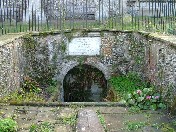 St.
Withburga of Dereham, Abbess of Dereham (Died AD 743) - The
Wuffing Connection
St.
Withburga of Dereham, Abbess of Dereham (Died AD 743) - The
Wuffing Connection
Withburga was the youngest of the saintly daughters of Anna,
Wuffing King of East Anglia.
Her sisters were Ethedreda and Sexburga; they had an elder
half-sister St. Saethrith and an illegitimate half-sister, St. Ethelburga
of Faremoutier-en-Brie. Withburga was also aunt of St. Ermengild
Withburga's Well - East Dereham
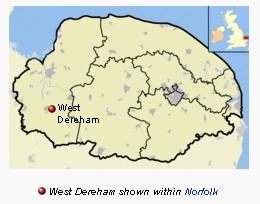 1392
- Priory of Barnwell - John de Bernewelle, or John
Outlawe, elected March 1392, died Nov. 1408 - John de Bernewelle, (fn. 213)
whose personal name was Outlawe; (fn. 214) possibly a canon of West Dereham, and
one of the three brothers of that name
[ The Canons of West Derham were White canons ]
1392
- Priory of Barnwell - John de Bernewelle, or John
Outlawe, elected March 1392, died Nov. 1408 - John de Bernewelle, (fn. 213)
whose personal name was Outlawe; (fn. 214) possibly a canon of West Dereham, and
one of the three brothers of that name
[ The Canons of West Derham were White canons ]
1193 - Hubert Walter
becomes Archbishop of Canterbury - St.Andrew
- His Home is West Dereham Abbey
1507 - Outlaw
(Owtlawe), Thomas, of Mattishall - Will ( 5 miles E.
by S. of East Dereham)
1567 - Outlaw
(Owtelawe), John, elder, joiner, of East Dereham - Will. (A
Joiner - Fine woodworker without using nails)
1572 - Owtlawe,
John, of Ringstead, Norfolk - probate will
1346 - Audham Hertfordshire - Thomas son of James Outlagh of Audham
1346 - Inspeximus by Thomas son of James Outlagh of Audham of a writing made by his said father to John son of Thomas Bounde of his freedom; and release of all claim in the said Thomas Bounde and John his brother, sons of the said John son of Thomas, &c. Dated at Wykemer, Thursday before the Translation of St. Thomas the Martyr, 20 Edward III. - Essex - Aldham - Inspeximus = a royal grant or a grant
This is interesting in that it seems James Outlagh and his son Thomas had "ownership", indentured servitude, over the Bounde men , so he had to be a important person of the time. These would have been villiens "serfs" on his land.
Also I have found a reference for "De Outlagh" in "Hindringham Outlagh Manor" An essay towards a topographical history of the county of Norfolk
The fees held of the Bishop of Norwich, were the manors of Ringsted Magna, Holkham Wake, Cockthorp, Sniterle, Glanford, Sniterle-Morley, South Birlingham Rightwise, Boyton South Birlingham, Hindringham Outlagh , ... in Norfolk
Parishes - Aldenham British History Online - Eldeham, xi cent.; Audenham, xiii cent.; Audham
The abbots of Westminster appear to have leased the manor from time to time. In 1361 it was leased to John de Ditton, clerk, with a stipulation that he should not cut the timber, that he should erect a new water mill, and pay the abbot and convent of St. Albans the 4s. yearly which was reserved in the agreement between the two monasteries above mentioned. From: 'Parishes: Aldenham', A History of the County of Hertford: volume 2 (1908), pp. 149-161. URL: http://www.british-history.ac.uk/report.aspx?compid=43264 Date accessed: 15 October 2010.
Aldenham - is a village and civil parish in Hertfordshire, approx. three miles north-east of Watford and two miles from Radlett. It was mentioned in the Domesday Book and is one of Hertsmere's 14 conservation areas. This secluded little village remains unspoilt and the parish itself is largely unchanged since Saxon times when the majority of the land was owned by the Abbots of Westminster Abbey.
1403 - BAAS ( Broxbourne ) Manor - Hertfordshire - Simon Outelawe
All the places in HITCHIN which were not in Harold's hands in 1066 were held BY HIS 'MEN' (Hitchin is in Herfordshire)
 1210~
- Margam
Abbey - John, son of Ralph Utlage, of
the land in the meadow of Leowine, known as Lewin's-mead, near to St.
James' Church, Bristol. - dated in the early years of the
thirteenth century.
1210~
- Margam
Abbey - John, son of Ralph Utlage, of
the land in the meadow of Leowine, known as Lewin's-mead, near to St.
James' Church, Bristol. - dated in the early years of the
thirteenth century.
1392 - Simon Outelawe, Michael Brailes plaintiffs - 1392 Sept. 29.-Oct. 5] York - Premises: 9 messuages, 18 shops in Bristol and suburbs
1398 - Simon Outlawe, Walter Chertheseye, William Chertheseye give Robert Corbet', knight, 100 shillings of rent in Hoddesdon and Amwell.
Notice one record is dated by Rich II and the next Henry IV Simon Utlawe seems to due well under Henry IV... :
1399 - Richard
II surrendered to Henry at Flint
Castle on 19 August 1399 - Richard's life after the deposition
is unclear
1399 - King
Henry IV on 13 October was crowned
1403 - Simon Outlawe at Baas Manor - Hertfordshire.- Westminster.- 20 marks of rent issuing from the manor of Baas and from 40 messuages, 4 carucates of land, 100 acres of meadow, 100 acres of pasture, 100 acres of wood and 20 pounds of rent in Hoddesdon', Brokesburne, Amwelle, Wormlee and Chestunt.- Richard Spyce and Isabel have granted to William Skrene and John Martyn the rent, which John Charteseye and Simon Outlawe, tenants of the aforesaid manor and tenements, were accustomed to render to Richard Spyce and Isabel, to receive each year by the hands of the aforesaid tenants and their heirs - William Skrene and John Martyn have given them 100 marks of silver. - 4 Henry [IV] [3 February 1403]. Image Page
On 2 April, 14 Henry VI. 1436, John Martyn, one of the justices of our lord the King (Thirty years later)
Unfortunately, the fortunes of John Charteseye and Simon Outelawe did not last long:
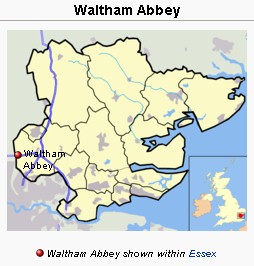 Waltham Abbey,
Essex - The name Waltham derives from weald or wald
"forest" and ham "homestead" or
"enclosure". The name of the ancient parish as a whole is Waltham
Holy Cross Waltham reverted to the King (Edward
the Confessor), who gave it to the Earl
Harold
Godwinson (later king). Harold rebuilt Tovi's church in stone around 1060,
in gratitude it is said for his cure from a paralysis, through praying before
the miraculous cross.
Waltham Abbey,
Essex - The name Waltham derives from weald or wald
"forest" and ham "homestead" or
"enclosure". The name of the ancient parish as a whole is Waltham
Holy Cross Waltham reverted to the King (Edward
the Confessor), who gave it to the Earl
Harold
Godwinson (later king). Harold rebuilt Tovi's church in stone around 1060,
in gratitude it is said for his cure from a paralysis, through praying before
the miraculous cross.
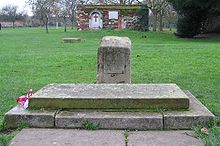 Legend
has it that after Harold's death at the Battle
of Hastings in 1066, his body was brought to Waltham for burial near to
the High Altar. Today, the spot is marked by a stone slab in the churchyard (originally
the site of the high alter prior to the reformation).
Legend
has it that after Harold's death at the Battle
of Hastings in 1066, his body was brought to Waltham for burial near to
the High Altar. Today, the spot is marked by a stone slab in the churchyard (originally
the site of the high alter prior to the reformation).
The grave of King Harold - see : Earl Godwin his son Earl Harold and his "Utlagh" men
Hertfordshire - History
of Hertfordshire - King
Henry IV moved his government temporarily to St Albans early in his
reign for fear of public opinion in London.[45]
He married Catherine
of France on 2 June 1420, and gave her Hertford Castle.[46]
Queen Elizabeth I lived at Hatfield
House near Hatfield
as a girl. When plague ravaged London, she held parliaments
at Hertford Castle[51]
in 1564 and 1581. (Baas Manor is very close to Hertford Castle)
House of Knights Templars - Preceptory of Temple Dinsley British History Online
Templar Treasure
Tunnels, page 1
BBC - Legacies - Myths and Legends -
Hertfordshire's Templar mystery - Article Page 1
 David Tree -
he chose to retire from acting and pursue life as a gentleman farmer. Having
inherited a Victorian School house and three cottages in East
Herts, he converted them to handsome dwellings. Since the property included
the wall of 15th-century house known as Baas Manor, he combined the cottages,
creating Baas Manor Farm.
David Tree -
he chose to retire from acting and pursue life as a gentleman farmer. Having
inherited a Victorian School house and three cottages in East
Herts, he converted them to handsome dwellings. Since the property included
the wall of 15th-century house known as Baas Manor, he combined the cottages,
creating Baas Manor Farm.
Film Locations Don't Look Now - Baas Manor Farm
related: Temple_Dinsley_History - Hertford Castle
A history of Hoddesdon in the county of Herfordshire About 1250 Dominus Henry de Bathonia or de Bathe, knight and judge, owned nearly all the Broxbourne lands other than the demesne and church lands. No record of the grant of these has come to light, but down to the time of the dissolution' 20s. per annum was paid to the Prior of the Hospital of St. John of Jerusalem for the lands of Baas," as of his manor of Broxbourne". ... Baa's manor is the original of the name 'Baas', pronounced 'Base',... three other (sub) manors contained in these and held by Bathonia, namely Gerkyns, Maryons, and Halle, the last two rented from the Knights of St. John. ...the site of Baas manor is a mile from the nearest part of Hoddesdon
Broxbourne Manor records:
1328 - John de Chertsey, clericus
1381 - Father of John Charteseye - John
Chertsey, clothier, owner of Asselyne's Warf in London
1400 - John Charteseye son of John Chertsey
1424 - Thomas Gloucester holds in succession to a Robert de Chertsey.
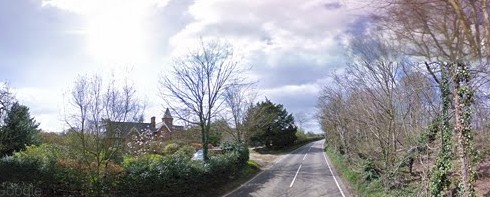 A History of Brickendon
The Broxbourne Bits
In 1066 the manor of Broxbourne was held by Stigand, Archbishop of
Canterbury. By 1086 it was in the possession of Adelaide, wife of Hugh de
Grandmesnil; later Ivo, the son and heir of Hugh, gave the manor to the monks of
Bermondsey Abbey, Surrey, about a mile south of the present Tower Bridge in
London. However, Ivo had previously mortgaged his lands to Robert, Count of
Meulan and first Earl of Leicester, and so with the agreement of the monks
of Bermondsey, Robert took possession of Broxbourne. In 1198 the manor was in
the possession of the Knights Hospitallers of St John of Jerusalem, the only
military-religious order of the Catholic Church that still survives to this day.
In about 1544, following the confiscation of the properties of the Hospitallers,
Henry VIII granted the manor to John Cock of Tewin, former bailiff of
the estate for the Knights Hospitallers.
A History of Brickendon
The Broxbourne Bits
In 1066 the manor of Broxbourne was held by Stigand, Archbishop of
Canterbury. By 1086 it was in the possession of Adelaide, wife of Hugh de
Grandmesnil; later Ivo, the son and heir of Hugh, gave the manor to the monks of
Bermondsey Abbey, Surrey, about a mile south of the present Tower Bridge in
London. However, Ivo had previously mortgaged his lands to Robert, Count of
Meulan and first Earl of Leicester, and so with the agreement of the monks
of Bermondsey, Robert took possession of Broxbourne. In 1198 the manor was in
the possession of the Knights Hospitallers of St John of Jerusalem, the only
military-religious order of the Catholic Church that still survives to this day.
In about 1544, following the confiscation of the properties of the Hospitallers,
Henry VIII granted the manor to John Cock of Tewin, former bailiff of
the estate for the Knights Hospitallers.
History of Hoddesdon in the county of Herfordshire Family names ... Of irregular names we have a curious instance in Simon Outlawe, a man of some position, who was co-feoffee with John Chertsey in the manor of Baas, ...
1381 - Father of John Charteseye - John Chertsey, clothier, owner of Asselyne's Warf St. Dunstun's Parish London - A Descriptive Catalogue of Ancient Deeds
[Middx.] 2514. Indenture witnessing that John Asselyne has granted to Ralph de Kneton a messuage with quay adjoining in the parish of St. Dunstan by the Tower, London, in Tamyse-strat, on condition that Ralph shall demise to John for his life a chamber with a drain (cloaca) adjacent in the east part of the aforesaid quay, with a stable underneath it, with free access night and day to the said quay, stable and chamber with horses, carts, and men, with reversion to Ralph at John's death ; Ralph paying John for life 10 mares yearly for the residue of the messuage and for the said quay, and repairing all the premises. If Johu die within a year from the present date, Ralph shall pay his executors 20 mares within a month of such decease. Witnesses:—John Lovekyn, Mayor, John de Brykelesworthand Thomas Irlond, sheriffs of London, and others (named). Sunday after the Invention of Holy Cross, 10 May, 40 Edward III. Seal.
A. 2530. Release by Geoffrey Kneveton, of co. Derby, to John Ive, rector of St. Michael's of Wodstrete, and Sir Laurence Kelleshulle, chaplain, of all his right in the quay called 'Asselyne's Warf' with buildings thereon in St. Dunstan's parish, London, and grant of the reversion of all the tenements that John Asselyne holds for life on the said quay; all which premises they had by feoffment of Master Ralph Kneveton his brother, formerly the King's baker. 8 March, 45 Edward III
Release "John Ive" rector of St. Michael's to John Asselyn holds for life on the said Quey - 8 march 45 Edward III
Appendix IV - Documents relating to the port of London British History Online - Gibsons Quay. Formerly called Asselynes Wharf after John Asselyne, who owned it in 1366, it was purchased by Sir Christopher Draper a few years before the survey of 1559. (fn. 12) The quay, with one jibbet, was let in 1582 for £50 a year to William Wiggens. It was subsequently known by his name.
Map of port of London British History Online - No. 9 Gibsons Quay: image
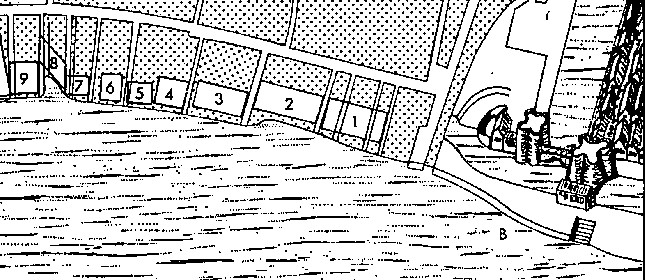
Gibson's quay seems to be gone now and it was between the Sugar Quay building and the customs House - Imported sugar from the plantations brought in with slave ships used to be unloaded at Sugar Quay, then taxed, before being taken for barter at the Royal Exchange
Gibsons
Quay.
Formerly called Asselynes Wharf was West of lane called
Watergate, and south of Thames Street, Watergate is to be identified with Water
Lane, then the site of this Quay or Key is now covered by the Custom House.
Inquisitions - 1581 Abstracts of Inquisitiones Post Mortem for the City of London Part 3 (pp. 32-43)
Christopher Draper, Knight. Writ dated at Westminster 23 June, 23 Eliz. [1581]. Delivered into court the last day of October, 23 Eliz.
Inquisition taken at the Guildhall [no date given], before John
Braunche, Knight, Mayor and escheator, after the death of Christopher
Draper, knight, ... Christopher Draper was seised in his demesne
as of fee of 1 messuage commonly called the Gallie in the parish of St. Dunstan
in the East, in London, in the occupation of Clement Draper; and
of a certain other large messuage called Asheling Wharfe and formerly
called Puckman Wharfe and afterwards called Crechurche-wharfe and late
called Gibson's Key,
situate in the said parish.
...
The said messuage called Gibson's Key
is held of the Queen by the service of the 20th part of a knight's fee and the
yearly rent of 23s., and is worth per ann., clear, £8. The messuage
called the Gallie is held of the Queen in free burgage of the City of London and
not in chief, and is worth per ann., clear, £5.
| - - -
Agnes Hickman.
Inquisition taken at the Guildhall, 5 June, 42 Eliz. [1600], before Nicholas
Mosley, knight, Mayor and escheator, after the death of Agnes Hickman, late the
wife of William Hickman, esq., by the oath of William Crowche, John
Jenninges, Robert Durrant, Peter Noxton, Cuthbert Lee, Andrew Feilde, Edward
Catcher, Michael Crowche, Richard Kirkby, William Abbott, Nicholas Askwith,
Elias Parry and John Cordell, who say that Agnes Hickman long before her death
was seised in her demesne as of fee as one of the daughters and coheirs of
Christopher Draper late of London, knight, deceased, by hereditary descent,
of the 3rd part of 1 capital messuage, cellars, buildings, yards and other
houses of merchandize thereto belonging, situate in a certain street called
Thames Street in London, in the parish of St. Dunstan in the East in the
ward of or the Tower; the 3rd part of a wharf commonly called Drapers Key or
Gibson's Key in Thames Street to the said messuage belonging, now or late in
the tenure of William Wiggins; and the 3rd part of 2 messuages, with the
buildings, cellars, houses, &c., thereto belonging abutting upon or adjacent
to the said capital messuage, now or late in the tenure of John Brickett and
Robert Nunne....The said Robert Draper, to whom the said premises
descended, still survives and is aged 24.
| - - - -
Gibson's Key - A Dictionary of London
West of lane called Watergate, and south of Thames Street,
belonging to Amisia Gibson, 32 H. VIII. (L. and P. H. VIII. Vol. XVI. pp. 239
and 503). In parish of St. Dunstan in the East, 35 Eliz. 1593 (Lond. I. p.m.
III. p. 172).
Former names : "Asselynis Warff" (44 Ed. III. Anc. Deeds, A.
2551). "Asselyns Wharf" (ib. A. 2514). "Asselynes wharf"
(ib. A. 1706). "Asshelynes wharf," 1465-6 (Ct. H,W. II. 553).
"Assheling warffe," 23 Eliz. 1581 (Lond. I. p.m. III. p. 36).
"Pakkemannys Wharf," "Pakenames Wharf," "Pakename
warfe," 7 Rich. II. (Anc. Deeds, A. 1779) ; 1465-6 (Ct. H.W. II. 553) ;
32 H. VIII. (L. and P. H. VIII., XVI. 239). Puckman Wharfe, 23 Eliz. 1581
(Lond. I. p.m. III. p. 36). "Crychurch warffe," 32 H. VIII.
1541 (L. and P. H. VIII. XVI. 239). "Crechurche-wharfe," 23
Eliz. 1581 (Lond. I. p.m. III. p. 36).
Gibson's Key alias "Draper's Keye" formerly in tenure of
Christopher Draper, 35 Eliz. (1593) (Lond. I. p.m. III. p. 172).
These names are obviously derived from the successive owners who were in
possession of the Key from time to time, and they furnish a good example of the
changes of nomenclature that took place in these quays from time to time.
If the lane called Watergate is to be identified with Water Lane, then the
site of this Key is now covered by the Custom House.
Appointed a general place for lading and discharging goods under the Act of
Parliament, 1559 (Strype, ed. 1720, I. ii. 49)
Yes - Water lane separates Sugar Quay from the Customs House.
There is a St. Dunstans' Wharf: This is 142 Narrow Street Poplar in Limehouse:
Fincham / Barton Bendish - Richard Outlawe and son Robert 1417-1431
1419 - Grant.
Richard Outlawe of Fyncham
and Isabella his wife and Robert their son to Geoffrey Stonham of Berton
bendyche.13 Mar 1419
1419 - Richard
Outlawe appoints Richard Reed and Thomas Fullere to
deliver seisin to Geoffrey Stonham of Bertonbendyche of 3 acres of land
in Fyncham - 14 Mar 1419 1419 - Grant.
Richard Outlawe of Fyncham and Isabella his wife
to John Stonham of Berton - 28 Sept 1419
1419 - Grant.
Richard Outlawe of Fyncham to Geoffrey Stonham
of Berton Bendych - 21 Dec 1419
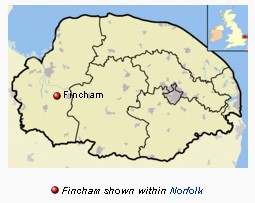 Fincham, Norfolk
- is a civil
parish located approximately 12 miles south of King's
Lynn in the north west of the English
county of Norfolk.
Fincham has a single pub, The Swan, and a single church, St. Martin's church.
The church was built during the Middle
Ages and renovated
by the Victorians.
The village used to have two churches, though one became derelict
and was destroyed by royal bequest. The village, at one time, hosted 5 public
houses.
Fincham, Norfolk
- is a civil
parish located approximately 12 miles south of King's
Lynn in the north west of the English
county of Norfolk.
Fincham has a single pub, The Swan, and a single church, St. Martin's church.
The church was built during the Middle
Ages and renovated
by the Victorians.
The village used to have two churches, though one became derelict
and was destroyed by royal bequest. The village, at one time, hosted 5 public
houses.
Fincham history - Medieval Fincham - By 1460, Fincham's agricultural land had doubled to 1850 acres, including pasture (from 843 at Domesday). By 1575, there were 2000 acres. St Michaels was a Norman building, spacious with a square tower. It passed under the control of Shouldham Priory in 1350. St Martins had an effective Perpendicular rebuild in around 1450
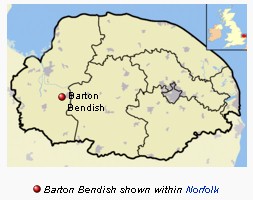 Barton Bendish
- is a village and a civil
parish in the English
county of Norfolk
[1]
. The village is 7.6 miles east of Downham
Market, 38.6 miles west of Norwich.
The village lies 14.4 miles south of the town of Kings
Lynn.
Barton Bendish
- is a village and a civil
parish in the English
county of Norfolk
[1]
. The village is 7.6 miles east of Downham
Market, 38.6 miles west of Norwich.
The village lies 14.4 miles south of the town of Kings
Lynn.
1458 - Owtelawe, John, of Weasenham, Norfolk - Grant of Administration - Will (This is near King's Lynn and near West Dereham)
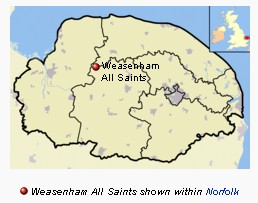
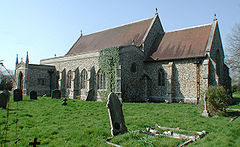 Cambridge University Library Online -
Coke of Weasenham Papers
Cambridge University Library Online -
Coke of Weasenham Papers
The papers of the Coke family of Weasenham Hall (Norfolk) were acquired by the University Library in 1998. It includes a series of fourteenth century court rolls with accounts for the two manors of Kipton and Northall, which were acquired in 1592 by Sir Edward Coke (1552-1634), Attorney General under Elizabeth I.
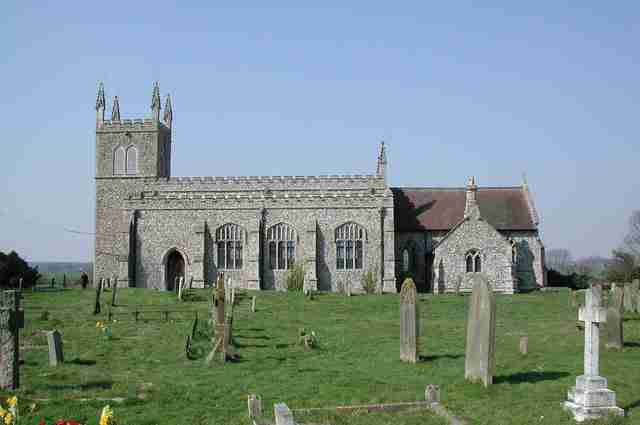 Sir
Edward Coke - (pronounced "Cook") (1 February 1552 – 3
September 1634) was a seventeenth-century English
jurist and Member
of Parliament whose writings on the common
law were the definitive legal texts for nearly 150 years. Born into a
family of minor Norfolk
gentry, Coke traveled to London
as a young man to make his living as a barrister.
There he rapidly gained prominence as one of the leading attorneys of his time,
eventually being appointed Solicitor
General and then Attorney
General by Queen
Elizabeth.
Sir
Edward Coke - (pronounced "Cook") (1 February 1552 – 3
September 1634) was a seventeenth-century English
jurist and Member
of Parliament whose writings on the common
law were the definitive legal texts for nearly 150 years. Born into a
family of minor Norfolk
gentry, Coke traveled to London
as a young man to make his living as a barrister.
There he rapidly gained prominence as one of the leading attorneys of his time,
eventually being appointed Solicitor
General and then Attorney
General by Queen
Elizabeth.
As Attorney General, Coke famously prosecuted Sir Walter Raleigh and the Gunpowder Plot conspirators for treason.
In 1606, Coke was made Chief Justice of the Court of Common Pleas, later being elevated, in 1613, to Lord Chief Justice of England. During this period, Coke became fabulously wealthy, eventually coming to own 105 properties.[5]
Sir Edward Coke was born at Mileham, Norfolk, the son of a barrister from a Norfolk family. Mileham is a village mid way between East Dereham and Fakenham in Mid Norfolk.
The Saxon Priory's were less supported after the conquest....except by other Saxon's.
1463 - Outlawe, Thomas, capellanus, of Walsyngham Parva - Will (Capellanus meaning "chaplain") The priory passed into the care of Canons Regular sometime between 1146 and 1174.
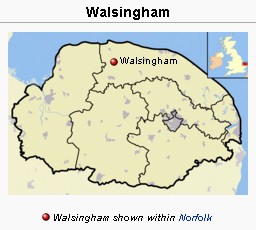
 Walsingham's history as a pilgrimage centre stretches back to Saxon times.
In 1061, during the reign of Edward the Confessor, Richeldis, the widow of the
lord of the manor of Walsingham Parva, had a vision in which Our Lady appeared
to her and took her in spirit to Nazareth. Here she was shown the the place
where the Angel Gabriel had appeared to her at the Annunciation. She was told to
take note of the measurements of the Holy House and to build a reproduction of
it in Walsingham, to be a place of pilgrimage; England's Nazareth. Richeldis had the vision three times, and then hastened to carry out the
instructions she had received. The matter was put in the hands of skilled
carpenters, but the question arose, where should the house be built? There seem
to be two traditions:
Walsingham's history as a pilgrimage centre stretches back to Saxon times.
In 1061, during the reign of Edward the Confessor, Richeldis, the widow of the
lord of the manor of Walsingham Parva, had a vision in which Our Lady appeared
to her and took her in spirit to Nazareth. Here she was shown the the place
where the Angel Gabriel had appeared to her at the Annunciation. She was told to
take note of the measurements of the Holy House and to build a reproduction of
it in Walsingham, to be a place of pilgrimage; England's Nazareth. Richeldis had the vision three times, and then hastened to carry out the
instructions she had received. The matter was put in the hands of skilled
carpenters, but the question arose, where should the house be built? There seem
to be two traditions:
The first tradition states that a spring of water erupted at the location where the house was to be built. This holy well became part of the great Augustinian Priory in which the Holy House built by Richeldis was later enshrined. The second tradition states that during the night there was a heavy fall of dew, but in a certain meadow two spaces of about equal size remained quite dry. Richeldis took this as a sign that the house was to be set up on one of these plots, and chose the one that was close to a well (the Holy Well?).
Pilgrims came in huge numbers. They stopped a mile outside Walsingham at the Slipper Chapel to remove their shoes. Kings, nobles, and ordinary folk entered England's Nazareth as equals to worship Jesus, the Son of God and child of Mary.
Destruction - The upheavals of the Reformation, as a result of King Henry VIII's dispute with Rome brought about the suppression of the Shrine in 1538. The statue of Our Lady of Walsingham (Mary holding Jesus on her knee) was taken to London to be burnt. The Priory was dismantled and left in ruins. This could have been the end of the story, however late in the 19th Century interest in the antiquities of Walsingham began to revive...
Norfolk Churches - Little Walsingham - In the Middle Ages, the shrine of Our Lady at Walsingham was second only to the Shrine of St Thomas of Canterbury in its significance to English pilgrims. By the 12th century, a Priory had grown up here at Walsingham, and pilgrims, unable to visit the real Nazareth in the Holy Land because of its conversion to Islam, came to England's Nazareth instead.
Saxon noblewoman Richeldis de Faverches had a vision of recreating the house where Jesus's birth was announced by Gabriel. Thus was the legend of Walsingham born.
The story starts with Richeldis' vision of creating a shrine at Walsingham. According to one legend ghostly workers assembled the materials gifted by Richeldis into the Holy House. Succeeding generations built on the shrine, erecting the Priory around it, which became the Augustinian Walsingham Abbey helped by royal patronage over the years, until the reign of Henry VIII, who had it destroyed in 1538.
Our Lady of Walsingham - Wikipedia, the free encyclopedia
Our Lady of Walsingham is a title used for Mary, the mother of Jesus. The title derives from the belief that Mary appeared in a vision to Richeldis de Faverches, a devout Saxon noblewoman, in 1061 in the village of Walsingham in Norfolk, England. Lady Richeldis had a Holy House built in Walsingham which became a shrine and place of pilgrimage.
In passing on his guardianship of the Holy House, Richeldis's son Geoffrey left instructions for the building of a priory in Walsingham. The priory passed into the care of Canons Regular sometime between 1146 and 1174.
Walsingham is a village (actually two conjoined villages: Little Walsingham and Great Walsingham) in the English county of Norfolk. The village is famed for its religious shrines in honour of the Virgin Mary and as a major pilgrimage centre. It also contains the ruins of two medieval monastic houses.[1][2]
Walsingham became a major centre of pilgrimage in the eleventh century. In 1061, according to the Walsingham legend, an Anglo-Saxon noblewoman, Richeldis de Faverches, had a vision of the Virgin Mary in which she was instructed to build a replica of the house of the Holy Family in Nazareth in honour of the Annunciation. Her family name does not appear in the Domesday Book.
When it was built the Holy House in Walsingham was paneled with wood and contained a wooden statue of an enthroned Virgin Mary with the child Jesus seated on her lap. Among its relics was a phial of the Virgin's milk. Walsingham became one of Northern Europe's great places of pilgrimage and remained so through most of the Middle Ages. ...
Many were the gifts of lands, rents and churches to the canons of Walsingham and many were the miracles sought and claimed at the shrine. Several English kings visited the shrine, including Henry III (1231 or 1241), Edward I (1289 and 1296), Edward II in 1315, Edward III in 1361, Henry VI in 1455, Henry VII in 1487 and finally Henry VIII, who was later responsible for its destruction when the shrine and abbey perished in the Dissolution of the Monasteries. Erasmus, in fulfilment of a vow, made a pilgrimage from Cambridge in 1511 and left as his offering a set of Greek verses expressive of his piety. Thirteen years later he wrote his colloquy on pilgrimages, wherein the wealth and magnificence of Walsingham are set forth and some of the reputed miracles rationalised. Two of Henry VIII's wives — Catherine of Aragon and Anne Boleyn — made pilgrimages to the shrine.
Walsingham Parva - GREAT OR OLD WALSINGHAM, AND LITTLE, OR NEW WALSINGHAM.
The King's Manor.
King William seized on this, which was one of King Harold's lordships, and a beruite belonging to
the royal manor of Fakenham, containing 3 carucates of land, 13 villains, 7 borderers, with one carucate in demean, 2 carucates among the tenants, paunage for 10 swine, and acre and half of meadow, 2 mills, 2 horses, 5 cows, and 24 sheep; and there were 8 socmen, with one carucate of land; 2 borderers also belonged to it, half an acre of meadow, the moiety of a mill, and 3 carucates: all this was valued in
Fakenham.
...
The Earl of Clares Lordships.
Rainald, son of Ivo, obtained two of the principal manors in these towns, on the Conquest:
one in Great Walsingham, of which Ketel a freeman, was deprived... The same Rainald had also the
grant of a lordship in Walsingham Parva, on the deprivation of the aforesaid
Ketel,
...
Walsingham Priory.
The widow lady of Ricoldie de Faverches, dwelling in Walsingham Parva, founded there, in or about
1061, a chapel in honour of the Virgin Mary, in all respects like to the Sancta Casa at Nazareth, where the Virgin was saluted by the angel Gabriel on a vision of the Virgin enjoining her
thereto; (fn. 6) a pretence generally made use of in like foundations. Sir Geffrey de Faveraches, her son, soon after the conquest, endowed it, granting to Edwin, his clerk or chaplain, this chapel of St. Mary, with the church of All-Saints in the said
town, with its appertenances in lands, tithes, rents, services, &c. which the said
Edwin possessed the day he went to Jerusalem; viz. 20s. per ann. out of his demean, for two parts of the tithe of his land, the land at Snaring, which Hawis gave to God, and the said chapel, 8 acres in the field of the said town, with part of a
meadow. ... The said knight seems to be the first founder of the priory, built the priory church, and gave the chapel of our Lady all the ground within the site of the
church, 8 acres of land, with 20s. rent per ann. out of his manor, if the yearly value of the offerings of our Lady did not exceed 5
marks
...
But the greatest beauty and glory of this priory was the chapel (fn. 10) of the blessed Virgin, which is said to have been
about 8 yards long and 4 yards and 10 inches wide.
...
So great was the fame of this idol or image of the Lady of Walsingham, that
foreigners of all nations came on a pilgrimage to her, insomuch that the number of her devotees and worshippers seemed to equal those of the Lady of Loretto in Italy, and the town of Walsingham Parva owed its chief support and maintenance
thereto.
...
But this so famous image of the Lady was, in the 30th of Henry VIII. brought to Chelsea by London, and there publickly
burnt.
....
In this town of Walsingham Parva was also an house or priory of Grey Friars or Friars Minors, founded by the Lady Elizabeth de Burgh Countess of Clare, who had a patent for it in the 21st of Edward
III.
Houses of Austin canons - The priory of Walsingham
Bishop Latimer wrote a jocular letter to Cromwell in June, 1538, suggesting the burning of the image of the virgin of Walsingham and others: 'they would make a joly mustere in Smythfeld.' (fn. 56) John Husee, writing to Lord Lisle, on 18 June, also attempted to be witty on the same subject.
An Elizabethan ballad entitled 'A Lament for Walsingham,' thus concludes:—
Levell, levell with the ground The Towres doe lye,
Which with their golden glitt'ring tops Pearsed oute to the skeye.
Where weare gates noe gates are new, The waies unknown,
Where the presse of freares did passe, While her fame far was blowen.
Oules doe scrike where the sweetest himenes Lately wear songe,
Toades and serpents hold their dennes Where the palmers did throng.
Weepe, weepe, O Walsingham, Whose dayes are nightes,
Blessings turned to blasphemies, Holy deeds to dispites.
Sinne is where our Lady sate, Heaven turned is to helle;
Sathan sitte where our Lord did swaye, Walsingham, oh, farewell!
1392 - ship
of John Owtelawe, called James of Lynn, departing the last
day of February - customs levied thereon at Lynn (Interesting ~70 years
earlier see above - West Lynn)
1454 - Protection
to John Owtelawe in the retinue of John earl of Worcester - Oct 23 - 33
Henry VI - French Rolls -
John
Tiptoft, Earl of Worcester - "the butcher of England" - in
1449 Lord
High Treasurer and then as Lord
Deputy of Ireland (1456–1457) - King
Henry VI's seizure with madness, in August 1453, supplied York with an
opportunity of getting control of the government without the use of force
against the King. .(A Council of Regency was set up).. the lords came up to
London, early in 1454, with great retinues
1456 - Kings
Lynn - John Outlawe, the son of Richard Outlawe, upon whom was
conferred the freedom of our burgh - Same guys?
1463 - July
21 - Commission
to Robert Cotyngham, master of a ship called le Thomas, to take
mariners for the governance of the same to go to sea with other ships for the
resistance of the king's enemies.
The like to the following :— Richard Outlawe, master of a ship called le
Mari Talbot.
1468 - Robert Deryng of Lynne, maistre of the ship called the Marye of Lynne, wherof is owners Richard Outelawe and Aleyne Thomsone, satth, he sailed from the towne of Lynne towardes Pruce in Dantzike - DRÁP BJÖRNS. - VERZLUN - Kings Lynn and the Medieval Hanseatic League - Lübeck - The Hanseatic City of Lübeck
1481 - 1st Duke of Norfolk - Lord John Howard, commanded the fleet in the war with Scotland with great success - In the late spring of 1481 John Lord Howard sailed into the Firth of Forth destroying and capturing Scottish ships and burning Blackness - Mary of Lynne - take mariners for the said ship, as the king has ordered an armed force to go to sea to resist his old enemy the king of Scots. - The schippes that foloweth goeth to Scotland with the Lord Howard - The Mary of Lynne
Sir Thomas Walgrave may perhaps have been the person designated in this letter as the Master of Carbrooke. At all events, the date is clearly about this time. At Carbrooke, in Norfolk, was a commandry formerly belonging to the Knights Templars, which, like most of the possessions of the order, when it was suppressed in Edward II's time, was given to the Knights of St. John.
NAU Archaeology publications page
|
Hutcheson, A.R.J. |
2007 |
‘The Origins of King’s Lynn? Control of Wealth on the Wash Prior to the Norman Conquest’ Medieval Archaeology 50, 71-104 |
|
Hutcheson, A.R.J. |
2006 |
Excavations at the Preceptory of the Order of St John of Jerusalem, Carbrooke, Norfolk, East Anglian Archaeology Occasional Paper 21 |
The story of William Caxton by Susan Cunnington
...
On another occasion the son, Sir John, writes to his father : ' Please you to
wit that I am at Lynn and am informed by divers persons that the Master
of Carbrooke (a Master of Knights Templars) would take rule in the Mary Talbot
as for captain, and give jackets of his livery to divers persons which he
waged (paid) by other men, in the said ship.
Fenland notes &
queries. A quarterly antiquarian journal for the fenland, in the counties of Huntingdon, Cambridge, Lincoln, Northampton, Norfolk, and Suffolk
" To my right worshipful father, John Paston. " Please you to weet that I am at Lynn, and understand by divers persons, as I am informed, that the master of Carbrooke* would take a rule in the Mary Talbot as for captain, and to give jackets of livery to divers persons which he waged by other men, and not by him, being in the said ship ; wherefore insomuch as I have but few soldiers in mine livery here, to strengthen me in that which is the king's commandment, I keep with me your two men Dawbeny and Calle, which I suppose shall sail with me to Yarmouth, for I have purveyed harness for them, and ye shall well understand by the grace of God that the said master of Carbrooke* shall have none rule in the ships, as I had proposed he should have had, because of his business ; and for this is one of the special causes I keep your said men with me, beseeching you ye take it to none displeasure with me, notwithstanding their herdenj at Wygenhall shall be done this day, by the grace of God, who have you in his keeping.
* Carbrooke is in Norfolk, about midway between Castle Acre and Lynn. There was a society of Knight Templars at that place, and it would be interesting to know if there is any local trace of them now. The master of Carbrooke would mean the head of this society, who (f) was a busy-body and not fitted to act as subordinate under John Paston.
John Paston, the writer of the letter, was brought up in the family of the Duke of Norfolk ; was a soldier, and engaged in French wars ; became heir to his brother in 1479 ; High Sheriff of Norfolk in 1485 ; was made a Knight bannaret at the battle of Stoke in 1487 by Henry VII. ; and died in 1503.
The Pastons a family in the Wars of the Roses by Richard Barber
In May and June both John III and John II were involved in the preparations for repelling any sea-borne invasion. Any royal fleet was usually gathered by 'arresting' merchant vessels for use in war, and John II went to King's Lynn to carry out a warrant for the arrest of a ship called the Mary Talbot, about this time: he wrote to his father:
' This is to let you know I am at Lynn, and gather from various people that the master of Carbrooke wants to take command of the Mary Talbot as captain, or so I am told, and to give jackets of his livery to various people who have been hired by other men, and not by him, who are in the ship....by the grace of God, the master of Carbrooke will have no command in the ships as I intended he should, because of his plots.
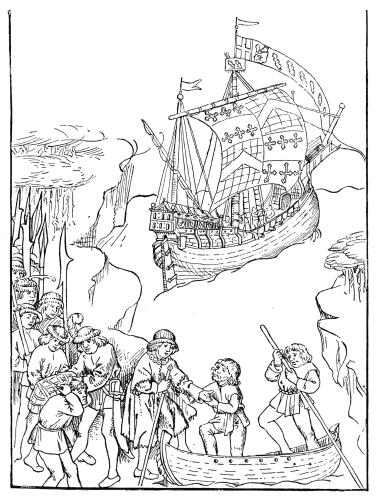 1463 -
August,
my mastyr hath payd Rechard Owtlaw, Mastyr of the Mary
Talbott, at the goynge to the see.
1463 -
August,
my mastyr hath payd Rechard Owtlaw, Mastyr of the Mary
Talbott, at the goynge to the see.
1463 - list
of the retainers who accompanied Sir John Howard to Wales - Crew of
the Mary Talbot of Lynne - Rechard
Owtlawe mayster - John Owtlawe.
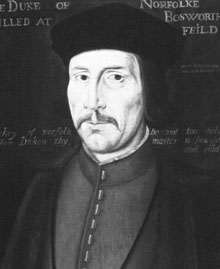 Sir
John Howard, 1st Duke of Norfolk - 12th Baron Segrave, 11th
Baron Mowbray, Earl
Marshal (1421 – 22 August 1485) was an English
nobleman, soldier, and the first Howard
duke
of Norfolk. He was a close friend and loyal supporter of King Richard
III of England[1]
with whom he died in combat at the Battle
of Bosworth.... The Howards were staunch adherents of the House
of York during the Wars
of the Roses, and John Howard, backed by his powerful Mowbray relations,
upheld the Yorkist cause in Norfolk. John Howard died at the Battle
of Bosworth Field on 22 August 1485 along with his friend and patron King
Richard. Howard was the great-grandfather of Anne
Boleyn and Catherine
Howard, the second and fifth Queens
consort, respectively, of King
Henry VIII. Thus, through Anne Boleyn, he was the great-great-grandfather
of Elizabeth I.
Sir
John Howard, 1st Duke of Norfolk - 12th Baron Segrave, 11th
Baron Mowbray, Earl
Marshal (1421 – 22 August 1485) was an English
nobleman, soldier, and the first Howard
duke
of Norfolk. He was a close friend and loyal supporter of King Richard
III of England[1]
with whom he died in combat at the Battle
of Bosworth.... The Howards were staunch adherents of the House
of York during the Wars
of the Roses, and John Howard, backed by his powerful Mowbray relations,
upheld the Yorkist cause in Norfolk. John Howard died at the Battle
of Bosworth Field on 22 August 1485 along with his friend and patron King
Richard. Howard was the great-grandfather of Anne
Boleyn and Catherine
Howard, the second and fifth Queens
consort, respectively, of King
Henry VIII. Thus, through Anne Boleyn, he was the great-great-grandfather
of Elizabeth I.
Memorials of the ancient of Ipswich, in the county of Suffolk By John Wodderspoon -
Sir John Howard was now engaged in assisting the king both by sea and land. Afterwards it will be seen he busied himself greatly in fitting out of ships. His ability and knowledge of the sea caused the king eventually to appoint him to arm and command of the fleet, and defend the coast, namely in 1470.
In 1463, Sir John Howard furnishes forth the ship Mary Talbot for the wars, the crew and men which she carried being collected from Ipswitch, Harwich, Lynn, and other places.* The Mary Talbot carried upwards of eighty persons, who appear to have been paid 2s. each upon entering service. Among them we find John Colpho of Wolverstone, John Dykeman of Erwarton, John Browne of Dovercourt, Nicholas Reed of Nacton, and John Bullen of Chelmondiston, with many others from near neighborhoods.
Many of the men on board the Mary Talbot were impressed into service... Thomas Lynnot was paid 48 s. for impressed 29 men... Richard Felaw attends the setting forth of the vessel.
* Sir John Howard had large possessions at Lynn, When Edward fled the kingdom, Sir J. Howard conveyed him to Lynn, and found him security until he quitted England.
In 1466 Sir John was still busy in building the " new kervelle," which he seems to have christened the " Mary Grase"' he bought " an ashe of ij. yerdes longe, for to make a lanteme and a stok for an image of our lady. In the same year he commanded the vessel which conveyed to Calais the English Commissioners accredited to the Courts of Burgundy and France." His steward notes that he was at Calais from the 15th of May to the 17th of September
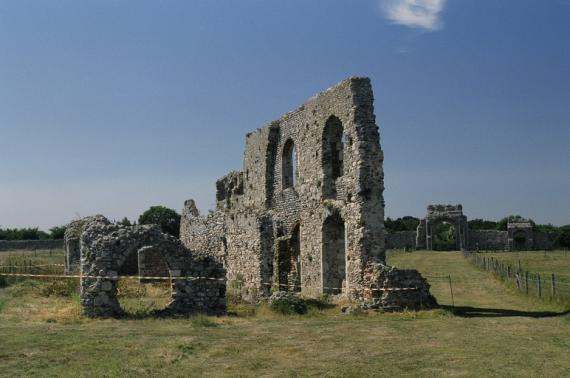 Although
not documented here, I have found elsewhere that The
"Mary Grase" was built in Dunwich
Although
not documented here, I have found elsewhere that The
"Mary Grase" was built in Dunwich
Formerly the early medieval capital of East Anglia, Dunwich is now a small village that over the past eight centuries has been suffering from coastal erosion. Today it is no larger than a few streets, a pub, and a few houses. And, famously, the Flora Tea Rooms, an excellent fish-and-chip shop.
Most of the former town lies underneath the waves, as the local museum demonstrates, and the town has made an industry out of its lost heritage (which included around a dozen churches, a market square, and a guildhall). Walking along the shingle beach it is frequently possible to pick up small artefacts and bits of archaeology (including bones from an eroding cemetery) from the crumbling cliffs overhead.Once a prosperous seaport with a population of 3000 and listed in the Domesday book, the town was largely destroyed by storms in 1286 and 1347, then fell further victim to the eroding coastline. Today, almost the entire town has disappeared, leaving only the remains of a couple of buildings.
Writer Anne Smith puts history into her novels:
Daughter of York - By Anne Easter Smith - ,,, The captain of my vessel, the Mary Talbot..."Richard Outlaw is a good man, in truth, but he did indeed win Fortunata in a game."
It is 1461: Edward, son of Richard of York, ascends to the throne, and his willful sister, Margaret, immediately becomes a pawn in European politics as Edward negotiates her marriage. The young Margaret falls deeply in love with Anthony Woodville, the married brother of Edward's queen, Elizabeth.
Richard Felaw was an Ipswitch man -Ipswich School A merchant and Alderman of Ipswich called Richard Felaw bequeathed his house in what is now Foundation Street to the School, endowing it with lands so that children of needy parents could attend without paying fees. One of the first pupils to benefit from Felaw’s endowment was Thomas Wolsey who never forgot that it was largely thanks to Felaw that he became what he became Lord Chancellor of England
1465 - "Eard" - Crayford - London - Thomas Outlawe - John Outlawe
So is this Thomas the same as the Pewterer Warden in 1501, below? There
have been very few London records for the Outlaw's and I suspect the they are
not readily available on the web. More records are being found as more out
of print books have been scanned. We know that at least a couple of groups of
Outlawe's were active in the naval shipping , owned there own ships were
involved with the Hanse Trading Guild and were active in Lynn and in London.
So where are the record's? Possibly the 1666 London fire is the
reason.
1457 - Kent
- Demise by William Rotheley and John Sharp to John Outlaw of land in a field
called 'Depeden' in the parish of Eard. 35 [Henry VI].
1462 - C.
5006. Grant by William Rotheley of Dertford and John Sharp of Eard to John
Outlawe of Eard of a messuage with garden and arable by Crayfordstrete,
also of a parcel of land and wood at Moltgrove by Groveshern in the
parish of Eard; also of a parcel of meadow in the marsh called Dokelynghope by
Tradehope, which inter alia they had, together with Walter Jolyf since deceased,
by the gift of Thomas Roys and Agnes his wife. 12 March, 2 Edward IV.
1493 - Inquisition taken at the Guildhall - London, 23 March, 8 Henry VII [1493], before William Martyn, Mayor and escheator, after the death of Edward Greene, by the oath of John Machyn, Thomas Outlawe, John Gage, Thomas Couper, William Wodestok, Henry Calvar, Thomas Rayner, Thomas Lybbys, Nicholas Jefray, William Cambre, Richard Spycer, John Broune, John Knyght, Thomas Chamberleyn, and Richard William - GUILDHALL London - Guildhall, London
William Martyn - Sir William Martyn, Lord Mayor of London in 1492 - (c. 1446 – 14 January 1503) - Athelhampton - located five miles (8 km) east of Dorchester, Dorset.... In 1350 Richard Martyn married the de Pydele heiress, and their descendant Sir William Martyn, Lord Mayor of London in 1492, built the current Great Hall in or around 1485. He also received licence to enclose 160 acres (647,000 m²) of deer park and to fortify his manor.
CRAYFORD - LIES the next parish south-eastward from Erith, having the river Thames and that parish for its northern boundary. It appears to have been called, soon after the arrival of the Saxons in this island, by the name of Creccan ford; that is, the ford or passage over the water, then called Crecca. now Cray. (fn. 1)
In the time of archbishop Saint Dunstan, who came to the see of Canterbury, in 960, it was known by the name of Erbede, or Eard, and at the conquest by that of Eard, alias Crayford; by which it continued to be described in all antient deeds and writings to the time of king Henry VIII.
The high London road crosses the southern part of this parish, in which is the village, commonly called Crayfordstreet .
There are now to be seen, as well on the heaths near Crayford, as in the fields hereabout, many artificial caves or holes in the earth, some being ten, fifteen, and others twenty fathoms deep. At the mouth, and thence downward, they are narrow, like the tunnel of a chimney, or passage of a well, but at the bottom they are large and of great compass, insomuch that some of them have several rooms or partitions, one within another, strongly vaulted, and supported with pillars of chalk. In the opinion of the neighbouring inhabitants, they were formerly dug, as well for the use of the chalk, towards building, as for the mending of their lands; but it is most probable that some of them were made for a farther use by the Saxons, our ancestors, who used them as secret hiding places for their wives, children, and goods, as well in times of civil wars as of foreign invasions.
THIS PLACE, in the time of the Saxons, was possessed by one Elfege, a powerful man, who by his will, made in the presence of archbishop Dunstan, about the year 970, gave a third part of his estates in Erhede, and elsewhere, to Christ church, in Canterbury;
Charities.
JOHN MARSHALL, owner of a tenement and 13 acres of marsh ground in this
parish, built an isle adjoining to the church of Crayford, and afterwards by his will devised 6s. 8d. part of the rent, for the repair of it, (fn. 32) and 10s. yearly to the poor to the distributed in the bread and cheese, and the remainder for an obit for ever in the church; other lands in this parish were
likewise given by divers persons for obits, and for the relief of the poor of it. But most probably these donations were seized on by the king's commissioners in king Henry VIIIth or king Edward the VIth's reigns, as having been given to superstitious uses, and the parish by that means has been deprived of any benefit from
them. From: 'Parishes: Crayford', The History and Topographical Survey of the County of Kent: Volume 2
(1797), pp. 263-285.
 Crayford
- is a town and electoral
ward in the London
Borough of Bexley that was an important bridging point in Roman
times across the River
Cray, a tributary of the River
Darent, which is itself a tributary of the River Thames. Crayford is
mentioned in the Domesday
Book as having a church and three mills, and a population of 27 villagers
and 2 smallholders. There were two main Manor Houses in the area during the Middle
Ages, Newbery
Manor on the site of what is now Crayford
Manor House, and Howbury
Manor near Slade
Green. Near to Newbery Manor was May Place, built for the Appleton (Apylton)
family who served Kings Henry
V and Henry
VI.[4]
Crayford
- is a town and electoral
ward in the London
Borough of Bexley that was an important bridging point in Roman
times across the River
Cray, a tributary of the River
Darent, which is itself a tributary of the River Thames. Crayford is
mentioned in the Domesday
Book as having a church and three mills, and a population of 27 villagers
and 2 smallholders. There were two main Manor Houses in the area during the Middle
Ages, Newbery
Manor on the site of what is now Crayford
Manor House, and Howbury
Manor near Slade
Green. Near to Newbery Manor was May Place, built for the Appleton (Apylton)
family who served Kings Henry
V and Henry
VI.[4]
London Borough of Bexley - Prior to the 19th century the area now forming the Borough was practically unoccupied: very few of the present settlements were mentioned in the Domesday Book. There are still open spaces, however, among the suburban streets and avenues. the Borough owns and maintains over one hundred parks and open spaces, large and small; and there is still a part of the Erith Marshes bordering the River Thames. The Crayford Marshes lie to the east of that river, as do Foots Cray Meadows further south.
Thomas Outlawe (Owtlawe) - Pewterers' Company - London - Wardeyn - 1504
1492 - Thomas
Outlawe - 1 acre with a garden on the
southern boundary in Mattishall, the south head of which abutted onto the
King's highway - Mattishall
(Norfolk)
1493 - Inquisition
taken at the Guildhall - London, 23 March, 8 Henry VII [1493], before William
Martyn, Mayor and escheator, after the death of Edward Greene, by the
oath of John Machyn, Thomas Outlawe, John Gage, Thomas Couper, William
Wodestok, Henry Calvar, Thomas Rayner, Thomas Lybbys, Nicholas Jefray, William
Cambre, Richard Spycer, John Broune, John Knyght, Thomas Chamberleyn, and
Richard William - GUILDHALL
London - Guildhall,
London
1493 - Death
of Ellen Wodeward witnessed by Thomas Outlawe
- London - 23 March, 8 Henry VII
1497 - Death
of Richard Chamberleyn witnessed by Thomas
Outlawe - London - 4 March, 12 Henry VII - 1497
History of the Worshipful company of pewterers of the city of London. - Google Books
 The Worshipful
Company of Pewterers is one of the older Livery Companies in the City of London.
It is number 16 in the order of civic precedence among over a hundred companies.
The earliest documented reference to it is in the records of the Corporation
dated 1348 when the "goodfolk, makers of vessels of pewter" came
before the Mayor and Aldermen asking for approval of the Articles which they had
drawn up for the regulation of the trade.
The Worshipful
Company of Pewterers is one of the older Livery Companies in the City of London.
It is number 16 in the order of civic precedence among over a hundred companies.
The earliest documented reference to it is in the records of the Corporation
dated 1348 when the "goodfolk, makers of vessels of pewter" came
before the Mayor and Aldermen asking for approval of the Articles which they had
drawn up for the regulation of the trade.
CHARTERS Edward IV granted the first Charter of the Company on 20th January 1474 (1473 in the calendar of the day). In addition to licensing the Freemen of the Mistery of Pewterers to found a Fraternity, it allowed the Guild to regulate the standard of workmanship, the training of craftsmen and the wages and prices to be set. This Charter granted the Guild the right of search throughout England to ensure the quality of pewter was maintained.
The first Hall, completed in 1496, was destroyed in the Great Fire of London. (1666)
1522 - Acle, Norfolk - Outlawe (Owtlaw), Simon, of Acle - Will
Houses of Austin canons - The priory of Weybridge British History Online
37. THE PRIORY OF WEYBRIDGE (fn. 1)
Hugh Bigod, earl of Norfolk, founded a small house for Austin Canons, dedicated to the honour of
St. Mary, at Weybridge, in the parish of Acle, towards the close of the reign of Henry III. Robert was the first warden or keeper of this humble foundation, and, by an undated deed, the earl granted to Robert and his brethren of the church of St. Mary all his marsh in Acle, with all appurtenances, in free alms.
Roger Bigod, earl of Norfolk, son of Hugh, the patron and founder, granted to Robert the chaplain, the first warden of the house and the brethren of the same, power to elect, after the death of the said warden, one of the brethren in his place, provided that two or three be nominated by them from themselves, or from elsewhere if sufficient be not there found, to be presented to the earl and his heirs, by whom the one that should seem most fitting should be presented to the bishop. From: 'Houses of Austin canons: The priory of Weybridge', A History of the County of Norfolk: Volume 2 (1906), pp. 406-407. URL:
http://www.british-history.ac.uk/report.aspx?compid=38294
In Tudor times, hundreds of oaks were felled here for timber to construct Elizabeth I's war ships.
The village stands beside a vast marshland area which in Roman times was a great estuary called Gariensis. Trading ports were located on high ground and Acle was one of those important ports. Evidence of the Romans was found in the late 1980s when quantities of coins were unearthed in The Street during construction of the A47 bypass. Some properties in the village, built on the line of the beach, have front gardens of sand while the back gardens are on a thick bed of flints. Records show that Acle was a fishing port as far back as Saxon times; the Church tower could possibly have served as a lookout point. Tradition has it that there is a Viking burial site 1 mile north of the village.
It is said that Acle, unlike many Norfolk villages, did not suffer any loss of life during the Black Death; villages which suffered badly were often abandoned afterwards, apart from the Church, and new villages were built a short distance away. Two good examples of this can be seen at Reedham and Horning.
In 1086 when the new Norman masters compiled the Domesday Book it was noted there were 23 villagers, 38 smallholders and three slaves. In 1101 Acle Bridge was opened and by the 12th century the village had a manor. The estuary which gave Acle its raison d’etre gradually silted up and rivers were formed after embankments were created by man during the 13th and 14th centuries. In the coming centuries Acle would continue to be an important trade centre for the surrounding area. There has been a market since the 13th century, but livestock, which was once central to it, has ceased in recent years. When the old saleground was closed, a 12th century rubbish dump was unearthed. Hundreds of pieces of medieval pottery and other artefacts were recovered including oyster shells, whelks and even a boars tusk. They were put on display in Norwich Castle Museum.
The Church, in common with many in East Anglia, is dedicated to St Edmund; the oldest part is the round part of the tower, Saxon or Norman in origin. Other fragments of Norman work have been found, but the nave dates from the 13th century and the north porch, showing good flintwork , and the octagonal part of the tower are 15th century.
Acle was at one time owned by the Crown then by the Earl of Norfolk, and
subsequently, by Lord Calthorpe (who became Lord of the Manor). It is only
comparatively recently that this estate has been broken up. The survey of 1838
lists several other interesting names connected with Acle; it is recorded that
the Dean and Chapter of Norwich owned 331 acres, the Earl of Plymouth 8 acres
and Magdalen College Oxford 2 acres.
...
Near Acle Bridge are the remains of an old priory (Weybridge Priory) founded
in the reign of Edward I (1272-1307) and occupied by Augustinian canons. Its
position in the midst of the marshes did not save the abbey from serious damage
in the rebellion, headed by Robert, Earl of Leicester and Hugh Bigod, Earl of
Norfolk, in the reign of Henry II. From 1168 until 1175 the abbey was in the
king's hand, Prior Adam being in charge of ecclesiastical matters and Wimar the
Chaplain, accounting to the king for the revenue. Owing to the state of
disrepair, the abbey applied in 1327 and was subsequently granted a license
to enclose the abbey with a battlemented wall. At the Dissolution, the abbey
was valued at £7.13.4 and was granted to the Duke of Norfolk. There is
little to see now apart from hummocky areas in a field beside the Acle
Bridge Inn, but the name is preserved in Priory Close near the Church in Acle.
 Acle - The church of St
Edmund is one of 124 existing round-tower
churches in Norfolk.
The round stage of the tower is the oldest part of the church, thought to be Saxon
in origin and of a date between 850 and 950 AD. The octagonal
stage was added in the 13th century, probably when the roof was raised. The battlements
are from 1472. The tower houses six bells, five of which were cast in Norwich
and date back to 1623. The tower is reinforced with a metal frame to enable the
bells to be rung safely.
Acle - The church of St
Edmund is one of 124 existing round-tower
churches in Norfolk.
The round stage of the tower is the oldest part of the church, thought to be Saxon
in origin and of a date between 850 and 950 AD. The octagonal
stage was added in the 13th century, probably when the roof was raised. The battlements
are from 1472. The tower houses six bells, five of which were cast in Norwich
and date back to 1623. The tower is reinforced with a metal frame to enable the
bells to be rung safely.
Entry to the church is by a porch on the north side, built in 1495. The dressed flints are in contrast with most of the walls which appear to be made of rubble.
The main body of the church, the nave, is thought on the evidence of the measurements and wall thickness to be Norman in origin. This is not immediately obvious as no Norman doorways or aches remain. In 1927, when ivy was being strapped from the outside walls, one of the buttresses collapsed revealing a find of Norman-worked stones, which were later reassembled for safekeeping in the rood stair space.
Nowhere, Norfolk - According to 19th-century directories, Nowhere or No-Where is a marshy area by the River Bure where the villagers of Acle, Norfolk had salt-pans to produce salt for food preservation, etc. Originally an extra-parochial liberty it was formally incorporated into Acle parish in 1862 and the name no longer appears in maps and gazetteers. In 1861 there were four inhabited houses and 16 people.
1558 - Owtlawe, Brian, of Forncett St Peter, Norfolk - probate will
Norfolk Churches - Forncett St Peter - Forncett - Forncett St Peter is a village 6 miles south east of the market town of Wymondham and 1 mile north west of Long Stratton. Its church, St Peter, has a fine Saxon round tower and interesting medieval staircase leading to the first floor of the tower.
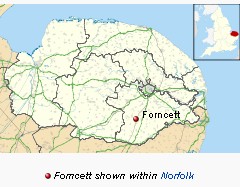
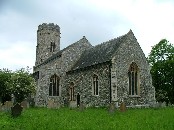
Adam
Owtlawe, Mariner - 1533 - d. 1545 - mariner n. One who navigates or assists
in navigating a ship.
[ He was more than a "seaman" - one who knows
all aspects of sea science - ships - ship building - navigation ]
1533 - London
and Middlesex Fines: Henry VIII - London & Middlesex - Adam
Owtlawe, 'maryner,' - Easter Anno 25 1533
1535 - Sebastian
Newdigate (Nedygate) dies in the Tower for denying the King's
supremacy
1536 - Pilgrimage of Grace
1537 - Jane Seymour dies
after birth of Edward
VI
1537 - Pilgrimage
of Grace Suppression - 216 were put to death; lords and knights, half a
dozen abbots, 38 monks, and 16 parish priests
1538 - Hospitallers
Order of St Thomas was dissolved
, along with other monastic orders in England, by Henry VIII
1539 - Henry VIII had unsuccessfully required the English
knights in Malta to disavow the authority of the Pope.
1539 - SIR THOMAS SPERTT to
MR.
GONSON - Has received Gonson's and the lord Privy Seal's letters. Spertt, William
Hourrey, John Tebowrow, Adam Outlawe, and Richard Couchey have viewed the
Great Nicholas of Bristol, and find no fault except that she draws 3 fathoms of water in ballast and 3½ when laden. Find in her 6 port pieces, 2 slings, a small fowler, 8
bassys, 6 hacbus, 1 new cable, 2 worn cables, 3 hawsers, 3 anchors, 4 tope
armurs, 10 flags, 1 streamer. She is worth 700l. if it were not that she draws so much water.
Portsmouth, 5 Sept. - King Henry VIII papers
From its price and their description of the vessel it can be deduced that it must have been a very large ship. The Great Nicholas carried 21 guns. [ It is interesting that Adam Owtlawe was included in the inspection of this ship, noting that his opinion was of value to the treasurer of the Navy. (Thomas Spert was Head of Trinity House and Comptroller of the navy / William Gonson) ]
1540 - Suppression of the Hospitallers of St. John in England - The Hospitallers could not be described as belonging to a monastic order and so Templecombe escaped in 1536 the suppression of the smaller monastic houses and was not dissolved until 1540, when an Act of Parliament (fn. 3) placed the possessions of the Hospitallers in the hands of the Crown as of an Order more loyal to the pope than to the king and existing for the promotion of superstitious ceremonies.
1540 - King
Henry VIII visits Hull with his Queen.
( Catherine Howard married Henry VIII on 28 July 1540)
1541 - Adam
Owtlawe - (£30) - '1541 London Subsidy roll: Tower Ward - "Lord
Admiral" Sir John Dudley knight
- William Gunston Navy Comptroller
1541 - Margaret
Pole nee Plantagenet, Countess of Salisbury - is executed for Treason
1541 - William Gonson's son David
Gonson, Knight of Malta, is hanged, drawn and quartered at Southwark (London)
1541 - Sir Thomas
Spertt Dies in December
1542 - Catherine Howard and the three men were executed.
1543 - Henry VIII marries Catherine Parr;
makes an alliance between Henry and Charles V (Holy Roman Emperor) against Scotland and
France - Catherine married Henry VIII on 12 July 1543 at Hampton
Court Palace
1543 - Adam
Owtlawe - send four ships to the Downes - Feb 23 - Sir Francis
Brian
to the Kings Council - Scotch prisoners - Feb.19, 1543
| - - - - -
Adam Owtlawe's secret mission with Francis Bryan with
the young
knights Sir John
Clere and
Sir Henry Carey, first Lord Hunsdon ( the natural son of Henry VIII by Mary
Boleyn) and Thomas
Newdegate:
Full text of "Letters and Papers, Foreign and Domestic, Henry VIII" (by Sir Francis Brian)
Example of a Shallop
| - - - - - Report by Sir Francis Bryan :
1543 - Westminster., 19 Feb. Bryan ^ ' that the King is advertised of the troubles we were in upon the seas and the danger and ruin of his ships, and that I was determined according to your commandment to send four ships to the Downes. The said ships were ready in Humber before the receipt of your letters, whereupon I sent a boat which has spoken with Mr. Clere and Mr. Carye, commanding them to lie off and on upon the coast between Humber and Newcastle, and as Mr. Nedygate and Adam Owtlawe were ready victualled I thought it more convenient that they should accompany Mr. Clere and Mr. Carye, than lie in harbour.
As Clere and Carye went forth of Humber they met a Scot of 30 tons laden with salmon, herring and barrelled fish with the lord Admiral's safe-conduct for George Browne and Ant. Papeworth, of Barwike, to bring, in Scottish ships or boats, certain fish to Berwike, Holy Hand, Aylmouth or Stakton at price therein limited (given). As the Scot had passed the places appointed and said he was going to Boston, Sir John [Clere] and Mr. Carye sent him to Hull, and I have stayed him and certified my lord Admiral. Clere also took a French boat, as I reported, which is at Newcastle, and the men, 31 and 3 Dutchmen, brought in the ships to Hull, and I have, by advice of Mr. Stanhop, delivered all 34 to the mayor to keep them and see them gently handled. Begs to know how their charges shall be paid. Here awaits the coming of Mr. Osborn with the King's further pleasure. The French have delivered an inventory of their goods, valued at 500 mks., which is sent to the lord Admiral. Hull, 23 Feb. Signed. Pp. 2. Add. Endd. : a xxxiiij .
[ Notice that Sir Francis addresses his "peers" as Mr. - Mister - (Master) and others like Adam Owtlawe, by their first and last names. ]
| - - - - - -
King Henry VIII's last Hurrah like so many of the characters involved.....
The expedition of 1544:
1544 - The Salamander and the Scottish-built Unicorn were captured at Leith and used as transport for the return journey as part of Lord Hertford's army 14 May 1544 - The Rough Wooing
I would think that Adam Owtlawe would have been part of the Scottish Invasion in May/April 1544 but I'm still looking ...
Burning of Edinburgh (1544) - Orders for the fleet at Tynemouth were given on 28 April. All the ships were to be ready to weigh anchor at a favourable wind. The Lord Admiral, Viscount Lisle's flagship would fly the St George Cross on the fore-top mast and two top-lights at night. The ships of the 'vaward', the vanguard, would follow and anchor as near as possible. Hertford and the treasure-ship (Ralph Sadler was treasurer) would follow with his ensign on the main-top mast of the Rose Lion with two night lights on the shrouds. The Earl of Shrewsbury, captain of the rear-ward would fly the ensign on his mizzen mast, with a cresset light in the poop deck at night. The other ships were not to show flags or lights. Any ship that was transporting base or double base guns was to mount them on the fore-deck for the landing
1544 - Henry VIII and Charles V invades France
Timeline of the Batte of Boulogne - The Tudors Wiki
Sieges of Boulogne (1544–1546) - the Duke of Suffolk, moved to the coast town of Boulogne and laid siege to it on 19 July
1544 - July 1544 Expedition to Calais - Captain Adam Owtlawe
1544 - Henry FitzAllen - April 1544 he was made knight of the Garter. In July 1544 he commanded with Suffolk the English expedition to France as Lord Marshal, and besieged and took Boulogne - Henry lorde marquis of Dorset
Letters and papers, foreign and domestic Henry VIII..
A four masted ship announces her arrival off Calais in July 1544 by firing the fifth gun on her main
gundeck. .... It is
quite possible that this is the Mary Rose shown before she sank in the Battle of the Solent in July 1545.
Appendix Letters and Papers, Foreign and Domestic, Henry VIII, Volume 19 Part 2 (pp. 479-487)
Diary of the Invasion of France.
The English historical review - contains an Account of the Expedition of 1544
 A manuscript in the Cambridge University Library, Dd. 14. 30 (3), contains an account of
the expedition of 1544, written by a steward who lived iat Lydingstone. The writer gives more detail than will be found in the diary printed in
Rymer's `Feodera,' xv. 52, but
his narrative breaks off abruptly at a very early stage.
A manuscript in the Cambridge University Library, Dd. 14. 30 (3), contains an account of
the expedition of 1544, written by a steward who lived iat Lydingstone. The writer gives more detail than will be found in the diary printed in
Rymer's `Feodera,' xv. 52, but
his narrative breaks off abruptly at a very early stage.
W.A.J Archibold.
July 3, 1544 :
 The
3rd day of July 1544 the Noble Prince Charles,
Duke of Suffolk,
Henry lorde
marquis of Dorset and Sir Anthony Browen Knight
[Mr] Master of the
Kings majesty horses, and of his graces Privy Chamber with diverse other
gentlemen set forth from Douer [Dover]
to Callys in a ship called [ blank ] and the said Duke of Suffolk caused the Master of the same ship or the
Captain
thereof called Adam Owtlaw to set in the top of the same, a flag of
Saint George where unto came the Lord Admiral of England
and the Admiral of Flanders with 30 gallant Ships of war, well manned and also well furnished with guns and artillery
and welcomed and saluted the Dukes grace not only with pleasant and loving words
but also with trumpets shames and shooting of great pieces of ordinances that it was
great wonder to hear the great noise of the same gun's and so conducted the Dukes ship to
[the Ryce Banke by Calles, whereas they of The Castle and also
The Ryce Banke saluted and shot great pieces of ordinance and so
welcomed the Dukes Grace likewise
to Callys, whereas he lay off Thursday at night and Friday all day, and of
Friday at night caused a trumpet to be sounded and proclamation to be made every
man to dislodge and to attend upon the Dukes Grace where as he camped iij English
miles off on Callys in a place called Cakewell by Peplyng within the English
Pale and there camped Saturday all night and of Sunday the 6th day of
July, we removed from
thence to a town called Whitsonby on the seaside within the french king's dominion,
where we camped till Friday.
The
3rd day of July 1544 the Noble Prince Charles,
Duke of Suffolk,
Henry lorde
marquis of Dorset and Sir Anthony Browen Knight
[Mr] Master of the
Kings majesty horses, and of his graces Privy Chamber with diverse other
gentlemen set forth from Douer [Dover]
to Callys in a ship called [ blank ] and the said Duke of Suffolk caused the Master of the same ship or the
Captain
thereof called Adam Owtlaw to set in the top of the same, a flag of
Saint George where unto came the Lord Admiral of England
and the Admiral of Flanders with 30 gallant Ships of war, well manned and also well furnished with guns and artillery
and welcomed and saluted the Dukes grace not only with pleasant and loving words
but also with trumpets shames and shooting of great pieces of ordinances that it was
great wonder to hear the great noise of the same gun's and so conducted the Dukes ship to
[the Ryce Banke by Calles, whereas they of The Castle and also
The Ryce Banke saluted and shot great pieces of ordinance and so
welcomed the Dukes Grace likewise
to Callys, whereas he lay off Thursday at night and Friday all day, and of
Friday at night caused a trumpet to be sounded and proclamation to be made every
man to dislodge and to attend upon the Dukes Grace where as he camped iij English
miles off on Callys in a place called Cakewell by Peplyng within the English
Pale and there camped Saturday all night and of Sunday the 6th day of
July, we removed from
thence to a town called Whitsonby on the seaside within the french king's dominion,
where we camped till Friday.
[ blank in manuscript ] ( English Pale - Invaded Land controlled by English
forces)
( It's really irritating that the name of Adam Outlawe's "The Duke's Flag Ship" is blank! .. but it is interesting the guy writing the diary knew exactly who Adam Outlawe was! )
We may be able to determine the name of the ship since it was the ship that carried the Duke of Suffolk, Sir Anthony Brown and the other lords and wanted to signal to Lord Admiral (probably John Dudley ) and the Admiral of Flanders which ship they were on i.e. the "flag ship". So the possible flag ship would have been most likely The Mary Rose, Peter Pomegranate or the Henry Grace à Dieu
This ship may have been The Mary Rose - The Mary Rose and the Cowdray Engravings
The Sister ship was Peter Pomegranate - It had a tonnage of 450 when first built, but in 1536 it was rebuilt and enlarged to a tonnage of 600; at that date the name was shortened to Peter (Catharine had fallen out of grace; she died in 1536).
The other great shipp was Henry Grace à Dieu - ("Henry Grace of God"), also known as Great Harry, was an English carrack or "great ship" of the 16th century. ... Very early on it became apparent that she was top heavy. She was plagued with heavy rolling in rough seas and her poor stability impacted gun accuracy and general performance as a fighting platform. To correct this, she underwent a substantial remodeling in 1536 (the same year as Mary Rose) where height of the hull was reduced. In this new form she was 1000 tons burthen and carried 151 guns of varying size, including 21 of bronze, and her full crew was reduced to between 700 and 800. Furthermore, she got an improved and innovative sailing arrangement with four masts each divided into three sections; the forward two square rigged with mainsail, topsail and topgallants and the aft two carrying five lateen sails between them. This allowed for easier handling of the sails and spread wind forces more evenly on the ship, resulting in better speed and maneuverability and allowed better use of the heavy broadside. The only surviving depiction of the craft (from the Anthony Roll) shows this rebuilt version[2].
Henry Grace à Dieu saw little action. She was present at the Battle of the Solent against French forces in 1545, in which the Mary Rose sank, but appears to have been more of a diplomatic vessel,
The Cowdray engravings are a set of images recording Henry VIII’s campaign in France during the summer of 1544 and the events of 19th July 1545 in
Portsmouth, the Solent and the Isle of Wight, showing the attempt by the forces of the French King, Francis 1st, to invade England and wrest the crown from Henry. One of the most notable events that occurred during the
“Battle of the Solent” was the loss of King Henry VIII’s vice flagship, the Mary Rose, and her sinking is clearly shown in this picture.
Detail from the departure of King Henry VIII from Calais in July 1544 with English ships in the harbour and Calais Castle
above.
The image shows the departure of King Henry VIII from Calais in July 1544. There are identifiable features in the landscape and high on the hill to the south of Calais, in the top right-hand section of the image, is
Sir Anthony Browne greeting King Henry VIII with these events being witnessed by many of their troops. Importantly, in the foreground of this image as there is also a four masted ship, which is equipped with nine guns on its main gundeck, each fitted with lidded gunports.
The fifth gun on the port side is being fired, probably in announcement of the ship’s arrival at Calais. It is not unreasonable to suppose that because the loss of the Mary Rose was an important event shown in the Portsmouth painting,
Sir Anthony Browne would have required an image within the set of paintings which depicted the Mary Rose as she had been before she sank.
This is therefore most probably the last Tudor image made of the Mary Rose afloat.
King Henry VIII followed by Sir Anthony Browne and Sir Charles Brandon 1st Duke of Suffolk
Mary Rose
- ... Very little is known of the
identity of the men who served on the Mary Rose, even when it comes to the names
of the officers, who would have belonged to the gentry. Two admirals and
four captains (including Edward and Thomas Howard, who served both positions)
are known through records, as well as a few ship masters, pursers,
master gunners and other specialists. Of the vast majority of the crewmen,
soldiers, sailors and gunners alike, nothing has been recorded....
The Mary Rose would have carried a captain, a master responsible for
navigation, and deck crew.
The fact that Adam Outlawe was the master of this ship must have been a highlight of his career in the Navy.
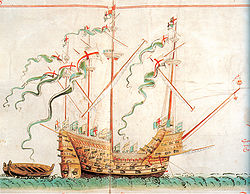 In 1545 Lord
Admiral John Dudley, Viscount Lisle welcomed King
Henry VIII on board the Henri
Grace a Dieu, popularly called Great Harry
In 1545 Lord
Admiral John Dudley, Viscount Lisle welcomed King
Henry VIII on board the Henri
Grace a Dieu, popularly called Great Harry
Ryce banke is Resbank and "Tower of Ruisbank" in Calais and The Castle is the Castle at Calais
Cakewell - Coquelles : Peplyng - Peuplingues : Calles - Calais : Whitsandebaye - Wissant (Whitsand) Bay : Boulogne-sur-Mer
Charles Brandon, "Prince Charles", 1st Duke of Suffolk - Henry FitzAlan, 19th Earl of Arundel - Anthony Browne (died 1548) - Sir John Gage (Tudor politician) - In 1544 he undertook an important role for the invasion of France, organising transport and supplies for the army, and he became a knight banneret.
Admiral of the fleet in 1544 was Thomas Seymour Lord Admiral of England Jan 1544 was Lord Lisle John Dudley Admiral of Flanders 1544 - Maximilian II of Burgandy
"Ryce banke" is Resbank and "Tower of Ruisbank" in Calais and "The Castle" is the Castle at Calais
List
of Captains, Lieutenants and Lords Deputies of English Calais
...
Calais had also castellans
(of Calais
Castle); "Captain of Calais Castle" is a different post
from "Captain of Calais", the title of the top commander and
military governor of the Pale for most of the period.
Calais - The old part of the town, Calais proper (known as Calais-Nord), is situated on an artificial island surrounded by canals and harbours
| - - - - -
The Royal Beer Run of July 1544
Henry VIII - July 1544, 6-10 - The Royal Beer Run
5 July.847. Suffolk and Browne to Henry VIII.
R. O. Winchester reports that he has letters from Mr. Halle declaring that the wagons, lymoners and mares out of Flanders will be at Calais tomorrow, as by Halle's letters to the Privy Council will appear.
Have with their whole number departed from Calais this Saturday because of the scarcity of horsemeat (of which they wrote yesterday) and to leave the town clear against Henry's coming, which they think should now be "the rather the better," and they trust he will here find nothing lacking.
Are tonight encamped at Cawkewell and will tomorrow night lodge in the enemy's ground between Marguison and the sea, 10 miles from Calais, as they wrote yesterday.
Camp at Cawkewell, 5 July. Signed.
7 July.868. Suffolk, Gage and Browne to Henry VIII. - R. O. Have presently received letters from my lord of Norfolk, my lord Privy Seal and Mr. Treasurer, and (being very sorry to see them in that need) have concluded to send 400 or 500 tun of beer, to be conveyed by Flemings, under conduct of the writers' soldiers, to St. Omer's, and thence to their camp under conduct of theirs. For this, Gage departs tomorrow early, to Calais. Will also send them such money as can here be spared, and will rather strain folks here than see them lack, "considering their journey importeth a great matter, and their return without anything doing should not sound all to your Majesty's honor." Enclose their letters. At the camp beside Whitsandebaye, 7 July. Signed.
10 July.882. Suffolk, Gage and Browne to Henry VIII. - Yesterday, received [letters] from the Privy Council [showing] that Henry intends to set forth hitherwards on Friday next. (fn. 14) Expect he will reach Calais in seven or eight days. All victuals are in good order, and of carriage there shall be no lack. The ordnance is arrived and nearly unshipped, but the great pieces will require time to mount. All men are come except those out of Suffolk, Essex and those parts, and such as are appointed to attend the King from Dover. Departed from Calais so soon in order to spare the English Pale against his coming, seeing that there is no hay left, old or new, and, if the grass were spoiled, great lack would ensue at the coming home. Departed when their number was still very small and they had only 14 small pieces and one barrel of powder; but now their number is increased and they have, as instructed, laid 1,000 men at Guisnes, and 600 to defend the East Pale, and now they must send horsemen to St. Omer's to conduct the money appointed to be sent to Norfolk and the lord Privy Seal. By the Council's said letter they are directed to march to Boleigne and begin the siege, leaving the King's own band to tarry for him at Calais.
10 July.883. Suffolk, Gage and Browne to the Council - Enclose letters presently received from Norfolk and the rest of the Council, touching the state of their camp, for whose relief the writers have taken order. From the camp at Whitsandebaye, 10 July. Signed
10 July.885. Suffolk, Gage and Browne to [Norfolk] - Have considered his Lordship's letters and despatched them to the Council. Understand by his trumpet that he marvels that he has received no letters from them since their arrival on this side the sea. If it had been so they could not much blame him; but they have written to him once or twice every day. As to his relief with victuals they despatched 80 tun of beer, and trust that it is received. Have written divers times to know what he wants, so that they may make a staple at Sainct Omer's for him. Albeit he never wrote that he lacked bread, or anything but drink, so that no great store of wheat was sent, they sent 500 qr. of malt, with brewers. After speaking with Jeronimus on Sunday last,* despatched him within one hour to his Lordship, thinking that at the approach to Monsterell he should be there to effect what he had devised. Marvel that he is not yet arrived. "We also understand by your trumpet that the Great Master keepeth no promise with you, which seemeth to us to mean somewhat more than we can now divine. For the situation of Monstrell, the strength of the same and the power that is in it we understand, as well by your letters as by your said trumpet, that the same is nothing so easy to be besieged nor to be had as the King's Majesty hath been informed, and can for our parts say nothing to it, but beseech God to send you as good speed as we would wish ourselves. From the camp besides Whitsandebaye," 10 July. Signed.
1544 - Sept
11 - We assailed the castle yesterday in play, but the defence was so earnest that "a great number of our men are hurt and some slain,
1544 - Sept 14
- The English Capture of Boulonge - The town was restored to the
French on the conclusion of peace (1550). - The town and castle of Boulogne to be delivered to the King tomorrow, 14 Sept., at 10 a.m., with all artillery, powder and
munitions
1544 - William Gonson's wife dies
1544 - Ships
- Great Shallop of Dover (Adam Owtlawe, c) - Cavendishe Shallopp
(Adam Owtlawe, c.) November 28 1544
From: 'Henry VIII: November 1544, 26-30', Letters and Papers, Foreign and Domestic, Henry
VIII, Volume 19 Part 2: August-December 1544
xv. Payments (like those in § ii.) made 14 Sept. for the Dragon (Dunstone Newdigat, captain), Great Pynneas (Robt. Garthe, c), Newe Barke (Thos Windane, c), Lytell Shallopp of Dover (Thos. Huttone, master), Great Shallop of Dover (Adam Owtlawe, c), New Pynnas made by Jamys Baker (John Borlye, c), Swalloo (Wm. Tyrell, c.), Great Gallyon (Sir Wm. Wodhowse, c), Mynyon (Wm. Cornocke, mr.), Lyon (Wm. Broke, c), Mary Jamys (John Bucke, c). Signed by recipients, three of them with marks.
xxiv. Payments (mostly like those in § ii.) made 20 Oct. for the Newe Barke (Thos. Windhame, captain), Lytell Shalloppe (Thos. Huttone, master), Newe Shallopp (John Booerley, c.), Cavendishe Shallopp (Adam Owtlawe, c.), Marye Jamys (John Cranewen, mr.), Greater Pynneas (Robt. Garthe, c.), Post of Deepe (Cornells Durport, mr.) and Facone Lysleye (Thos. Harding, c.). Not signed. (1905), pp. 396-421.
Letters and Papers, .Foreign and Domestic, of the Reign of Henry VIII: pt.1. -
He [Mr. Seymour] and Mister Carey doubt how ... the New Bark will stand the Narrow Seas this winter - Dover - 6 November 1544
Mr. Carey has been sick in bed three days and cannot yet rise to come a-land. Will send with the victuals... the New Barke,... and the Lesse Shalope. The rest remain here until he knows whether the King will have him meet with the fleets coming from Bordyowes, for which purpose he would choose...
"Ships appointed by Mr. Seymour to conduct the victuals from Portesmouth to Bulloyn." ... New Barke
Letters and Papers, Foreign ... - As yet, I hear no word what is become of the Grete Shalop.... by reason of the 'holoues' of the seas, that they were strained continually to pump, and specially ... the New Barke...
The Seymour family, history and romance
...
The news that a French fleet had put to sea, in the autumn of 1544, in order to cut off communication between
Boulogne and England, brought a new honour for Sir Thomas Seymour. He was appointed Admiral of the
King's Navy with instructions to convey a great quantity of provisions to Boulogne.
This accomplished, he was ordered to station the warships in mid-channel, and at the
same time, if possible, to ' appoint a convenient numbre of the small shallopps and other small vessels to passe in the
River Estaples, and there burne and bring away suche vessells of thenmies as may be there found, or do such
other annoyaunce to thenmies as the tyme will serve.'
On the 6th of November 1544 Seymour wrote to the Council advising that he should attack the coasts of Brittany
...A violent storm spoilt an intended attack on some of the enemy's ships which were
lying at Dieppe and in the Seine, and, being obliged to take recourse to the open sea,
his ships were so battered that the next day he reached the Isle of Wight with only part of the fleet,
all the boats having been lost during the night.
The king, being quick to anger, evidently conveyed his dissatisfaction at the failure of the enterprise to the
admiral through the Privy Council. Thus, on the 13th of November, Seymour wrote to the Council that he had
received their letters and 'perseve be the same that I am thought neglegent in the accomplechement of the Kynges
Heynes plesur.
This action appears to be the cause of Adam Owtlawe's death in 1544....
1544 - Owtlawe, Adam, [no place] 21 pynnyng - Prerogative Court of Canterbury - Probate Wills page 397 - Is this the same man? Did he die at sea? He was alive in October, this reference has just the year , no month (FYI - This is the court that would be used for someone who had died at sea).
1545 - Will of Adam Owtlawe - 09 January 1545 - Records of the Prerogative Court of Canterbury - Pynnyng - The PCC was the most important of these courts dealing with relatively wealthy individuals living mainly in the south of England and most of Wales. If a property-owner in England or Wales died overseas, such as sailors or soldiers, then their will was proved in the Prerogative Court of Canterbury regardless of where their property was held. - Adam Owtlawe Will - Had a wife named Alice and a son named Thomas and/or a son named Adam (it is very hard to read, so if know old wills, have a look and let me know.)
1545 - Dec
22 - For a weye of salt delivered to Brymer Outlawe, 30s.
14l. 16s. 8d. - Henry VIII: Papers - Somehow Related? Relative of
Adam? BRYMER is of Belgium origin, a locational name meaning
'one who lived by the sea-shore'. Not a common first name.
The "weye of Salt" may have
been a bereavement gift from Henry VIII no less.
example: Reynold
Calle's will 1501... To Robert Calle, nephew, a ' weye of salte '...To the Nunns
of Bunngaye, one weye of salt...To Ehzabeth Well, niece, 10s., a gowne and the
hood, one weye of salt, a little goblet of silver and 3 silver spoons.... I
still haven't found yet an explanation of the custom.
1545
- Mr. Stanhop was knighted
1546 -
Benjamin Gonson (William Gonson's son) becomes "Surveyor of all
our Shippes" (age 40)
1547 - Henry VIII
dies, Elizabeth was 13 years old, and was succeeded by her half brother, Edward
VI. Edward
Seymour acts as
Protector
1547 - Catherine Parr
married her final husband, Thomas
Seymour
1548 - Catherine Parr dies September 1548
birthing Mary Seymour
1548 - Thomas
Outlawe - King
Edward VI. issued a proclamation, Oct.
1548 - accused of piracy - 300 crown reward -
(Possibly Adam Owtlawe's son - and pirating for Thomas Seymour)
1549 - Lord Thomas Seymour of Sudeley was beheaded for treason on 20 March 1549
1550 - Sir Francis Bryan dies in Ireland (possibly poisoned)
1552 - Sir Stanhop(e) was beheaded.
1552 - Edward
Seymour was executed for conspiracy in 1552
1553 - King
Edward VI died on 6 July 1553, aged 15
1553-1558 - Queen
Mary I Reigns - renewal of Catholic Power - she had almost 300
religious dissenters burned
at the stake in the Marian
Persecutions, earning her the sobriquet
of "Bloody Mary". Thousands imprisoned
1558–1603 - Queen
Elizabeth I begins her Reign - 17 November 1558 – 24 March 1603
1559 - Ther
was a great complaynt made by one Adam Owtelaw to the clarke of the
markett that the brewers and bakers use to measure and streke the corne that
thei bye w' a rolle w ch hathe not be sene in eny other place. - Court on
Wednesday, 21 June [1559] - CITY OF NORWICH. ( This might be
Adam Owtlawe's son )
1561 - James
Bressey - Will
was proved on 25 October 1561. Buried in St. Magnus Churchyard in London
Witnesses: Hamnet Bressey, Robert Byrne, Andrew Outlaw, the writer hereof
- Bressey - was "servant to the Earl of Hertford", Edward Seymour (born
1537).
Edward Seymour was a brother of Jane Seymour, third wife of Henry VIII,
and of Thomas Seymour, who married Catherine Paar, Henry's sixth and last wife,
after the king's death. - Somehow related?
| - - - - - - - - - - -
Now for background on the interesting characters of this story..... This shows the company Adam Owtlawe kept :
| - - - -
It is interesting in inspection of the ship Great Nicholas of Bristol John Tebowrow "Teborow" appears to be John Husee and Lord Lisle's man . John Husee, was a solicitor and servant of the Lisles' . It is interesting who Lord Lisle was then : (Vice Admiral of the Navy and Illegitimate son of Edward IV).
So John Tebowrow served as witness to the inspection of the ship for Lord Lisle
Interestingly Adam Outlawe lived in the Tower Ward along with Lord Admiral John Dudley , Lord Lisle Plantagenet's stepson by his first wife and William Gonson the Paymaster of the Navy , much Later the Trinity Navy House would move to Tower Street Ward (1793-6)
Book 2, Ch. 27 - Tower Ward A New History of London (pp. 668-671)
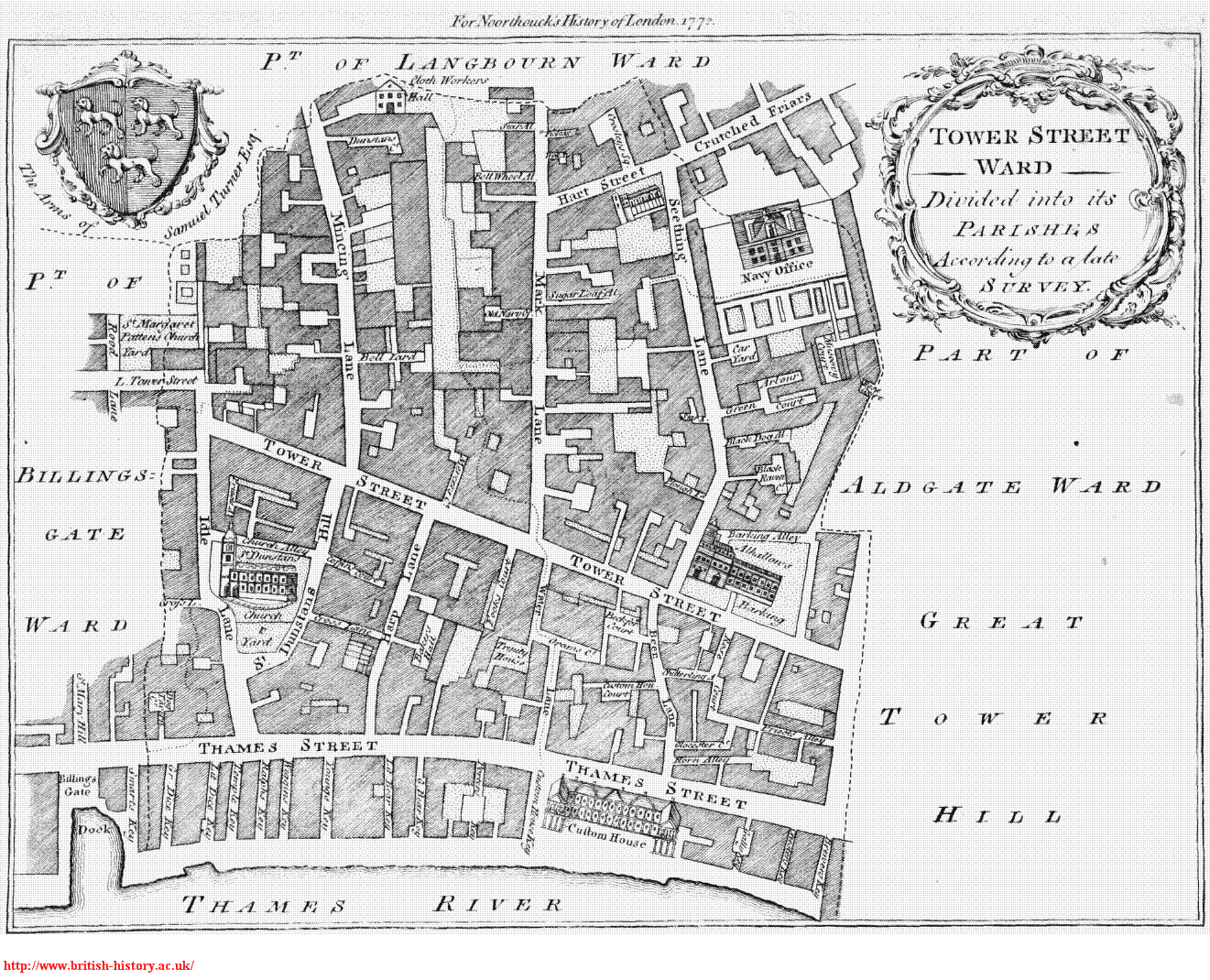
Trinity House.
About the middle of Water-lane, on the west side, stands the Trinity house,
belonging to the fraternity of the Holy Trinity in the parish of Deptford Strond.
This society was founded in the year 1515, by Sir Thomas Spert, knt.
comptroller of the navy to Henry VIII. for the regulation of seamen and the
convenience of ships and mariners on our coasts. ...
I've checked and the records of the Trinity Mariners Guild were destroyed in the great London fire of 1666 so that might have told us where Adam Outlawe was in the Mariner hierarchy , But it is clear that he was very high up if he was inspecting a ship with Thomas Spert the comptroller and lived in the same ward as William Gonson he must have been important.
| - - - -
(Sir Francis Bryan was a distinguished diplomat, soldier, sailor, cipherer, man of letters, and poet.) (Henry VIII)
 England Under The Tudors
Sir Francis Bryan (d. 1550) (early-fifties in 1543)
England Under The Tudors
Sir Francis Bryan (d. 1550) (early-fifties in 1543)
SIR FRANCIS BRYAN* (b. 1490 - d. 1550), poet, translator, soldier, and diplomatist, was the son of Sir Thomas Bryan, and grandson of Sir Thomas Bryan, chief justice of the common pleas from 1471 till his death in 1500. His father was knighted by Henry VII in 1497, was 'knight of the body' at the opening of Henry VIII's reign, and repeatedly served on the commission of the peace for Buckinghamshire, where the family property was settled. Francis Bryan's mother was Margaret, daughter of Humphry Bourchier, and sister of John Bourchier, lord Berners. Lady Bryan was for a time governess to the princesses Mary and Elizabeth, and died in 1551-2. Anne Boleyn is stated to have been his cousin; but we have been unable to discover the exact genealogical connection.1
In 1526 he lost an eye in a tournament at Greenwich, and had to wear an eye-patch from then on. Bryan was a second cousin of both Anne Boleyn and Jane Seymour. No portrait of Sir Francis survives. Catherine Howard married Sir Francis's mother's brother, so was a cousin also.
Sir Francis returned to favour following Cromwell's demise, becoming vice-admiral of the fleet.
In 1543, on the appointment of John Dudley, Lord Lisle as admiral, Bryan was made vice-admiral because of ‘his experience in sea matters’.
As a member of the privy council Bryan took part in public affairs until the close of Henry VIII's reign, and at the beginning of Edward VI's reign he was given a large share of the lands which the dissolution of the monasteries had handed over to the crown. He fought, as a captain of light horse, under the Duke of Somerset at Musselburgh 27 Sept. 1547, when he was created a knight banneret.
Mr
Clere is likey Sir John Clere (b. 1511 - d. 1557) - The Cleres inherited Blickling
Hall and estate in the late 1500s. The previous owners were the Boleyn
family, relatives of Anne Boleyn the second wife of Henry VIII. Edward
Clere had been knighted by Elizabeth I in 1580 and the family was extremely
wealthy. Edward, however, squandered away the fortune and died a bankrupt in
1611. His widow was forced to sell the house.
Sir
John Clere - 1544 - (other
Clere's - Sir Thomas (d. 1544) Sir Edward ) (in his mid-thirties in
1543)
Mr. Carye is
likey Henry Carey, first Lord Hunsdon (1524?-1596), governor
of Berwick and chamberlain of Queen
Elizabeth's household, born about 1524, was 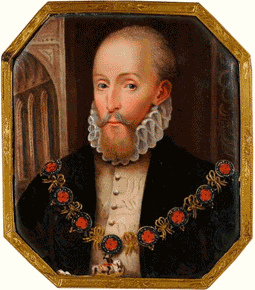
 only son of William Carey,
esquire of the body to Henry
VIII, by his wife Mary, sister of Anne
Boleyn and daughter of Sir
Thomas Boleyn. Through his mother he was first cousin to Queen
Elizabeth. His father died of the
sweating sickness in 1528, and his mother remarried Sir William Stafford,
who died 19 July 1543. (in his early-twenties in 1543)
only son of William Carey,
esquire of the body to Henry
VIII, by his wife Mary, sister of Anne
Boleyn and daughter of Sir
Thomas Boleyn. Through his mother he was first cousin to Queen
Elizabeth. His father died of the
sweating sickness in 1528, and his mother remarried Sir William Stafford,
who died 19 July 1543. (in his early-twenties in 1543)
Carey first comes into notice as member of parliament for Buckingham at the end
of 1547; he was re-elected for the same constituency to the parliaments of April
and November 1554, and of October 1555. In 1549 Edward
VI granted him the manors of Little Brickhill and Burton in Buckinghamshire.
He was knighted by his relative Queen
Elizabeth soon after her accession, and was created Baron Hunsdon on 13 Jan.
1558-1559, receiving on 20 March following a grant of the honour of Hunsdon and
manor of Eastwick in Hertfordshire, together with other lands in Kent.
Henry CAREY (1° B. Hundson) - Said to be son of Henry VIII by Mary Boleyn, officially son of Sir William Carey. The King granted the Carey's actual manors and estates during the affair and immediately before the child's birth.
Sir Thomas Spert - was the first Master of Trinity House in 1514. Born in the late 15th century (date unknown), he died December 1541. He was in turn master of the Mary Rose (before it sank) and the Henri Grâce à Dieu, both ships being flagship to Henry VIII of England. A commoner, he was knighted by Henry at the Palace of Whitehall in 1524. Spert Island off the coast of Antarctica is named for him.
Mr. Nedygate is Thomas Newdegate - a relative of John Newdegate Esq. of Harefield, (or more likely his son John Newdegate Esq.) born 6 Henry VII; dying in 1545 was succeeded by his eldest son. John Newdegate Esq. of Harefield MP for Middlesex in 1571, 1573, 1574
It is interesting that John Newdegate brothers, Sylvester and Duncan, were Knights of St John, and another brother Sebastian who was tortured by Henry VIII for the supremacy thing... He also had a sister/aunt? named Jane who knew Sir Francis Bryan
It is interesting that later in 1561 - Thomas Newdegate was trustee to a will with William Gardiner, someone connected to the MayFlower
Mr. Stanhop is Sir Michael Stanhope - Sir Michael Stanhope (ca. 1518 – 22 January 1552) was a Nottinghamshire landowner and suspected rebel against the English Crown. He was a descendant of the ancient Stanhope family of Rampton, Nottinghamshire. He was knighted in 1545. He was implicated in the events which led to the downfall of his brother in law Edward Seymour, 1st Duke of Somerset, Lord Protector of England, was arrested in 1551, convicted of treason and beheaded in 1552 alongside Sir Thomas Arundell - (he was 25 in 1543)
Mr. Osborn is John Osborne, comptroller of the King's ships - September 1542 - John Osborne, comptroller, of the King's ships and works at Detford and other places within the realm
 Mr. Seymour is Sir
Thomas Seymour - born c. 1508 - executed March 20, 1549
by order of Edward VI's privy council (age 36 in 1544)
Mr. Seymour is Sir
Thomas Seymour - born c. 1508 - executed March 20, 1549
by order of Edward VI's privy council (age 36 in 1544)
4th son of Sir John Seymour
and brother of Jane Seymour & Edward Seymour. His connections ensured his promotion, and he quickly won the favour of the King, who gave him many grants of land and employed him in the royal household and on diplomatic missions abroad. From 1540 to 1542 he was at Vienna, and in 1543 in the Netherlands, where he served with distinction in the war against France, holding for a short time the supreme command of the English army.
In 1544 he was rewarded with the post of master of the ordnance for life, becoming admiral of the fleet a few months later, in which capacity he was charged with guarding the Channel against French invasion.
Thomas Seymour, 1st Baron Seymour of Sudeley - ... Thomas also bribed a man called John Fowler, one of King Edward VI's closest servants, from whom he received information that the King frequently complained about the lack of pocket money he received. Thomas smuggled money to the King and began to voice open disapproval of his brother's administrative skills. As Lord High Admiral, he was able to control the English navy, and he openly asked people for support in case of a coup. As admiral, he also encouraged piracy, after bidding to capture the pirate Thomas Walton (Pirate), Thomas Walton instead made an agreement for a share of all booty seized by him. He was completely and thoroughly indiscreet in his bid for power.
Then there's Mary Seymour who for a time was held at Wexford Ireland:
Mary Seymour - ... Mary was also believed to have been removed to Wexford, Ireland and raised under the care of a Protestant family there, the Harts, who had been engaged in piracy off the Irish coast under the protection of a profit sharing arrangement with Thomas Seymour. A lozenge-shaped ring inscribed "What I have I hold" reputed to have been an early gift to Thomas by his brother Edward passed down through her descendants the Seymour-Harts up to at least 1927.
Edward Seymour was the senior political figure in the reign of Edward VI before he was levered out of power by John Dudley, Duke of Northumberland. Edward Seymour, regardless of his loyalty to the king, was executed for conspiracy in 1552.
Joan Fitzgerald, Countess of Ormond - Lady Joan was born in Desmond Castle, Kinsale, County Cork, Ireland in about 1509[4] or 1514,[5] the daughter and heiress-general of James Fitzgerald, 10th Earl of Desmond and Amy O'Brien. ... she was persuaded to marry the English courtier and diplomat Sir Francis Bryan in August 1548. He was appointed Lord Chief Justice of Ireland and the couple returned to Ireland in November 1548, where she had a son Sir Francis and a daughter, Elizabeth
Francis Bryan was born June 1, 1490 in Munster, County Clare,
Ireland and died Feb 2, 1550 in Clonmel,
Tipperary, Ireland.[ possibly piosoned] He was Chief
Gentleman for the Privy Chamber for Henry VIII of England.
Sir Francis Bryan married Joan Bryan, Duchess of Ormond (born Fitzgerald), they
had two sons, Francis "Justice of Ireland" II and Edward Bryan, Lord
of Upper Ossary. Francis Bryan I parents were Thomas "Thomas de
Bryan" III and Margaret Bryan (born Bourchier).
| - - - --
The Lord Admiral of England
- John Dudley - His mother, married as her second husband in 1511 Arthur
Plantagenet,
the illegitimate son of Edward
IV, who in 1523 was created Viscount Lisle in his wife's right; and Lisle's
rise in Henry VIII's
favour brought young Dudley into prominence. Lord Lisle
made Lord Admiral Jan. 11, 1544
| - - - - -
 Charles
Brandon, duke of Suffolk, was Henry VIII's closest friend.
Charles
Brandon, duke of Suffolk, was Henry VIII's closest friend.
Brandon's father was Henry VII's standard-bearer at the Battle of Bosworth Field and died defending the future king. Henry VII repaid his loyalty by educating young Charles with his own children, and from the beginning Charles and the future Henry VIII were devoted friends. But their friendship was sorely tested when
Brandon secretly married Henry's favorite sister, the beautiful Princess Mary
Tudor { The ship The Mary Grace was named after her. } . At this page, you can learn more about their romantic story and its aftermath.
| - - - - -
 Sir Anthony Browen Knight
[Mr] Master of the
Kings majesty horses, and of his graces privy Chamber - He was
made a Knight
of the Garter in 1540...Sometime after 1540, he married Elizabeth
Fitzgerald, daughter of the 9th Earl
of Kildare, his wife Alice having died....
Sir Anthony Browen Knight
[Mr] Master of the
Kings majesty horses, and of his graces privy Chamber - He was
made a Knight
of the Garter in 1540...Sometime after 1540, he married Elizabeth
Fitzgerald, daughter of the 9th Earl
of Kildare, his wife Alice having died....
| - - - -
 Henry
Lorde Marquis of Dorset is Henry FitzAlan, 19th Earl of Arundel (23 April
1512 – 24 February 1580) was an English nobleman, who over his long life
assumed a prominent place at the court of all the later Tudor sovereigns,
probably the only person to do so.
Henry
Lorde Marquis of Dorset is Henry FitzAlan, 19th Earl of Arundel (23 April
1512 – 24 February 1580) was an English nobleman, who over his long life
assumed a prominent place at the court of all the later Tudor sovereigns,
probably the only person to do so.
...
In 1540 he was appointed deputy of Calais.
He remained there, improving the fortifications at his own expense, until his
father's death in early 1544. He returned to England to assume the earldom, and
was made a Knight
of the Garter. War with France soon brought him back to the continent, where
he spent much of 1544. He then returned to England, where the king appointed him
Lord
Chamberlain.
| - - - - -
William Gonson - Wm. Gonson, paymaster of the King's ships, for " maryne causes," Just a few years earlier his son was executed and a Templar connection....
David Gunston
- Knight of Malta- Ven. David Gonson (Gunston),
Knight of St. John
Martyred at St. Thomas Waterings, Southwark, 12th July, 1541.
1541 - David Gunston - Knight of Malta- Ven. David Gonson (Gunston), Knight of St. John Martyred at St. Thomas Waterings, Southwark, 12th July, 1541. - David Gunston was imprisoned in the Tower of London in 1540 and was condemned to death by an Act of Parliament in 1541 for denying the authority of the King in spiritual matters. He was hanged, drawn and quartered at St. Thomas' Waterings, Southwark on 12 July 1541.
July 7, 1539, Henry VIII had unsuccessfully required the English knights in Malta to disavow the authority of the Pope.
David
Gonson was received into the English Auberge at Malta - on 20th October,
1533, and submitted his "proofs of nobility"; for each applicant for
admission as a Knight of justice must produce proofs of gentle birth, of
legitimacy, of good health, and of good character. David could prove his right
to bear the arms of Gonson quartering Tussell, Walter, Beckett, Young and
Colfax. He was the fourth son of William
Gonson by his marriage with Bennet Walter, sister and heiress of John
Walter.
William Gonson was a Gentleman Usher of the King's Chamber and later
became responsible for the naval administration of this country. In one
contemporary record he is called Vice-Admiral and Paymaster of the Navy. He
did at one time command ships but his principal work was covered by the later
title " Treasurer of Marine Causes," and he is so described in the
Gonson pedigree.
David's eldest brother Benjamin was "Surveyor of all our Shippes" in 1546 and " Treasurer of Marine Causes " in 1549.
Benjamin Gonson - was born Abt. 1506 in Deptford, Kent, England, (he would have been 37 in 1543)
Benjamin's Daughter Katherine married Sir John Hawkins, the famous sea captain. The name Gonson was pronounced as if Goonson, and was sometimes written Gunston. It is as Sir David Gunston that the knight is found in the list of English Martyrs. He was hanged, drawn and quartered at Southwark (London) on 12 July 1541 under the English Act of Supremacy. Blessed David was one of the older sons of Admiral William Gunson, sometime Treasurer of the Navy and Esquire of the Body to King Henry VIII.
The martyr's father, in fact, was William Gonson, captain of the 'Mary Grace' in 1513 and subsequently Paymaster of the Royal Navy. William Gonson's correspondence is plentifully scattered up and down among the state papers of the reign of Henry VIII. A letter to Cromwell mentions his wife in 1536. She died in 1544. Apart from this and his friendship with Cromwell10, Lord Lisle and other important officials, there is nothing personal that can be gathered from these letters.
The death of his son did not affect William Gonson's position. He obtained a grant of arms11 under Henry VIII. His profession is portrayed by the symbolism of a gun between two anchors.
A brass was erected in the church of Melton Mowbray, Leics., to the memory of Christopher Gonson and his wife Elizabeth in 1543 by Bartholomew, Rector of the same church, his son. The inscription states that they had another son William, who was Esquire of the Body to King Henry VIII12. He was, of course, the father of the subject of our enquiry. He named one of the King's ships the 'Christopher Gonson' - doubtless after his own father. Elizabeth Gonson of this brass was the daughter and heir of Roger Trussell of Essex.
William Gonson, Treasurer of the Navy, was the father of Benjamin Gonson, also Treasurer of the Navy and the Grandfather of Dame Katherine Gonson who married Sir John Hawkins, who held the office of Treasurer from 1573, when Benjamin Gonson resigned in favor of his son-in-law, until his death in 1595.
 Admiral
Sir John Hawkins (also spelled as John Hawkyns) (Plymouth
1532 – 12 November 1595) was an English shipbuilder, naval administrator and
commander, merchant,
navigator,
and slave
trader. As treasurer (1577) and controller (1589) of the Royal
Navy, he rebuilt older ships and helped design the faster ships that
withstood the Spanish
Armada in 1588. ... The first Englishman recorded to have taken slaves from
Africa was John
Lok, a London trader who, in 1555, brought to England five slaves from Guinea.
A second London trader taking slaves at that time was William Towerson whose
fleet sailed into Plymouth following his 1556 voyage to Africa and from Plymouth
on his 1557 voyage. Despite the exploits of Lok and Towerson, John Hawkins of
Plymouth is widely acknowledged to be the pioneer of the English slave
trade, because he was the first to run the Triangular
trade, making a profit at every stop. ... John Hawkins formed a
syndicate of wealthy merchants to invest in the slave trade.
Admiral
Sir John Hawkins (also spelled as John Hawkyns) (Plymouth
1532 – 12 November 1595) was an English shipbuilder, naval administrator and
commander, merchant,
navigator,
and slave
trader. As treasurer (1577) and controller (1589) of the Royal
Navy, he rebuilt older ships and helped design the faster ships that
withstood the Spanish
Armada in 1588. ... The first Englishman recorded to have taken slaves from
Africa was John
Lok, a London trader who, in 1555, brought to England five slaves from Guinea.
A second London trader taking slaves at that time was William Towerson whose
fleet sailed into Plymouth following his 1556 voyage to Africa and from Plymouth
on his 1557 voyage. Despite the exploits of Lok and Towerson, John Hawkins of
Plymouth is widely acknowledged to be the pioneer of the English slave
trade, because he was the first to run the Triangular
trade, making a profit at every stop. ... John Hawkins formed a
syndicate of wealthy merchants to invest in the slave trade.
In 1595 he accompanied his second cousin Sir Francis
Drake, on a treasure-hunting
voyage to the West
Indies, involving two unsuccessful attacks on San
Juan. During the voyage they both fell sick. Hawkins died at sea off Puerto
Rico. Drake succumbed to disease, most likely dysentery, on January 27, and
was buried at sea somewhere off the coast of Porto Belo.
1535 - Sebastian
Newdigate (Nedygate) dies in the Tower for denying the King's supremacy
- Arrested on 25 May, 1535, for denying the king's supremacy, he was thrown
into the Marshalsea prison, where he was kept for fourteen days bound to a
pillar, standing upright, with iron rings round his neck, hands, and feet.
There he was visited by the king who offered to load him with riches and
honours if he would conform. He was then brought before the Council, and sent
to the Tower, where Henry visited him again. His trial took place, 11 June,
and after condemnation he was sent back to the Tower. With him suffered Blessed
William Exmew and Blessed Humphrey Middlemore.
Sebastian
Newdigate He was a younger son of John Newdigate of Harefield
Place, Middlesex, king's sergeant, and Amphelys, daughter and heiress of
John Nevill of Sutton, Lincolnshire. He was educated at Cambridge, and on going
to Court became and intimate friend of Henry VIII and a privy councillor
Sebastian Newdigate (died c. 1535) was a Roman Catholic priest and
Carthusian monk, of England
 The
Carthusian Order, also called the Order of St. Bruno, is a Roman
Catholic religious order of enclosed monastics. The order was founded by Saint
Bruno of Cologne in 1084 and includes both monks and nuns. The order has its own
Rule, called the Statutes, rather than the Rule of St Benedict, and combines
eremitical and cenobitic life.
The
Carthusian Order, also called the Order of St. Bruno, is a Roman
Catholic religious order of enclosed monastics. The order was founded by Saint
Bruno of Cologne in 1084 and includes both monks and nuns. The order has its own
Rule, called the Statutes, rather than the Rule of St Benedict, and combines
eremitical and cenobitic life.
 What
is the “Chartreuse” ?
What
is the “Chartreuse” ?
Crusades-Templars
- The Carthusian order is still considered the strictest order of the Roman
Catholic Church - The order famously claims "nunquam reformata quia
nunquam deformata" ("It needs no reform that has never been
deformed.")
- - - - - - - - - - - - So What's a Shallop?
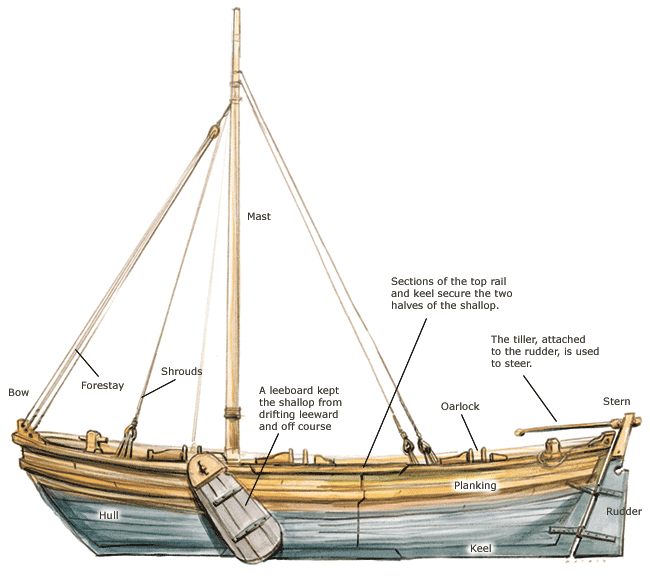 The Shallop –
Captain John Smith Chesapeake National Historic Trail - National Park Service
The Shallop –
Captain John Smith Chesapeake National Historic Trail - National Park Service
In the 1600s, the word “shallop” referred to an open wooden workboat such as a barge, dory, or rowboat. Shallops were small enough to row but also had one or two sails.
Captain John Smith’s shallop could carry 15 men. It was probably about 30 feet long and 8 feet wide. It drew less than 2 feet of water, which was important for navigating the shallow waters of the Chesapeake Bay and many of the tributaries. Like most English boats of the period, the shallop was built of oak planks fastened together with wooden pegs. It had at least one mast and one or two sails made of hemp canvas.
Like a barge, a shallop could carry heavy cargos in shallow water. John Smith described his boat as “open barge neare three tuns burthen”—which meant it could carry up to three tons of cargo. Its exact shape and style remain a mystery. - — it could be powered by oars or sails, travel in deep or shallow waters, and was light enough to pull ashore. In calms, its mast could be lowered and stowed inside the boat.
- - - - - - - - - - - -
Henry VIII Biography
In 1542 Catherine Howard and the three men were executed. In July 1543 Henry
married his sixth wife, Catherine
Parr. She was a good stepmother to Henry's two daughters Mary
and Elizabeth.
Catherine also helped to moderate Henry's religious persecutions. Henry VIII
died in 1547.
1543 - Henry VIII marries Catherine
Parr;
alliance between Henry and Charles V (Holy Roman Emperor) against Scotland and
France
1544 - Henry VIII and Charles V invade
France
Henry's reign marked the birth of English naval power and was a key factor in England's later victory over the Spanish Armada
Henry VIII and Scotland
- In 1543 Henry wrote “A declaration of the cause of war with Scotland”
in which he justified why war against James V was just and why England had a
right to subdue the Scots.
In December 1543 the Scottish Parliament abrogated the treaties it had signed
with England but reaffirmed those Scotland had signed with France. Henry sent
the Earl of Hertford and an army to the Scottish borders. Tthey destroyed
whatever they could so that the region could not support a landing by the French
if one took place in 1544. The show of force was sufficient for some nobles
to swear allegiance to Henry. In September 1545, another attack by the English
on the Borders also destroyed crops and farms.
Humber - Estuary in northeast England formed by the Ouse and Trent rivers, which meet east of Goole and flow east for 60 km/38 mi to enter the North Sea below Spurn Head. It is an important commercial waterway, and the main ports are Kingston upon Hull on the north side, and Grimsby on the south side
Trinity House
- The Corporation came into being in 1514 by Royal
Charter granted by Henry
VIII 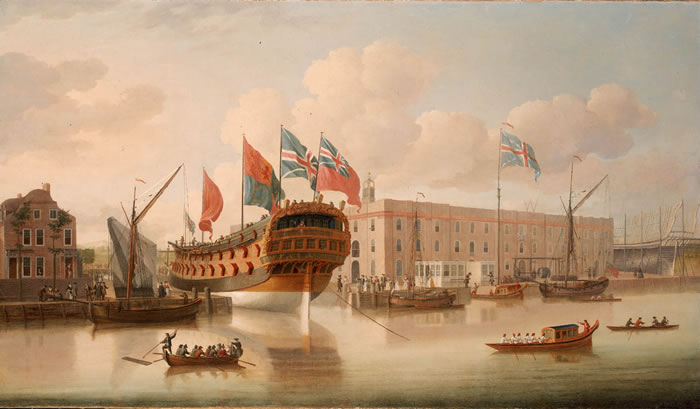 under
the name "The Master, Wardens, and Assistants of the Guild, Fraternity, or
Brotherhood of the most glorious and undivided Trinity, and of St. Clement in
the Parish of Deptford-Strond in the County of Kent." [3].
The first Master was Thomas
Spert, captain of Henry’s flagship Mary
Rose. The name of the guild derives from the church of Holy Trinity and
St Clement, which adjoined the king's new dockyard at Deptford.[4]
under
the name "The Master, Wardens, and Assistants of the Guild, Fraternity, or
Brotherhood of the most glorious and undivided Trinity, and of St. Clement in
the Parish of Deptford-Strond in the County of Kent." [3].
The first Master was Thomas
Spert, captain of Henry’s flagship Mary
Rose. The name of the guild derives from the church of Holy Trinity and
St Clement, which adjoined the king's new dockyard at Deptford.[4]
Queen Elizabeth I in Norfolk 1578 - Star Chamber - Woodhouse vs. Outlawe
Here, Evidently there was some trouble between the Woodhouse's and King's Lynn and The Outlawe's - a star chamber was a serious situation and notice this is happens when QEI makes her trip thru Norfolk in 1578 and stays with the WoodHouse family at Kimberley and Henry's the Vice Admiral and he and brother Roger are Knighted and all - don't mess with the Queen's favorites! : I love the bit for their "Stubborn answers" a 100 pound fine!
While this was going on, in 1578 the reason for the journey from London, QEI was avoiding an epidemic....
1578 - The epidemic of 1578 at Norwich was a far more serious one than that of the capital, and was traced to the visit of the Queen: " the trains of her majesty's carriage, being many of them infected, left the plague behind, which afterwards increased so and continued as it raged above and three-quarter years after."
1578 - Queen
Elizabeth I journeys to and from Norfolk in 1578 - Roger Wodehouse
and his wife Mary Corbet were hosts to Queen Elizabeth I at their
fortified and moated house, Kimberly Tower
1578 - Henry
Woodhouse - Roger Woodhouse made Knights by the queen
1578-1579 - Woodhouse
v. Outlawe -
Court of Star Chamber: Proceedings, Elizabeth I - 21 Eliz - So was
an Outlawe an Alderman of Lynn at the time?
History of the borough of King's Lynn Hillen, Henry J Free Download & Streaming Internet Archive
September 1576 - communication from the Privy Council was addressed to " the Mayor (Christopher Graunt) and his brethren"- ...Some, to whom the election apperteyned, had not so good consideracion as they shold have had ; but without regarding their Lordships advice [they had] made choice of one that had lately been noted before them in the Sterre (Star) Chamber, for some undutifull misdemeanours within that towne much to their sclaunder... The "better choice" refers to the recent election of Gregory Baker on the 29th of August, who was to succeed Christopher Graunt on the 29th of the next month
THE QUEEN IN NORFOLK.
The Queen made several provincial tours. She visited Suffolk (July 1561) and Norfolk (August
1578), when her "progresses" were
unusually extended. At the end of July 1578 she stayed at Long Melford and Hawsted; on the 7th of August her Majesty entered
Bury St. Edmunds, and Euston on the 10th. Great preparations were made at Norwich for her reception, and workmen were brought
from Lynn and Yarmouth to assist. Thomas Churchyard, in the service of Henry Howard, Earl of Surrey, was for three weeks busily
engaged arranging the masques, ceremonies, and festivities. ...
Richard Outlaw -
Pursuivant for Queen Elizabeth I ,and he had a son, William
Outlaw.
Although "priest hunters" were considered a surly bunch,
however, Richard Outlaw along with Colyer and Anthony Atkinson
were "noted"
Pursuivant's, or the manager's of the other "surly ones". Also Richard
attends the Elizabeth's Council at York, so he must have been respected and
presentable. York was the center of the catholic problem and plots of the time.
See Lord Sheffield's note.
This was a time of Transition, QEI would pass away along with William Cecil, Francis Walsingham and Richard Topcliffe, to be replaced by his son Robert Cecil. James I Stuart son of Mary Qeen of Scots, would take power.
Context of the time - So why is the Queen's messenger rounding up Catholic Jesuit priests and throwing them in dungeons?
1587 - Mary,
Queen of Scots - Executed
1588 - Spanish Armada
destroyed attempting to invade England
1590 - Sir Francis Walsingham dies....
 Sir
Francis Walsingham - (c. 1532 – 6 April 1590) is usually
remembered as the "spymaster"
of Queen
Elizabeth
I of England. Walsingham is frequently cited as one of the earliest
practitioners of modern intelligence both for espionage
and for domestic security. He oversaw operations which penetrated the heart
of Spanish
military preparation, gathered intelligence from across Europe,
and disrupted a range of plots against the queen, securing the execution of Mary,
Queen of Scots. Walsingham was one of the small coterie who directed the Elizabethan
state, overseeing foreign, domestic and religious policy, and the subjugation of
Ireland. He
worked to bring Scotland
and England together. Overall, his foreign policy demonstrated a new
understanding of the role of England as a maritime, Protestant
power in an increasingly global economy. He was an innovator in exploration,
colonization and the use of England's potential maritime power. He is also a
convincing prototype of the modern bureaucrat. ... In the realm of counter-espionage,
Walsingham was behind the discovery of the Throckmorton
and Babington
plots to overthrow Elizabeth I, return England to Catholicism and place Mary,
Queen of Scots, on the throne.
Sir
Francis Walsingham - (c. 1532 – 6 April 1590) is usually
remembered as the "spymaster"
of Queen
Elizabeth
I of England. Walsingham is frequently cited as one of the earliest
practitioners of modern intelligence both for espionage
and for domestic security. He oversaw operations which penetrated the heart
of Spanish
military preparation, gathered intelligence from across Europe,
and disrupted a range of plots against the queen, securing the execution of Mary,
Queen of Scots. Walsingham was one of the small coterie who directed the Elizabethan
state, overseeing foreign, domestic and religious policy, and the subjugation of
Ireland. He
worked to bring Scotland
and England together. Overall, his foreign policy demonstrated a new
understanding of the role of England as a maritime, Protestant
power in an increasingly global economy. He was an innovator in exploration,
colonization and the use of England's potential maritime power. He is also a
convincing prototype of the modern bureaucrat. ... In the realm of counter-espionage,
Walsingham was behind the discovery of the Throckmorton
and Babington
plots to overthrow Elizabeth I, return England to Catholicism and place Mary,
Queen of Scots, on the throne.
One of the people Richard Outlawe would have known and worked with early on was Sir Francis Walsingham but all the records for Richard Outlawe are after Walsingham's death in 1590 , after that he would have worked for spymaster Robert Cecil :
1590 - Robert Cecil, 1st Earl of Salisbury - was made Secretary of State following the death of Sir Francis Walsingham in 1590, and he became the leading minister after the death of his father in 1598, serving both Queen Elizabeth and King James as Secretary of State. ... He a protégé of Sir Francis Walsingham (Elizabeth's principal spymaster), he was trained by them in matters of spycraft as a matter of course. For most of his working life he served as spymaster for King James.
1592- William Cecil, 1st Baron Burghley - He collapsed (possibly from a stroke or heart attack) in 1592. Before he died, Robert, his only surviving son by his second wife, was ready to step into his shoes as the Queen's principal adviser. Having survived all his children except Robert and Thomas, Burghley died at his London residence on 4 August 1598
 1593 - Christopher Marlowe
- the foremost Elizabethan
tragedian[2],
next to William
Shakespeare, he is known for his blank
verse, his overreaching protagonists,
and his mysterious death. - A warrant was issued for Marlowe's arrest on 18
May 1593. No reason for it was given, though it was thought to be connected
to allegations of blasphemy—a manuscript believed to have been written by
Marlowe was said to contain "vile heretical conceipts." He was
brought before the Privy
Council for questioning on 20 May, after which he had to report to them
daily. Ten days later, he was stabbed to death by Ingram
Frizer. Whether the stabbing was connected to his arrest has never been
resolved.[3]
1593 - Christopher Marlowe
- the foremost Elizabethan
tragedian[2],
next to William
Shakespeare, he is known for his blank
verse, his overreaching protagonists,
and his mysterious death. - A warrant was issued for Marlowe's arrest on 18
May 1593. No reason for it was given, though it was thought to be connected
to allegations of blasphemy—a manuscript believed to have been written by
Marlowe was said to contain "vile heretical conceipts." He was
brought before the Privy
Council for questioning on 20 May, after which he had to report to them
daily. Ten days later, he was stabbed to death by Ingram
Frizer. Whether the stabbing was connected to his arrest has never been
resolved.[3]
1593 - Father Henry Walpole, when he was in custody of Outlaw the pursuivant, at York, went another way to work to make a Protestant clergyman keep abstinence.... Outlaw himself, in the Queen's uniform, ... Will Outlaw, little Will, the pursuivant's son, listening with all his ears, and the boy's mother, won by the obedience to the lad, refusing the parson the pigeon pie on which he had set his heart. - Dec 4 - The Month Volume 61 - Google Books
... He was asked to return to England in 1593. The Jesuit, his brother and an English soldier sailed together on a French ship headed for Scotland because the southern ports of England were closed because of the plague. On Dec. 4, 1593, the three passengers were put ashore at Flamborough Head, Yorkshire, after 10 days of stormy sailing, but separated on land. Father Walpole was resting at an inn 10 miles inland when he was arrested for being a priest; he had been betrayed by a fellow passenger who was earning money to buy his way out of prison.One night of freedom in England was followed by 16 months of imprisonment. Walpole admitted during his first interrogation that he was a Jesuit and had come to England to convert people. He was transferred to York Castle for three months, and was permitted to leave the prison to discuss theology with Protestant visitors. Then he was transferred to the Tower of London at the end of February, 1594, so that the notorious priest-torturer Richard Topcliffe could wrest information from him. Walpole was tortured brutally on the rack and was suspended by his wrists for hours, but Topcliffe stretched the tortures out over the course of a year to prevent an accidental death.
Walpole endured torture 14 different times before being returned in 1595 to York to stand trial under the law that made it high treason for an Englishman simply to return home after receiving Holy Orders abroad. The man who had once aspired to be a lawyer defended himself ably, pointing out that the law only applied to priests who had not given themselves up to officials within three days of arrival. He himself had been arrested less than a day after landing in England, so he had not violated that law. The judges responded by demanding that he take the Oath of Supremacy, acknowledging the queen's complete authority in religion. He refused to do so and was convicted of high treason.
On April 7, Walpole was dragged out of York to be executed along with another priest who was killed first. Then the Jesuit climbed the ladder to the gallows and asked the onlookers to pray with him. After he finished the Our Father but before he could say the Hail Mary, the executioner pushed him away from the ladder; then he was taken down and dismembered. The Jesuits in England lost a promising young priest whom they had hoped would take the place of Father Southwell; they received another example of fidelity and courage.
Richard Topcliffe
- (14 November 1531 – 1604[1])
was a landowner and Member
of Parliament during the reign of Elizabeth
I of England. He became notorious as a  priest-hunter and torturer and was often
referred to as the Queen's principal "interrogator".
Topcliffe entered the service of the Queen's secretary, William
Cecil in the 1570s, and worked for Sir
Francis Walsingham and the Privy
Council.
priest-hunter and torturer and was often
referred to as the Queen's principal "interrogator".
Topcliffe entered the service of the Queen's secretary, William
Cecil in the 1570s, and worked for Sir
Francis Walsingham and the Privy
Council.
Topcliffe was a fanatical persecutor of Catholics and the Catholic Church, and was involved in the interrogation and torture of many priests and laity, at a time when all Catholics were accused of actively seeking to overthrow the ruling Anglican establishment of England in order to return England to Catholicism.
Topcliffe gained a reputation as a sadistic torturer who frequently played mind games with prisoners under interrogation.[2] He claimed that his own instruments and methods were better than the official ones, and was authorized to create a torture chamber in his home in London. He also involved himself directly in the execution of sentences of death upon Catholic recusants, which involved hanging, drawing and quartering.
1593 - To Richard Owtlaw, pursyvaunt, for arestinge Mr. Robert Ramsden - Arch deacon of York in the church of York upon a tachment - ** A singular incident. The Archdeacon of York, Robert Ramsden, a notorious person, has a writ served upon him in the minster at the suit of the Chapter.
The Reliquary - EXTRACTS FROM THE PARISH REGISTERS OF ST. MICHAEL'S, STAMFORD. - After being under the ban of municipal excommunication nearly two years, he made his peace Aug. 24,1592, in the following terms: "I, Robert Ramsden, am sorrye for myne offence comytted againste the whole corporacon, and doe pmise amendement hereafter and doe submitt my selfe to the alderman and his brethren for my newe fyne to be taxed and sett for my reinfranchizementj and uppon this submissson the saide Robert was refranchised."
Peck, quoting from the corporate roll, states that in the second aldermanship of John Elmes, gent., in 1598-9, that in the latter year some base people had raised some notorious scandals against (Rt.) Meadows and Ramsden, two of the comburgesses; but those things coming to be examined by commissioners, appointed for that purpose, to witt, M r. Allington, Mr. Wingfield, Mr. Lambert, and Mr. William Bodenham; and they appearing to be falsely accused, and those things maliciously suggested, the two comburgesses were cleared, and the wicked detractors punished.
1594 - The Tyrone Rebellion, also known as the Nine Years War from 1594 - 1603
 1594 - Royston,
1594 - A prisoner died, He had been sent up from York, where he was in Outlaw
the pursuivant's custody. Father Grene's MS. records vol iii p. 767 - Records of the English province of
the society of Jesus ... - Google Books
1594 - Royston,
1594 - A prisoner died, He had been sent up from York, where he was in Outlaw
the pursuivant's custody. Father Grene's MS. records vol iii p. 767 - Records of the English province of
the society of Jesus ... - Google Books
 1594/5 - Certificate, addressed to the Lords of the Council, from Edward Mercer, Mayor of Northampton, and John Cater, practitioner in physic there, that Thomas
Gravener, a prisoner on his journey from York to London, in charge of Richard Outlawe, the Queen's
pursuivant, was at the George Inn in Northampton sick in bed of a dropsy, his belly and his legs being so swollen that in their opinion he was not able to travel.—13 Jan.,
- Calendar of the manuscripts of the ... - Google Books
- Thomas
Wyatt - EPITAPH OF SIR THOMAS GRAVENER KNIGHT (Wyatt died in 1452 so this
must be for an earlier Thomas Gravener - his father?) - Sir
Thomas Grosvenor
1594/5 - Certificate, addressed to the Lords of the Council, from Edward Mercer, Mayor of Northampton, and John Cater, practitioner in physic there, that Thomas
Gravener, a prisoner on his journey from York to London, in charge of Richard Outlawe, the Queen's
pursuivant, was at the George Inn in Northampton sick in bed of a dropsy, his belly and his legs being so swollen that in their opinion he was not able to travel.—13 Jan.,
- Calendar of the manuscripts of the ... - Google Books
- Thomas
Wyatt - EPITAPH OF SIR THOMAS GRAVENER KNIGHT (Wyatt died in 1452 so this
must be for an earlier Thomas Gravener - his father?) - Sir
Thomas Grosvenor
1594/5, Jan. 17 - Signifies the death of Gravener the very same Monday after the pursuivant went from Northampton, and therefore before Topcliffe's arrival on Friday to view his state of body, etc. He died like a dumb dog, never showing by utter show one to name God or to think upon God. As well when there was no likelihood of death as when there appeared danger, he would turn his face from the sound of God, and being wished to pray to himself in his own prayers, shunned both the advice and the act himself, so as no appearance of anything but treason to God and to the Queen was discerned to lurk in him. He was buried immediately by the Mayor, and a Coroner's quest did sit upon him, but I being somewhat acquainted with the malice of his church, presume to wish that his body may be taken up again and opened and his stomach examined, thinking some proof will fall out in that act to show that he took poison at Berwick, when he did perceive that he did lie in the net there. It is a resolution taught in the Church to such as to whom they commit these desperate acts and practices, I have found often.
Now, if I may be bold to say it, there remaineth only to know this Gravener's whole heart to enforce his familiar to utter all the secrets that Gravener or the Earl of Tyrone did impart to him (Hailes, the elder, I mean)—a man less savouring of loyalty, obedience, honest religion and humanity than ever I did see, even very red fire itself, and worth seeing and also worth hearing to discern the fury of the Catholic opinion. And it will prove no lost labour, for assuredly by hearsay you cannot believe that disloyalty we simple commissioners do see by their fury expressed, being put to trial. And that is our grief, and mine especially, that we are often taken to be cruel. But God is the witness of all.—Northampton, 17 Jan. 1594. From: 'Cecil Papers: January 1595', Calendar of the Cecil Papers in Hatfield House, Volume 5: 1594-1595. (1894), pp. 77-100.
1594 - On Christmas Eve, 1594, at midnight, Outlaw, another pursuivant, was sent to search a house in or about Winsley Wood, and there he met Anthony Atkinson, the searcher of Hull, who had brought with him thirty men. They entered the house, and after breaking down walls and otherwise damaging the place, arrested Mr Warcop, Jno. Sadler, two menservants, and Father Alexander Rawlings, who were all afterwards imprisoned. - THE BLOCKHOUSES OF KINGSTON-UPON-HULL AND WHO WENT THERE - This Warcop was of Babbington’s conspiracy, and was of counsel with Engleby in all matters, and is a most dangerous person.”
The Babington Plot was the event which most directly led to the execution of Mary, Queen of Scots. This was a second major plot against Elizabeth I of England after the Ridolfi plot. It was named after the chief conspirator Anthony Babington (1561–1586), a young Catholic nobleman from Derbyshire. The plot grew out of two originally separate plans. The first involved a Spanish invasion of England with the purpose of deposing Elizabeth and replacing her with Mary; the second was a plot by English Catholics to assassinate Elizabeth. However, both plots were under the guidance of two of Mary's chief agents in Europe, Charles Paget[6] and Thomas Morgan, the latter being Mary's chief cipher clerk for all her French correspondence
1601- James I of England - From 1601, until the last years of Elizabeth I's life, certain English politicians, notably her chief minister Sir Robert Cecil,[61] maintained a secret correspondence with James in order to prepare in advance for a smooth succession
1601 - WILLIAM
OUTLAWE matriculated Emmanuel College, 1601. (Possibly Richard
Outlawe's Son)
1602 - We have sent
Trollopp to you, in the custody of Richard Owtlawe, the pursuivant attending upon this
Council - July 18 From: 'Cecil Papers: July 1602, 11-20'
We have likewise sent Calverley up under the like pass, as he came into this country from the Bishop of
London
Calverley,
Edmund, priest - Trollop,
Cuthbert, priest - Conflicts
of Jesuits and Seculars in the Reign of Elizabeth
A historical sketch of the conflicts
- Appeal
made Nov 17 1600 by English Priests
1603 - Elizabeth I dies - 24 March - The Queen's health remained fair
until the autumn of 1602, when a series of deaths among her friends plunged her
into a severe depression. In February 1603, the death of Catherine
Howard, Countess of Nottingham, the niece of her cousin and close friend Catherine,
Lady Knollys, came as a particular blow. In March, Elizabeth fell sick and
remained in a "settled and unremovable melancholy".[192]
She died on 24 March 1603 at Richmond
Palace, between two and three in the morning. A few hours later, Cecil and
the council set their plans in motion and proclaimed James
VI of Scotland as king of England
1603- James I of England
- James was proclaimed king in London later the same day - James survived
two conspiracies in the first year of his reign, the Bye
Plot and Main
Plot, which led to the arrest, among others, of Lord
Cobham and Sir Walter
Raleigh.[70]
Those hoping for governmental change from James were at first disappointed when he
maintained Elizabeth's Privy
Councillors in office, as secretly planned with Cecil,[70]
but James shortly added long-time supporter Henry
Howard and his nephew Thomas
Howard to the Privy Council, as well as five Scottish nobles
1604 - Richard Topcliffe
- died in November or December 1604 in his bed at the age of about 72.
1605 - Gunpowder Plot
- in earlier centuries often called the Gunpowder
Treason Plot, was a failed assassination attempt against King
James I of England and VI of Scotland by a group of provincial English
Catholics led by Robert
Catesby - Among the plotters was Guy
Fawkes,
1606 - April 6 - Information of Richard Outlaw, Pursuivant, relative to the apprehension of John Vavasour, alias Healey, and the obtaining from him the key of his chamber in Carnaby's house. From: 'James I: Volume 20: April, 1606', Calendar of State Papers Domestic: James I, 1603-1610 (1857), pp. 308-314.
1609 - Edmund
Sheffield, 1st Earl of Mulgrave - was a member of the councils of the
Virginia Company (23 May 1609)
1611 - Nov. 26. Lord
Sheffield to the Same. Sends up the prisoners by Rich. Outlaw, Pursuivant,
whose service he commends. The poverty of the Courts of the North now
prevents their paying any rewards or even fees. Was obliged to conduct the
search for these prisoners at his own charge.
1614 - Owtlawe, Richard, of Sedgeford - probate will (Possibly our pursuivant Richard? last record for him is 1611) Sedgeford 6 km south of the North Sea and 5 km (3.1 mi) east of the Wash. - Norfolk Churches - Sedgford St. Mary's Round Tower Church - referred to as 'Saxo-Norman', meaning that the design is Saxon but built after the Norman conquest
1614 - March 6. Statement by Leonard Rountree of four articles to prove the superiority of the Protestant over the Romish faith, which were sent to him by Dr. Favour; of his replies thereto; and conversations upon them with William Outlaw, Mr. Burton, and Mr. Harwood. (William Outlawe - Richard Outlawe's son ?)
1624 - Married Thomas Wright, of Ripon, and Jane Outlawe, widow, of St. Michael-le-Belfrey, York - St Michael le Belfrey, York - The church is famous for being the place where Guy Fawkes was christened on 16 April 1570
1625 - Outlawe, Richard, Yorke (Bur. St Michaels of Belfrays, June 11, 1625) - Most likely the pursuivant
| - - - - - - - - - - - -
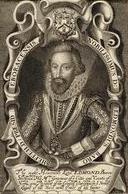 Edmund Sheffield, 1st Earl of Mulgrave
- KG
(c. 1564–1646) was a British peer
and Member
of Parliament, who served as Lord
Lieutenant of Yorkshire from 1603 to 1619 and Vice-Admiral
of Yorkshire from 1604 to 1646. He was created Earl
of Mulgrave in 1626. In
1588 he commanded the White Bear, one of the queen's ships, in the defeat of the
Spanish Armada. Suspicions of his religion caused by the fact that he had
married a catholic were said to be the cause of his ill-success. Yet he seems to
have been suspected very unjustly, and a letter from the north in 1599 praises
his zeal in apprehending priests. ‘He will undertake any service against the
papists, for God hath called him to a very zealous profession of religion’. He
also interested himself in colonization, and was a member of the councils of
the Virginia Company (23 May 1609), and of the New England Company (3
Nov. 1620). In the latter capacity he was one of the signers of the first
Plymouth patent on 1 June 1621
Edmund Sheffield, 1st Earl of Mulgrave
- KG
(c. 1564–1646) was a British peer
and Member
of Parliament, who served as Lord
Lieutenant of Yorkshire from 1603 to 1619 and Vice-Admiral
of Yorkshire from 1604 to 1646. He was created Earl
of Mulgrave in 1626. In
1588 he commanded the White Bear, one of the queen's ships, in the defeat of the
Spanish Armada. Suspicions of his religion caused by the fact that he had
married a catholic were said to be the cause of his ill-success. Yet he seems to
have been suspected very unjustly, and a letter from the north in 1599 praises
his zeal in apprehending priests. ‘He will undertake any service against the
papists, for God hath called him to a very zealous profession of religion’. He
also interested himself in colonization, and was a member of the councils of
the Virginia Company (23 May 1609), and of the New England Company (3
Nov. 1620). In the latter capacity he was one of the signers of the first
Plymouth patent on 1 June 1621
The Sheffield family descended from Sir Edmund Sheffield, second cousin of Henry VIII, who in 1547 was raised to the Peerage of England as Baron Sheffield of Butterwick and in 1549 was murdered in the streets of Norwich during Kett's Rebellion.
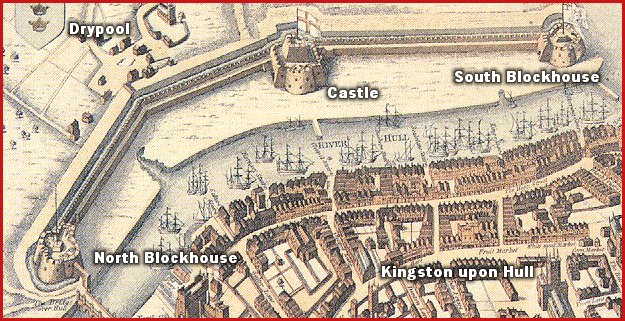 Hull Castle - was situated in what is now the city of Kingston
upon Hull in the historic county of the East
Riding of Yorkshire, England
(grid
reference TA104287).
This was a coastal fortress built by Henry
VIII between 1538
and 1544. It was
the most northerly of these fortresses and the last to be built during his
reign. It was sited between two blockhouses
and connected to them by a curtain
wall. Around 1680
it was absorbed into the Citadel and used as a magazine. It was finally
demolished in 1863.
Hull Castle - was situated in what is now the city of Kingston
upon Hull in the historic county of the East
Riding of Yorkshire, England
(grid
reference TA104287).
This was a coastal fortress built by Henry
VIII between 1538
and 1544. It was
the most northerly of these fortresses and the last to be built during his
reign. It was sited between two blockhouses
and connected to them by a curtain
wall. Around 1680
it was absorbed into the Citadel and used as a magazine. It was finally
demolished in 1863.
Catholic prisoners were sent to the North Blockhouse at Hull Castle
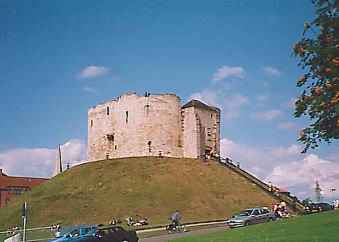 York Castle -
(of which Clifford's Tower is a part) is a fortification in
the city of York, England.
The principal remains of the 13th century - 14th century castle
are the keep and
some of the curtain
wall. From its start in 1068 through to the English
Civil War, the castle had an eventful history.
York Castle -
(of which Clifford's Tower is a part) is a fortification in
the city of York, England.
The principal remains of the 13th century - 14th century castle
are the keep and
some of the curtain
wall. From its start in 1068 through to the English
Civil War, the castle had an eventful history.
In 1536, political leader Robert Aske was hanged above Clifford's Tower on the orders of King Henry VIII, following the failure of Aske's Pilgrimage of Grace protest against the Dissolution of the Monasteries. ...When the English Civil War broke out in 1642, the Royalists under Henry Clifford, the last Earl of Cumberland, took possession of the castle and city of York and garrisoned them. Clifford repaired the castle and strengthen the walls to permit them to support cannon. Baile Hill, which was 20 feet high and had been incorporated into the city walls, also became a gun emplacement.
1603/4-1609 - Henry Outlawe Gentleman in London - Blackfriars Playhouse
So who was this prominent Henry Outlawe Gentleman in London who was involved with the Blackfriars Playhouse in the early 1600's???
1603/4-1609 - Henry Outlawe deposes on Edward Kirkham's behalf that for a total of fifteen weeks between 1603 and 1604, Henry Evans collected 30s a week 'for the use of stools standing upon the stage at Blackfriars.' Outlawe does not believe that Evans gave account of this income to the rest of the sharers. - Blackfriars - St Anne's - London - English professional theatre, 1530-1660
Amazing it seems Henry Outlawe is a
"gentleman" working with Thespians - just after QEI's death and the
beginning of James I.... :
It would seem he had to know Shakespeare... He testifies in 1609 about events in
1603 and 1604. Why was it he that needed to testify?
Blackfriars Playhouse
... Shakespeare and the Blackfriars Theatre - The Elizabethan Playhouse
 In 1600, Richard Burbage leased the Blackfriars to Henry Evans for 21 years for £40 per annum, but in August 1608, Richard Burbage took back the lease from Evans, and William Shakespeare and other King's men players became part owners of what was to become the Blackfriars Playhouse.
William Shakespeare bought a house a short walk away from Blackfriars theatre in Ireland Yard. The acting troupe performed at Blackfriars during the winter months while continuing to spend the summers at the Globe.
In 1619 the local residents again tried to close the theatre but due failed due to the intervention of the Privy Council.
...
The Blackfriars Playhouse Indoor Elizabethan Playhouse Theatre
The known facts about the Blackfriars Playhouse indoor Playhouse, which was used as one of the venues for English Elizabethan Theatre, are as follows:
London Location of the Blackfriars Playhouse indoor Playhouse - Ludgate Hill
The Blackfriars Playhouse indoor Playhouse was opened in - 1576
The famous people associated with the Blackfriars Playhouse indoor Playhouse were Richard Farrant, William Shakespeare and the Burbage family
...
Blackfriars Playhouse - originally a Dominican Monastery
The Blackfriars Playhouse Theatre was located in the City of London on the site of a dissolved 13th-century Dominican monastery.
The original Dominican monastery was built in 1275 and was located between the River Thames and Ludgate Hill.
...
The First Blackfriars Theatre
In 1538 the Dominican monastery of Blackfriars was closed due to the dissolution of the monasteries by King Henry
VIII. The monastery estates, which consisted of many different buildings on a vast area of land, were divided up and sold or leased.
In 1576, during the reign of Queen Elizabeth I, some of the buildings were leased to Richard Farrant who was Master of the boy choristers called the Children of the Chapel Royal. During the Elizabethan era the young boy members of the choirs were also encouraged to participate in drama. These troupes were called Children's companies. These children doubled as child actors and the buildings were used for play rehearsals and private performances prior to the 'Chapel Children' acting troupe performing at court. This was, therefore, the first Blackfriars theatre. The whole district retained the name and when the old refectory was turned into the theatre, the name was used to define its location. Plays were staged there until 1584 when the first 'Blackfriars Theatre' was closed due to various objections from City officials.
Also :
Hubert de Burgh, 1st Earl of Kent - (c. 1160 – before 5 May 1243) was Earl of Kent, Justiciar of England and Ireland, and one of the most influential men in England during the reigns of John and Henry III. ...After the death of William Marshal in 1219, Hubert de Burgh effectively became regent of England. In this position de Burgh acquired a number of enemies and rivals. ... He died in 1243 in Banstead, Surrey, England and was buried at the church of the Black Friars in Holborn.
English professional theatre, 1530-1660 - Glynne William Gladstone Wickham, Herbert Berry
The Blackfriars Company was reorganized under Edward Kirkham
The Blackfriars Company was reorganized under Edward Kirkham, Alexander Hawkins (acting for Evans), Thomas Kendall, and Robert Payne: and on February 4, 1604, it secured a royal patent to play under the title "The Children of the Queen's Revels."
Luminarium Encyclopedia.
The Blackfriars Theatre.
...
In 1596, another part of the old Blackfriars was bought by James Burbage,
owner of the Theatre and father of famed actor Richard Burbage, for £600
from the estate of Cawarden, late Master of Revels. This set of rooms, cellars,
and yards was near the Pipe office, next to the house of Sir George Cary. Burbage
spent an enormous sum to convert these rooms into a private indoor playhouse.
The residents of Blackfriars got an injunction against the theatre being used by
an adult troupe and Burbage had to lease the playhouse to children's
companies—around 1597, the Chapel Children are found in residence.
Richard Burbage, the principal actor with the Chamberlain's
Men, Shakespeare's company, inherited the second Blackfriars Theatre in 1597.
In 1600, he leased it to Henry Evans at an annual rate of £40, for a term of
21 years, and the children's performances continued. The Children of the Chapel
were renamed Children of Queen Anne’s Revels after the accession of James
I in 1603.
After the performance of Eastward Ho (1605), a collaboration between
Jonson, Marston, and Chapman, the Children lost their royal patronage,
because of a passage about Scots in Act III which offended King James so much
that he had the authors briefly imprisoned.
The playhouse ceased to be productive, and Burbage took back the lease from
Evans.
In 1608, Burbage, along with actors from his company, formed a company of
housekeepers, or owners, and began to use the playhouse. The King's Men, as the Chamberlain's
Men were now known, played at the Blackfriars during the winters. Later
works by Shakespeare, as well as works by Beaumont
and Fletcher, were
performed there.
In 1619, Blackfriars residents again tried to close the theatre, citing it as a
public playhouse, but the Privy Council intervened and confirmed its use. The
King's Men performed there without interruption until the closing of the
theatres with the English Civil War in 1642.
Ringstead - Thornham - Sedgeford - Shingham - Stow Bardolph
1513 - Outlaw
(Owtlawe), Richard, of Thornham - probate will
1548 - Owtlawe,
Walter, of Stow Bardolph - probate will - Stow
Bardolph - Norfolk Churches
1572 - Owtlawe,
John, of Ringstead, Norfolk - probate will
1587 - Outlaw
(Owtlawe), Robert, labourer, of Thornham -
Will - Thornham, Norfolk
1596-1597 - Outlaw
(Outely), John, husbandman, of Ringstead Andrew - Will.
- Ringstead -
Norfolk Churches
1600 - Owtlawe,
Thomas, of Shingham -probate will
1600 - Owtlawe,
Robert, of Thornham - probate will
1614 - Owtlawe,
Richard,
of Sedgeford - probate will
 Fragments In Time -
Ringstead, Norfolk The
Ringstead Downs, near the village, are a favourite resort of picnic parties.
Fragments In Time -
Ringstead, Norfolk The
Ringstead Downs, near the village, are a favourite resort of picnic parties.
Ringstead, Norfolk - is a village and civil parish in the English county of Norfolk. It covers an area of 11.13 km2 (4.30 sq mi) and had a population of 355 in 155 households as of the 2001 census.[1]
Thornham, Norfolk - is a village and civil parish in the English county of Norfolk. It is situated on the north Norfolk coast some 7 kilometres (4.3 mi) north-east of the seaside resort of Hunstanton, 30 km (19 mi) north of the town of King's Lynn (Thornham is very close to Ringstead) , Population 478
Sedgeford - is a civil parish in the English county of Norfolk, about 6 km south of the North Sea and 5 km (3.1 mi) east of the Wash. It is approximately 90 km (56 mi) north east of Cambridge. It covers an area of 17.06 km2 (6.59 sq mi) and had a population of 540 in 224 households as of the 2001 census.[1
Stow Bardolph - is a civil parish in the English county of Norfolk, lying between King's Lynn and Downham Market on the A10. The Stow Bardolph estate was purchased by the Hare family in 1553
Shingham - Beachamwell - is a village and civil parish in the Breckland district of Norfolk, England. According to the 2001 census it had a population of 334. It is about 10 miles (16 km) east of Downham Market. - Church of St Botolph
THE GUILD OF ST. MARY, in the church of St. Mary in the Market Place, first mentioned 1282–5; its minutes are extant for 1298–1319, and also its Bede Roll for 1349. (fn. 40) Besides many leading townsmen it had as members the Justice John of Cambridge, its alderman in 1311, Archbishop Walter Reynolds and Richard of Bury, Bishop of Durham. Women were admitted as members. It probably took an active part in the rebuilding of the church after the fire of 1290. It is once referred to as 'the Guild of Merchants of the blessed Virgin of Cambridge', and it augmented its funds by small-scale trading, (fn. 41) but it cannot be regarded as a Guild Merchant of the chartered type. By 1337 it had five chaplains. (fn. 42) In 1352 by royal grant it was allowed to coalesce with the Guild of Corpus Christi to found a college, (fn. 43) and Henry of Lancaster, the cousin of Edward III, was chosen alderman of the joint guild.
THE GUILD OF CORPUS CHRISTI, in St. Bene't's Church, was in a thriving condition in 1349 when it is first mentioned. Its minutes for 1350–61 are preserved, (fn. 45) but give no details of the union with St. Mary's Guild, or of the foundation of the college. They allude to the performance of a play, The Children of Israel, in 1353. (fn. 46) There is no evidence of its existence later than 1371 and it is not named in the Chancery certificates of 1389. Miss Bateson suggested that its extinction might be associated with the rising of 1381
Corpus Christi College, Cambridge
- The guild of Corpus
Christi was founded in Cambridge
in 1349 by William Horwode, Henry de Tangmere and John Hardy[4]
in response to the Black
Death. [ One can imagine that with the many lose of life that they may
wanted to will there belongings to a local community pot. ]
1348 - 1350 - The Black
Death under Edward II - caused
the death of more than half of the nation's inhabitants
1349 - (1281 -1318? ) - Cambridge
Gilds - St Mary's gild. - Willelmus Outelawe - Hugo
Outlawe.
CAMBRIDGE GILDS - BEDE ROLLS A- Tho. Outlawe.
ST MARY'S BEDE ROLLS. - Matildis Outlawe
ST MARY'S GILD - Pro anima Emme Outlawe - Hugo Outlawe
CORPUS CHRISTI GILD - Henricus Houtlawe et Alicia uxor ejus
intraverunt frater- nitatem et dederunt elemosine xiiij. s. et xij. d. pro cera
et habet diem ad solvendum in die nativitatis sancti Johannis baptiate. sol.
H[orwod] vij. 8. et sol. viij 8. thesaurie - Henry Houtlawe
and
Alice his
wife entered
into a
brother-counsel
in these matters,
they gave alms,
and fourteen.
to
wit, and
twelve.
d.
for
the wax,
and he
has a day to
pay to the in
the day of the
nativity of St John
baptiate.
the
sun.
Of
Horwod
seven.
8.
and
the sun.
eight
8.
the
treasurer,
Ap. 29. 1349. 27. Add. MSS. 5813,/. 157 (6), No. 5. Matilda Outlaw of Cambridge, widow, grants to the Alderman and gild of St Mary a messuage in St Edward's parish. (No witnesses named.)
Outlawe, Houtlawe, Utlaw, Emma 19(1) Hen. and Alicia 35 Hugo 21 (1) Joh. 17 (2), 154 (1) Mat. 15 (1) Ric. uxor Johanna 124; see Houtlaw Tho. and Beatrix 14 (2)
1349 - Matilda
Outlaw
of Cambridge, widow, grants to the alderman and Gild of St.Mary a
messuage in St. Edward's parish.
1399 - Thomas
Outlawe purchased
the right of a little ferry boat for 13s. 4d. from the Gild of Corpus
Christi
1399 - Richard Outlawe, 58, on that day went with master Ivo la Zouch, chancellor of Cambridge University, to the church
1539 - Outlaw: pensioner - Gonville and Caius College, Cambridge
Gonville and Caius College, Cambridge - Gonville and Caius is the fourth-oldest college at the University of Cambridge and the third-wealthiest. The College was first founded, as Gonville Hall, by Edmund Gonville, Rector of Terrington St Clement in Norfolk in 1348, making it the fourth-oldest surviving college. When Gonville died three years later, he left a struggling institution with almost no money. The executor of his will, William Bateman, Bishop of Norwich, stepped in, transferring the college to the land close to the college he had just founded, Trinity Hall, and renamed it The Hall of the Annunciation of the Blessed Virgin Mary, endowing it with its first buildings. By the sixteenth century, the college had fallen into disrepair, and in 1557 it was refounded by Royal Charter as Gonville and Caius College by the physician John Caius.
1601 - WILLIAM OUTLAWE matriculated Emmanuel College, 1601. (Interesting - was this the son of Richard Outlaw the pursuivant?)
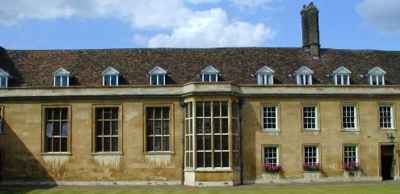 Elizabeth & Parliament
- The 1580s dining hall of Emmanuel College, Cambridge
- an Elizabethan foundation
Elizabeth & Parliament
- The 1580s dining hall of Emmanuel College, Cambridge
- an Elizabethan foundation
Emmanuel College, Cambridge
- The college was founded in 1584 by Sir Walter
Mildmay on the site of a Dominican
friary. Mildmay, a Puritan,
originally intended Emmanuel to be a college of training for Protestant
preachers to rival the successful Catholic
theological schools that had trained Dominican
friars for years.
Emmanuel graduates had a large involvement in the settling of North America. Of
the first 100 university
graduates in New England, one-third were graduates of Emmanuel College. Harvard
University, the first college in The
United States, was named after John
Harvard (B.A., 1632), who was an Emmanuel graduate. Early Emmanuel men
included several translators of the 1611 Authorised Version.
Pembroke College, Cambridge - On Christmas Eve 1347, Edward III granted Marie de St Pol, widow of the Earl of Pembroke, the licence for the foundation of a new educational establishment in the young university at Cambridge. The Hall of Valence Mary, as it was originally known, was thus founded to house a body of students and fellows.
Corpus Christi College, Cambridge - It is notable for being the only college to have been founded by Cambridge townspeople, having been established in 1352 by the Guilds of Corpus Christi and the Blessed Virgin Mary.
1693 - SAMUEL OUTLAWE,
son of Thomas Outlawe, of the Isle of Ely, admitted sizar and matriculated Jesus
College 1693; B.A. 1697; ordained deacon 1698 ;
; curate of Fotheringay 1698; priest 1699, and received
government allowance to Leeward Isles in 1705.
Jesus College, Cambridge
- The College was founded in 1496 on the site of a Benedictine
nunnery by John
Alcock, then Bishop
of Ely. It has been traditionally believed that the nunnery was turned into
a college because the nunnery had gained a reputation for licentiousness.
St Radegund
- She is the patron saint of Jesus College Cambridge, which was founded on the
site of the twelfth-century nunnery of Saint Mary and Saint Radegund. John Alcock
is chiefly remembered as the founder of Jesus College (1496). He provided for
this by suppressing the nunnery of St Radegund and appropriating the buildings
and revenues of the nunnery to the use of the new college.
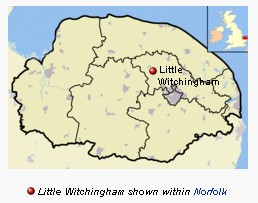 MARBLE INSCRIPTIONS: Wichingham parish.
In memory of Thos. Outlawe, the elder, gent: who died
July 3, 1633.
In memory of Thos. Outlawe, gent; who died May 15, 1650.
In memory of Ralph Outlawe, gent; who died Nov. 14, 1670, and
Elizabeth, his wife, who died July 4, 1671.
Eynford Hundred - Witchingham, Magna and Parva British History Online
Turtevile's Manor. - The site of it was in Wichingham Parva, or St. Faith's, and was given to St. Bennet's abbey, by
Ernaldus, a Saxon; Hugh, the abbot, in the reign of King Stephen, granted it to Roger de Turtevile and his heirs, paying 10s. per ann. to the convent.
...
In the 14th of Charles I (1640). Ralph Outlaw was lord; and in 1664, Thomas
Outlaw of Turtevile Manor.
Outlaw, argent, a saltire between four foxes, or wolves heads, couped, gules.
The History and antiquities of the county of Norfolk (Volume 3) by Alexander Jeffrey - TURTEVILE'S MANOR. The site of it was in Witchingham Parva, or St. Faith's, and was given to St. Bennet's abbey by Ernaldus a Saxon. Hugh, the abbot, in the reign of king Stephen, granted it to Roger de Turtevile and his heirs, paying jos. per ann. to the convent. ... In the 14th of Charles I. Ralph Outlaw was lord, and in 1664 Thomas Outlaw.
North Erpingham Hundred - Gunton British History Online "Cley Hall in Wichingham"
Eynford Hundred - Witchingham, Magna and Parva British History Online ...In the 17th of Edward IV. John Berney, Esq. of Wichingham, died seized of this manor in Wichingham, St. Faith's; John Berney was lord in the reign of Henry VIII. and left it to his son John .
Bartholomew de Antingham was lord in the 52d of Henry III. in which year William Kerdeston of Bintre, and Cecil his wife, passed by fine, to him, 2 messuages, 170 acres of land, 9s. rent, a mill, 2 acres of wood, 13 of meadow in Wichingham Parva, Alderford, &c. ...In the 40th of Elizabeth, May 28, Martin Berney, and Margaret his wife, Christopher Grimston of Grey's Inn, Esq. and Elizabeth his wife, daughter of Martin Berney, conveyed it by fine, to William Collins, who in the said year passed it to Edward Turner.
It came afterwards to the Outlaws, and Elizabeth Outlaw, widow, kept her first court on the last day of March, 1670.
[ So it seems Turtevile Manor and Cley Hall are one in the same ]
Thomas Outlaw of Wichingham Parva was living in 1620, and by Mary his wife, daughter of — Corie, was father of Ralph, who married Elizabeth, daughter of Robert, and sister of Sir Robert Kemp, of Spain's Hall, in Finchingfield, Essex, by whom he had Thomas, his son and heir, living in 1664, and had by Sarah his wife, daughter of William Hunt, Esq. of Hilderston, (son of Sir Thomas Hunt,) Ralph his son and heir, who married first Ursula, daughter of Richers Brown of Fulmerston; his 2d wife was Elizabeth, daughter of Robert Adams of Norwich, and dying sans issue, about 1670, left part of his estate to — Brown of Saxthorp, and part to Elizabeth his wife, who afterwards married Gyles Cutting, an attorney.
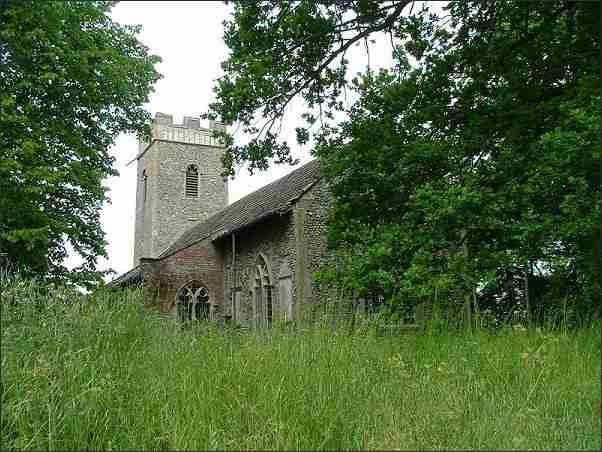 Little Witchingham churchyard is a sea of high
grasses, the few remaining headstones bobbing determinedly..
Little Witchingham churchyard is a sea of high
grasses, the few remaining headstones bobbing determinedly..
It is to Little Witchingham that you go to find one of the finest sets of wall-paintings in Norfolk. They appear to date from the first half of the 14th century, during that great flowering of artistic endeavour that would be cruelly brought to an end by the Black Death, which killed perhaps a half of the population of East Anglia. Indeed, in a fascinating aside, the guide book theorises that the south nave wall has been prepared for painting, but that this never happened. Perhaps the pestilence intervened, and as at Kersey in Suffolk left in evidence the Dog That Didn't Bark.
On the south wall, the wall paintings depict the Passion of Christ, and what is probably a panoply of the Apostles. On the west wall, too indistinct to make out now, were doctrinal paintings; the Three Living and the Three Dead, illustrative of the transitoriness of earthly wealth, and what may have been Christ in Majesty. Looking at them, I couldn't help thinking that they are assertive of orthodox Catholicism, and perhaps they were evidence of an even earlier date for my proto-reformation?
The south aisle is more curious; on the outer wall are fragments of figures and scenes that could be anything, but as one appears to show a ram caught in a thicket, and another a King and Priest side by side, perhaps they are episodes from the Old Testament. These are unusual subjects for a 14th century painting, but even stranger are the huge roundels set above the pillars on the south side of the arcade. They depict the symbols of the Evangelists, and quite frankly they look so Victorian that they might easily have come from high in the roof of some 19th century Brighton Anglo-catholic citadel.
But the Victorians did not know about any of these paintings. We know this because this church was little-used even then, and by the start of the 20th century it was abandoned. In 1967, the enthusiastic art historian Eve Baker found it ruinous, roofless, and full of elder trees and ivy. The story goes that she climbed in through one of the empty windows, began stripping away ivy and found that the whitewash came off with it, revealing marvellous things. Thanks to the Norfolk Churches Trust, a plan of repairs was put in place, and the wall-paintings properly excavated in the early 1970s. This perfect little church is now in the care of the Churches Conservation Trust. I told my companion, Tom Muckley, that I thought Little Witchingham church a magical place. Tom wondered if I would have found it so magical if it had just been another struggling Anglican church, and I guess he is probably right.
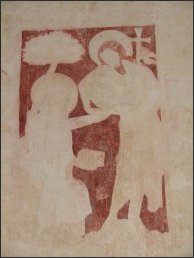 Thomas
touches the wounds of the Risen Christ
Thomas
touches the wounds of the Risen Christ  Priest and King
 St. George and the Dragon
 Christ carries his cross
Lymehouse - Stepney - London
The Marriage Registers of St. Dunstans Stepney in the County of Middlesex - Google Books
1647 - May 16 - Edward Cooley of
Lymehouse Shipwright and Evah Outlaw, M.
1658
- Nov 16 - John Outlawe of Lymehouse Shipwright and Elizeabeth Baker of
Ratcliffe,
W. Page 92
Photos of Saint Dunstan, Stepney, Middlesex
Saint Dunstan is the parish church of Stepney and the mother church of the East End. Its ancient dedication of Saint Dunstan and All Saints was revived in 1896. The bells in the tower feature in the nursery rhyme Oranges and Lemons - "... when will that be, say the bells of Stepney."
In the 16th century the riverside hamlets of Stepney became London's 'Sailortown'
and St Dunstan's became known as the Church of the High Seas. It was here
that seafarers gathered for blessings of their voyages. Until the 1950s all
UK births, marriages and deaths at sea were registered in this parish.
Registers from 1586 are housed at the London Metropolitan Archives and post July 1837 at The Family Records Centre. The Red Ensign, flag of the Merchant Navy, still flies from the tower and the church contains several memorials to Admirals and men of the Merchant and Royal Navy Fleets. The unusually spacious and leafy churchyard was enlarged in the 1600s for the burials of Plague victims. In a period of 18 months 6583 died in the parish and in September 1665, 154 were buried in one day. Only a few tabletop tombs from the 18th century remain but the churchyard was once crowded with the graves of seaman, captains, merchants of the East India Company and clergy. (Notes from Pitkin Guide and church leaflet)
The East of London Family History Society Home Page
Outlawe's in Essex
1143-1144 - Geoffrey de Mandeville, 1st Earl of Essex - Geoffrey maintained himself as an Outlaw and a bandit in the fen-country, using the Isle of Ely and Ramsey Abbey as his headquarters. He was besieged by King Stephen and met his death in September 1144 in consequence of an arrow wound received in a skirmish. Denied burial because he died excommunicate, his body was wrapped in lead. Eventually it was taken to the Templar community in London. He was buried in the Temple Church in London. His son arranged for an effigy to be placed on the floor, where it still can be seen today
1230 - Alan le Utlage in the Tax Rolls 'Feet of Fines' for the county of Essex
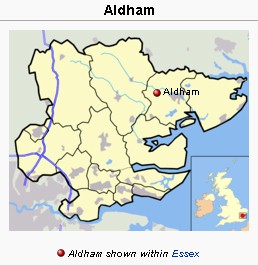 1346 - Inspeximus by Thomas son of James Outlagh of Audham of a writing made by his said father to John son of Thomas Bounde of
his freedom; and release of all claim in the said Thomas Bounde and John his brother, sons of the said John son of Thomas, &c. Dated at
Wykemer, Thursday before the Translation of St. Thomas the Martyr, 20 Edward III.
- Essex - Aldham
- Inspeximus = a royal grant or a grant - The
2001 census gave the parish population as 513.
1346 - Inspeximus by Thomas son of James Outlagh of Audham of a writing made by his said father to John son of Thomas Bounde of
his freedom; and release of all claim in the said Thomas Bounde and John his brother, sons of the said John son of Thomas, &c. Dated at
Wykemer, Thursday before the Translation of St. Thomas the Martyr, 20 Edward III.
- Essex - Aldham
- Inspeximus = a royal grant or a grant - The
2001 census gave the parish population as 513.
1360 - John Outelagh and Joan his wife, def. 1 messuage and 1 carucate of land in GreatChisell, Little Chisell, Heyden and Crishale - Essex
1376 - Widow of John Outelagh , Joan his wife, def. 1 messuage and 1 carucate of land in GreatChisell, Little Chisell, Heyden and Crishale - Essex
1558 - John Leper of Moche Bromeley Will - John Owtelawe - Essex
1573 - Will:
John Owtlawe: Little Clacton: singleman - 13 April - Essex
1575 - Thomas
Owtlawe - Assizes held at Chelmsford 3 March 1575 - Essex
1577 - Indictment
of Thomas Outlawe of Thorpe yeoman stole there two bushels of barely
worth 3s.4d., belonging to Henry Haste. Pleads not guilty; guilty; clerk
- Essex Assizes held at Chelmsford 6 March 1577
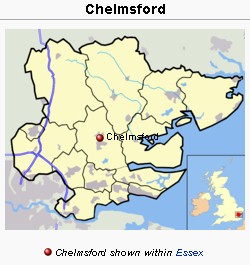
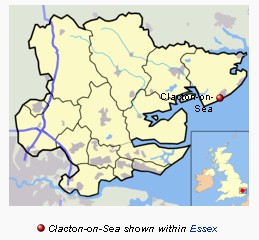 Chelmsford
- is the county
town of Essex, England
and the principal settlement of the borough of Chelmsford.
It is located in the London commuter belt.
Chelmsford
- is the county
town of Essex, England
and the principal settlement of the borough of Chelmsford.
It is located in the London commuter belt.
Little Clacton - is a small rural village in Essex. It is located on the Tendring Peninsular. Close to Clacton-on-Sea.
Thorpe-le-Soken - a village in Essex, located southwest of Walton-on-the-Naze, Frinton-on-Sea and northwest of Clacton-on-Sea.
Great Bromley - is a village and civil parish in the Tendring district of Essex. It lies 6 kilometres (4 mi) south of Manningtree and 9 kilometres (6 mi) east of Colchester and includes the hamlets of Balls Green and Hare Green.
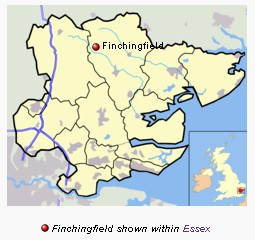
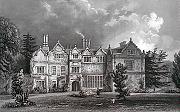
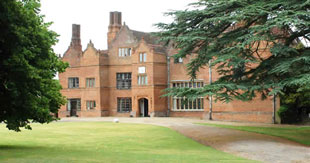
Spains Hall is an Elizabethan country house near Finchingfield in Essex.
Spains Hall has been a family home for nearly ten centuries. Named after Hervey de Ispania who held the Estate after the Norman Conquest, Spains Hall has been in continuous occupation by only three families ever since.
The present house dates from the early 15th century when the Estate passed to the Kempe family on the marriage of Margery de Ispania to Nicholas Kempe. The front you see today was built in 1585 and in 1637 the house was beautified by Robert Kempe with Dutch gables and silver leaded drainpipes, the restoration of which won a Heritage award in 1977. Allegedly, Robert Kempe was knighted by Cromwell in front of the house in 1641.
The last of the Kempe male line is said to have been killed by robbers and in 1760 the Estate was purchased by Samuel Ruggles, a clothier from the nearby town of Bocking. His descendents, the Ruggles-Brise family, still live in the house today.
IV. RALPH OUTLAW, born ca. 1595. Married Elizabeth
Kempe ca. 1615-16. He died July 4, 1671.
Children: (1) Thomas; (2) Rev. Ralph Outlaw; (3) Elizabeth; (4) Mary; (5)
Robert, Sec. V; (6) Charles; (7) Edward
V. ROBERT OUTLAW, (IV-III-II-I) our prime suspect as being a father of Capt. John and
Edward.
1660 - Book
1. Assents - Outlaw,
Ralph 1660 p.217
1610 - Ralph
Outlaw, of Witchingham, Norfolk, gent., and of Barnard's Inn. - Feb.
13 - Admissions Gray's Inn - "gentleman of blood" place their
children in these Inns of Court (The hero of Charles
Dickens's novel Great
Expectations, Pip, lodged in Barnard's
Inn with Herbert Pocket for a number of years following his arrival in London.
(Barnard's ~= Undergraduate school, Grey's Inn ~= Graduate Law school )
) Grays Inn - Ralph Outlaw - Ralph
goes to society college
1615 - Elizabeth
Kempe marries Ralph Outlaw son Robert born 1626 (Notice that
he's got his Law degree from Grey's Inn by now)
1622 -Will
of JONH MINGAY, of Arminghall,co.Norfolk, Esq.. -
To WILLIAM MINGAY, son of my said son HENRY £100 and the
residue of the said sums given to the other children of my said son HENRY are to
be used by him for their benefit and to be paid to them when eighteen, if
they marry with the consent of their father, EDWARD READ, esq. and RALPH
OUTLAWE, gent, their Kinsman. - My son HENRY and my daughter
FRANCES KEMPE - 4 October 1622
(John Mingay had some connection to Grey's Inn and notice Ralph had already
married Elizabeth Kempe in 1615) - Frances
Mingay abt 9-18-1575 - 12-1633; married Robert Kempe
1626 - Robert Outlawe was born - son of Ralph Outlawe and
Elizabeth Kempe
1644 - Robert
Kempe Knighted by Oliver Cromwell at Spain's Hall (Essex) 7th Aug
1644 (brother of Elizabeth Kempe)
Supposedly Robert marries an unknown woman and has two sons, future Capt. John
Outlaw about 1640 and Edward about 1652.
1658
- Nov 16 - John Outlawe of Lymehouse Shipwright and Elizeabeth Baker of
Ratcliffe,
W. Page 92
A Robert Outlaw is buried at Ringland Parish about 1680. The only thing really known is the grave at Ringland. Keep in mind that the Great Fire of London occurs in 1666 and probably destroys many records.
An earlier and famous Kempe lady is Margery Kempe and she is from the neighborhood King's Lynn! And she visits Hospital of St Thomas of Canterbury in Rome!
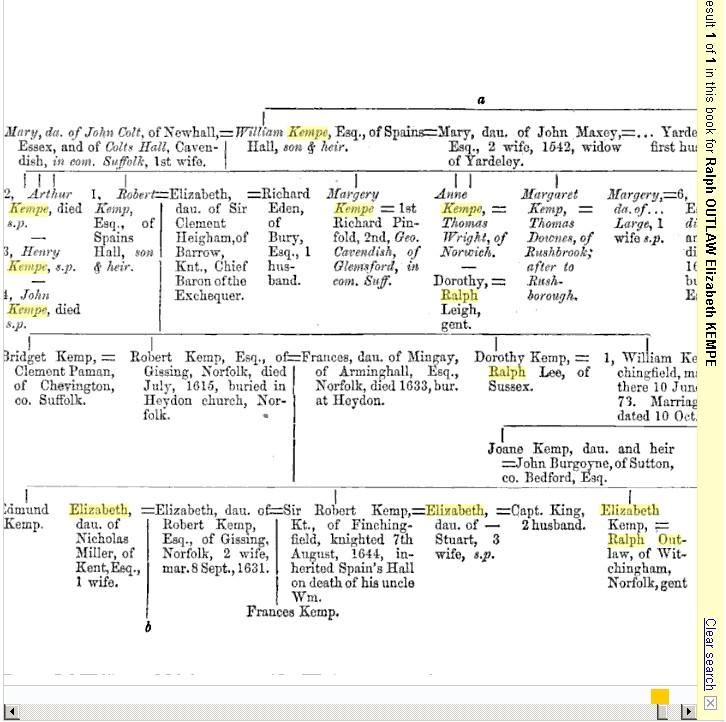
The English reports - Google Books
Sir Robert Kempe Last Will and Testament.... his wife Dame Elizabeth Kempe
after the decease of Ruth Kempe, widow, my daughter-in-law; shall pay unto my godson Robert Outlaw, out of the rents and profits of the jointure-lands of the said Ruth Kempe, for and during the natural life of him the said Robert Outlaw, one annuity of twenty pounds per annum; and unto Elizabeth Outlaw, the daughter of my nephew Thomas Outlaw, the sum of twenty pounds per annum during her natural life.
Ruth Kempe widow, daugher-in-law of the said Sir Robert Kempe, Knight... and lately the wife of William Kempe Esquire deceased... the only son and heir apparent...
Since Edward and John Outlawe were cousins to Matthew Kemp, they may have teamed up together for the voyage to Virginia:
1659 - (Col.) Matthew Kemp - son of Edmond Kemp - grant to him 1100
acres on Planketank - Lancaster/Middlesex Virginia sheriff of the county
1659
Died 1683 - Edmund Kemp was the grandson of Robert Kemp and nephew of Sir
Robert Kemp,
[ according to the chart above Edmund Kemp was the BROTHER of Sir Robert
Kemp . Matthew Kemp was the nephew of Sir Robert Kemp ]
House of Lords Journal Volume 17 - 1
February 1704 - Sir R. Kemp's Bill.
The Earl of Manchester reported from the Lords Committees, the Bill, intituled,
"An Act for vesting Lands in Essex, devised by Sir Robert Kemp Knight, deceased, to the Children and Grandchildren of Elizabeth Outlaw, One of his Sisters and Coheirs, in Trustees, to be sold, for the Benefit of the Devisees," as fit to pass, without any Amendment.
The Question was put, "Whether this Bill shall pass?"
It was Resolved in the Affirmative.
ORDERED, That the Commons have Notice, that the Lords have agreed to the said Bill, without any
Amendment.
Thomas Outlaw - Kerdiston and Reepham History (follow link for more information)
1647 - Dispute between Edward and Francis
Heyward against Thomas Outlaw and others concerning Kerdiston Heath
1650 - Outlawe,
Thomas, of Kerdiston - Will
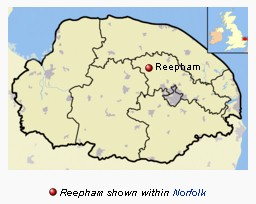 English
Outlaw Ancestors
English
Outlaw Ancestors
5. Robert Outlaw of Kerdiston ?
Children of Thomas Outlaw and Margaret Cory:
2. Thomas Outlaw of Kerdiston ca 1600 - 15 May 1650 ?
Norfolk Record Office - NROCAT- on-line catalogue
Commissioners warrant and affidavit of notice in a dispute between Edward and Francis Heyward against Thomas Outlaw and others concerning Kerdiston Heath - 1647
Note re previous law suits about three highways running through Caddow Green and Kerdiston Heath, nd [17th century];and a certificate of a commission relating to a Chancery case between Edward and Francis Heyward against Thomas Outlaw and others concerning the manorial waste of Kerdiston and Reepham, 23 Charles I [1647-1648].
Chancery decree in a suit between Edward and Francis Heyward against Thomas Outlaw and others concerning the waste in Kerdiston with Reepham held of the manor of East Greenwich 1656
A visitors guide to the inland village of Salle in Norfolk. Blink and you could well miss the itzy-bitzy village of Salle, which is as neat as a button; It has a truly huge church for such a small place, which echoes with the cries of rooks, who erupt from its tower like a plume of smoke. Inside is a brass for Geoffrey and Alice Boleyn (1440) anncestors of the Boleyns or Bullens who lived in the village as early as 1318, before acquiring Blickling Hall. Anne Boleyn was of course the ill fated wife of Henry VIII who was executed by her husband after having been found guilty of adultery and incest with her brother George Boleyn. It has been rumoured that Anne Boleyn is buried at this church... Just one mile away is the historical market town of Reepham...
1657 - RALPH OUTLAWE, of Tuttington, County Norfolk, and Elizabeth, his wife, living in 1657
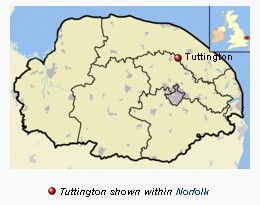
 Its
church, St Peter and St Paul, is one of 124 existing round-tower
churches in Norfolk.
Its
church, St Peter and St Paul, is one of 124 existing round-tower
churches in Norfolk.
CAMBRIDGESHIRE, NORFOLK AND SUFFOLK - Google Books
John Outlaw - Farmer, Landowner
1661 - Ralph Outlaw, A. M. Tho. Thorowgood, rector of Cressingham Magna.
 The church of
Cressingham-Magna is an uniform building of flint, boulder, &c. and copings of free-stone, consisting of a nave, north and south isles, and a chancel all covered with lead, and is dedicated to St. Michael; the nave is about 48 feet long, and, together with the isles, about 42 feet wide, the vault of the nave is supported by pillars, each formed of 4 pilasters joined together, which bear up 8 neat arches, four on each side, and as many windows over them; the roof is of oak, having principals whereon are carved the effigies of bishops, priests, &c. At the west end of the nave stands the tower, of the same materials as the church, with a wooden cap covered with lead, and a weathercock thereon; in this tower hang four modern bells: in this tower (fn. 20) is a bell-sollar, or place for the ringers; such places were in ancient time frequently erected by the gifts of
well disposed persons, for the greater convenience and decency of their processions, that the priest and people coming in at the western door might not be any way incommoded by the ropes and
ringers.
The church of
Cressingham-Magna is an uniform building of flint, boulder, &c. and copings of free-stone, consisting of a nave, north and south isles, and a chancel all covered with lead, and is dedicated to St. Michael; the nave is about 48 feet long, and, together with the isles, about 42 feet wide, the vault of the nave is supported by pillars, each formed of 4 pilasters joined together, which bear up 8 neat arches, four on each side, and as many windows over them; the roof is of oak, having principals whereon are carved the effigies of bishops, priests, &c. At the west end of the nave stands the tower, of the same materials as the church, with a wooden cap covered with lead, and a weathercock thereon; in this tower hang four modern bells: in this tower (fn. 20) is a bell-sollar, or place for the ringers; such places were in ancient time frequently erected by the gifts of
well disposed persons, for the greater convenience and decency of their processions, that the priest and people coming in at the western door might not be any way incommoded by the ropes and
ringers.
 While the glass at Great Cressingham is not well-known, even more of a secret is the fact that this church has no fewer than five figure brasses, with the inlays for a couple more. They are all late medieval. The two best are probably those for Thomasina and Richard Rysle, who died in 1497. These 45cm figures are perfect miniatures. Twice as tall is William Eyre, who wears a colar with IHC on it. His wife's figure is now missing, as is another figure which must have been a mourning son. Very curiously, the inscription underneath has been trimmed at both ends, probably as a result of the two figures being removed, but also possibly to remove the Catholic prayer clauses. The best of the figures, though, is the Priest John Aborfeld, in full eucharistic vestments of the early years of the 16th century, when time was running out for the English Catholic Church
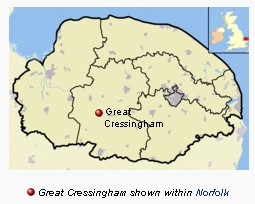 Great Cressingham
- lies 2.5 miles (4.0 km) north west by road
from Little
Cressingham, 5 miles (8.0 km) west of Watton,
6 miles (9.7 km) south of Swaffham
and only 1.5 miles (2.4 km) off the A1065
arterial
road just north of Hilborough
in the Breckland
District of Norfolk.
As of 2007, it has an estimated population of 235[2]
in an area of 9.84 km2 (3.80 sq mi).
Great Cressingham
- lies 2.5 miles (4.0 km) north west by road
from Little
Cressingham, 5 miles (8.0 km) west of Watton,
6 miles (9.7 km) south of Swaffham
and only 1.5 miles (2.4 km) off the A1065
arterial
road just north of Hilborough
in the Breckland
District of Norfolk.
As of 2007, it has an estimated population of 235[2]
in an area of 9.84 km2 (3.80 sq mi).
The village church is dedicated to Saint Michael[3] in the Benefice of Cockley Cley[4]
There is a pub called the Olde Windmill Inn.
The village school was built in 1840. It was used as a local Authority school until 1992 and was then acquired by Tom and Sally North. They have restored it as closely as possible to how it would have been in Victorian times and now run free historical school days.[5] Great Cressingtham is on the very edge of the Stanford Battle Area.
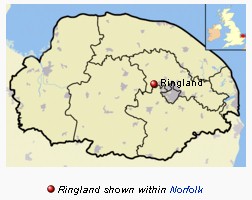
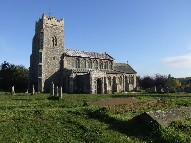 ROBERT OUTLAW, (IV-III-II-I) our prime suspect as being a father of Capt. John and Edward. There is a slab to him in Ringland
Parish
ROBERT OUTLAW, (IV-III-II-I) our prime suspect as being a father of Capt. John and Edward. There is a slab to him in Ringland
Parish
In the middle aisle of the church is a slab to Robt. Outlawe, no date. (1680?)
It must be said that I already knew that Ringland church was the most important church in Norfolk which still had to make its way onto the pages of this website. There may be bigger churches, there may be more famous ones, but none so artistically and historically significant as St Peter.
HOUSES OF PREMONSTRATENSIAN
CANONS (White Robe Canons)
42. THE ABBEY OF WEST DEREHAM
Hubert Walter, dean of York, who afterwards became successively bishop of
Salisbury and archbishop of Canterbury, founded at his birthplace of
West Dereham, in the year 1188, an abbey for
Premonstratensian canons, which was
colonized from Welbeck. The canons were to pray for the souls of the founder and
his parents, his brothers and sisters and all his relatives and friends, as well
as for the souls of Ralph de Glanville, justiciary of England, and Bertha his
wife. (fn. 1)
King John, on 7 September, 1199, confirmed all the grants made to the abbey by
the founder and by other early benefactors; at the same time, at the request of the
founder, who was then archbishop of Canterbury, he conferred on the abbey
and its tenants exemption from all kinds of service, tolls and dues. (fn. 2) In
the same year John granted to the abbey a weekly Wednesday market, and an annual
fair of four days, namely on the festival of St. Matthew and the three following
days, (fn. 3) and in 1201, the king confirmed to them the grants of half the
church of Holkham and of the church of Ringland. (fn.
4)
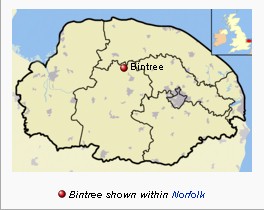 Bintree village, Norfolk
- Sometimes spelt Bintry, you will find this village 8 miles north
east of Dereham and 9 miles south east of Fakenham.
It has a pretty church, St Swithin, with a 14th century tower and beautiful
stained glass windows.
Bintree village, Norfolk
- Sometimes spelt Bintry, you will find this village 8 miles north
east of Dereham and 9 miles south east of Fakenham.
It has a pretty church, St Swithin, with a 14th century tower and beautiful
stained glass windows.
The church heraldry of
Norfolk by Rev. Edmund Farrer Published in 1887, A.H. Goose and co. (Norwich)
...
Slab at the West End - Bintry - St. Swithun Church:
On a saltire, between four wolves' heads couped, a crescent {Outlaw of Little Witchingham, co. Norfolk, granted 1613, Argent, a saltire gules between four wolves' heads, couped proper.) Crest: A demi-wolf, pierced through the side with an arrow, feathered and headed, the arrow lying sinister bend ways (Outlaw, A demi-wolf proper, pierced through the side with an arrow or, feathered and headed argent, the arrow lying sinister bendways.)
"Here under resteth ye body of Ralph Outlaw, Rector of Bintry, who was son of Ralph Outlaw, of Little Wichingham, in the county of Norfolk. He departed this life ye first day of February, 1688, aged 68 yeres. " Reader, pray stay, death's trophies view and see In them what thou thyself, ere long, must be. "
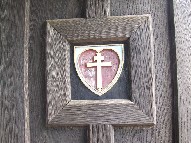 The
True Cross was said to be a part of the Cross of which Jesus Christ was
crucified, ... the True Cross came from the Court of Baldwin 1 in Constantinople
to a small village priory in Norfolk.
The
True Cross was said to be a part of the Cross of which Jesus Christ was
crucified, ... the True Cross came from the Court of Baldwin 1 in Constantinople
to a small village priory in Norfolk.