 |
[ Outlaw Genealogy | Bruce
History | Lost Chords ] [ Projects | News | FAQ | Suggestions | Search | HotLinks | Resources | Ufo ] |
|
[ Outlaw Genealogy | Bruce
History | Lost Chords ] [ Projects | News | FAQ | Suggestions | Search | HotLinks | Resources | Ufo ] |

1103BC - Arrival of Brutus
of Troy in Britain - The island was then called Albion, and was inhabited by a few giants...Brutus called the island after his own name
'Brit-ain' and his companions
'Brit-o-ns' . He built a city which he called 'New Troy,'
Later, Lud, the brother of Cassibellaun made war against Julius Caesar,
and ordered it to be called after his own name, 'Kaer-Lud,' , the 'City of
Lud' [or 'Lud-Dun,' corrupted into 'Lon-don'].
750 BC - Etruscans
- emerge in Italy
723 BC - The
kingdom of Israel was invaded by Assyria
and the rest of the population deported.
323 BC - Hellenistic period
begins - death
of Alexander
the Great in 323 BC
220 BC - Dying Gaul - commisioned by Attalus I of Pergamon to celebrate his victory over the Galatian, the Celtic or Gaulish people of parts of Anatolia (modern Turkey).
52 BC – Battle of Alesia – Caesar defeats the Gallic rebel Vercingetorix, completing the Roman conquest of Gallia Comata.
54BC - Julius Caesar's invasions of Britain - Lud son of Heli - When he died, he was buried at Ludgate - Crumbling statues of King Lud and his two sons, which formerly stood on the gate, now stand in the porch of the church of St Dunstan-in-the-West on Fleet Street in London - Lud, the brother of Cassibellaun made war against Julius Caesar, and ordered it to be called after his own name, 'Kaer-Lud,' , the 'City of Lud' [or 'Lud-Dun,' corrupted into 'Lon-don']. - Caesar doesn't stay
44BC - Julius Caesar - assassinated
- Ides of March -
March 15
26-33AD - Pontius
Pilate Reports to Tiberius Caesar on Jesus
Christ being Crucified - 15th
year Tiberius Caesar
44-69AD - The 70
disciples of Jesus Christ - Lazarus
and Mary Magdalen landed at the place called Saintes-Maries-de-la-Mer
near Arles - France
60-61AD - Romans
annihilate the Druids in Anglesey - Bitterness
against Roman oppression had driven Boudicca, queen of the Iceni tribe, into a
revolt that came close to expelling the invaders.
62AD - Joseph of Arimathea with 12 missionaries landed on the Isle of Britain in
62 AD. - Philip
the Apostle sent twelve Christians to Britain, one of whom was, Joseph of
Arimathea
70AD - Destruction of
Jerusalem by Titus - 1,000,000 Jews perished - survivors sold into slavery
- Solomon's temple destroyed
132–136AD - Bar
Kokhba revolt - Jews Barred from Jerusalem - Suppression by Hadrian -
Christianity split from Judaism - 580,000 Jews were killed
350 AD - c. 950 AD Estimated use of the Ogham in Ireland and southwestern England.
352 AD - Jewish revolt against Constantius Gallus
370 AD - Angeln (Angles) - Woden (Wotan/Odin) is claimed as an ancestor figure by many of the Anglian, Jutish and Saxon tribes which later migrate to Britain. Far from being a warrior chieftain, the pre-Christian sagas always describe Wotan as a magician, not a fighter.
311 – 383 - Ulfilas - Wulfila; Little Wolf - translated the Bible from Greek into the Gothic language. For this he devised the Gothic alphabet based on the Getae's alphabet - Ulfilas converted many among the Goths, preaching an Arian Christianity, which, when they reached the western Mediterranean, set them apart from their Orthodox neighbors and subjects.
325 - First Council of Nicaea
- Arian Theology rejected - Trinity accepted
325 - 400 A.D. The
Goths are converted to Arian Christianity. Ulfias writes his translation of the
New Testament, the only surviving work of written Gothic.
381 - First Council of Constantinople - affirms the Trinity - rejects Arianism
410 A.D. - Alaric,
king of the Visigoths, an Arian Christian - conquers Rome.
410 - Romans
leave Britain
420 - Angles are settled as laeti along the coast of the British territory of Dewyr to serve in the defence of the coastline against raiders, and the leader of these is possibly one
Saebald, son of Sigegeat of Waegdaeg's Folk. - Laeti
- term used in the late Roman
Empire to denote communities of barbari ("barbarians")
- Deira - laeti
settled in this military zone had little contact with civilian authorities.
When Roman military command chain ceased to function they had little difficulty
in cutting loose from whatever post Roman territorial authority emerged, to
found a barbarian kingdom.
442 - Britain falls
under the rule of the Saxons
450 - Kingdom of
East Anglia - was settled by the Anglo-Saxons as early as around 450,
earlier than many other regions. It emerged from the settlement and political
consolidation of Angles in the approximate area of the former territory of
the Iceni
458 - Feast of Long Knives - massacre of British
leaders by the Saxons - Night of the Long Knives (Arthurian)
- Saxons Takeover Kent
476 - Decline of the Roman Empire
- Romulus
Augustus, the last Emperor
of the Western
Roman Empire, was deposed by Odoacer,
a Germanic chieftain - Odoacer was an Arian Christian
493-553 - Ostrogothic
Kingdom - was established by the King
Theodoric the Great - Ostrogoths in Italy
and neighbouring areas. Gothic Arian Christians
500-600 - Wehha
of East Anglia - Wehha was a pagan king
of the East Angles who, if he actually existed, ruled the kingdom
of East Anglia during the 6th century
527 - The Kingdom
of Essex was traditionally founded by Aescwine
in 527 AD, occupying territory to the north of the River
Thames, incorporating much of what would later become Middlesex
and Hertfordshire,
though its territory was later restricted to lands east of the River
Lee.
530 - The Order
of Saint Lazarus established leper hospitals with the first being in Jerusalem
in the year 530 - Burton Lazars
569 - Saxons accompanied the Lombards
into Italy
570 - Birth of Muhammad
600-749 - Wuffa of East Anglia - By tradition Wuffa was named as the son of Wehha and the father of Tytila, but it is not known with any certainty that Wuffa was an actual historical figure. The name Wuffa was the eponym for the Wuffingas dynasty, the ruling royal family of the East Angles until 749
614 - Siege_of_Jerusalem_(614) - culminated with the conquest of Jerusalem in 614 by Persian and Jewish forces and the establishment of Jewish autonomy
632 - Death of Muhammad. Abu Bakr chosen as caliph.
637 - Siege_of_Jerusalem_(637)
637 - Jerusalem
surrendered to the Saracens, the caliph Omar gave guarantees for the safety
of the Christian population.
Earliest Outlaw Rune Stone in Geatland Småland:
700~1000AD - Útlagi
placed this stone in memory of Sveinn -Rune sm103 - Småland
(Early Viking style rune)
710 - Arab armies enter Spain from North Africa.
772 - Charlemagne begins his war of extermination against the heathen Saxons, destroying the Irminsul.
782 - The Massacre of Verden, in which Charlemagne ordered 4,500 imprisoned Saxons massacred
793 - Vikings - First attacks on England - the monasteries of Lindisfarne and Iona
799 - Patriarch
of Jerusalem sends Charlemagne his blessings and relics from the Holy
Sepulcher
772-804 - Saxon Wars - Saxons are conquered by Charlemagne
in a long series of annual campaigns
812 - King Coenwulf
- Mercia
823 - King Ceolwulf
I - Mercia
823-825 - Beornwulf
- King of Mercia
839-856 - Æthelwulf of Wessex
- meaning 'Noble Wolf', was King of Wessex
Father of King Alfred (Not a wuffing)
845 - Great Heathen
Army Viking Danes attacks Paris
865 - Great Heathen
Army of Viking Danes land in East
Anglia. Under the command of Halfdan
Ragnarsson and Ivar
the Boneless, with the support of Ubbe
Ragnarsson, it aimed to conquer and settle in England.
866 - Great Heathen
Army of Viking Danes - conquered the Kingdom
of Northumbria, followed in 870 by the Kingdom
of East Anglia.
866 - Harald made the first of a series of conquests over the many petty
kingdoms which would compose all of Norway, including Värmland
in Sweden, which had sworn allegiance to the Swedish king Erik
Eymundsson.
869 - Wuffing
King Edmund is martyred by the Danes near Thetford - Last of the
Wuffings
870 - Great Heathen
Army of Viking Danes - conquered the Kingdom
of East Anglia.
871-899 - Saxon King Alfred
the Great ruled
872 - after a great
victory at Hafrsfjord near Stavanger,
Harald FairHair of Norway found himself king over the whole country. His
realm was, however, threatened by dangers from without, as large numbers of
his opponents had taken refuge, not only in Iceland,
then recently discovered; but also in the Orkney
Islands, Shetland
Islands, Hebrides
Islands, Faroe
Islands and the northern European mainland.
874 - Great
Heathen Army of Viking Danes - conquered Mercia.
878 - Battle of
Ethandun - Alfred
the Great defeats the Danes
- Great Heathen Army
899 - Alfred the
Great - died on 26 October 899
901 - Edward the Elder
takes the title "King of the Angles and Saxons"
902 - Ragnall -
The
ruling Vikings of Dublin expelled from Dublin in 902 ...; some went to
France, some to England, and some to Wales.
902 - Eric, ruler of the
Danes in East Anglia, dies in the Battle of Holme
918 - Edward the Elder
becomes ruler of Mercia following the death of his sister Aethlfleda
920 - Edward the Elder takes
East Anglia from the Danes
920 - 961 - Haakon
I of Norway - (c. 920–961), given the byname the Good,
was the third king of Norway
and the youngest son of Harald
I of Norway and Thora Mosterstang - King Harald determined to
remove his youngest son out of harm's way and accordingly sent him to the court
friend, King Athelstan
of England. Haakon was fostered by King Athelstan, as part of a peace
agreement made by his father, for which reason Haakon was nicknamed Adalsteinfostre.[2]
The English king brought him up in the Christian
religion. On the news of his father's death King Athelstan provided Haakon
with ships and men for an expedition against his half-brother Eirik
Bloodaxe, who had been proclaimed king.
924-939 - Æthelstan
ruled England
911-927 - Reign of "Rolo"
Robert I - First Duke of Normandy under Charlemagne.
- Rollo is great-great-great-grandfather of William
the Conqueror. - ancestor
of the present-day British royal family, as well as an ancestor of all
current European monarchs - 'As Rollo's death drew near, he went mad and had a
hundred Christian prisoners beheaded in front of him in honour of the gods
whom he had worshipped,
Outlaw 1613
Visitation Legend :
957 - Outlawe(s) Banished
for political offences to Ireland
by King Edwy - St. Dunstan Banished
- 1613
Visitation Legend
958 - Outlawe(s) kill - "gather" many Wolves heads in Ireland
- 1613
Visitation Legend
959 - Edgar King of Mercia
and Northumbria becomes King of all England
959 - Outlawe(s) Return to England "with many wolves
heads" under King
Edgar reigns - St. Dunstan returns - 1613
Visitation Legend
960 - King
Edgar general pardon in return for a certain number of wolves' tongues
from each criminal - fact
961 - The Welsh having no gold, King
Edgar orders tribute of 300 Wolves heads annually from Wales
969 - Ramsey
Abbey
was founded by Ailwyn - Aylwin, foster brother of King Edgar ,
- Alfwold (d. 990), younger brother of Aylwin
granted - Bythorn
- Kingston /
Wistow - was royal demesne and belonged to King Edgar
Second later Utlage Rune in Geatland
Västergötland, Sweden
:
990~1010AD - Utlage
raised this stone in memory of Eyvindr, a very good thegn -
Rune vg62 - Ballstorp, Edsvära, Västergötland, Sweden
999 - Norman pilgrims returning from the Holy
Sepulchre in Jerusalem
by way of Apulia stopped at Salerno,
Italy
1005-1016 - Famine
in England - half
the population of the larger island perished, although many of the dead were
caused by the wars
1009-1085 - Norman
conquest of Southern Italy - the regional Byzantine authority is pushed out
1014 - Danish
Earl Thurctel -(Thurkill) - sides with the Cnut - Scandinavian
loan-words in Middle
1015 - The
assembly of the Witteuanghemote pronounced against any Dane who should take
the title of king of England a perpetual sentence of outlawry. Utlage.
out-law, signifies a mau
banished or outlawed.
1016–1035 - Dane Cnut
the Great defeats Edmund
Ironside - Cnut was left as king of all England - Aethelred's son
Eadwig fled from England but was killed on Cnut's orders.[41]
Edmund Ironside's sons Edward and Edmund likewise fled abroad. Edward
the Confessor and Alfred
Atheling went into exile among their relatives in Normandy.
1017 - Cnut weds Emma
of Normandy, the widow of Aethelred, and daughter of Richard
the Fearless, the first Duke
of Normandy.
1021 - Earl
Thurkill
and wife Egitha Eadgytha banished, expelled from England - Earl
of East Anglia
Utlag "de Utlag" from Utlag
Where is that?
1023 - Gilbert Egghlan of Utlag and Bargaria ulor and. a'o. D'my mlliii - Keighley West Riding Yorkshire
1035–1040 - Harold Harefoot (or Harold
I) - Rules England after Cnut's death
1036 - Edward
the Confessor and his brother Alfred failed attempt to depose Harold
Harefoot - Edward escaped to Normandy; Alfred was betrayed, captured, blinded, tortured, and murdered.
1040–1042 - Harthacnut -
succeeded by Edward
the Confessor in England. Harthacnut was the last Danish king to rule
England.
1042-1066 - Edward the Confessor - son of Æthelred
the Unready and Emma
of Normandy, was one of the last Anglo-Saxon
kings
of England - Edward's reign began on the death of his half brother
Harthacnut
1045 - Harold
Godwinson becomes Earl
of East Anglia
1050 - Helgi
Hundingsbane - can safely be dated, on the basis of other evidence, after
the year 1000 - composed probably not earlier than the second quarter of
the eleventh century - the Ylfings' son
1051 -
Earl Godwin and his sons Earl Sweyne and Earl Harold are outlawed. Earl
Harold and his men are banished to Ireland. Godwin to Flanders
1051
- In October Godwin and the
rest of his sons were declared outlaws and given five days to leave the country.
The men of Dover were
left unpunished. Godwin, his wife Gytha, and his sons Swein, Tosti and Gyrth
boarded ship at Bosham and left for Flanders. Harold and Leofwine Godwinson
sailed from Bristol for the Norse stronghold of Dublin in Ireland.
1052 - Emma
of Normandy - dies - Queen Emma supported another candidate, Magnus
the Noble, and Edward had his mother arrested. Later she survived trial
by ordeal
1052 - Earl Harold gathers
followers in Ireland, he sailed from Ireland,
and joining his forces to those of his father. The great council not only
agreed that Godwin and his sons were innocent, but decreed the restoration of
their earldoms.
1053 - Battle of
Civitate: Normans Defeat Papal-Lombard Army, Capture the Pope
1054 - The schism
between the Eastern and Western churches is traditionally dated
1065 - Jerusalem was taken by the Turcomans,
who massacred three thousand citizens. Terrible oppression of the Christians in
the city followed - A history of Palestine, 634-1099
1066 - Normans
receive the blessings of the Lombard Pope Alexander II for the conquest
of England.
1066 - Earl
Harold (Godwinson) becomes King Harold II
1066 - Battle of Fulford
Yorkshire - King Harald
III of Norway and Tostig
Godwinson, Harold
Godwinson's banished brother take York. Victory for the Viking army
1066 - Battle of Stamford Bridge
East Riding Yorkshire - After a horrific battle, both Hardrada and
Tostig along with the majority of the Norwegians were killed. Although
Harold repelled the Norwegian invaders, his victory was short-lived: King
Harold II is defeated and killed at Hastings
less than three weeks later.
1066 - Norman Invasion England by - William
of Normandy
1066 - King Harold II dies at Battle
of Hastings. Harold Godwinson, the last Anglo-Saxon ruler -
Harold was killed by an arrow in the eye - Harold was killed by four
knights, probably including Duke William, and his body brutally dismembered -
Harold suffered first the eye wound, then the mutilation
1066 - Harold's men at
Hastings - Thurkill From Berkshire
- Thurkill
died at Hastings
1066 - Edgar The Outlaw
Ætheling
was proclaimed King Edgar II by a Witenagemot in London. He was never
crowned and submitted to William I some six to eight weeks later, at the age of
about fourteen or fifteen. - 14 October 1066
1068-1069 - Sons
of Harold Godwine and Magnus - Diarmait king
of Leinster lent them the fleet of Dublin
for their attempted invasions of England.
1068 - Edgar The Outlaw
Ætheling joins in the rebellion of the Earls Edwin and
Morcar, when defeated he fled to the court of King Malcolm III of
Scotland
1069 - Edgar The Outlaw
Ætheling - King of Denmark Sweyn Estridson invade England, capturing York
later defeated
1069- 70 - Harrying
of the North - subjugation of Northern
England (Yorkshire) - death toll over 100,000 - scorched
earth policy
1069 - Three
sons of King Swein came from Denmark, with two hundred and forty ships into the
Humber, together with Earl Osbeorn and Earl Thorkil.
1070 - Thurcytel
AND
Utlamhe "the Exile" - with Hereward the Wake - Utlamhe
The Exile
1070
1071 - William de
Warenne - showed a special desire to hunt down Hereward
the Wake who had murdered his brother the year before
1072 - Norman
Invasion of Scotland - Treaty of Abernethy,
1074 - Edgar The Outlaw
Ætheling makes peace with William I in
Scotland
1075 - Revolt of the Earls
- a rebellion of three earls against William
I of England (William the Conqueror). Ralph
de Guader - the Earl
of East
Anglia
1076 - Waltheof, Earl of Northumbria
Huntingdon - last of the Anglo-Saxon
earls was the only
English aristocrat to be executed during the reign of William
I. - beheaded on May 31, 1076 at St.
Giles's Hill, near Winchester
- buried in the chapter house of Croyland
Abbey
1076 - All earldoms
are now held by
Normans
1086 - William writes to the
Pope that England owes no allegiance to the Church of Rome
1086 - Thurkil
the White
and his wife Leofflæd are mentioned in the Domesday book, Thurkil as
pre-Conquest holder of Wellington
1086 - Domesday Book
- the survey was to determine who held what and what taxes had been liable under
Edward
the Confessor; the judgment of the Domesday assessors was final
No record of Outlagh or Utlag has yet to be found documented in the Domesday
Book - The Domesday[2]
Book is really two independent works. One, known as Little Domesday,
covers Norfolk,
Suffolk and Essex.
The other, Great Domesday, covers the rest of England
... There are also no surveys of London,
Winchester
and some other towns ... Durham; parts of the north east of England were covered
by the 1183 Boldon
Book, ... Search
and read more about Domesday book
1086 - Hindringham - Ulf;
Wulfnoth, free man of Archbishop
Stigand ; Saewulf reeve of Bishop William; Aethelwine, Free Man, Alwine cild,
free man; O., free man of Bishop Aethelmaer ( Ulf's - Wolf's Outlaws
and freemen)
1086 - Bedingfield Hall Manor. The Domesday tenant in chief, Ralph de Limesi, married Christiana, one of the sisters of Prince Edgar Atheling,"* by whom he had a son Ralph, who married one named Halewise. He does not seem, however, to have retained this manor - THE MANORS OF SUFFOLK
1086 - Manor of Horemead Magna near Lapston Church Hertfordshire given to Edgar Atheling (Adeling) by the Conqueror - Great Hormead Hertfordshire
1087 - Death of King William I
- William Rufus
Rules till 1100 - the third son of William
I of England
1088 - The Rebellion of 1088 occurred after the death of William
the Conqueror and concerned the division of lands in the Kingdom
of England and the Duchy
of Normandy between his two sons William
Rufus and Robert
Curthose. Hostilities lasted from 3 to 6 months starting around Easter of 1088.
1088 - William de
Warenne - died shortly afterwards of wounds he received while helping
suppress the rebellion
of 1088.
1088 - Anglo-Varangians - a large number of
Anglo-Saxons and Danes emigrated to the Byzantine Empire by way of the Mediterranean.[5] One source has more than 5,000 of them arriving in 235 ships.
1093 - Scottish throne after Malcolm's death in 1093 when he backed a successful bid by Edgar Atheling to dethrone Malcolm III's brother Donald Bane in favor of his nephew, also named Edgar. The newly crowned King Edgar, who ruled Scotland from 1097 to 1107, thus owed his position to William. - Edgar, King of Scotland
1095 - Prince
Henry decided to marry Nest to one of his followers, Gerald
de Windsor, whom he appointed Constable of Pembroke.
Consequently, Nest is the maternal progenitor of the FitzGerald
dynasty
1095-99 - First
Crusade
1098 - Edgar
The Outlaw Ætheling - given a fleet by Emperor Alexius I Byzantine
Emperor to assist in the First Crusade
1099 - Soldiers
of the First Crusade successfully scale the walls of Jerusalem and take
the Holy city - July15 1099
1100 - William
II dies while hunting - Henry
I the fourth son of William
I of England rules till 1135
1100 - King Henry I of
England made a grant to “the lepers of Saint Lazarus of Jerusalem”
1100 - PAYNE PEVEREL, son of William Peverel the Elder, started the Fraternity of the Holy Sepulcher a Chivalric Order. He was awarded lands and holdings in Salop in addition to his holdings in Bourne, Barnwell and Cambridge...he built the magnificent church of the Holy Sepulcher in Cambridge near the Castle
1102 - Fleet - Harding of England arrives at Jaffa - English ships - Edgar Atheling , Robert FitzGodwin
1106 - Battle of Tinchebray - Henry I of England captures his older brother Robert Curthose, the Duke of Normandy and Edgar Atheling (uncle of Henry's wife),
1106/7 - Fleet
of Englishmen, Danes, Flemings arrives at Jaffa - English ships
sailed for the Holy land 1102, 1107, 1112
1109 - Robert
of Baskerville Crusades in Jerusalem - Robert
de Baskerville returns from Jerusalem
1112 - Pain
Peverel founds Barnwell Priory moving
the 6 canons from St Giles to 30 canon's and 13 acres
1113 - Hospitaller's
in Jerusalem receive papal approval of independence
1113 - Bromholm Priory
established - House of Glanville
1114 - the
Fraternity of the Holy Sepulchre on land given by Abbot
Reinald of Ramsey between 1114 and 1130 - Cambridge Round Church
1115 - Official recognition
of the Hospital of Saint Lazarus came by a Bull of Pope Pascal II in 1115
1116 - The Order of Hospitallers was founded in the 11th century and recognized by Pope Paschal II in
1116.
1120 - White Ship Disaster
- Those drowned included William
Adelin, the only legitimate son of King Henry
I of England - Source of the
Anarchy 1135-1154
1125 - The St. Mary Magdalene
Leper Chapel, Cambridge
- oldest surviving building in Cambridge
1128 -
Templar founder Hugh de Payens visits Normandy and England to raise
troops for the Holy land.
1129 - Robert
Fitzroy, Earl of Gloucester - illegitimate son of Henry
I, grandson of William the Conqueror, founded the Priory
of St James Bristol in 1129
1130 - The
Round Church of Cambridge was built in about 1130 and was
originally a wayfarers' chapel
1133 - PAYNE PEVEREL dies on Crusade in Jerusalem
- There is some doubt about the date of Pagan Peverel's death
1135-1154 - Henry I dies
without male heir - names daughter Matilda - Beginning of the Anarchy
1135-1154
1136 - Almaric
St. Norbert's
Premonstratensian apostolate
, sets out in 1136 for the Holy Land
1137 - Almaric founded the Premonstratensian
Abbey of St.
Abacuc in Jerusalem
1140 - Jordan de
Briset and his wife founded the hospital and priory of St John of
Jerusalem and the nunnery of St Mary. at Clerkenwell
1142 - The first mention of the
Order of Saint Lazarus in surviving sources dates to 1142.
1142 - Krak des
Chevaliers - also Crac des Chevaliers, is a Crusader
castle in Syria
and one of the most important preserved medieval castles in the world. In
1142 it was given by Raymond
II, Count of Tripoli, to the Knights
Hospitaller. It remained in their possession until it fell in 1271.
1143-1144 - Geoffrey
de Mandeville, 1st Earl of Essex - Geoffrey maintained himself as an
Outlaw and a bandit in the fen-country,
using the Isle
of Ely and Ramsey
Abbey as his headquarters. He was besieged by King Stephen and met his
death in September 1144 in consequence of an arrow wound received in a skirmish.
Denied burial because he died excommunicate, his body was wrapped in lead. Eventually
it was taken to the Templar
community in London. He was buried in the Temple
Church in London. His son arranged for an effigy to be placed on the
floor, where it still can be seen today.
1147 - Margam Abbey was founded in 1147 by Robert Consul (died 1147), Earl of Gloucester, as a Cistercian house. The foundation gift consisted of lands between the rivers Afan and Kenfig. The abbey later received the manor of Resolven, and many other lands, making it the richest religious house in Wales. - Grant By William De Bonville to Margam Abbey of land held by the Templars in the time of his father - Robert Consul = Robert Fitz Roy - illegitimate son ot Henry I and Nesta (Wales) - William Fitz Robert - Son of Robert Consul - Nest ferch Rhys - (died after 1136) was a Welsh princess of Deheubarth who was renowned for her beauty - After her father's death in 1093, Deheubarth was conquered by the Normans and King Henry I of England appointed himself her protector. Nest is thought to have borne him a son, Henry FitzRoy (1103-1158). -Around 1095 King Henry decided to marry Nest to one of his followers, Gerald de Windsor, whom he appointed Constable of Pembroke. Consequently, Nest is the maternal progenitor of the FitzGerald dynasty - Robert, 1st Earl of Gloucester
1147-49 - Second Crusade -
Roger de Mowbray participated in the Second Crusade in
1147 - William
Peverel confirmed his grants and then went off to Jerusalem where he died
without heir.
1147 - On May
19, 1147, the first contingents of crusaders left from Dartmouth
in England, consisting of Flemish,
Frisian,
Norman, English,
and Scottish
crusaders, and some from Cologne,[4]
who collectively considered themselves "Franks".[5]
No prince or king led this part of the crusade, England at the time being in the
midst of The
Anarchy. The fleet was commanded by "Hervey"
Henry
Glanville, Constable of Suffolk.[6][7]
Other crusader captains included Arnold
III of Aerschot, Christian of Ghistelles, "the
men of Kent under" Simon of Dover, Andrew of London, and
Saher of Archelle.[8]
- Fall of Lisbon
- The siege began on July 1. The Christians soon captured the
surrounding territories and besieged the walls of Lisbon itself. After four
months, the Moorish
rulers agreed to surrender (October 21), because the Crusaders' siege
tower reached their wall (thus causing a one day standstill) and because of
hunger within the city, which was sheltering populations displaced from Santarém
as well as "the leading citizens of Sintra,
Almada, and Palmela."[11]
- Some of the crusaders set sail and continued to the Holy Land.[6]
Most of the crusaders however settled in the newly captured city, and Gilbert
of Hastings was elected bishop
- Frank Leslie's popular monthly
1147/50 - The hospital of Burton Lazars was founded by Roger de
Mowbray, who granted to the lepers of St. Lazarus of Jerusalem 2 carucates of land at
Burton - The Knights Templar, had the policy for knights contracting leprosy to join the Order of Saint Lazarus with the Templars paying a pension for each affected knight’s admission.
1150
- The Order of
Saint Lazarus expands to Europe
1150-1210 - Earliest
use in literature of "Outlaw" as a proper last name:
Renaus de Montauban - Ullage l'englois. Outlaw
the Englishman, "late 12th century"
1150-1300 - Geoffrey Utlage witness and land in St. Giles parish - Hospital of St. Giles - Hospitaller Cartulary - Essex - St. Giles Maldon
1157 - Master General of Saint Lazarus, Raymond de
Puy, a former Master of the Order of Saint John, adopted a green cross as the Order’s badge, green then being the traditional colour for hospital
services.
1158 - Pipe
Roll of Northumberland - EdgarAetheling (A Son of Edgar
Atheling ?)
1159 - King Henry II of
England - Order of Saint Lazarus - a grant from Roger de Mowbray
with a manor and lands at Burton Lazar in Leicestershire
1166 - Dairmait
Mac Murchada the King of Leinster sailed to Britain and met with King Henry II
of England... Mac Murchada then travelled to Bristol, where he
recruited the Earl of Pembroke, Richard FitzGilbert de Clare (better known
as Strongbow) as well as a handful of lesser Anglo-French barons including
Robert FitzStephen, Richard FitzGodebert, Maurice FitzGerald, Raymond le
Gros and Milo de Cogan. (See a note on Norman
names.)
1166 - August, 1166,
Robert Fitz-Harding of Bristol entertained Dermot MacMurrough, King of
Leinster, his daughter, Eva, and sixty of his followers at a feast in Bristol
1167 - Pipe
Roll of Northumberland - EdgarAetheling (A Son of Edgar
Atheling?)
1169 - Preceptory of Denny
(Denny Abbey - Cambridgeshire) the site near Waterbeach was handed over to the Knights
Templar
First Record of Utlage ----- >
1150~1169 - Bromholm Priory
- House of Glanville
- Charter of Bartholomew
de Glanville To Bromholme Priory - Walteri Utlage - And two thirds of the tithes of
MY MEN: that is, my uncle by my mother, Roger de Bertuna: And
Geoffrey, priest of
Honinges: and Turstan despensatoris: Warini
de Torp, Ricardi Hurel, Walteri Utlage: and Roberti de Buskevill: And the tenth of the whole
Ricardi filii Ketel. - It is interesting that there are no
Outlawe records between 1170 and 1194 ...
1169 - Ely
Priory was treating for its transfer to the
Knights Templar (Preceptory of Denny)
1169 - Norman
Invasion of Ireland Begins - (Earl
of Pembroke Richard DeClare) Strongbow
who led the initial invasion of Ireland - 1 May 1169 Main
body of Norman, Welsh
and Flemish
forces landed in Wexford ,
near Bannow, County
Wexford. This was at the request of Dermot
MacMurrough (Diarmait Mac Murchada), the ousted King
of Leinster who sought their help in regaining his kingdom.and with the
approval of Henry II, - Topic
1169 - De
Marisco, Hervey,
one of the most distinguished of the Anglo-Norman invaders of Ireland, nephew
to Earl Strongbow, came over with the first band of adventurers led by Robert
FitzStephen, in May 1169, and received large grants of land in Tipperary,
Wexford, and Kerry - his younger brother was: Geoffrey
1170 - Alan
de Inglefeld to Peter son of
Hagenilde and whichever of his boys he chooses for their lives, for 10s.
annual rent and all services saving the King's. Witnesses: Ilger de Inglefeld,
Peter the lord's uncle, Robert
Puncun, Nicholas Pincerna, Robert de la More, William de Holme and Walter his
brother, Walter de Molesford, and Hugh Amis. Seal missing. ½ virgate without
house or 'curia' (formerly held by Roger, brother of the grantee) and 1 a. of
meadow in 'Hyda Calcebuef'. Berkshire Record Office -
Englefield, Berkshire
- Why was Peter son of Hagenilde so important? Is there a
connection to the Utlag's in Kent?
1170 - Sir Thomas Becket is martyred. Canonized in 1173
1170 -
The
Preceptory of Denny - in
Cambridgshire - Knights
Hospitaller of St. John of Jerusalem established
1170 - Kells
- Kilkenny - Mills - earliest known one existed around 1170, and was owned
by Baron Geoffrey FitzRobert de Marisco
1171 - King
Henry II lands in Ireland
with a large fleet at Waterford,
becoming the first King
of England to set foot on Irish soil
1171 - King Henry II. went
over to Ireland, Bartholomew de Glanville, Wimar the chaplain, and
William Bardul render their account for 320 hogs sent to the army in Ireland
1171 - The people of
Bristol were given Dublin as a colony by the king and many Bristolians
settled there. Charter
was issued by Henry II in 1171-1172, giving the men of Bristol the right to
live in the City of Dublin. Later charters contain grants to the city of
rights, privileges and property
--- > First record in Ireland:
1172 - Torsten
Utlag
- Reginaldus Utlag - Dublin Roll of Names
- (First Utlag record in Ireland - Ostman or
Englishman?)
1172 - Brothers Torsten and Reginaldus UTLAG, the sons of a Wiltshire
landowner named WUDLULACH held large estates in Tipperary and County Dublin
1173/74 - Revolt of 1173–1174
- was a rebellion against Henry
II of England by three of his sons, his wife Eleanor
of Aquitaine and rebel supporters. It lasted 18 months and ended in the
revolt's failure: Henry's rebellious family members had to resign themselves to
his continuing rule and were reconciled to him. - rebel barons,
principally Hugh
Bigod, Earl of
Norfolk
1174 - Priory of KILMAINHAM was erected on the site of
KILMAIGNEND by Richard Strongbow, Earl of Pembroke for the Knights Templars
dedicated to the Order of ST. JOHN
1175 - Treaty
of Windsor , made with Ruaidrí mac Tairrdelbach Ua Conchobair (often
Anglicised Rory O'Connor the King of Connaught), Henry II became the High King
of Ireland. This Treaty resulted in large scale emigration from England to
Ireland and 800 years of English control of Ireland
1176/77 - Hugh Bigod, 1st Earl of Norfolk
- kept his lands and his earldom, and lived at peace with Henry II until his death
reportedly in 1176/1177, in Palestine.
1176 - Waterbeach
and the Knights Templar, to whom, following disputes, Denny and
Elmney were granted in 1176
1177 - Prince
John - Lord of Ireland
1177 - Battle of Montgisard - King Baldwin IV, and Philip of Alsace who had recently arrived on pilgrimage, planned an alliance with the Byzantine Empire for a naval attack on Egypt; but none of these plans came to fruition - The Arab force was routed and their casualties were massive, only a fraction managed to flee to safety.
1180-1199 - Torsten
Utlag - Burgess - Dublin Ireland
1183 - William Fitz Robert, 2nd Earl of
Gloucester died - was the son and heir of Sir
Robert de Caen, 1st Earl of Gloucester, and Mabel
FitzHamon of Gloucester, daughter of Robert
Fitzhamon.- his only son and heir Robert died in 1166, Earl William made
John, the younger son of King Henry
II, heir to his earldom
1185 - Frederick
Barbarossa, the Holy
Roman Emperor, pledged his protection to the Knights of St. John in
a charter of privileges granted in 1185.
1185 - Prince
John's first expedition to Ireland
1185 - Clerkenwell
Priory - Order of the Knights
Hospitallers of St
John of Jerusalem - church was consecrated by the Patriarch
of Jerusalem, Heraclius,
in 1185
Utlage in Bristol:
1186~1202 - Confirmation
by the Prior of St. James's, Bristol, to John, son of Ralph
Utlage, of land in Lewin's Mead - Before
1186 - John, son
of Ralph Outlawe.
Leowini the whole of that
land in the meadow. Ralph
his father had bought from the
Ailwardo weaver.
1187 - The Capture of Jerusalem by Saladin
1187 - The
Premonstratensian abbeys in Jerusalem and Bethlehem are destroyed
1187 - The Order of Hospitallers
- the surrender of Jerusalem to Saladin in 1187 the hospital there was lost and
the Order became completely military
1187 - Hospitaller Knights moved their headquarters to Margat - Margat
1188 - Walter
Hubert founds West Dereham
Abbey for Premonstratensian
house of canons
1188 - Baldwin,
archbishop of Canterbury proceeded to Radnor - accompanied by Ranulph de
Glanville, privy counsellor and justiciary of the whole kingdom, and there met
Rhys, son of Gruffydd, prince of South Wales - Gerald of Wales
1189 - King
Richard I
reigns 6 July
1189 – 6 April 1199
1189-92 - Third Crusade
- Richard I The Lion heart - Hubert Walter goes with him
1191 - Hospitallers
Order of St Thomas of Canterbury at Acre established (during the Third
Crusade, 1189-92) Richard the Lion Heart
1191-1192 - Kingdom Of Cyprus is
Established by Richard The Lionheart
1193 - Hubert Walter
becomes Archbishop of Canterbury - St.Andrew
- His home was West Dereham Abbey
1194 - Richard
I, held the Order in affection as a result of services to him on Crusade, granted the
English Hospitallers a charter in 1194 enlarging their privileges
Record(s) of Utlag/Utlage/Vtlag/Vtlagh
1194-1198----- >
1194 - Jordan Utlag, Richard Uthlag and
William Utlag - Rotuli curiæ
regis - Sixth year of
King Richard I - 1194, 18- 20 Nov - 6 Ric. I
1195 - Rochester
Priory - Kent. - The manor and church of Lambeth, given the
manor and church of Darenth, Tenants... "the widow Hagenild" (Vtlage?).
Ranulf de Glanville...Gilbert de Glanville - Lambeth
was a royal manor belonging to Countess Goda, sister of Edward the
Confessor... business was concluded 7 Richard I (1195)
1195 - Bartholomew
de GLANVILLE
Sheriff of Suffolk was born 1145 in Stratford, Suffolk, England. He died
1195 in Bromholme, Suffolk, England.
1196 - William
Fitz Osbert (LongBeard) - Last Saxon champion is executed in London - Rotuli curiæ regis
William Fitz Osbert
1197 - Hospitaller
Knights moved their headquarters From Margat to Acre - Hospitaller
fortress Acre
1198
- Philip
, Henry , Richard , William and Jordan, sons of
Vtlag’ - Kent Pipe Rolls - John 1198
1199 - King
Richard's death on 6 April 1199 - King John reigns till Oct 1216
1199 - IBER FEODORUM
- Alanus Utlage, iij. quarteria in
Hindringham et
Homeresfeld - Honour of Wormegeye - Honor
of Wormegay
1199 - IBER FEODORUM
- Norfolk - Robert Utlag - Roger de Nuiers for Robert Utlag
1186~1202 - Confirmation
by the Prior of St. James's, Bristol, to John, son of Ralph
Utlage, of land in Lewin's Mead
1200~1210 - Grant
by the Prior of St. James's, Bristol, to Margam Abbey, of land in Lewin's
Mead, Bristol, Formerly held by John, son of Ralph le Utlage
1200-1212 - De Helia Vtlagh
(Vtlagh from Elim [ Elham?] )
- The rents which is due to the court of St. Augustine about Mildelton
- (Milton
Kent)
1200-1250
- Deed
of grant, Lynn - 1d annual rent from a certain [piece of land] 4 feet wide in
Damgate held by Peter Strac
Grant by Laurence Outlaw (utlator) of Len to the
Hospital of the Blessed Mary Magdalen of Len and to the infirm brothers
there for the souls of his parents and his benefactors, the 1d to come from his
purse during his lifetime Anglo-Norman Studies Proceedings of ... - Google Books
-
There was an epidemic of leprosy in Europe from 1000 to 1200 A.D., which
was probably started by the returning soldiers of the Crusades. Leprosy
occurred in Britain from 625 to 1798, and at one time there were 326 lazar
houses (leprosaria) in Great Britain.
1202-04 - Fourth Crusade - Crusaders sack Constantinople
1207 - Hubert
de Burgh purchased of Roger de Burnham and Julian, his wife, William de Noiers,
Robert Fitz Ralph, and Alice his wife, and Robert de Utlagh, their
several nine parts of two knights fees in Runton and Beeston and Hinderingham,
for which they paid castle gaurd to Dover. 9th of King John *The Norfolk antiquarian miscellany - Google Books
- West Runton - Beeston Regis
- Hindringham
1207 - Alan
the son of Robert de Vtlage, granted the land of Beston and Runton to
the Prior of Walsingham by deed , sans date, bounded as there.
1209 - Albigensian
Cathar Crusade (1209–1229) was a 20-year military campaign initiated by
the Catholic
Church to eliminate the Cathar
heresy in Languedoc
- Notice Twenty Years - The return of Human Sacrifice - Thousands murdered ,
tortured and burned at the stake
1210 - Margam
Abbey - John, son of Ralph Utlage, of the land in the meadow of Leowine,
known as Lewin's-mead, near to St. James' Church, Bristol. - dated
in the early years of the thirteenth century. - Cartae et alia munimenta quae ad dominium de
Glamorgancia pertinent Clark, George Thomas
1210
- Roger
Utlag - Witness - Lease Steeple Bumpstead Essex - Sir Robert de Vere
- Gilbert de Baillol - William de Watevill - Richard de Kann -
Cartulary of the Knights of St John
1211 - The Cambridge Fair
was granted by King John with the revenues from the fair going to
the Priory of Barnwell
- one of the oldest fairs
in the UK
1213-14 -
Philip son of Roger of Wormdale , prior and convent of Canterbury
Cathedral Priory Witnesses: William Utelage - Wormdale,
Kent
1215
- Haghenild
Vtlaghe - lands of Newton and Newington -
Heirs One part to
Hildith married to a Norman William , two parts to Simon, and Adam, and Henry and Roger son of Thomas and his
heirs -
The register of St. Augustine's abbey,
Canterbury, commonly called the Black book - Hubert
de Burgh, the justice of England 1215
1215? - Utlaghe, Simon - case 907 - Bracton's Note book: A collection of cases decided in the King's Court of Henry III Volume 1
1215 - Geoffrey
de Marisco founded a Commandery of the Knights Hospitallers at Hospital
- parish of Aney Ireland - Hospital,
County Limerick
1215-28 - Geoffrey
de Marisco was Justiciar (chief governor) of Ireland for eight years between
1215 to 1228.
1215/7 - First Barons' War - Rebellious barons—led by Robert FitzWalter and supported by a French army under the future Louis VIII of France - Fitzwalter is remembered as a champion of English liberty, and has also become associated with various legends, including that of Robin Hood.
1215 - Magna Carta - Robert de Vere - one of the guarantors of Magna Carta
1216 - King John dies - William Marshal acts as regent for Henry III
1218-1220 - Fifth Crusade -
1219 the government in the hands of Hubert de Burgh
- Ranulf de Blondeville, 6th Earl of Chester
1218 - Alan
le Ultage
- 21 Aug. Winchester. Suffolk. Alan Outlaw gives the king
20s. for having a writ to attaint the jurors of novel disseisin before the justices at Westminster at Michaelmas three weeks, as last above . Order to the sheriff to take security from Alan for rendering those 20s. to the king for this writ. 1 Witness the earl.
- 2 Henry III
1225-1233 - Richard
le Utlage and William le Utlage
- witness to Grant by Michael son of Ioce of Bumpstead to William fitz
Ralph - Philip de Beauchamp, Robert fitz Ralph, William de Helion
, Gilbert de Helion - Bumpstead Essex
1225 - Re-issue of the
Magna Carta - first version of the Charter to enter English law
1225 - Warin
le Utlage- gives the king half a mark for having a pone
before the justices of the Bench against Thomas of Hereford and Isabella, his
mother, concerning 30 acres of land with appurtenances in Swanton and
in Hoe. Order to the sheriff of Norfolk to take etc - 8 April - 9 Henry
III
1228 - Warin le
Utlagh v. Thomas de Hereford, in Swanetun. - Norfolk fines - 12th Henry III.
1230 - Alan le
Utlage in the Tax Rolls 'Feet of Fines' for the county of Essex
1230 - 3 May - King
Henry
III leads an army to France,
and marches on Bordeaux.
1230
- Peter
- Petrus le Utlage de Depa (Dieppe) - leads the ship - Patent Rolls
of Henry III - Dieppe, Seine-Maritime
1230 - Richard
Utlage - witness Grant by William de Heliun to Knights of St John - Roger
fitz Bernard, Roger of Baillul - Bumpstead (Helion)
1230-34 - Richard
Utlage - Charter Witness - Gilbert de Bailull - Bumpstead - Cartulary of the
Knights of St John of Jerusalem
1230-34 - Richard
Utlage -
William de Heliun - witness Grant to the hospital of the holy house
of Jerusalem - one acre Bumpstead (Helions)
1231 - Henry III fights a campaign
in 1231 against Llywelyn the Great
in Wales. June - Llywelyn captures Cardigan Castle and defeats the
English, forcing a truce
1232 - Emma who
was wife of Alan Le Vtlage v. Bartholomew de Brancestr of Ilketshal -
Suffolk
- 16 HENRY III
1234 - Richard Marshal, 3rd Earl of Pembroke (1191 – 16 April 1234) was the brother of William Marshal, 2nd Earl of Pembroke,... conflict had broken out in Ireland between Marshal's brothers and some of the king's supporters. Hostilities followed, and Richard made an alliance with the Welsh Llywelyn the Great. He crossed from Wales to Ireland, where Peter des Roches had allegedly instigated his enemies to attack him, and in April 1234 he was overpowered and wounded at the Battle of the Curragh by forces led by Maurice FitzGerald, Justiciar of Ireland and died of wounds on 16 April 1234 while being held prisoner. He was buried at Kilkenny and was succeeded by his brother Gilbert
1235 - Famine
in England, 20,000 died in London
alone
1236 - William Utlaghe
- London - witness to a mugging - William le Large suspect in murder -
Crown Pleas: 19 Henry III - 21 Henry III - 27 Dec. 1236
1237 - Freedom
of the City in the City
of London, first recorded in 1237 - first given in 1237 and recipients
have privileges to carry out trade and own land
1238 - Assassination
attempt was made on Henry III at Woodstock Palace by a man who later confessed
to being an agent of the Marisco family
1239-1242 - The Barons' Crusade, also called the Crusade of 1239, was in territorial terms the most successful crusade since the First ...the Barons' Crusade broadly spanned from 1234-1241
1240 -
10 June 1240 Richard,
1st Earl of Cornwall left England with a smaller host of crusaders.
This group consisted of roughly a dozen English barons and several
hundred knights, including William II Longespée.
1240 - Adam
fil' Symon v. Warin le Utlag, in Qeywode. (Bishop of Norwich app. clam.).
24th Henry III.
1241 - Isabel widow of William
Vtlage, their native in the vill of Fraistingthorp - GRANT by
Matilda Constable, Prioress of Swina - Priory of Bridlington in East
Riding of the county of York
1250 - Battle of Al Mansurah - Mansoura, Egypt - the Seventh Crusade, the Capetians were defeated and put to flight; between fifteen to thirty thousand of their men fell on the battlefield. Louis IX of France was captured - The Round Church at Little Maplestead, Essex - Among the chiefs who either fell in this battle, or were taken prisoners, were King Louis; Alphonsus, Count of Poitiers; Charles, Count of Anjou; Ralph de Cuscy; Hugh, Earl of Flanders; Hugh Brun, Earl of Marche; Robert de Vere; all the Knights Templars, except three; and all the Knights Hospitallers
1250 - (William) - Willelmum le Utlag -
Close
Rolls, January 1250 - Henry III
1250 - William le
Utlag - Agmodesham - Buckinghamshire - Death of Johan de Puttenham - The hundred of Burnham - Amersham
- 34 Henry III - Prompted to take up for the death of a man from the men of
Agmodesham. - The mandate of the sheriff of Buckingham is, as William Colebrond 'out of the Aumedesham,
Robert Leg, and William le Utlag, and Elias Barleg 'to cause to come as far as London, so that he set the sea on the Monday next after the feast of the Epiphany Dommim there, to
answer for the death of William le Slee, Johamiis Puteham out, hence, calls
them. Witness as above. - Putnam
lineage - genealogical notes concerning the Puttenham family in England
1258-9 - Mass starvation Volcano caused mass deaths in London’s East End
1259 -
A pitched
battle was fought in Syria, between the
Templars and Hospitallers. The Templars were defeated
1260 - LITTLE WENHAM CASTLE - circa 1260-1290 for Sir John de
Vallibus (Vaux)
1260 - Witness
Richard le Utlawe Essex - Grant of Rent
William de Wateville to John de Vallibus and his heirs of land in
Hempstead, Essex witnessed by Sir Nicholas
Peche, Sir Andrew de Helyun, Sir Simon Peche, Philip de Codree, John
de Bosco, Richard de Kanne, Richard le Utlawe, Hugh de Sanford, Roger de
Reymes, Geoffrey de Bello, Simon Clericus
1260 - William de
Baillol, Walter de Brandeby, and Thomas le Utlaghe unjustly disseised
William Yoll of his free tenement in Yarpestrop - 44 HENRY III
- Assize of York
1260 - Roger Utlagh
- or Roger Outlawe (c.1260-1341 ) was a born - leading Irish
statesman of the fourteenth century and held the office of Lord
Chancellor of Ireland. Today he is remembered as the brother-in-law of the
celebrated " Witch of KIlkenny " Alice
Kyteler, and for his efforts to shield her from prosecution....Roger
joined the order of the Hospitallers
and served with the English army against the Scots
1264-1267 - The Second
Barons' War (1264–1267) was a civil
war in England
between the forces of a number of barons
led by Simon
de Montfort, against the Royalist forces led by Prince Edward (later Edward
I of England), in the name of Henry
III.
1264 - Battle of Lewes -
Prince Edward I defeated
and taken hostage by Simon
de Montfort
1264 - St.
Michael's Parish - Bernewelle - Grant to Robert son of Hubert Walter of
all rents in Cambridge and outside for a yearly payment of a pair of white
gloves
1265 - De Montfort's Parliament
- De Montfort insisted the representatives be elected.
This first parliament in England was held in a field near Kenilworth
Castle, Warwickshire, known as Parliament Piece. It is now a
protected site which cannot be built upon. - Timeline 1260-1270
- Alternative History - King Simon I convenes the first elected Parliament
of England in Westminster, near London. Among the Parliament's
decisions is the expulsion from the kingdom of the Knights Templar, who had
sided with emperor Stephen. Some hundreds knights, their estates confiscated but
their lives spared, go into exile in Northumbria and Denmark.
1265/7 - The War of the Disinherited, 1266-67
- Rebels were led by Simon V de Montfort, Earl of Leicester, until his defeat and death at the
Battle of Evesham on 4 August 1265. and was followed by two more years of bloody fighting.
Henry III weak and senile - son Edward takes charge of the government.
1265 - Roger
Godberd was outlawed for fighting against King Henry
III in the Battle
of Evesham - a possible historical basis for the legend of Robin
Hood - Godberd served under Simon
de Montfort - caught in 1272 - he was pardoned upon the return of Edward
I from the Eighth
Crusade
1268 - Siege of Antioch (1268)
- Baibars inflicted a
devastating defeat on the Seventh
Crusade of King Louis
IX of France - 40,000 Christians were massacred and another 100,000
enslaved - A little boy was worth twelve dirhems
a little girl five dirhems
1268 - The
city of Antioch was captured by the Mamelukes. Many thousands of the
Christians were massacred, and no fewer than a hundred thousand sold into
slavery.
1270 - Eighth
Crusade - 20 August Edward sailed from Dover
for France, brought with him around 225 knights and all together
1000 men - April
1270 Parliament agreed an unprecedented levy of one-twentieth of every
citizen's goods and possessions to finance Edward's Crusade to the Holy Lands.
1270 - Hugo le
Utlagh - Thomas le Utlagh - Bodeham - Close
Rolls, May 1270 - Henry III
- Hugh le Utlagh is come before the king and asked for the land of Thomas le Utlagh
to the same Thomas in Bodeham released on pledges, etc.
1270 - Hugh
le Utlaghe de Bodeham
gives
half a mark for having a writ ad terminum. Order to the sheriff of
Norfolk. Oct/1270-1
1271 - Krak
des Chevaliers - in 1271 Krak des Chevaliers was captured by the Mamluk
Sultan Baibars
after a siege lasting 36 days, and then purportedly only by way of a
forged letter purportedly from the Hospitallers' Grand Master that caused the
Knights to surrender.
1271/4 - Ninth
Crusade - Edward continued on to Acre,
crusader outpost in Syria. His time spent there is often called the Ninth
Crusade. - 2 August 1274 did Edward returned to England, and was crowned on 19
August
1272 - Norfolk. Thomas le Utlaghe, Hugh le Tayllur, Olyva his wife and John le Bakun have made fine with the king by 40s. for having a writ of appeal, concerning which they have paid 20s. into the king’s Wardrobe for which they are quit, and they are to pay the other 20s. at the king’s Exchequer. And they have lands in Norfolk.- 56 Henry III - Excerpta è rotulis finium- 1216-1272 : Henry III - Court of Chancery
1272 - Whereas Thomas le Utlagh of Bodham, by a writ obtained from the chancery in his name without the king's knowledge and will, is drawn into a plea before the justices of the Bench over a messuage and 50 acres of land in Bodham for this that these were said to be the king's escheats of the lands of Normans ; the king because he now knows for certain that they are not his escheats and that the said writ was obtained by enemies of the said Thomas to annoy him, being unwilling that he should be worried by reason of his suit contrary to justice, to provide for the discharge of his soul and of the souls of his heirs, at the instance of Augustin Auger, king's yeoman, remits to Thomas and his heirs his suit so far as regards any exaction or challenge of the messuage and land. - Westminster - May 8 1272 - 56 Henry III
1272-1307 - Reign of Edward I also known as Edward Longshanks and the Hammer of the Scots, - Born in June 1239 at Westminster, Edward was named by his father Henry III after the last Anglo Saxon king (and his father's favourite saint), Edward the Confessor.
1272-1307 - Witness:
Thomas Houtlawe - Cambridge St. Mary Deeds
- Bailiffs;
William Camber; Robert Witesmith; Roger Coteler; William Lorimer; Thomas
Houtlawe - Thomas Outlawe
1273 - Richard
Utlawe, County Bedford, (taken from the Hundred Rolls).
1274 - Edward I
returns from the Crusades
and is crowned
on 19
August
1276 - The
courtyard of Peter the Outlaw ("Utlag'");
Richard of Sureis to Sir William the Constable property all the service of 5ac.
in Esthalsham - Halsham
Yorkshire?
1276 - Robert de
Torteville - Master Templar of England
1279 - June 12 Rochester - Simple Protection, for three years, for David de Pembrok, and Cecil[ia] la Utlaghe - Kings Writ - 7 Edward I - (Every indication is that Cecilia Utlaghe was from Ireland along with David de Pembrok and in England for schooling ) Earliest record of an Utlaghe from Ireland !
1279 - Isabella
Hutlawe
holds of William Muschet one messuage with a croft adjoining by the
service of - Horningsea
- Cambridge
- HORNINGSEA - 5 miles north of Cambridge, between Fen Ditton and
Waterbeach - Horningsea
1279 - Peasants
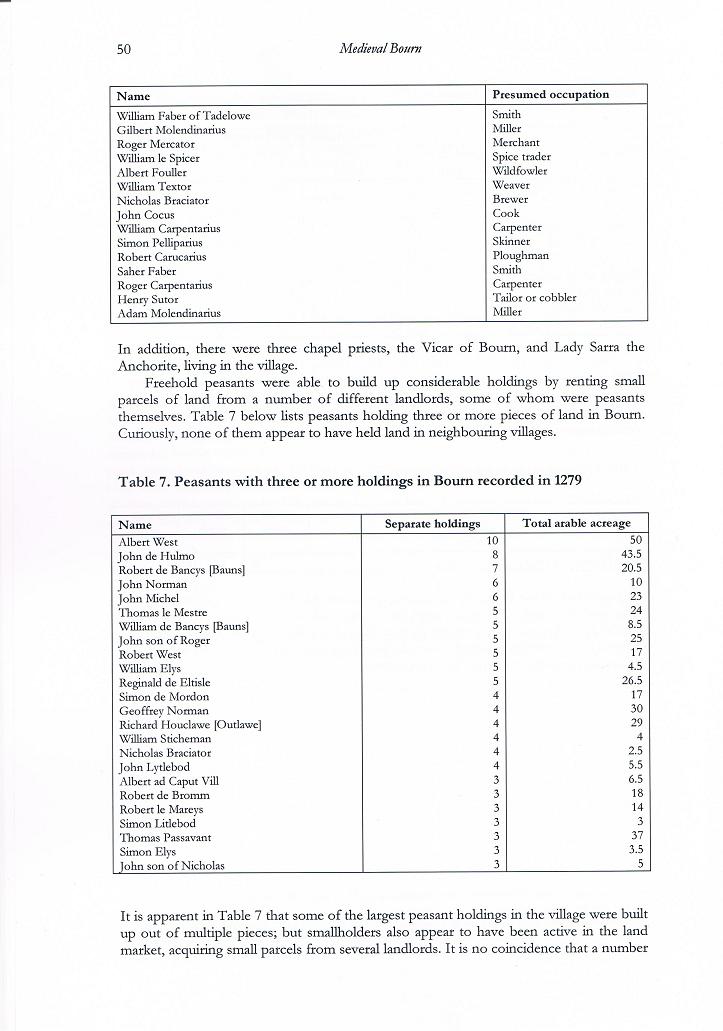
in Bourn (Cambridge) with three or more holdings - Richard Houtclawe
(Outlawe) 4 holdings - 29 acres
1280 - Robert de
Torteville - Master Templar of England
1280 - Jose
de Keteller father of Alice Kyteller died - Alice Kyteller was about 10 years
old
, Alice, who was an only child, inherited his business and properties
1282 - Llywelyn the Last
- last prince of an independent Wales
before its conquest by Norman Edward
I of England - Edward sent his head on to London. In London, it was set up
in the city pillory
for a day, and crowned with ivy
{i.e. to show he was a "king" of Outlaws} and in mockery of the
ancient Welsh prophecy, which said that a Welshman would be crowned in London as
king of the whole of Britain. Then it was carried by a horseman on the point
of his lance to the Tower
of London and set up over the gate. It was still on the Tower of London 15
years later -
Outlaw
: This surname was probably strengthened by the King giving pardons to those outlaws who accompanied him into Wales in the
1300's as part of his forces, and who thus became respectable members of the community.
1282 - Pardon to Ranulph le Mariner for the death of John Utlagh, as it appears by the testimony of Adam de Hoghton and his fellows, justices appointed for the delivery of the gaol of Lancaster, that he killed him in self-defence. - 10 EDWARD I.
1283 - David de Pembrok, struck out because no
writ - Robes for Christmas - Earl of Norfolk's Estates in Ireland - Carlow
1283 - Sir
John de Vallibus was Sheriff of Norfolk and Suffolk and Steward of the Duchy
of Aquitaine in 1283, He died in 1288
1283 - Dafydd ap
Gruffydd became
the first nobleman in England to be hanged, drawn and quartered
1285 - Hospitaller
Charter of
Ida daughter of the late
Richard Utlaw of
the five acres of land and
half an acre of meadow, with appurtenances.
- Roger
[ son of Richard ] Outlaw
( of Bumpstead Helion ), Ida daughter of Richard
1288 - Thomas Utlagh - Close Rolls, Edward I - September 1288
1290 - Hugh de
Utlaghe - Rosponte, New Ross Ireland
1290 - A deed mentions Hugh de Utlagh holding property in
New
Ross Wexford Ireland, in the "Street behind Market Street".
- Hugh de Utlagh
was a citizen of New Ross on the borders of counties Kilkenny and Wexford.
1290 - Edict of Expulsion
- King
Edward I issued an edict expelling all Jews
from England. it was
formally overturned in 1656
1291 - The fall of Acre, 12 May 1291
- Priory church of the Order of St. Thomas of Canterbury established at Nicosia
on Cyprus
1291 - Hospitaller
Knights moved their headquarters to Limassol in Cyprus - Kolossi_Castle
- Limassol
1291 - Margery de Pembrok, staying in
England, nominating Walter de Bodenham in Ireland for one year.
David de Pembrok as the preceding. April 21 - Newcastle-on-Tyne
1292 - John
Balliol crowned King of Scotland
- swore loyalty to Edward I
1294 - Balliol lost authority amongst Scottish magnates - Magnates
concluded the 'Auld Alliance' with France (then at war with England over
the duchy of Gascony) - an alliance which was to influence Scottish history
for the next 300 years
1294 - James
fil' Henry le Vaus (?) v. * Hugh le Utlawe, in Bodham and Westbekham.
- Norfolk fines - 22 Edward I. - Bodham
- West Beckham
1296 - 'Sussex subsidy of 1296:
The rape of Arundel',
Villat' de Madhurst, Tortingeton, et Bynstede - Willmo le Utlagh
- Madehurst - Tortington
- Binsted
1296 - Capture of Berwick
- The English brutally took the city. As many as 10,000 men, women and children
were killed. - 30 March
1296 - Balliol formally renounced his homage to Edward in April 5
1296
1296 - Battle of Dunbar
- April 27
1297 - William
Wallace, famous for wearing green clothes (like Robin Hood) , Defeats
the English Army at Sterling Bridge, William
Wallace makes a sword belt out of Hugh
de Cressingham's skin.
1297 - The Great Charter
1297:
Edward I reissued Magna Carta of 1225 in 1297 in return for a new tax
1298 - Dame Alice Kyteler marries William Outlawe
brother of
Sir Roger
Outlawe, Chancellor of all Ireland
1301 - De Waltero Ughtlawe -
Overton' - 'The Subsidy: Liberty of Saint Mary, York', Yorkshire Lay Subsidy:
30 Ed. I (1301)
1302 - Soldiers
of DE HOLT , Norfolk , Jacobum Utlagh (James Utlagh)
1305 - Sir William
Wallace - Hanged, Drawn and Quartered - stripped naked and dragged
through the city at the heels of a horse to the Elms at Smithfield. He was
hanged, drawn and quartered — strangled by hanging but released while he was
still alive, eviscerated and his bowels burnt before him, beheaded, then cut
into four parts. His preserved head (dipped in tar) was placed on a pike atop
London Bridge. His limbs were displayed, separately, in Newcastle upon Tyne,
Berwick-upon-Tweed, Stirling, and Aberdeen.
1306 - Margaret formerly wife of Thomas son of Christiana of
Trentham, not prosecuting her writ against Richard Utlaghe of
Newcastle-under-Lyme and Alice his wife, she and her sureties, viz., Thomas de Knotton of Newcastle, and Thomas son of Adam of the same,
are in misericordiâ. m.
19. Staffordshire: 34 Edward I - Newcastle-under-Lyme
- Staffordshire Hoard
1306 - Master Fulques de
Villaret, sailed for Rhodes on 13th June 1306 with two galleys and
some transports carrying only 35 knights and 500 infantry -
Hospitallers
1306 - The
Great Exile (Jews from France) - July 22 - King Philip IV
France condemned the Jews to banishment, took forcible possession of
their property, real and personal
1307 - Edward I
died on 7 July 1307 - Edward II rules
1307 - French
King Philip secretly orders the mass arrest of all the Knights Templar in
France on Friday, October 13, 1307
1308 - Witness
William Utlawe of Kilkenny - Quitlaim of the manor of Knocktopher
- Walter de la Haye, knight
1308 - Edward
II married - Isabella
of France
- 25 January
1308 - Templar house: The
Preceptory of Denny in Cambridgshire - the
fraternity at Denny was arrested in 1308
1309 - Gerald
fitz Maurice, Lord of Kerry, the last Grand Prior of the Order (of St.John
Templars) Ireland - Fitz-Maurice
Norman, Welch, and Legendary Ancestors
1309
- Ranulph
Galicien & Philip le Utlagh plaintiffs & Jordan Rey-
nald & Juliana his sister concerning the obstruction of a certain way -
Rolls of the Assizes - Common pleas in Jersey
1309 - Grant
to John de Cantebr' of annual rent of 6s from John Utlagh for a tenement
next to the tenement of Alan de Well'. Witnesses: Simon de Refham, mayor-
Cambridge - Great St. Mary Parish deeds
1309 - Hospitallers
moved to the island of Rhodes
1310 - (Feb.
13). Thomas de Cantewelle, Knight, Edmund le Gras, William fitz Edmund le Gras,
John fitz Simon Shorthals, Roger de Wauncy, and others, were securities to
Richard de Valle and Alice Keteller, his wife (formerly wife of Adam le
Blound, of Callan), for the payment of 200 marks, loaned by the said Richard and
Alice to William Utlawe of Kilkenny. [Patent Rolls]
1310 - Trials
against the Irish Templars commenced in January in Saint
Patrick's Cathedral - accusations based on hear-say flew at the knights, but
no evidence could be found and no confessions were forthcoming. The trials
ultimately fizzled out, ending after six months in an anti-climax. The Templars
were admonished to be good Christians and pensioned off. The property of the
Knights Templar in Ireland was either taken by the crown or transferred to the
Hospitallers
1310 - Lord Mayor
of Kilkenny - William Outlawe
1310 - Roger
le Utlaghe messuages in Burton-on-Trent - Nov 28 1310 - 4 Edward II
- Burton upon Trent
- Staffordshire,
England - Letters
patent of Edward [II] granting pardon to the Abbot and Convent of Burton
for breach of the Statute of Mortmain in respect of various properties in Burton
upon Trent - Property: messuage in Burton from Roger le Utlaghe,
another from Richard Cobard, a third from Emma filius Hugonis le Pestur, all in
Burton, and an acre of land in Calvermedwe from William Cobard.
1311 - Commission
of oyer and terminer to William de Ormeaby, Williiam de Colneye, John de Peyton
and William de Goldyngton, on complaint by Gilbert de Clare, earl of Gloucester
and Herford, that John prior of Ely, Ralph de Derby, William de Lenghare,
William de Denton, Matheas Outlawe, Nicolas le Charetter, Nicolas Dykeman
and William Benard, with others rescued Richard Bathman from the custody of
his bailiff, John Donne, who had arrested him for the larceny of an ox in
the earl's moiety of the town of Lakingbethe, [Lakenheath]
co. Suffolk, in which he had the
liberty of 'infangenethef'. - Gilbert de Clare, 8th Earl of Gloucester
- March 1311 he was appointed guardian of the realm while the king was still in
Scotland. - (Matthew) Matheas OUTLAWE in connection with Lakinghethe
(Lakenheath) Sfk. - Lakenheath
1311-12 - Lord
Mayor of Kilkenny - Henry Outlawe - chief magistrate was known as the Sovereign
Henricius Owtlawe 1312
1311-1340 - Sir Roger Outlawe
- The Grand Prior - Hospital Of Saint John Of
Jerusalem In
Ireland
- Priory of Kilmainham - Lord Justice
1312 - The Knights Templar were dissolved . Much of their property was given to the Hospitallers. The holdings were organized into eight tongues (one each in Crown of Aragon, Auvergne, Castile, England, France, Germany, Italy, and Provence). Each was administered by a Prior or, if there was more than one priory in the tongue, by a Grand Prior. At Rhodes and later Malta, the resident knights of each tongue were headed by a Bailli. The English Grand Prior at the time was Philip De Thame, who acquired the estates allocated to the English tongue from 1330 to 1358.
1313 - Earl of Gloucester &
Hereford names William OUTLAWE as one of his attorneys. - Gilbert de
Clare, 8th Earl of
Gloucester 1291-1314 (Ireland?)
- Calendar of the Patent rolls
Vol-1 - Gilbert de Clare letters nominating Nicolas de Balscote and William OUTLAWE as his
attorneys in Ireland for 5 years
1313 - Gilbert de
Clare, earl of Gloucester and Hertford, staying in England, Westminster, has
letters nominating Nicholas de Balscote and William Outlawe his attorneys in Ireland for five
years. May 1 - Westminster
1313 - Willielmus Outlagh
- The Tallage of 6 Edward II - Bristollia Bristol - Tallage
- Bristollia or, memoirs of the city ...
- Gloucestershire - Bristol
1314 - Grant to
John Outelaw, cutler, of a messuage received from John de Comberton and Julia his wife (as in
3.a) - Cambridge
1314 - John
Outlawe
v. Henry le Pescour of Cantebrigg' & Joan his wife in Gransete - Cambridge-
7 Edw II. 79
1314 - Matthew
Outlawe of Lakenheath Suffolk - "borrowed" a cart
for a visit to Ipswich - Case is record in the court Sept 1314
1314 - King Philip
of France had the last Master of the Templars, Jacques
de Molay and Geoffroi
de Charney, Preceptor of Normandy, were burned at the stake - March
1314 - Battle of Bannockburn
- June 24 - Robert the Bruce defeats Edward II Army - After
Earl of Gloucester was killed, the English army soon fell into disarray,
and the battle resulted in a resounding victory for the Scots, and a humiliating
withdrawal for the English. Robert the Bruce was the earl's
brother-in-law ( Maud de Burgh ), and mourned his death
1314 - On the death of
Gilbert, last Earl of Gloucester and Hertford, of the De Clare family, who
fell at the Battle of Bannockburn in 1313,. leaving no issue, his three sisters, the Ladies Alienore (wife
of Hugh de Spencer, junior), Margaret (wife of Hugh de Audley), and Elizabeth (widow of John de
Burgh), became co-parceners of his inheritance, including the Lordship of
Kilkenny. ... the portion allotted to Sir Hugh de Spencer, junior, and Alienore, his wife, includes
"half of one Knights fee in Kiltranyn which William fitz Maurice holds."
1315-17 - The
Great Famine of 1315–1317 - crop failures cause millions of deaths
1315 - We read of John OUTLAW in connection with many other citizens including Simon de Refham
(Reepham), Alan de Welles, Stephen de Thetford, Roger de Costesye (Costessey) and Adam de Bungey being involved in a case of assault & theft in the
Cambridge area.
1316 - Complaint by
Thomas Baynard, clerk - that John Utlagh , ... Roger Utlagh ...with the
commonalty of the town of Cambridge and others,
assaulted him at Cambridge, carried away his goods and assaulted his men and servants. Aug 20 1316
- York - 10 Edward II
1316 - Quitclaim
to Joan his sister, widow of Alan de Wells, of a piece of land near St
Michael's churchyard - Witnesses:... John Outelawe - Creator John de Cambridge
1317 - Simon
de Everesdon and Margaret his wife v. John le Utlawe junior and Alice
his wife in Brunne - Cambridge 10 Edw II 83 ( Brunne -
BOURN, anciently
"Brunne" or "Burne," is a village, a parish in the hundred of
LONGSTOW, county of CAMBRIDGE, 1¾ mile (S.E by E.) from Caxton - Bourn
1319 - Adam Utlagh is mentioned re Bury St Edmund
1320 - Complaint by Thomas de
Pateshulle, parson of the church of Grantsete,
that (the people of Cantebrigge) ...Roger Utlagh of Cantebrigge, with
others assaulted him at Grantsete, co. Cambridge, beseiged him in his
houses, and carried away his goods. by fine of 20s Westminster
- Feb 24 1320 - 13 Edward II.
1321 - Grant
to Thomas le Tournour, burgess, of a shop with a solar, as in last. - Witnesses:
Simon de Refham, mayor;. John Outelawe . Cambridge
1322 - John
Utlagh - Cambridge - Calendar of Patent Rolls
1324 - Dame Alice Kyteler
was charged with heretical sorcery escapes
to England with help from Brother-in-law Sir Roger Outlawe
1324
- William Outlawe nephew of
Sir Roger Outlaw is ordered to make
pilgrimage to the Shrine of St. Thomas at Canterbury
1324
- Summons
to Thomas Fitz John Earl of Kildare to the war in Aquitane -
Similar summonses were sent to William Utlawe
of Kilkenny - 18 Edw. II 30 Oct. (Aquitane)
1324 - War of
Saint-Sardos - was a short war fought between the Kingdom
of England and the Kingdom
of France . The war was a clear defeat for the English, and led
indirectly to the overthrowing of Edward
II of England.
1326 - Margaret
Outlawe - William fitz Maurice
who married Margaret daughter of William Outlawe , the wealthy banker of Kilkenny
- William Fitz Maurice
- Williaim fitz Maurice, son and heir of Maurice fitz
Maurice, succeeded his father, and in the extent of the services due to Richard, Earl of Gloucester and Hertford in the county Kilkenny,
taken in the year 1247 - they are later known as the "Maurice
Fitgerald"s
1326 - Suffolk manor of Lakenheath
- Matthew Outlawe was said to owe half of the cost of trees needed to build a house
- Matthew
Outlawe of Lakenheath
1326 - Roger
Mortimer and Queen
Isabella September 1326, Mortimer and Isabella invaded England
- 15 October a London mob seized and beheaded without trial John le
Marshal and Edward II's Treasurer, Walter
de Stapledon Bishop of Exeter, together with two of the bishop's squires -
On 27 October, the elder Despenser was hanged
and beheaded at the Bristol Gallows.- The Earl
of Arundel, Sir Edmund
Fitz Alan, an old enemy of Roger Mortimer, was beheaded on 17
November - 24 November Hugh Despenser the younger was brutally
executed and a huge crowd gathered in anticipation at seeing him die — a
public spectacle for public entertainment. They dragged him from his horse,
stripped him, and scrawled Biblical verses against corruption and arrogance on
his skin. They then dragged him into the city, presenting him (in the market
square) to Queen Isabella, Roger Mortimer, and the Lancastrians. He was then
condemned to hang as a thief, be castrated,
and then to be drawn
and quartered as a traitor, his quarters to be dispersed throughout England.
Despenser's vassal Simon of Reading was also hanged next to him, on charges of
insulting Queen Isabella
1327 - Suffolk
Subsidy - Sparhauk Outlawe Oakley , Robert Outlawe - Mendlesham , Adam Outlawe
- Lakenheath
1327 - King
Edward II abdicates
- abdication was announced and recorded in London on 24 January 1327
- later imprisoned at Berkeley
Castle in Gloucestershire where, it was generally believed, he was murdered
by an agent of Isabella and Mortimer on 11 October 1327. Edward
III—was 14
1327 - the Scots invaded northern England and defeated the English at Stanhope in Weardale in County Durham.
1327 - OFFICERS in IRELAND, anno primo R. Edwardi III., with their yearly fees - The Justice of Ireland, 500l.; Thomas FitzJohn Earl of Kildare. In the 2nd year, Roger Owtlawe, Prior of St. John's, the Chancellor, 40l.; the same Roger Owtlawe, the Justice holding pleas before the Justice and Council of Ireland
1327
- July
12 - Topcliffe - John Utlagh, the chancellor (or Ireland) ... concerning
the repulse of the Irish rebels.... (meant Roger rather then John?)
- Calendar of the close rolls preserved in the Public Record Office Edward III
1327 - Mayors
and Bailiffs - Mayor Eudo de Helpringham - Bailiffs - John Outlawe,
Alan de Badburgham - History of the town of Cambridge pg 138
- Edward III. (25 Jan. 1327) - Township and borough
History of Cambridge
1327 - Grant
to William de Saham of a plot of land - Eudo de Helpringham, mayor; John
Outlawe; Alan de Badburham, bailiffs - 23 June 1327 - Cambridge,
St Bene't's parish
1327
- Grant
to William de Saham of a plot of land - Eudo de Helpringham, mayor; John
Outlawe; Alan de Badburham, bailiffs - 24 June 1327 - Cambridge,
St Bene't's parish
1327 - Robert
Outlawe in the Subsidy Tax rolls of the county of Sussex
1327 - Adam Outlawe
- Suffolk Subsidy Roll - Hundred of Lacford - Villata de Lakinghethe-
1 Edward III (1327) - Lakenheath
1327
- Roger
Utlagh , Prior of the Hospital (Knights Hospitallers) of Ireland - PETITION
TO THE KING
1328 - Treaty of Edinburgh–Northampton - was a peace treaty, signed in 1328 between the Kingdoms of England and Scotland. It brought an end to the First War of Scottish Independence, which had begun with the English invasion of Scotland in 1296. The treaty was signed in Edinburgh by Robert the Bruce, King of Scotland, on 17 March 1328, and was ratified by the English Parliament at Northampton on 1 May.
1328 - April
28 - Brother Roger Utlagh, Prior of the Hospital of St. John of Jerusalem in
Ireland, chancellor of Ireland - 2 Edward III - Close Rolls
1328 - The Earl of Kildare, dying in April, 1328, was succeeded as
Viceroy by Roger Utlagh, Chancellor for Ireland, and Prior of the Knights Hospitallers of
Kilmainham.
1328 - Grant to Roger Fouke, cutler, of a messuage in
'Neunham Hamelett' and two and a half acres of arable land, in three parcels, in
Newenham Croft. - creator:
John Outlawe, cutler - Cambridge, Newnham, St Peter's and St
Giles's parish
1329 - Bourn
raiding party of Kingston - John Outlawe and others, rescue 2
horses for the "lord" Priory of Bernewelle - Pg
64/65
1330 -
Hospitallers
continued crusade action from Rhodes
1330 - Exemption
for life, of William Utlawe from being put on assisce, juries or
recognisances, and from appointment as mayor, sheriff, coroner or other minister
of the king against his will. March 10 1330
1330 - Records
of the Priory of St Mary and St Radegund Witnesses: John Pilat, Mayor of
Cambridge, Stephen de Pawfeld, John de Theversham, Robert Seman, bailiffs, John
Utlawe, John De___ et aliis. - Cambridge
- Creator Sir John de Cantebr', knight - Lease to John de Hadenham,
cutler - Witnesses: John Pylet, mayor; Robert Seman; Hervey Peryn; Stephen de
Panfeld; John de Teuersham, bailiffs; Philip Caily; John Outlaw;
John de Deneford; William de Thaxstede - Oct, 1330
1331 - Roger
Outlaw commanded an expedition against Brian O'Brian and other
enemies of our lord king in Munster to Athyssel in Tipperary, in which Arnold
Outlawe commanded eleven men at arms and fourty-eight footmen - 4 Edward
III. Arnold Outlawe was the protégé of Arnold le Poer. - The Normans in Thomond
1332 -
Geoffrey Utlawe - Lay Subsidy Rolls for
Lincolnshire, England - Kesteven Martin - Kesteven
- Martin, Lincolnshire
1332 - Request
that the king give no further credence to any similar allegations made against
the bishop - Maurice Fitz Thomas, Earl of Desmond - Arnold le Poer, knight;
Roger Outlawe, Prior of the Hospital of St John of Jerusalem in Ireland, Justice
of Ireland.
1332 - William
Outlawe is said to have been Prior of Kilmainham, and lieutenant of John
Lord Darcie, Lord Justice.
1333-1338 - Burke
(de Burgh) Civil War
1333 - Aug 4 - Power for
Roger Outlawe, prior of St. John of Jerusalem in Ireland, to treat with the Irish rebels, and receive them into the K.'s peace.
1333 - Aug 4 - The K. desires the
archbp. of Cashel, William de Burgh, earl of Ulster, and 14 others, to assist Roger de Outlawe in his treaty of
peace.
1333 - Grant to Richard his son and Helen his wife of a meesuage in 'Wales' in Holy Trinity parish between a messuage of his own and one of
John Outlawe and stretching from the king's highway to the tenement of the
Archdeacon of Ely.
1334 - Witnesses:
Edmund de Ovying'; John Breton; Richard le Smyth; William Mareys; Roger
Outlawe of Barton (Barton,
Cambridgeshire)
1334 - Grant
to William de Saham, burgess of Cambridge, and Agnes his wife, of half an acre
of arable in Barton field between land of the Prior of Barnwell and land of
William de Brunne abutting on le Rugganacreforelonges and on land of Stephen
Cosyn - Roger Outlawe of Barton
1334 - Crusader navy defeated Turkish pirates in the Gulf of Edremit - Crusaders held the port of Smyrna - Edremit - Smyrna
1335 - William
Outlawe. - Names of
Persons summoned to attend John Darcy, Justiciary, with arms and horses in his Expedition
to Scotland
1335 - Persons
summoned by John Darcy, Justice Ireland, with arms and horses in his Expedition
to Scotland in 1335 - Roger de Pembrok
1336 - Grant to Roger Outlawe, prior of the Hospital of St. John of Jerusalem in Ireland, of the custody of the lands in Ireland, which Henry de Cogan, deceased, held for life of the inheritance of
Peter de Cogan, tenant in chief, to hold during minority of the heir of the said Peter by the rent of 50/. payable at the Exchequer of Dublin. By C - July 10 Perth
1336 - Grant
for life,
to William son of Nicholas Utlawe that
his houses in cities, boroughs and other places in Ireland shall be quit
of livery of the king's justices and ministers there, that none of these shall
make any livery or lodge in them against his will. Also that nothing shall be
taken by them of the victuals and goods of him or his men in that land for the
king's use against his will or without due satisfaction. By K. - July 10 Perth
1337 - Hundred Year's War begins - 1337 - 1453
1339 - The parson of the church of Potton was robbed in 1339 of wheat, barley, beans, peas and other goods and chattels to the value of forty marks by William, son of William de Hurle of Potton, John Wymond of Potton and John Lettice of Potton, The same William de Hurle and another assaulted Reginald Outlawe, parson of the church of Esthattelee at Potton and wounded him, and William was presented as a common assaulter and disturber of the peace. - THE LANDS OF THE SCOTTISH KINGS IN ENGLAND - Potton - - Esthattele = East Hatley St. Denis
1340 - Seal
- William Utlage (?), - Used by Robert of Durham, merchant.-
Inscription: SIGILLVM WILELMI VTLAGE - Seal design: Round,
armorial, a lion rampant. - pdf
1340 - Presentation of
Reginald le Outlawe, parson of the church of Esthattele, in the diocese of
Ely, to the church, of Risshenden, in the diocese of
Lincoln, in the king's gift by reason of the temporalities of the priory of Lenton being in his hands, oni an exchange of benefices with Hugh de
Luffenham.
[ Esthattele seems connected to Barnewell Abbey - St
Michaels Cambridge - St John's Hospital - John de Hattele
- Estenhale:
its eastern extremity towards Barnwell Priory was called Estenhale]
- Esthattele = East Hatley St. Denis
(Cambridgeshire)
1340 - Viceroy
- The
Bishop of Hereford returned to England in 1340, leaving the government to the
Chancellor, Prior Roger Utlagh, on whose death, in the same year, Edward
appointed Sir Jean D'Arcy, Viceroy of Ireland, for life
1341 - Death of Roger
Utlagh - Outlaw - Roger Outlaw, still Prior, Chancellor and
Lord Justice of Ireland died at Any (Knockainy Co. Limerick)
1341 - Reginald Outlawe of
Brunne, rect. of E. H. exchanged in 1341 with Thomas de Eure of Blakolmslee.
- Esthattele = East Hatley St. Denis
1342 - William son of William Outlawe grants to
Johanna, who was the wife of William Outlawe - Kilkenney
1343 - Debtor:
Thomas Outlawe, of Bodham [Holt Hundred, Norfolk. Creditor:
Sir Simon, the Prior, and the convent of Walsingham [North-Greenhoe Hundred, Norfolk], and James
Cappe, of Burston [Diss Hundred, Norfolk]. - 1343 May 15
1346 - Norfolk,
HUNDREDUM DE HOLT. Juratores.—Johannes de Honeworth, Thomas Uthlagh
1346 - Inspeximus by Thomas son of James Outlagh of Audham of a writing made by his said father to John son of Thomas Bounde of
his freedom; and release of all claim in the said Thomas Bounde and John his brother, sons of the said John son of Thomas, &c. Dated at
Wykemer, Thursday before the Translation of St. Thomas the Martyr, 20 Edward III.
- Essex - Aldham
- Inspeximus = a royal grant or a grant
1346 - Battle of Caen (1346) - Landing in France- The campaign began on 11 July 1346 when Edward's fleet departed the south of England and landed the next day at St. Vaast la Hogue, 20 miles (32 km) from Cherbourg.
1347 - Grant to Henry de Tangmere and John de Bernewell (Outlawe), burgesses, of a messuage as in 58, 60, and 61. Messuage - Buildings and land
1347 - Robert Outelawe's land in Barton Cambridge - Madwefeld of Berton at ‘ le Cros '
1348 - 1350 - The Black Death under Edward II - caused the death of more than half of the nation's inhabitants - visitations of the plague again in 1361 , 1369 , 1375 - Population began to rise again in 1520
1349 - The Guild
of Corpus
Christi was founded in Cambridge
in 1349 by William Horwode, Henry de Tangmere and John Hardy[4]
in response to the Black
Death.
1349 - (1281 -1318? ) - Cambridge
Guilds - St Mary's guild. - Willelmus Outelawe - Hugo
Outlawe.
1349 - Grant
to John le Noble, chaplain, Henry de Tangmere, William de Horwod, John
Arnald, Thomas de Wentsworth, Thomas de Childerley, John Eckles, furbisshour,
Eudo Fock and Simon de Sleford, clerk, of a shop with a solar above. - Creator Matilda Outlawe
- Cambridge, St Edward's parish - 20 Apr. 1349
1349 - Grant
to Henry de Tangmere, burgess, of six shillings and eight pence of annual
rent from one messuage once William de Pokelyngton's - The messuage lies between
a messuage once Matilda Outlawe's and Tripereslane. - Cambridge,St Edward's parish
21 Sep. 1349
1349 - Matilda
Outlaw
of Cambridge, widow, grants to the alderman and Guild of St.Mary a messuage in
St. Edward's parish. (No witnesses named.)
1349 - Grant
to John Annys of Haslingfield of a messuage with buildings and adjacent croft
and of an acre of land in Barton - The messuage and croft lie between land of
the Prior of Barnwell and the king's highway, one head of the corft abutting on
Brunnebrok, the messuage abutting on the highway. Half an acre of the land list
in Bradefeld between land of the Prior of Barnwell and land of John
Lorimere abutting on land of the said John; half an acre lies between land of
John Breton of Abington and abuts on land of John Sweyn.Witnesses: Edmund
Ovynge; Robert Outlawe; John Rogge; John Shasteleyn; John Mareys senior -
Barton- 23 Edward III
1349 - Registrum de Kilmainham: Chapter Acts in Latin of the Knights Hospitallers of St. John of Jerusalem at their chief house of Kilmainham, near Dublin, under the Grand Prior Roger Outlawe, 1321-39 - Bodleian Library - Balliol College, Oxford
1352 - Bernewelle
Priory
acquires Hauteyn Estate 1350 - Henry Outlawe for 2 pence - pg
67
1352 - The Black Death by this year had killed
25 million people in Europe alone
1360 - John
Outelagh and Joan his wife,
def. 1 messuage and 1 carucate of land in GreatChisell, Little Chisell,
Heyden and Crishale - Essex - Crishall
- Cristeshalla, or "nook of land dedicated to Christ".
-
William atte Wode of Crishale and
Walter Pytee of Chisell, pi. John Outelagh and Joan his wife, def. 1 messuage and 1 carucate
of land in Great Chisell, Little Chisell, Heyden and Crishale. PI. and the heirs
of William to hold of the chief lords. Cons 100 marks. - 34 EDWARD III
1361 - visitations
of the plague again in 1361 , 1369 , 1375 - Population began to rise again in
1520
1361 - Cambridge, Holy Trinity parish
- Grant to Master Thomas de Elteslee, senior, William Horwode, John Raysoun and
Thomas Caumpes of four shillings annual rent from a messuage opposite the
conduit and between tenements of the guild of Corpus Christi and of Henry
Utlawe.
1362 -
Rome - The Hospital of Saint Thomas of Canterbury in Rome is established - Margery Kempe1363 - Outlawe, Thomas, capellanus, of Walsyngham Parva - Will (Capellanus meaning "chaplain") The priory passed into the care of Canons Regular sometime between 1146 and 1174. - Walsingham Parva
1366 - Witnesses: William le
Quer; Richard Wyth; John Outelawe; John Lam; John Page of Grantchester -
Grantchester, Cambridgeshire
1366 - Records of the
Priory of St Mary and St Radegund - Gift with warranty - . Witnesses: John
Moris, Mayor, William de Horwode, Thomas Dunston, John Goldsmyth,
Henry Outlawe et aliis.
1369
- visitations
of the plague again in 1361 , 1369 , 1375 - Population began to rise again in
1520
1370 - Geoffrey Chaucer writes the
Canterbury Tales
1372 - Chishall - It was holden in 1372 by William Cardon, under Geofrey de Magnaville; and under Humphrey de Bohun, earl of Hereford and Essex, by the heirs of ... John Outlaw
1374 - Priory of St Mary and St Radegund
- Licence for an easement - The prioress (unnamed) and the nuns to Geoffrey
Castre and Margaret, his wife, for an eavesdropping from their house in Walls
Lane upon Sarans Croft for the breadth of one foot of St Paul's. Witnesses:
William de Horwode, Mayor of Cambridge, Stephen Morice, John de Norton, Robert
de Brigham, Henry Outlawe et aliis. - 21 April 1374
1374 - Adam OUTLAWE signed ordinances of the
Guild of St John the Baptist in West Lynn (ref. BARDSLEY) - Adam
Outelawe - Original Ordinances - The history of freemasonry
- Early British Freemasonry - Such guilds
were everywhere under the patronage of the Holy Trinity, or of certain saints
1374 - Grant
to Agnes Lorymer of Barton of a messuage with adjacent croft and 3 acres of
arable in the vill and fields of Barton and Whitwell - Witnesses: Robert
Outlawe
1375 - visitations
of the plague again in 1361 , 1369 , 1375 - Population began to rise again in
1520
1375 - Grant
to William Trewe of Grantchester and Johanna his wife of a tenement called
Lakeres Place and 2½ acres and 1 rood of arable. Lakeres Place lies between a
plot of John Blauet and the common lane to the common river bank; ½ an acre
lies against Brunewell; 1 acre lies at Le Dedeman; 1 acre liest against
Bradeweye; ½ a rood lies below Ryggeweye. Witnesses: William Smyth; John
Outlawe senior; John Lacy; John Outlawe junior; William in the Lane.
-
Creator: Thomas Eltesle senior. - June 25 1375 - Grantchester Cambridge
- Janus
records
1376 - Hospitallers
leased the Principality of Achaia from Joanna of Naples for 4,000
ducats per year - Joan I of Naples
1376 - Widow
of John Outelagh , Joan his wife,
def. 1 messuage and 1 carucate of land in GreatChisell, Little Chisell,
Heyden and Crishale - Essex
- John Rydere, parson of
Heyden. and Nicholas
son of Hugh Parys of Heyden, pi. by John Heyden. William Manewod of
Heyden and Alice his wife, def. 2 messuages, 2 tofts, 76 acres of land, 3 acres of
wood and 2s. rent in Heyden, Cristeshale, Elmedon and Great Chyshull. PI. and the heirs of Nicholas to hold a moiety of the chief lords, with
the homages and services of John Upstret, Katharine Arneys, Richard Curteys and
Joan Outlawe and their heirs, and also the remainder of the other moiety, which
John atte More of Heyden holds for life by the law of England. Cons. 20 marks.
- 49 Edward III
1377 - PRIESTS. John
Morcell, Wm. Fletcher, John son of Wm. Utlawe, Ric. Godeberd. Oct. - Prebendal
Church of Colewych - Colwich,
Staffordshire
1377 - King
Edward III dies - Richard II rules by regency of John of Gaunt
1378 - The
Great Western Schism splits the Catholic Church when two opposing are
elected, Pope
Urban V + in Rome and Pope Clement VII in Avignon.
1381 - Peasant's Revolt - Richard II - The man accused of ravishing Robert Martyn's wife was later pardoned...beginning of the end of serfdom in medieval England - One captured rebel leader, when asked the reasons for the revolt, said, "First, and above all . . . the destruction of the Hospitallers.
1381/3 - John
Outelawe
was Bailiff at Bourn/Cambridge 1381-1383 - Pg 98
1384 - Thomas
Baret relieves John Outelawe of the office of Bailiff at
Bourn/Cambridge - 7th year of Richard II - Pg27
1384 - GRANT
by John de Ingaldesthorp, Knt. to John Outlawe, sen. and Thomas de Acre
of Westlenn and William Spicer, burgess of Lynn, of five acres of land in
Westlenn [West in St. Peter's parish extending from the King's way,
of old called "Satirday Damp" to the common gaol (jail);
to hold by service of a silver penny.
1385 - Operation
of the ferry to West Lynn was farmed to Thomas Outlagh for 13s.4d.
1385 - Exchequer Lands. —The tenants jointly hold the pasturage of a cottage called
Colynfield, and pay xls. John fil. Richard holds a plot and two acres of land called
Outlawe, once of Simon the Headborough, 2s. .- Cleadon - Whitburn
- Durham
So this seems to be John Outlawe and his
"brothers" from West Dereham and be goes on to become John de
Bernewelle Outlawe at Barnwell Priory....:
1387 - Manumission
of three nativi by licence from the Holy See : John Outelawe senr., John O.
junr., and Thomas. O., lay brethren of Norwich dioc. Bull addressed to West
Derham Abbey. They were born of a free mother, but their father Nichs. O.
/ laicus was " servus " of the Bp. fo. 61. - BISHOP ARUNDELL'S
REGISTER.
See: The abbey of St. Albans from 1300 to the dissolution of the monasteries
on the freeing of Villiens (serfs) and the Peasants
Revolt. - Thomas Arundel
1388 - Parliament met at Cambridge. The king and his court lodged at Barnwell Priory until the end of the session - 9 September 1388
1389 - Richard
Outelawe,
and Joan his
wife, Cantebriggie
town,
diocese of
Ely.
- St Mary's Gild - Cambridge - Jan 31 1389
1389 - Records of the
Priory of St Mary and St Radegund - Gift with Royal licence - Witnesses: Robert Brigham, mayor of
Cambridge, John
Blankpayn, John Marchal, Richard Martyn, John Norton, Robert Martyn, Richard Outlaw et
aliis. (regards Barnwell Priory)
1390 - ... in favour of Richard Bedewynde of Redynge 'hosteler' and John Hosteler 'that was Richardes servant Bedewynde' of Redynge at suit of John Outlawe of Bristol for ...
1391 - William
Bykhill and Simon Outlawe v. William Skreyve and Agnes his wife in
Fynberg magna - Suffolk - 14 Richard II
1392 - Isle of Ely - Priory of Barnwell -
in Cambridgeshire,
- John
de Bernewelle, or John Outlawe, elected March 1392, died Nov. 1408 - John
de Bernewelle, (fn. 213) whose personal name was Outlawe; (fn. 214) possibly a
canon of West Dereham, and one of the three brothers of that name
1392 - Simon
Outelawe, Michael Brailes plaintiffs - 1392 Sept. 29.-Oct. 5]
York - Premises: 9 messuages, 18 shops in Bristol and suburbs
1392 - Ship
of John Owtelawe, called James of Lynn, departing the last
day of February - customs levied thereon at Lynn
1393 - The Sacking of Bergen (Norway) in 1393 was one of two attacks on Bergen by the Victual Brothers, a former trading guild turned to piracy. In 1395 the Victual Brothers attacked again
1394 - Simon
Outelawe - Aug 4 Westminster pg 458
1395 - John Hattele clerk and Simon
Outlawe of Cambridgeshire
1395 - John
Outlawe juror Sleaford Kesteven
Lincolnshire - Kesteven
- Sleaford
1395 - Several small Yarmouth and other ships taken by Danish pirates in a sharp conflict off the coast. Lost £20,000 in specie.
1396 - Richard of Greteham of Marton 'netmaker indicted for stealing three sheep of John Outlawe the day after the feast of St. Michaels - Marton, Lincolnshire
1396 - Battle of Nicopolis - The Last Crusade - English Hospitallers - the presence of "English" may be attributed to Knights Hospitaller of the English tongue , who joined their comrades for the crusade after leaving Rhodes (where the Hospitallers were based at the time) and sailing up the Danube - The Crusaders were defeated
1397 - Richard Outlawe - Close Rolls, Richard II - November 1397 - John Reede, Alexander Westmerland and John Spenser of Cambridgeshire to set free Brice Gorell, if taken at suit of the king and Richard Outlawe for leaving...
1398 - Simon
Outlawe,
Walter Chertheseye, William Chertheseye give Robert Corbet', knight, 100 shillings of rent in
Hoddesdon and Amwell.
1399 - Counterpart
of lease to John Outlaw, barker, of two acres of arable land in 'le
Carmefeld' next 'Bynbrook' and land of St John for 8 years - Cambridge Fields
1399 - Richard
Outlawe,
58, on that day went with master Ivo la Zouch, chancellor of Cambridge
University, to the church - See : Richard Outlawe 1399 Cambridge
1399 -
Thomas Outlawe purchased the right of a little ferry
boat for 13s. 4d. from the Gild of Corpus Christi
1399 - Essex.
A. 783. Grant by John Forster and Robert Watevyle, goldsmiths and Herts.
citizens of London, and John Ive, clerk, to John Charteseye and Simon
Outelawe, of all their lands, Ac., in Waltham Holy Cross, Halyfield, and
elsewhere, in Essex, with their appurtenances in Chesthunte, Herts. 24 February,
1 Hen. IV. Three seals. (1399) -
1399 - Richard
II surrendered to Henry at Flint
Castle on 19 August 1399 - Richard's life after the deposition is
unclear
1399 - King Henry
IV on 13 October was crowned
1399 - Robert Digges, rector of Clenchwarton, &c. confirmed to John Outlaw, senior, of West
Lenne, Edmund Baleset, burgess of Lenne, a messuage and lands here; dated at West
Lenn on the feast of St. Peter in Cathedra; witnesses, Richard de Bellons, Richard de
Well - First
Henry IV
1400 - Counterpart of lease to William de Lennea [Lynn], cutter, of 4
acres of arable land in Cambridge field for 26 years at an annual rent of
6s 8d. - Witnesses: Thomas Trevet, mayor; Robert Martyn; Richard Outlawe.
1403 - The
Knights Hospitallers of Jerusalem, driven from Smyrna (in 1403) by Timur,
settled at Rhodes, which they held till 1522
1403 - Simon
Outlawe at Baas Manor - Hertfordshire.- Westminster.
1403 - Demise by
Walter Merwe and Elizabeth his wife, to
John Cherteseye and Simon Owtlawe, for the lives of the grantors, of a
messuage, land, and rent &c. in Waltham Holy Cross, in which the said Walter and Elizabeth had been enfeoffed for life by John Martyn and
Simon Owtlawe, who lately had the same by fine in the court of the abbot of Waltham Holy Cross, from John Charteseye
and Elizabeth his wife. 28 June, 4 Henry IV.
1403 - Commission
to Robert Outelawe and Adam Outelawe (and others) That no persons
banished from the said realms nor sea-robbers be received in any ports or ships
of the realm. Feb 17- Feb 24 - Henry IV Patent Rolls. - Reference is made of
Robert & Adam OUTLAWE being appointed, with others, to take certain enemies of the King into custody.
1404 - Robert
Outlawe - Close Rolls, Henry IV - February 1404
1404 - Gift
by William Britlyngg of Cambridge, Hugh Plouwryght and Richard Outlawe,
executors of the will of Robert Martyn of Cambridge, to Adam Leveryngton of
Cambridge, chandler, and Margaret, his wife, of a tenement in St Bene't parish.
Given at Cambridge - 20 Apr. 1404.
1404 - Quitclaim
to John Pig, tailor, and Thomas Pig of all right to a tenement hitherto held
jointly with William Britling, Hugh Plowright and Richard Outlawe. -
2 July 1404 - 5 Henry IV
1408 - Grant
to Richard Aunger, Thomas Fan and John Marchal of the same of 10 acres of
arable in the fields of Barton - half an acre lies next to land of Robert
Outlawe
1408 - William
Asshebourne, Lynn’s town clerk received a letter from Lynn men in
Danzig setting out their ordinances recently drawn up for “their company”
there. - Lynn and the German Hanse.
1413 - Margery Kempe settled debts, and set off
from Kings Lynn for
pilgrimage of the Holy Land
1414
- Thomas
Paunfeld continues his complaint against the Prior and convent of
Barnwell. He requests a writ summoning the people of Chesterton to
attest to the truth of what he says, and another summoning the Prior of
Barnwell and Robert Scot, one of the canons, to present their evidence on
their behalf, and that the judgment in a plea in Common Pleas, and other
evidence which he specifies, might also be brought. John Outlaw, Prior of
Barnwell
1415 - Thomas Russell, master of the ship called the "Holigost de Lenn Oct. 12. 1415 - A ship called the Holigost of Lynn took part in transporting Henry V's expedition to France in 1415 (C.P.R., 1413–1416, 382).
1416 - Letters
of attorney for John Aleyn of Barton to deliver seisin to Richard and John
Aunger of Barton of 3 acres and 3 roods of arable scattered in Barton fields.
Creator John Outlawe of Barton
1417 - A. 10008. Feoffment by Henry Fullere of
Berton, co. Cambridge, to Richard Aunger, Robert Outlawe, the younger, and Richard Freman of
Hatteley, of all his lands, in Berton and Grancete. Berton, Thursday after the Beheading of St. John the Baptist, 5 Henry
V.
1418/19 - Robertson
of Richard Outlawe appoints Richard Reed and Thomas Fullere to deliver
seisin to Geoffrey Stonham of Bertonbendyche of 3 acres of land in Fyncham
- 6 Hen V - 14 March 1418/19 - Norfolk Record Office
1419 - Grant.
Richard Outlawe of Fyncham
and Isabella his wife and Robert their son to Geoffrey Stonham of Berton
bendyche.13 Mar 1419
1419 - Richard
Outlawe appoints Richard Reed and Thomas Fullere to
deliver seisin to Geoffrey Stonham of Bertonbendyche of 3 acres of land
in Fyncham - 14 Mar 1419 1419 - Grant.
Richard Outlawe of Fyncham and Isabella his wife
to John Stonham of Berton - 28 Sept 1419
1419 - Grant.
Richard Outlawe of Fyncham to Geoffrey Stonham
of Berton Bendych - 21 Dec 1419
1420 - Lease for life of 2 - Johanna Outlawe widow of John Outlawe sen. peautner (sic) Premises: parcel of land in churchyard 30ft long and 14ft broad which John Outlawe held - 8 Hy.V (1420) 12 May - Bristol Record Office - St James Parish, Bristol
1427 - Grant to Richard Dykes and Thomas Owtelawe, both of Barton, of a messuage with adjacent croft and 3 acres of arable scattered in the vills and fields of Barton and Whitwell - Half an acre of land lies in Barton field in Le Holyffeld between land of the Prior of Barton [sic, for Barnwell] and land of William Fodreyngton and abuts on land of the said Prior...Witnesses: Henry Aleyn; Robert Owtelawe; Nicholas Aunger; Thomas Fan; John Atkyn; Thomas Reyner; John Lyefchild; John Aunger; Robert Warder - 4 May - 7 May Quitclaim to Richard Dykes and Thomas Owtelawe, both of Barton, on messuage and lands
1429 - Saint Joan of
Arc - arrived at the siege
of Orléans on 29 April 1429 - captured by the English 23 May 1430 -
executed
burned at the stake 30 May 1431
1431 - Feoffment.
Richard Outlawe of Fyncham and John Webster of
Carbeysthorp to Richard Cabraund (?) of Carbeysthorp and Edmund Qwyth, senior,
of the same. - Messuage in Thorp aforesaid
1431 - The
son of Margery Kempe married a Prussian woman and both travelled to Lynn,
leaving their child in Danzig.
Margery’s son died in Lynn and she escorted her
daughter-in-law back to Danzig
1432 - Feoffment by Richard
Waynflet, vicar of .... to Richard Lacy of Graunceter and Robert Waryn of 1a. land in the town and fields of
Berton, next land of Thomas Owtelaw, &c., which he had by the feoffment of William Cole of
Cotyn. Berton, Saturday before St. (Sancte) .. 10 [Henry] VI.
1437 - John Outlawe - 03/23/1437 - Archer - Les Andelys - Captain Thomas Picot - John Talbot Earl Shrewsbury - BNF, MS. Fr. 25773, no. 1175
1437 - John
Utlawe, chaplain to the Precentor - Lincoln Cathedral
( The Lincoln Cathedral
was used for the filming of The
Da Vinci Code )
1437 - Vtlawe John,
chaplain - Lincoln Cathedral
1440 - The printing press was invented in the Holy Roman Empire by Johannes Gutenberg, around 1440.
1441 - John Outlawe - 1441 - Archer - Expedition France - Richard Duke of York - Richard Duke of York - TNA, E101/53/33, m3
1445 - John Outlawe - 06/15/1445 - Archer - Retinue Kings Councillor - Sir William Oldhall - TNA, E101/53/33, m3
1450 - Defendant Outlawe, Thomas, of Haselyngfeld, Cambs, yeoman - debt - Plaintiff Robert Semer - Essex
1452 - Leonardo da Vinci
was born April 15, 1452 – died May 2, 1519
1453 - The Fall of Constantinople
- Beginning of the History of Istanbul
1454 - The
Gutenberg Bible - first finished copies were available in 1454 or 1455
1454 - Richard
Outlawe - Foss Bridge - York - Bridges of York
1454 - Protection
to John Owtelawe in the retinue of John earl of Worcester - Oct 23
- 33 Henry VI - French Rolls - John
Tiptoft, Earl of Worcester - "the butcher of England" - in
1449 Lord
High Treasurer and then as Lord
Deputy of Ireland (1456–1457) - King Henry VI's seizure with madness, in
August 1453, supplied York with an opportunity of getting control of the government without the use of force against the King.
... the lords came up to London, early in 1454, with great retinues
1456 - Kings Lynn -
John Outlawe, the son of Richard Outlawe, upon whom was conferred the freedom of our burgh
- ( given - Keys to the City )
1456 - John
Outelawe, son of Richard Outelawe, app. of Adam Okey (A.) - Freemen of
Lynn
1456 - Release by
Thomas Outlawe to John Marke of William Audley's former lands in
Grantchester, Barton, Coton, Whitwell and Cambridge.
1457 - Kent
-. Demise by William Rotheley and John Sharp to
John Outlaw of land in a field called 'Depeden' in the parish of
Eard. 35 [Henry VI].
1457 - Thomas
Owtelawe - Tenament - St. Mary's Parish Cambridge
1458 - Grant
to Richard Clyve, Nicholas Clyve, John Aspelon junior 'legis peritus', Richard
Rolf amd Richard Denys of a tenement with a house upon it and 5 selions of
arable in the vill and fields of Barton - The tenement lies between a
tenement lately of William Baycele on one side and land once 'le Vaches' and
land lately of John Marsall on the other and abut on the highway; the
selions lie together in the same place between land once of William Baycele and
land once of Cristine Aunger and abut on the said tenement.. Malster holds
the property by enfeoffment from Thomas Outlawe, Nicholas Aunger
senior and Richard Dyke.- Witnesses: Robert Fanne; Richard Freman; John Freman
his son, of Barton; Nicholas Aunger; Sampson Aunger of Whitwell. - 30 June 1458 Barton
1458 - Owtelawe,
John, of Weasenham, Norfolk - Grant of Administration
1459 - Deed
of gift - Richard Quayle of Fittleworth - A croft and 15a. in a field
called Meneham in Madehurst Witnesses: John Short, Richard Outlawe,
Thomas Hale, William Lydgater, Thomas Short - 10 December 1459 - West Sussex
Record Office
1461 - Battle of Towton - Wars of the Roses on 29 March 1461 - 50,000 soldiers from the Houses of York and Lancaster fought for hours amidst a snowstorm on that day, which was Palm Sunday. - Yorkists found themselves heavily outnumbered. Part of their force under John de Mowbray, 3rd Duke of Norfolk, had yet to arrive - The arrival of Norfolk's men reinvigorated the Yorkists and, encouraged by Edward, they routed their foes. Many Lancastrians were killed while fleeing; some trampled each other and others drowned in the rivers. Several who were taken as prisoners were executed. - the chronicles state that the Lancastrians eventually fled across these "bridges" of bodies
1463 - July
21 -
Commission to Robert Cotyngham, master of a ship called le Thomas, to take mariners for the governance of the same to go to
sea with other ships for the resistance of the king's enemies.
The like to the following :— Richard Outlawe, master of a ship called le Mari
Talbot.
1463 - Auguste,
wytnessyth what my mastyr hath payd to Rechard Owtlaw, mastyr of the Mary
Talbott of Lynne, at the goynge to the see. -
list
of the retainers who accompanied Sir John Howard to Wales in 1463 - crew
Rechard Owtlawe
mayster - John Owtlawe.
1463 - Outlawe,
Thomas, capellanus (Chaplain), of Walsyngham Parva - Will
1463 - War of Roses Begins
-1455 to 1485
1468 - Robert
Deryng of Lynne, maistre of the ship called the Marye of Lynne, wherof
is owners Richard Outelawe and Aleyne Thomsone, satth, he sailed from the
towne of Lynne towardes Pruce in Dantzike - DRÁP BJÖRNS. - VERZLUN
1468 - Will
- Outlaw (Outlawe), Richard, of Mattishall -
Mattishall
1470 - Edward
IV fled from King's Lynn by ship in 1470 at the height of the Wars of the
Roses. He stayed the night in the house belonging to Walter Coney, which was on
the site of the newsagents, opposite Wenns pub, at the south end of the High
street. He returned to England 1471 with an invasion army travelling in
Hanseatic ships
1470 - John
Tiptoft, Earl of Worcester - "the butcher of England" - Captured
by the Lancastrians, he was beheaded at Tower Hill, London
1471 - Battle of Tewkesbury
- decisive battles of the Wars
of the Roses - many prominent Lancastrian nobles were killed during
the battle or were dragged from sanctuary two days later and immediately
executed. - 4 May 1471
1471 - Sir John
LANGSTROTHER Grand Prior of the Knights of St John of Jerusalem in England
- Fought at the battle of Tewkesbury. After the battle Sir John was one
of those taken from sanctuary and executed - Buried
in the Church of St. John, at Clerkenwell
1472 - FEOFFMENT
by Agnes Balle, of Lenn Episcopi, dau.and heir of John Balle, to Thomas Cokkeson,
of North Lenn, William Greneland, William Herald, Richard Dunnysby, and Adam
Outlawe, of West Lenn, chaplain, of two acres of land in the field of
Clenchewardton at Gripgate.
Witn. John Dawe; Robert Moote; Geoffrey Bedelle; etc.
1474 - Outlaw
(Owtelaw), Thomas, of Watlington - Will -
Probate - Norfolk
1474 - The
Treaty of Utrecht - the English King conveyed a quay and tenements in the
Norfolk town of Lynne to the Hanse. Lübeck invited Danzig to take
charge of the property, the complex now known as Hanse House - King's Lynn and the Medieval
Hanseatic League - A number of Lynn merchants and their
associates seem settled in several Baltic seaports by the early 15th
century, particularly in Wismar, Stralsund and Danzig
1477 - Deeds relating to Barton - 1 half acre next to land lately of Robert Outlawe, now of Nicholas Cleve
1479 - Thomas Wayn, Robert Oweton and William Owtlawe, feoffees to the use of John Langham, clerk - Thomas Gyggys Gent.- Land in Dockyng Norfolk - 19 Edw. IV - Docking, Norfolk
1480 - The Siege of Rhodes took place from May to July 28,
1480. About 500 Knights Hospitaller
and 4000 soldiers under command of Grand Master Pierre d’Aubusson managed to repulse the attacks of the Ottoman army which numbered about 70,000 men.
1481 - 1st Duke of Norfolk - Lord John
Howard, commanded the fleet in the war with Scotland with great
success - In the
late spring of 1481 John Lord Howard sailed into the Firth of Forth destroying and
capturing Scottish ships and burning Blackness - Mary of Lynne
-
take mariners for the said ship, as the king has ordered an armed force to go to sea to resist his old enemy the king of
Scots. - The schippes that foloweth goeth to Scotland with the Lord Howard
- The Mary of Lynne
- Rechard Owtlawe
mayster - John Owtlawe.
1481 - Feoffment by Adam Outlawe of West Lynn, chaplain, to John Dawson of Northlenn, chaplain, 1 September 1481 Thomas de Acre's chantry and which were granted with other lands by William Walton, esquire, to Adam Outlawe and John Harold of North Lynn, shipmaster
1483 - Outelawe, Thomas, haknay man - Milton Gravesend Kent - St Mary Gracis by the Tower - Trespass - East_Smithfield
1485 - Battle of Bosworth - penultimate battle of the Wars of the Roses - Richard III of England dies (lost) only king to die in battle on English soil since Harold II, - supporters of Richard , John Howard dies, Thomas Howard his son taken prisoner and imprisoned. Henry VII of England first monarch of the House of Tudor. takes power.
1492 - Christopher Columbus in America - Pedro
Álvarez de Sotomayor was Christopher Columbus
1492 - Thomas
Outlawe - 1 acre with a garden on the
southern boundary in Mattishall, the south head of which abutted onto the
King's highway
1493 - Inquisition taken at the
Guildhall - London, 23 March, 8 Henry VII [1493], before William
Martyn, Mayor and escheator, after the death of Edward Greene, by the oath of John
Machyn, Thomas Outlawe, John Gage, Thomas Couper, William Wodestok, Henry
Calvar, Thomas Rayner, Thomas Lybbys, Nicholas Jefray, William Cambre, Richard
Spycer, John Broune, John Knyght, Thomas Chamberleyn, and Richard William
- GUILDHALL London
- Guildhall, London
1493 - Death
of Ellen Wodeward witnessed by Thomas Outlawe
- London - 23 March, 8 Henry VII
1497 - Death of Richard Chamberleyn witnessed by Thomas Outlawe - London - 4 March, 12 Henry VII - 1497
1499 - Walshe
(Walsh), Roger, of Blickling - Probate Will
1499 - William
WALSH
born 1475 in Colby, Norfolk, England. married Olive CLERE in 1499 in
Colby, Norfolk, England.
1501 - Thomas Owtelaw
- Milton - West Kent wills
1501 - Sir ADAM OUTLAWE, of West Lenn
(Lynn), St. Peters, priest, died 1501 - Bequeaths a tenement to the West Lynn town bellman to pray for the souls of
Thomas
of Acre and his wife Muriel - Maybe
referring to Castle Acre in Kings Lynn - It is 15 miles (24 km) east
of the town of King's
Lynn
Home of
Castle Acre Priory
- Adam
Outlawe Will
1503 - Outlawe
(Outelawe), Adam, Sir, priest, of Westlen, St Peter - Will - Kings
Lynn
1504-5 - In
the tyme of Laurence Aslyn mr willm pecok and Thomas Outlawe wardeyns -
History of the Pewterers' Company - glasid by Thomas Owtlawe pg 74, pg
76
1507 - Outlaw
(Owtlawe), Thomas, of Mattishall - probate will
1508 - Death
of Henry Frowyk - witnessed by Thomas Outlawe
- London - 20 May, 23 Henry VII [1508]
1510 - Sir
Will. Hodge of West Lynn,
chantry priest of this chantry, by his will, in 1510, was buried at the
east end of our lady's chapel, in this church, and gives to Agnes Hode his
sister, all of the houses which he bought of Robert Outlaw, with the
garden, for her life ; after her decease, gives them to this chantry - West
Lynn
1513 - Outlaw
(Owtlawe), Richard, of Thornham - probate will
1517 - The Protestant Reformation Begins
1519 - Leonardo da Vinci
– died May 2, 1519
1520 - Thomas
Outlawe born - Thomas Outlaw, born
Abt. 1520 in County Norfolk, England; died Abt. 1580 in County Norfolk,
England.
1522 - Loss of Rhodes in 1522
of the Hospitallers - The siege
lasted six months, at the end of which
the surviving defeated Hospitallers were allowed to withdraw to Sicily.
- Siege
of Rhodes (1522)
1522 - Outlawe
(Owtlaw), Simon, of Acle - Will
1523 - Hospitallers lose Rhodes
1527 - Bond by Robert Oughtred, knight, Anthony Pykeryng, and Robert Ovey of London, 'gentilmen,' to Thomas Stephynson of London, 'cook,' to be paid on October 6 next. 5 September 18 Henry VIII.
1530 - The King of
Sicily, who was the Holy Roman Emperor Charles V, gave the knights Hospitaller's
on Sicily the island of Malta - March 1530
1530 - Hospitallers
move to the island of Malta
1533 - Adam
Owtlawe, 'maryner' - St. Mary Matfelon - London Fines Henry VIII -
Easter Anno 25 - St Mary
Matfelon - church, popularly known as St Mary's, Whitechapel
1536 - Pilgrimage of Grace
- Uprising in the northern counties of England against the Reformation
legislation of Henry
VIII. Royal mandates to dissolve the monasteries in the north triggered
riots in Lincolnshire and Yorkshire, where 30,000 armed rebels under
Robert Aske occupied York, demanding a return to papal obedience and a
parliament free from royal influence.
1536 - Henry
FitzRoy - son of King
Henry VIII of England and his teenage mistress, Elizabeth
Blount dies
1537 - Pilgrimage of Grace Suppression
- 216 were put to death; lords and knights, half a dozen abbots, 38 monks, and
16 parish priests
1537 - Colony of Recife
in Pernambuco Brazil
is established by Portugal
1537 - Spanish discovered the potato in Peru
1538 - Hospitallers
Order of St Thomas
was dissolved
, along with other monastic orders in England, by Henry VIII
1539 - Outlaw: pensioner - Gonville and Caius College, Cambridge
1540 - Suppression of the Hospitallers of St. John in England - The Hospitallers could not be described as belonging to a monastic order and so Templecombe escaped in 1536 the suppression of the smaller monastic houses and was not dissolved until 1540, when an Act of Parliament (fn. 3) placed the possessions of the Hospitallers in the hands of the Crown as of an Order more loyal to the pope than to the king and existing for the promotion of superstitious ceremonies.
1541 - Adam
Owtlawe - (£30) - '1541 London Subsidy roll: Tower Ward
1542 - Simon Owghlawe owns land in Upton, afterwards possessed by Thomas
Clere, 1542. Thomas Clere
also had land here which formerly belonged to John Reynes of Acle. — Court of
Wards and Liveries, vi. 129.
1542 - Simon
Owghlawe - Outlawe - land in
Acle, Mowton, Boyton,
Northbyrlyngham Fysshely and Upton
1543 - Adam
Owtlawe - send four ships to the Downes - Feb 23 - Sir Francis Bryan to the
Kings Council - Scotch prisoners -
(Sir Francis Bryan was
a distinguished diplomat,
soldier, sailor,
cipherer, man
of letters, and poet.)
(Henry VIII)
1544 - Feoffment.
William Walsh of Colby, gent., to Robert Purdy,
chaplain of Colby, Oldsted -
Jan 1544
1544 - The Salamander
and the Scottish-built Unicorn were captured at Leith and used as
transport for the return journey as part of Lord
Hertford's army 14 May 1544
1544 - July
1544 Expedition to Calais - Captain Adam Owtlawe
1544 - Ships
The Newe Barke 160 t., 120 m., Adam Owtlawe. (fn. 7) - Caleis
- Greate Shalop (D.), Oct 29 1544
1544 - Ships
- Great Shallop of Dover (Adam Owtlawe, c) - Cavendishe Shallopp (Adam
Owtlawe, c.) November 28 1544
1544 - Owtlawe,
Adam, [no place] 21 pynnyng - Prerogative Court of Canterbury - Probate Wills
page 397 - Adam Owtlawe's Will
1544-51 - Roger OWTLAWE v. Ralph
ELKEN.: Unlawful distress of cattle in the hundred of Tendring.: ESSEX.
1544-51 - John, grandson and heir of John
OWTLAWE, v. Stephen GARDYNER.: Detention of deeds relating to a messuage and
land in Clacton.: ESSEX.
1545 - Ralph
Outlaw born - Ralph Outlaw,
born
Abt. 1545 in Little Wichingham, County Norfolk, England; died Abt. 1610 in Little
Wichingham, County Norfolk, England
1545 - Dec
22 - Due to Woodhouse for the "tythebern" at Paston, Michaelmas 37 Hen. VIII., 10l. For
the manor of
Wheaker, 66s. 8d. For a weye of salt delivered to Brymer Outlawe, 30s. 14l. 16s.
8d. - Henry VIII: Papers
1547 - Henry
VIII dies,
Elizabeth was 13 years old, and was succeeded by her half brother, Edward
VI.
1547 -
Battle of Pinkie Cleugh
- September 1547 - Edward Seymour led a well-equipped army into Scotland,
supported by a large fleet
1548 - Owtlawe,
Walter, of Stow Bardolph - probate will
1548 - Thomas
Outlawe - King
Edward VI. issued a proclamation, Oct.
1548 - accused of piracy - 300
crown reward
1549 - Kett's Rebellion -
was a revolt in Norfolk,
England
during the reign of Edward
VI, largely in response to the enclosure
of land. Suppress by John
Dudley , Sir
Thomas Woodhouse and Sir
Thomas Clere
1549 -
Lord Admiral Thomas Seymour, was beheaded
for reasons of state, and amongst
the articles of accusation were several charging him with dealings with
pirates
1550 - Sir
Francis Bryan dies in Ireland after marriage to - Lady
Joan Fitzgerald, the widow of James
Butler, 9th Earl of Ormond possibly poisoned - He died suddenly at Clonmel,
Ireland in
1550.
1551 - Siege
of Tripoli (1551) - the Ottomans
besieged and vanquished the Knights
of Malta in the fortress of Tripoli,
Libya
1551 - Thomas
Owtlawe - Rector - 04/12/1551 - Claxbe Pluckacre - Lincoln - Claxby Pluckacre
today it is a deserted
medieval village - Claxby Pluckacre once had a church dedicated to Saint
Andrew - Whilst nothing remains it can be seen as earthworks
1552 - Edward
Seymour - was executed in January 1552 for scheming to overthrow Dudley's
regime
1552 - Bargain
and sale, Henry Rychers of Swannington, gent., to Robert his brother: manor
called Turtevilles in Witchingham St Faith and all messuages, lands etc., in
Witchingham St Faith, Witchingham St Mary, Alderford - lease of 20 years to Raffe
Owtlawe, and said manor acquitted of title of
dower of Elizabeth, wife of grantor - Turteville
origin - Honour Reginald de Valle Torta (Turteville or Turville) in Devon - Trematon
Castle - 1270 - Trematon
- 1490 -
Alice Turtevile, lord of Turtevile's manor, Stivekey, Norfolk
1552-1618 - Sir
Walter Raleigh - early life, though he spent some time in Ireland,
in Killua
Castle, Clonmellon,
County
Westmeath, taking part in the suppression of rebellions and participating in
two infamous massacres at Rathlin
Island and Smerwick.
Later he became a landlord of properties confiscated from the Irish.
He was beheaded at Whitehall in 1618.
1553 - King
Edward VI died on 6 July 1553, aged 15
1553-1558 - Queen
Mary I Reigns - renewal of Catholic Power - she had almost 300 religious
dissenters burned
at the stake in the Marian
Persecutions, earning her the sobriquet
of "Bloody Mary". Thousands imprisoned.
1558 - John
Leper of Moche Bromeley Will - John Owtelawe - Essex
1558 - Owtlawe,
Brian, of Forncett St Peter, Norfolk - probate will
1558 - Outlawe, Thomas, rector of Claxbie, 1558 - Diocese of Lincoln. Consistory
1558–1603 - Queen
Elizabeth I
begins her Reign - 17 November 1558 – 24 March 1603
1559 - Ther
was a great complaynt made by one Adam Owtelaw to the clarke of the
markett that the brewers and bakers use to measure and streke the corne that
thei bye w' a rolle w ch hathe not be sene in eny other place. - Court on
Wednesday, 21 June [1559] - CITY OF NORWICH.
1560-1 - Letter of attorney
of Peter Walle, clerk, made to John Outlawe. Oath book of
Colchester
1561 - James
Bressey - Will was proved on 25 October 1561. Buried in St. Magnus Churchyard in
London Witnesses: Hamnet Bressey, Robert Byrne, Andrew Outlaw,
the writer hereof
1561 - Johannes Owtlawe - ordination - Parish Church, Ludham - ordination - deacon - Ludham Church - Ludham
1563 - London
20,000 people died of the plague
- Queen Elizabeth I moved her court to Windsor Castle where she
erected gallows and ordered that anyone coming from London was to be hanged
1563 - Outlaw,
of Wichingham - a saltier between 4 wolves' heads - erased gules - Coat
Armour used in Norfolk Before 1563
1563 - Thomas
Owtlaw of Somerset County - The
Visitations of Norfolk, 1563 and 1613 (moves back and settles in Wichingham
Norfolk)
1565 - Siege of Malta (1565)
- Thomas Docwra was
succeeded as Grand Prior by Sir William Weston, the last Grand Prior of the
Knights Hospitaller in England before the dissolution - grand
master Jean Parisot de la Valette exhibited superb leadership when he stopped
Suleyman the Magnificent from dislodging the Knights from their Maltese
headquarters
1566 - Nostradamus dies
- Michel de Nostredame -14 December or 21 December 1503 – 2 July 1566 -
dies
1567 - Outlaw
(Owtelawe), John, elder, joiner, of East Dereham - Will. (A
Joiner - Fine woodworker without using nails)
1568 - Dutch Revolt - against
the Spanish Empire
1568 - Queen
Elizabeth takes possession of Mary Queen of Scots - Mary was moved by
the English authorities to Bolton
Castle in mid-July 1568
1568-69 - Payne
v Saunders, Nicholson, Mitchell, Owtlawe.
. Court of Star Chamber: Proceedings, Elizabeth I plaintiffs
1570 - Thomas
Outlawe born - Abt.
1570 in County Norfolk, England; died July 03, 1633 in Little Wichingham, County
Norfolk, England
1571 - Combined
fleet of the Knights of Malta and several European powers virtually
destroyed the Turkish navy at the Battle of Lepanto
1572 - Thomas
Howard, 4th Duke of Norfolk was executed for treason in 1572
1572 - Owtlawe,
John, of Ringstead, Norfolk - probate will
1573 - Will:
John Owtlawe: Little Clacton: singleman - 13 April - Essex
1575 - Thomas
Owtlawe - Assizes held at Chelmsford 3 March 1575 - Essex
1576 - The Theatre
- was constructed in 1576 by actor-manager James
Burbage, near the family home in Holywell Street
1577 - Indictment
of Thomas Outlawe of Thorpe yeoman stole there two bushels of barely
worth 3s.4d., belonging to Henry Haste. Pleads not guilty; guilty; clerk
- Essex Assizes held at Chelmsford 6 March 1577
1577 - Thomas
Owtlawe Grocer App. 19 Eliz. (1577) Norwich Freeman
1577 - Sir
Francis Drake begins voyage around the world ( and returns in 1580) renaming his ship the Pelican to
the Golden Hind
1578
- The
epidemic of 1578 at Norwich was
a far more serious one than that of the capital, and was traced to the visit
of the Queen: " the trains of her majesty's carriage, being many of them
infected, left the plague behind, which afterwards increased so and continued as
it raged above and three-quarter years after."
- The Sweating Sickness, a Tudor england disease
1578 - Queen
Elizabeth I journeys to and from Norfolk in 1578 - Roger Wodehouse
and his wife Mary Corbet were hosts to Queen Elizabeth I at their fortified and
moated house, Kimberly Tower
1578 - Henry
Woodhouse - Roger Woodhouse made Knights by the queen
1578 - Henry Woodhouse, vice-admiral of Norfolk and
Suffolk v Chr. Grante, mayor of Lynn and others the aldermen, for neglecting to aid the admiral to seize two ships in the Haven of Lynn until the title to the said ships should be decided,
and for their stubborn answers, that they would neither aid nor resist. Fleet and £100
fine. 20 El.
1578-79 -
Woodhouse v. Owtelawe
- Court of
Star Chamber: Proceedings, Elizabeth I
- 21 Eliz
1578-79 - Woodhouse
v. Outlawe -
Court of Star Chamber: Proceedings, Elizabeth I - 21 Eliz
1578-79 - Woodhouse v. Bate and Owtlawe
- Court of Star Chamber - 21 Eliz
1583-95 - Queen's Men
- formed at the request of Francis
Walsingham partially in order to regularize the London acting companies
1584 - The first voyage made to the coasts of America, with two barks,
Captains M. Philip Amadas , M. Arthur Barlowe , who discovered part of the Country now called
Virginia, Anno July 1584.
1585 - Charles
Howard, 1st Earl of Nottingham known as Howard of Effingham - Howard
was named Lord
High Admiral in 1585
1585 - Ralph Lane — became commander of
the Grenville colony when it landed on Roanoke Island in July,
1585.
1585 - Roanoke
Colony on Roanoke
Island in Dare
County in present-day North
Carolina was an enterprise financed and organized by Sir
Walter Raleigh. Chartered by QEI.
1586 - Famine in England which gave rise to the
Poor Law system - 1597 -
Elizabethan
Poor Law of 1601
1586 - Sir Walter Raleigh grows
the first potatoes in Ireland on his Estate at Youghal
1587 - Outlaw
(Owtlawe), Robert, labourer, of Thornham - probate will
1587 - Mary, Queen of Scots -
Executed Feb 8, 1587
1587 - Sir
Francis Drake Raid on Cadiz - May 1, 1587 - Elizabeth I gave the English
privateer, Sir Francis
Drake, an outstanding leader of previous naval expeditions, the command of a
fleet whose mission was to inspect the Spanish military preparations,
intercept their supplies, attack the fleet and if possible the Spanish ports, 1st
May the English destroyed between 23 and 33 Spanish ships at Cadiz
1587 - John White Colony — Although destined for the Chesapeake Bay, John White
brought a group of settlers from England to Roanoke Island. They arrived on July 22,
1587. (Virginia Dare Grandaughter of John White is born
1588 - Spanish Armada destroyed attempting to invade England - Charles Howard, known as Howard of Effingham was Lord Admiral
1590 - John White returned to Roanoke Island in August
1590, and found the island deserted. The colony has become known as "The Lost Colony.
1590 - Thomas
Outlaw : a brother alderman of Robert Davy of Norwich - pg 289
1590 - Robert
Outtlawe de --- Jurator - Dublin - COURT BOOK OF THE LIBERTY OF
SAINT SEPULCHRE WITHIN THE JURISDICTION OF THE ARCHBISHOP OF DUBLIN, 1586—
1590
1590-1594 - Margaret
OUTLAW - Stretham, Cambridgeshire, Daughter of Robert
OUTLAW
1590-1592 - Outlawe,
Ralph, of Little Witchingham - Will.
1593 - London Theatres close due to the Bubonic Plague (The Black Death)
1593 - To Richard Owtlaw, pursyvaunt, for arestinge Mr. Robert Ramsden - Arch deacon of York in the church of York upon a tachment - ** A singular incident. The Archdeacon of York, Robert Ramsden, a notorious person, has a writ served upon him in the minster at the suit of the Chapter.
1593 - About the 13th December,
Mr Ann, of Frickley, was taken and brought to York. He was committed to
Colyer, a noted pursuivant, and his wife to Outlaw, also a noted pursuivant, but a few days after he was sent to Hull Castle.
1594 - The
Students of Grays Inn entertained the Queen and her Courtiers with a very
magnificent and expensive Masque
1595 - Ralph
Outlawe born - born
Abt. 1595 in County Norfolk, England; died July 04, 1671 in County Norfolk,
England. - He married Elizabeth Kempe
1595 - The names of such persons as are now of
Her Majesty's Counsell at Yorke . Richard Outlawe the pursevaunte attending
there
1595 - Henry
Walpole
- spring of 1595, he was sent back to York for trial on the capital
charges - record
in his own hand of his discussions while he was in the custody of Outlaw, the
pursuivant.- he
was hanged, drawn and quartered on April 17 1595 - Domestic, Eliz., vol.
248., n. 51
1596-1597 - Outlaw
(Outely), John, husbandman, of Ringstead Andrew - Will. - Ringstead
- Norfolk Churches
1599 - Globe Theatre - built
in 1599 by Shakespeare's playing
company, the Lord
Chamberlain's Men, and was destroyed by fire on 29 June 1613
1599 - Outelawe,
John, Stowmarket, S., clothier DN/INV16/129 1599
1600 - The Queen honoured the nuptials of Lord Herbert with her presence in Black Friars
1600 - Robert
Bulwer of Wood Dalling, Norfolk, gentleman and Humphrey Levett of Swaffham
Market, Norfolk, gentleman v Thomas Gybson of Thorpe, Norfolk, gentleman and Thomas
Outlawe of Norwich, Norfolk, broker. Defrauding of first plaintiff over a
loan; common law suit for debt against both plaintiffs.
1600 - Owtlawe,
Thomas, of Shingham -probate will
1600 - Owtlawe,
Robert, of Thornham - probate will
1600 - Queen Elizabeth granted a Royal
Charter to "George,
Earl of Cumberland, and 215 Knights,
Aldermen,
and Burgesses"
under the name, Governor
and Company of Merchants of London trading with the East Indies - 31
December 1600 - East India Company formed
1600 - William Adams (sailor) - first Englishman to arrives in Japan - Portuguese Jesuit priests claiming that Adams' ship was a pirate vessel and that the crew should be crucified as pirates.
1601 - The Earl of Essex Rebellion
- Robert
Devereux, 2nd Earl of Essex in 1601 against Elizabeth
I of England and the Cecil
Family
1601 - WILLIAM
OUTLAWE matriculated Emmanuel College, 1601.
1601 - Elizabeth Owtelaw
of Norwich marries Thomas Jellis parson of Ellough Suffolk - Aug
10 - Ellough
1602 - We have sent
Trollopp to you, in the custody of Richard Owtlawe, the pursuivant attending upon this
Council - July 18 From: 'Cecil Papers: July 1602, 11-20',
1602 - The Dutch
East India Company (Vereenigde
Oost-Indische Compagnie or VOC in Dutch,
literally "United East
Indian Company") was a chartered
company established
1602 - Smyth, John, of Bridge, and Mary Outlawe
(widow), Nov. 27 -Canterbury marriage licences
1603 - Queen Elizabeth I dies - James I takes the throne of England
1603 -
The
Bubonic Plague (The Black Death) again ravages London killing 33,000 people
1603 - Thomas
Jellis parson of Ellough - Widower of Elizabeth Owtelaw - marries Marye
Searles - Nov 21
1603/4-1609 - Henry Outlawe deposes on
Edward Kirkham's behalf that for a total of fifteen weeks between 1603 and 1604,
Henry Evans collected 30s a week 'for the use of stools standing upon
the stage at Blackfriars.' Outlawe does not believe that Evans gave account of this income to the rest of the sharers.
- Blackfriars
- St Anne's - London - English professional
theatre, 1530-1660
1605 - The Gunpowder Plot
of 1605, in earlier centuries often called the Gunpowder
Treason Plot, was a failed assassination attempt against King
James I of England and VI of Scotland by a group of provincial English
Catholics led by Robert
Catesby - Among the plotters was Guy
Fawkes,
1606 - Outlawe, Thomas, of Norwich - Administration. - Probate
1606 - Recusancy
- Rob. Timperan [doth frequent Sutton and cometh not to the Church. This fellow was committed to prison to Mr. Owtlawes
at York, and brake from him about two yeres since and giveth forth lewd wordes viz. that before he be taken he will thrust a knife in
them], Hemesley January 8, 1606 - Helmsley
1606 - York - April 6 - Information of
Richard Outlaw, Pursuivant, relative to the apprehension of John
Vavasour, alias Healey, and the obtaining from him the key of his chamber in Carnaby's
house. 'James I: Volume 20: April, 1606', Calendar of State Papers Domestic: James I, 1603-1610 (1857), pp. 308-314. -
Calendar of State Papers, Domestic Series, of the Reigns of Edward VI., Mary ...
1607 - Outlawe,
Ralph, of Norwich - Will
1607 - Jamestown
Virginia Colony established - It was founded by the London
Company (later to become the Virginia
Company), headquartered in London
1608 - The
Bubonic Plague (The Black Death) again ravages London
1609 - Edmund Sheffield, 1st Earl of Mulgrave
- was a member of the councils of
the Virginia Company (23 May 1609) - The Second Charter of Virginia
- Captain Edward Harwood
1609 - The
Blessing to Virginia
1609 - William
Vynor & Mary
Outlawe - Dec 19 - Marriages at St. James - Clerkenwell
1610 - Ralph
Outlaw, of Witchingham, Norfolk, gent., and of Barnard's Inn. - Feb.
13 - Admissions Gray's Inn - "gentleman of blood" place their
children in these Inns of Court (The hero of Charles
Dickens's novel Great Expectations, Pip, lodged in Barnard's
Inn with Herbert Pocket for a number of years following his arrival in London.
(Barnard's ~= Undergraduate school, Grey's Inn ~= Graduate Law school
) )
1611 - The King James Bible is published
1612 - Henry Frederick, Prince of Wales - Heir apparent , Eldest son of James I - died at 18 of Typhoid Fever
1612 - Bermuda Colony
established - In 1615, the colony was passed to a new company, the Somers
Isles Company (The Somers Isles remains an official name for the
colony
1613 - Thomas Outlaw - Was granted Arms and Crest in June 1613
1613 - The
Visitation of Norfolk for 1613 includes Ralph Outlawe of Little
Wichingham (son of Thomas) and Amye his wife, daughter and heir of John Bevis of
Little Wichingham, and their children as follows:
(1) Thomas Outlawe (to
whom was granted arms and crest) and Margaret, his wife, daughter of Francis
Cory of Brameston, and their children, Roger, Thomas, Anne and Elizabeth.
[Need to find out about Roger and
Thomas!]
(2) Amye Outlawe, wife of George Southgate of Reefeham:
(3) Mary
Outlawe, wife of Thomas Allen of Great Wichingham;
(4) Margaret
Outlawe, wife of John Goodge of St. James in Suffolk;
(5) Elizabeth
Outlawe, wife of Robert Allen of Norwich;
(6) Ralph Outlawe, and
(7)
Simon Outlawe.
This Visitation also includes John Outlawe of East Derham, and Margery,
his wife, second daughter of William Walshe, by Olive, his second wife, and
their children as follows: John, Catherine, Joane and Cecilly. (Harleian Society
- Vo. 32)"
1613 - Francis
Cory, son and heir of Thomas Cory, of Bramerton, Norfolk, gent. admitted Gray's
Inn - Nov 15 - ( Margaret Cory's
brother who is married to Thomas Outlawe, which is Ralph Outlawe's brother -
confused?)
1614 -
The Blessing ship, with
100 passengers arrived in Bermuda.
1614 - March
6. Statement by Leonard Rountree of four articles to prove the superiority of the Protestant over the Romish
faith, which were sent to him by Dr. Favour; of his replies thereto; and conversations upon them with
William Outlaw, Mr. Burton, and Mr. Harwood.
1614 - Owtlawe,
Richard,
of Sedgeford - probate will
1615 - Elizabeth
Kempe marries Ralph Outlaw son Robert born 1626 (Notice that
he's got his Law degree from Grey's Inn by now)
1616 - Shakespeare died on April 23 1616
1617 - Hornsey, Richard, of
Bishopsbourne, miller, and Mary Outlawe of Bridge, St. Margaret's, Cant. Isaac Outlawe of Bridge,
husb., bonds. Canterbury Marriage licences- Nov. 9
1617 - Sched
excom: Thos OUTLAWE Bridge Kent; non-appearance - 6 May
1617 -
Canterbury Cathedral
1617 - Indenture
of convenant to levy a fine relating to lands in Burnby -
Witnesses: Henry Outlawe, Desmond Fortescue, Robert Scruton - 22
Jul 1617 - East Riding of Yorkshire
1618 - Rountree,
Leonard - Perpetual Vicar - St
Peters, Isle of Thanet - Canturbury Kent - dies 1625 - Isle_of_Thanet
- A memorial
for Mr. Leonard Rowntree, minister, obt. 1624
1618 - Robert Hussye & Francis Outlawe
- 11 Oct 1618 - Marriages at Hedenham Norfolk - Hedenham
1618-1648 - Thirty Years' War
1620 - The eldest branch of the family seated at Little Witchingham, in Norfolk
- Thomas Outlawe was living in 1620 and by Mary (Cory)
Outlawe daughter of Francis Cory
1620 - Mayflower - Pilgrims arrive at Plymouth Colony
- In 1623, a year after the death of captain Christopher
Jones, the Mayflower was most likely dismantled for scrap lumber
in Rotherhithe,
London.[4]
1621 - Dutch West India
Company (WIC) was chartered as a trading monopoly similar in organization to
the Dutch East India Company - WILLEM
USSELINX
1622 -Will
of JONH MINGAY, of Arminghall,co.Norfolk, Esq.. - To
WILLIAM MINGAY, son of my said son HENRY £100 and the residue
of the said sums given to the other children of my said son HENRY are to be used
by him for their benefit and to be paid to them when eighteen, if they
marry with the consent of their father, EDWARD READ, esq. and RALPH
OUTLAWE, gent, their Kinsman. - My son HENRY and my daughter
FRANCES KEMPE - 4 October 1622 -
(John Mingay had some connection to Grey's Inn and notice Ralph had already
married Elizabeth Kempe in 1615) - Frances Mingay abt 9-18-1575 - 12-1633;
married Robert Kempe
1623 - Saint_Kitts -
first English
colony was established in 1623, followed by a French colony in 1625, Spanish
1629, English 1630.
1624 - Barbados - the
English ship Olive Blossom, arrived in Barbados in 1624.
1624 - Robert
Hussye dies in Virginia plantation Flowerdew in 1624 but no mention
of a wife (Francis Outlawe)
1624 - Married Thomas Wright, of Ripon, and Jane Outlawe, widow, of St. Michael-le-Belfrey, York - St Michael le Belfrey, York - The church is famous for being the place where Guy Fawkes was christened on 16 April 1570
1625 - Outlawe,
Richard, Yorke (Bur. St Michaels of Belfrays, June 11, 1625)
1625 - James I died - Charles I of England
- was King
of England,
King
of Scotland,
and King
of Ireland
from 27 March 1625 until his execution in 1649
1625 - The
first English ship touched the island of Barbados on May 14th 1625 under
the command of Captain John Powell. The island was claimed for King James I.
1625 - The Proclamation of 1625
ordered that Irish political prisoners be transported overseas and sold as laborers to English
planters, who were settling the islands of the West Indies
1626 - Robert Outlaw
- born 1626 - died 1680 - Ringland Parish Norfolk
1627 - On February 17th 1627,
Captain Henry Powell landed with a party of 80 settlers and 10 slaves to occupy
and settle the island of Barbardos.
1627 - British
Colony in Barbados established (The Windward Islands)
1627 - Barbados -
arrival of the first English settlers in 1627–1628 Barbados was under
uninterrupted English control during the colonial period
1630-1654 - WIC - Recife the new capital of Dutch Brazil - WIC - Dutch West India Company
1632 - Robert
Kempe, of Gissing, co. Norfolk, Knt., and Elizabeth Kempe, sister of the said
Robert and
Ralph Outlawe, of Little Wichingham.'co. Norfolk, gent
1633-35 - The Great
Migration: Ships to New England 1633-35
1633 - THOMAS OUTLAW, (11-1) born ca. 1570; died at Little Wichingham, July
3, 1633 - granted Arms and Crest in June 1613
1633 - In
Memory of Thomas Outlawe , the elder, Gent : who died July 3, 1633
1634 - Curaçao
- Dutch captured the island from Spain.-
Commerce and shipping — and piracy—became
Curaçao's most important economic activities - The Snoga
Synagogue in Willemstad was built by Sephardic
Portuguese Jews from Amsterdam and Recife, Brazil.
1635 - Details
the roll of passengers of The Blessing, which sailed from London,
mid-July, 1635, bound for New England. The ship arrived safe at Massachusetts
Bay - J
Lester, Master
1636 - Sint Eustatius
- Dutch
West India Company took possession of the island
1636 - Providence
Island Company - Capt Robert Hunt was chosen for The Blessing in
May 1636
1636 - Cromwell inherited
control of various properties in Ely
from his uncle on his mother's side, as well as that uncle's job as tithe
collector for Ely Cathedral, a committed puritan and had also established
important family links to leading families in London and Essex.
1637-40 - Thomas Ivey - On 2 November 1640, as the first step in obtaining a headright patent, he testified to the Lower Norfolk County court that he had transported three persons to Virginia: himself and his wife in the ship Rebecca in 1637, and William Browne in the Blessing in 1637.[
1637 - William
Browne in The Blessing to Virginia in 1637. The ship Blessing made several
trips to Virginia and John Sibsey was a freighter in this ship on occasion. Servants
named Edward Cooper, John Moore, and Jobe Seamore are also mentioned in court
records as having arrived in the Blessing in 1637 (Ivey Family
history)
1637 - RALPH OUTLAWE,
son of Ralph, of Wichingham, admitted pensioner and matriculated Pembroke College,
1637; B. A. 1642; M. A. 1645
1637 - Apprentice
- Radolphus
Outlaw filius (son of) John Outlaw de Ely in Com Cambridge agricol to Willm
Dawkins 7 years
1639 - Admission
Lincoln's Inn - Thomas Outlawe, son and heir app. of Ralph Outlawe, of Witchingham
Parva, Norfolk, gen. - Feb 6
1639/40 Henry
Outlawe filius Alex Outlawe de Hadnam in Com Cantabrig agric to
William Dawkins 7 yrs [Haddenham]
1639/40 John Outlaw - Deptford
- shipwright - West Kent wills
1640-47 - During the English Civil War (1643-1647) and in the following Commonwealth period, records were poorly kept and many are now missing after being destroyed or hidden by the clergy. During 1653-“1660 the registering of births, marriages and deaths was taken over by civil officers (confusingly called Parish Registers), but the registers were returned to the churches following the Restoration in 1660.
1640 ~ Captain John Outlaw - Birth abt 1640 - Possible Father Robert Outlaw born abt 1626 grave Ringland parish 1680 died abt 1697 Boucherville, Montreal Quebec Canada
1642 - Sir Robert Kemp was the eldest son of Robert Kemp, of Gissing in Norfolk created a baronet 14 March 1642,
1642 - The beginning of the English Civil War (Cromwell). - Autumn of 1642
1643 - William Outlaw - Freeholder St. Mary's Swaffham Prior Cambridge (Cromwell - Round Heads Army in Cambridge)
1644 - Allegedly Robert Kempe Knighted by Oliver Cromwell at Spain's Hall (Essex) 1644 (brother of Elizabeth Kempe) (there is no official record of this see: Knights, baronets and peers of the Protectorate
1645 - Apprentice - Radolphus Outlaw filius John Outlaw de Ely in com Cambridge agricol to Willm Dawkins 7 years (notice - another 7 years)
1646 - Owtlawe,
Radulphus - Ordi (ordination) - priest - 4/6/1646
1646 - Apprentice
- Alexander
Outlawe sonne of Alexander Outlawe of Hadnam in the County of Cambridge yeoman
to Roger Keyser 8 yeares
1646 - Thomas Outlawe, Edward Heyward and the wastes of the manor of Kerdiston.
1647 - May 16 - Edward Cooley of
Lymehouse Shipwright and Evah Outlaw, M. Marriage - St.
Dunstons Stepney Lymehouse London
1647 - Dispute between Edward and Francis Heyward against
Thomas Outlaw and others concerning Kerdiston Heath
1648 - the outbreak of the Second English Civil War
1648 - John Anderson, shipwright, Boston, sold one half of ship John and Sarah to Robert Allen of Norwich, Eng., merchant - New World Immigrants (Cromwell's Scotch Prisoners transported to Boston on the John and Sarah - Robert Allen possible descendant of Elizabeth Outlawe, wife of Robert Allen of Norwich)
1649 - The death warrant for King Charles I was eventually signed
by 59 of the trying court's members, including Cromwell
(who was the third to sign it); Fairfax conspicuously refused to sign. Charles
I was executed on 30 January 1649.- Cromwell
invades Ireland 1649-1653
1649 - Famine
in Northern England
1649 - The Barbadian Society of Gentlemen Adventurers set off northward and
opened the Carolinas (seven of the first 21 governors being Barbadian, two
from Massachusetts)
1650 - Outlawe,
Thomas, of Kerdiston - Will
1650 - In
memory of Thomas Outlawe of Gardeston, Gent : who died May 15 1650
1650 - Gravestone
- Street Hall - In
Memory of Thomas Alleyn of Wichingham Magna, Gent. : Feb 3 1650 -
and his two wifes: - with the arms of Alleyn, p. bend sinister frappee
argent and sable six martlets counterchanged and this distich: Death here
advantage hath of life I spye, One Husband with two wifes at once may lye.
- Mary
Outlawe, wife of Thomas Allen of Great Wichingham - Norfolk Family History Society -
Thomas
Allen and Mary (Outlawe) - Street-Hall Cressingham
- (Strehall) - A fourth manor known as Street-Hall (Strehall) also existed
- the Pastons, and Sir William Paston the judge held it, and John Paston,
Esq. his son, died seized of it, and Street-Hall in Cressingham,
in the 6th of Edward IV. - Family of Richard Alleyne
- COL. REYNOLD ALLEYNE, b. Bef. August 1609, Stowting, Kent, England - first
adventurers to the settlement made on the
1652 ~Edward Outlaw
- Birth Abt 1652 - Possible Father Robert Outlaw born abt 1626 grave Ringland
parish 1680 died 1712
1652-1653 - The First
Anglo–Dutch War (Dutch:
Eerste Engelse Zeeoorlog) was the
first of the four Anglo–Dutch
Wars. It concluded with an English victory in the Battle
of Scheveningen in August 1653
1654-5 - Admiral Sir William Penn
takes Jamaica in 1654
1654 - Governors
of towns in Ireland under Cromwell begins to send vagrants to ships for
transport to the Caribbee Islands, Barbados
1654 - Portugal took Recife from the Dutch, reigniting fears of
persecution. Twenty-three Jews fled trying to get to Amsterdam. But pirates
waylaid the ship; they were rescued by a French ship bound for New Amsterdam.
Peter Stuyvestant didn’t like Jews and didn’t want them. But the Dutch West
Indies Co. (which had some Jews on the board of directors, Nathanson relates),
demanded Stuyvesant take the Jews in. They
established America's first Jewish congregation, Shaare Israel. 1654
- synagogue situated in Bridgetown Barbados
1654 - Shearith
Israel was the only Jewish congregation in New York City from 1654 until
1825
- Chatham Square
1655 - General-at-Sea William
Penn ( father of William
Penn, founder of the Province
of Pennsylvania. ) and General Robert
Venables seized Jamaica
without orders in the name of England's
Lord Protector Oliver
Cromwell, - Jamaica became a base of operations for buccaneers,
including Captain Henry
Morgan.
1655-7 Edmund Kemp - justice
of Lancaster County, Middlesex (Virginia)
1658 - 15
Sephardic families fleeing Barbados came directly to Newport. Rhode Island
- Newport
became the home of many Quakers, another despised religious group who had
become experts in the banking and commercial fields and in the selling of
slaves. - Several
Rhode Island merchants not only distilled and sold rum, but also controlled
large sugar plantations – men like Quaker Abraham Redwood of Newport who
inherited from his father a large sugar plantation in Antigua that consisted of
over 200 slaves. At one point the Quaker Church in Newport asked Redwood to
either leave the African trade or leave the church. He left the church.
1658 - Nov
16 - John Outlawe of Lymehouse Shipwright and Elizabeth Baker of
Ratcliffe, W. (marriage) W.=Widow - St.
Dunstons Stepney Lymehouse
London
1658 - Outlaw, Edward, of Norwich - Will. - probate - Archdeaconry of Norwich Probate Records
1659-60 - Register of St. George Tombland Norwich - Mr. Outlawe in Alderman's Book - St George Tombland, Norwich - Mr. Outlawe - Register St. George Tombland, Norwich
1659 - (Col.) Matthew Kemp - son of Edmond Kemp - grant to him 1100 acres on Piankatank - Lancaster/Middlesex Virginia sheriff of the county (Cousin to Edward and John Outlaw) (may have been inheritance on death of this father)
1660 - Edmund Kemp deceased - father of Matthew Kemp - Uncle to Edward and John Outlaw
1660 - The
Restoration - 4 April 1660, Charles II issued the
Declaration
of Breda, which made known the conditions of his acceptance of the crown of
England.
1660 - The Royal
African Company - Company of Royal Adventurers Trading to Africa, it was
granted monopoly
over English slave trade, by charter
in 1660.
1661 - Oliver
Cromwell's body was exhumed
from Westminster Abbey, and subjected to the ritual of a posthumous
execution
- Cromwell was
gibbeted after his death when monarchists disinterred his body during the
restoration of the monarchy
1661 - A Swiss Medical Doctor's Description Of Barbados in 1661. - At Amsterdam, in 1660, he signed aboard the Black Horse, a ship captained by a Mr. Armstrong of Exeter, England
----- > First record of Outlaw's in New World: Who was Capt. Thomas
Outlaw on the Blessing?
1661 - Captain
Thomas Outlaw - The Blessing of London - arrives in Boston
1661-1684 - Ralph Outlaw, Rector/Vicar of Necton All Saints - Necton All Saints History - Necton All Saints Norfolk Churches
1662 - Will
of George Haddelsy or Haddelsey, Mariner being bound forth on a Voyage to the
West Indies in the Ship or Vessell Blessing of London of
Hambrook, Yorkshire
1662 - the Dutch
West India Company made Curaçao
a center for the Atlantic
slave trade
1663 - Charles
II grants the
Carolinas to Lords
Proprietors - Sir John Colleton take planters and slaves from Barbados
to the Carolinas. Sir
John Colleton is known by some as the Father of Slavery to the North American
Continent. Sir John Colleton's son, Peter Colleton (governor of Barbados
1673/4) operated as a financier between the colonies and England and was
instrumental in organizing and financing the Hudson Bay Company . Colleton
was also a member of the Company of Royal Adventurers Trading to Africa,
later reorganized as the Royal
African Company, which held a monopoly on the English slave trade and
eventually transported 5,000 slaves a year to America.
1664 - Turtevile's Manor -
Wichingham Parva, 1640 Ralph Outlaw was lord; and in 1664, Thomas
Outlaw was Lord
1665-1667 - The Second Anglo–Dutch War was fought between England and the United Provinces from1665 until 1667, the war ended in a Dutch victory
----- > First records of John and Edward
Outlaw in New World:
1665 - Edward Outlaw as a young teen and his brother Capt. John Outlaw come to
Virginia.
1665 - Capt.
John Outlaw sails "The Olive Branch" ship of six guns
with 96 men of crew back to Virginia from Florida. Part of Edward Morgan's
fleet preparing to attack the Dutch West Indies
1665
- Cook Vs. Gerrard
- Sir Robert Kempe - my godson Robert Outlaw - Elizabeth Outlaw, the daughter of my nephew Thomas
Outlaw - Cook_versus_Gerrard.rtf -
my further will and mind is, that the said
Thomas Kempe and his heirs
respectively, in consideration of the devise aforesaid, immediately from and
after the decease of Ruth Kempe my daughter-in-law,
shall [176] pay unto my godson Robert Outlaw,
out of the rents and profits of the jointure-lands of the said Ruth Kempe,
for and during the natural life of him the said Robert Outlaw,
one annuity or yearly rent-charge of twenty pounds per annum, by half-yearly
payments, at LadyDay and Michaelmas yearly ... and unto Elizabeth Outlaw, the
daughter of my nephew Thomas Outlaw,
the sum of twenty pounds per annum, by half-yearly payments, at Lady-Day and
Michaelmas yearly, during her natural life ... Secondly, it appears by the
will, that Kempe the devisee, immediately after the death of Ruth,
should pay out of the jointure lands 201. a year to one Robert Outlaw, a
godson of the devisor, for his life, at Lady-Day and Michaelmas
1665-1666 - The
Great Plague (1665-1666) was a massive outbreak of
bubonic
plague in the Kingdom
of England that killed an estimated 100,000 people, 20% of London's
population.
1666 - Great Fire of London
1666 - Outlawe v.
Burrage: Middx
1668 - John & Edward Outlaw with another young man killed illegally a steer
but only John was fined indicating that Edward was still underage.
1668 - Outlawe
v. Burridge - Whittington
1668 - Capt.
John Outlaw - argument with constable in Virginia - Edward Outlaw
present
1669 - Captain John Outlaw, of the Western branch of Elizabeth River in Lower
Norfolk County, VIRGINIA, was living there in the year 1669 [along with his
brother Edward Outlaw, a minor.]
1670 - Capt. John Outlaw disappears with Laurence Gunfallis's nice 14 foot boat worth 750 pounds of Tobacco - Generall Court, held ye 27 September, 1670, at house of Samuel Davis , county of Albemarle, Province of Carolina
1670 - The Hudson's
Bay Company - The company was incorporated by British royal
charter as The
Governor and Company of Adventurers of England trading into Hudson's Bay.
1670 - Treaty of
Madrid, Spain acceded to Europe’s right to settle the New World -
England took control of Jamaica
and the Cayman
Islands
1670 - Cley-Hall, Little Wichingham, Elizabeth Outlaw, widow, who kept
her first court on the last day of March 1670
1670 - Barbados population estimated at 60,000 , approximately sixty percent being African slaves
1670 - Colony
of Charlestown South Carolina established
1671 - A separate
administration was installed in the Leeward Islands, independent of the
Government of Barbados
1672 - OLD RAC merges with the Gambia Merchants' Company , forming
the "new" Royal
African Company
1672- Kempe v. Kempe, Outlawe, Leigh and others: Essex
1673 - Edward Outlaw of the Western Branch of Norfolk Co, VA was summoned for
not keeping up the roads.
1674 - Edward Outlaw was paid bounty for a wolf's head.
1674 - Thomas
Outlaw - County Norfolk - Admittted Corpus Christi College - Cambridge
1674 - THOMAS OUTLAWE,
son of Ralph Outlawe of Bintry, admitted pensioner Corpus Christi College
1674, and matriculated 1675.
1674 - Probate
inventory. - Outlaw,
Edward, cordwainer, of Elsing, Norfolk (Cordwainer - shoemaker )
1674- Brettingham v.
Outlawe: Norf .
1675- Kemp
v. Kemp, Outlawe, Comber, Payne
and Doughty: Essex
1677-79 - The
Culpeper Rebellion - Led by John Culpeper and George
Durant - Culpeper was finally removed by the proprietors and
tried for treason and embezzlement but was never punished
1678 - On 15 Jan 1678
Edward Outlaw is referred to as a mariner when he received 100 acres
of land for importing himself twice. On that same day Dennis Ashley
received 100 acres. The next day Francis Thelabell and Sarah his wife
deeded to Dennis Ashley and Edward Outlaw 300 acres
1678 - Rev. Robert Outlaw to a messuage and land in Yardley. 4 October, 1676
1678 - Edward Outlaw, First, / Elizabeth Davenall of Elizabeth Parish, Lower Norfolk County, VIRGINIA - 300 acres of land called Beach Ridge
1682 - Captain John Outlaw
- serves as mate on the Bachelor’s Delight, HBC - Hudson
Bay Company , commanded by Benjamin Gillam* who sailed from New England
to the the Nelson River
1682 - Thomas
and Edmund Outlaw - Thelnetham Suffolk - Bokenham
Family
1683 - Died - Matthew Kemp son of Edmund Kemp was the grandson of Robert Kemp and nephew of Sir Robert Kemp
1684 - Ralph Outlawe becomes Rector of Bintree - Bintry - Ralph Outlaw
1684 - Ship
Lucy - HBC - Captain John Outlaw
1685 - Ship Success
- HBC - Captain John Outlaw - Lost
1685 - Charles II of England died - Charles had no legitimate children, but acknowledged a dozen by seven mistresses - Charles's eldest son, the Duke of Monmouth, led a rebellion against James II, but was defeated at the Battle of Sedgemoor on 6 July 1685, captured and executed. James was eventually dethroned in 1688, in the course of the Glorious Revolution.
1685 - James II of England reign began 6 February 1685. dethroned in 1688...
1686 - Taken French prisoner for a third time by
d'Iberville, Capt John Outlaw joins the French service in Quebec.
1688 - Glorious Revolution
- also called the Revolution of 1688, is the overthrow of King
James
II of England (James VII of Scotland and James II of Ireland) by a union of
English Parliamentarians
with the Dutch
stadtholder
William
III of Orange-Nassau
(William of Orange). William's successful invasion of England with a Dutch fleet
and army led to his ascending the English throne as William
III of England jointly with his wife Mary
II of England. - William crossed the North
Sea and English
Channel with a large invasion fleet in November 1688, landing at Torbay
1688 - Ship
Mary - Sponsor/Owner - John Abraham /
John Outlaw - Wrecked
1688 - Ralph Outlawe, Rector of Bintry, who was the son of Ralph Outlawe of
Little Wichingham in the County of Norfolk. He departed this life ye first day
of February 1688
1689 - William III of England - William ruled jointly with his wife, Mary II, until her death on 28 December 1694 (Mary, born at St. James's Palace in London on 30 April 1662, was the eldest daughter of James, Duke of York (the future James II & VII),
1692 - Captain John Outlaw (Jean Outelas) married Françoise Denis - Boucherville, Quebec
1693 - SAMUEL OUTLAWE, son of Thomas Outlawe, of the Isle of Ely, admitted sizar and matriculated Jesus College 1693; B.A. 1697; ordained deacon 1698 ; ; curate of Fotheringay 1698; priest 1699, and received government allowance to Leeward Isles in 1705.
1696 - Jean Outelas commanded a royal frigate La Boufonne, which left Quebec on a privateering expedition on 9 June 1696
1697 - Concession of the lordship in Acadia Jean Outelas the 29-3-1697 Denis/d'Iberville - Captain to Hudson Bay in 1682-1690, taken prisoner in 1690 by d'Ibervill
1697 - Joseph Outelas born July 10, 1697 son of John Outlaw (Outelas) John-Jean et Françoise Denys
1697 - Battle of Hudson Bay - originally the “Violent” renamed L'Esquimau/Esquimaux (the Eskimo), a supply ship (150 ton brigantine) Jean Outelas, Capt., capable of carrying from 10-12 guns; one report says the last was crushed by the ice pack either during or immediately after the battle. - Sept 5 1697
1698 - John Outelas passes away in Quebec/Acadia? - 16 july 1698 - (wife is remarried July 17 1698)
1702 - William III of England - Died - Anne, Queen of Great Britain reign began - Anne's Catholic father, James II and VII, was deposed during the "Glorious Revolution" of 1688. Her Protestant brother-in-law and cousin William III became joint monarch with his wife, Anne's sister Mary II. After Mary's death in 1694, William continued as sole monarch until he was succeeded by Anne upon his own death in 1702.
1705 - Outlaw,
Samuel, Leeward Islands, May 13, 1705. Money
' - King William III. gave twenty pounds to each minister and schoolmaster going
to the Western Colonies, and this was continued by her late Majesty October 29,
1714.' Vol. 181, folio 32. [He was a graduated minister] - The London West India Interest in the Eighteenth
Century - The Sefardim of the Island of
Nevis -Leeward Islands - Sugar and slavery an
economic history of the British West Indies, 1623-1775 - British Leeward Islands
- colony of the Leeward Islands had existed since 1671, but in 1816 it was
divided in two, with Antigua, Barbuda and Montserrat in one colony, and Saint
Christopher, Nevis, Anguilla, and the Virgin Islands in another. - History of the British West Indies
- England gave the Leewards a separate government in 1671
, a Governor-in-chief was put in charge of St.
Kitts, Nevis,
Anguilla, Montserrat,
Antigua and Barbuda.
1705 -Money warrant for 20l. to
Samuel Outlaw for his passage to the Leeward Islands as chaplain. (Money order dated May 22 hereon). Money Book XVII, p. 373.
1705 - John Lawson surveyed and developed the province’s first town, Bath,
and built a house there himself. That same year, Pennsylvania
was compelled to halt the import of Indian slaves for fear of being
overwhelmed by them. Many of these were Tuscarora women and children.
- White traders stole great numbers of young Indians from the woods and bought
the Indian captives kept by warring tribes. They sold these captives to colonies
as far away as Pennsylvania and Barbados, trading through the Charleston slave
markets
1707 - Under the Acts of Union, England and Scotland became one realm, a united kingdom called Great Britain, on 1 May 1707
1710 - Blackbeard's Origin - Citizens Of Bern Switzerland, Landing Here With Swiss And Palatines, Founded New Bern, 1710
1711 - New Berne - Palatine Tuscarora Indians Massacre - George Kornegay
- John
George Kornegay's family, only his son George survived. George
Kornegay, along with another young boy, George
Koonce, was taken hostage by the Indians and held until the spring of
1712. Both George's were then apprenticed to Jacob Mullen (Miller)* (see
note), clerk of the Craven County Court until they were of age. Jacob saw to it
that these orphaned Palatine boys received their fair share of the land promised
earlier to the colonist in the De Graffenreid expedition. - Elizabeth
Outlaw, married William Kornegay, one of the sons of George
Kornegay, of Craven County, N.C. - Descendants
of John George Kornegay
1711 - The Salamander,
John Ralph, master, was built for the coastal trade and for no other service in
the Elizabeth River, Virginia about 1707 for Lewis Connor, a merchant. In April 1708 molasses and sugar were laden on the ship in
the James River. Given a permit to
sail to the Potomac, no further security was needed for such a trip.
The sloop was seized in the Potuxon River in Maryland.
EDWARD OUTLAW, ship’s carpenter and builder of
The Salamander,
filed a two page deposition on July 30, 1711 in the case.
1714 - Anne, Queen of Great Britain - died - George I of Great Britain - reign began - George was born in Hanover, in what is now Germany, and inherited the titles and lands of the Duchy of Brunswick-Lüneburg from his father and uncles. - George ascended the British throne as the first monarch of the House of Hanover. Although over fifty Roman Catholics bore closer blood relationships to Anne, the Act of Settlement 1701 prohibited Catholics from inheriting the British throne; George was Anne's closest living Protestant relative. In reaction, Jacobites attempted to depose George and replace him with Anne's Catholic half-brother, James Francis Edward Stuart, but their attempts failed.
1721 - Edward Outlaw, Second / Ann Ivey - owned lands in Albemarle County (Now Chowan, Bertie and others), on Warrick Swamp, Catherine Creek and elsewhere.
1727 - George II of Great Britain - reign began - George was the last British monarch born outside Great Britain.
1729 - Joseph Outelas (son of John Outlaw) marries Marie-Anne Boucher July 25 1729 Montreal
1730 - Francoise Outelas early French colonial settler, businesswoman Born: 31 May 1730 Birthplace: Boucherville, Canada
1734 - Jean-Baptiste Outelas born 16 july 1734 - Boucherville Canada
1738 - George III of the United Kingdom
- reign began - he was born in Britain, spoke English as his first language, and
never visited Hanover -
The King Who Lost America
1744 - Joseph Outelas marries Catherine Legardeur Oct 27 1744 Quebec
1745 - EDWARD OUTLAW, Third / Patience Whitfield - received several grants for land in New Hanover County, in that part of it which is now Duplin County, where lived until his death in 1759. His residence was on North East River at what is known as the George Outlaw old place at Outlaw's Bridge.
1754-63 - French and Indian War - 1,512 UK KIA and 13,400 Disease. 10,000 Acadian (French) settlers died being deported from Nova Scotia of starvation, disease, warfare, exposure.
1756 - Francoise Outelas married Antoine Drouet de Richarville at Kaskaskia, a settlement near the mouth of the Kaskaskia River in present-day Illinois.
1758 - Lord (Sieur) Outelas and Chief Kisensi lead an attack on British and Iroquois along La Chute River near Fort Edward There was Rogers, in plain sight, gliding on the ice of the Lake — and so they gave up the pursuit.
1759 - Mr Outelas - Fort Carillon - returned from a party on Fort Lydius where he took two prisoners
1761 - When
“the intercolonial 'trust' or combine formed in 1761,” it was “composed
largely of American Jewish Merchants - Newport Jews held residences in other
places like Portugal, the West Indies, Boston, Leicester (Mass.),
Providence, Richmond, Wilmington, Savannah, Charleston, North Carolina and
New Orleans.
1770 - GEORGE OUTLAW - Moved to Burke County, Ga. about 1770 - residence
as Burke County, Ga., another as Darlington County, S.C - Died probably in
Darlington County, S.C. Wife, probably Lydia Bentley
1775-83 - American
War of Independence - US:
KIA 7,000 Disease: 63,000 UK: KIA 4,000 Disease: 27,000 Hessians: KIA 1,800 Disease: 6,000
TOTAL: 108,800
1775 - BENTLY OUTLAW, born 1751, Duplin County, N.C. Went to
Chesterfield
County, S.C. early in life, and died there 1852. Was a bachelor until after the
Revolution, and stated that his military service was "principally chasing down
Tories."
1776-1782 - North Carolina suffered through a brutal civil war between pro-British Tories and American
Whigs; a devastating British invasion in 1781; hostile relations with its Native American neighbors; the occupation of its most important seaport, and a campaign by Patriot forces under the leadership of Major General Nathanael Greene to prevent the British from conquering the south
1777 - Llewelyn
Conspiracy - The John Llewelyn (planter from Martin Co) Tory
conspiracy was deeply rooted in Bertie County. The
leader in Bertie was William Brimmage. Llewelyn planned "to kill
all the heads of the Country" during one bloody night of terror, although
he had first claimed the Tories could succeed "without Spilling blood - The Gourd Patch Conspiracy
- William
Brimage - had taken part in Llewelyn's society - Brimage was married to
Elizabeth West daughter of Colonel Robert West of Bertie County
1781
- Major
James H. Craig - British Army - occupied Wilmington - Gathered Highland Scotch
and other Tories- Lawless gangs of Tories burned, shot, and hanged - robbed
and burned defenseless homes for their own profit. OUTLAW,
Lewis, Private - killed in Duplin by Tories August 1781
1785 - The
Treaty of Dumplin - Under the terms of the treaty, signed 10 June 1785,
all lands south of the French Broad and Holston Rivers were ceded to the
State of Franklin.
1786 - A
series of Indian attacks. Colonel Alexander Outlaw and Col. James Cosby,
with 250 men marched to Coyatee and forced the Cherokee chiefs, The Tassel and
Hanging Maw to sign the Treaty of Coyatee in which they agreed to open
the land to the north bank of the Tennessee to white settlement.
1788 - Australia Day -
the date commemorates the arrival of the First
Fleet at Sydney Cove in 1788. After the loss of the United States, Britain
needed a new penal colony for the relocation of convicts in its overcrowded
prisons. In 1787 the First
Fleet of 11 ships and about 1350 people under the command of Captain
Arthur Phillip set sail for Australia
1789 - 1789 -
1792 - New
York Stock Exchange is established - the Buttonwood Agreement by
twenty-four New York City stockbrokers and merchants - Benjamin
Seixas - Isaac M. Gomez
1794 - Cotton gin -
was created by the American
inventor Eli
Whitney in 1793 to mechanize the cleaning of cotton. The invention
was granted a patent
on March 14, 1794. The growth of cotton production expanded from 750,000
bales in 1830 to 2.85 million bales in 1850. As a result, the South became
even more dependent on plantations
and slavery,
making plantation agriculture the largest sector of the Southern economy
1798 - Outlaw, Robert
- cavalry . .cadet: 1798 - Lieutenant : Aug. 18,1801 - Captain: May 20, 1813 - Died Oct. 25, 1819, at
Fort St. George Madras India
1798 - Napoleon's forces
expelled the knights from Malta in 1798
1799 - Will
of John Alexander (1738-1799), a minister in the Church of England
and a Loyalist (Tory) during the Revolutionary War - Capt'n George West, George
Outlaw, Esq., and Mr. Edward Outlaw, Executors . The will is dated April 4
1795 and was probated in the August 1799 term of the court of Bertie County,
North Carolina -
Charity Outlaw, married Rev.
John Alexander - Daughter Rachel Alexander married Joshua Outlaw -
(was he part of the Llewelyn
Conspiracy ? )
1801 - Joseph Marie Jacquard invented a mechanical loom
that was programmed with punched cards to weave complex patterns - Jacquard loom
1806 - Vellore Mutiny
- on 10 July 1806 was the first instance of a large-scale and violent mutiny
by Indian sepoys
against the British
East India Company - The revolt, which took place in the South
Indian city of Vellore,
was brief, lasting only one full day, but brutal as mutineers broke into the Vellore
fort and killed or wounded 200 British troops, before they were subdued
by reinforcements from nearby Arcot.
1812-15 - War
of 1812 - Total deaths ~20,000
1813 - Francis Cabot Lowell
- the first textile mill in America where all operations for converting raw cotton
into finished cloth
could be performed in one mill building. With Paul
Moody he devised an efficient spinning
apparatus and a power
loom, based on the British models but with technological improvements.
1816 - OUTLAW,
Thomas Floyer Vans 1816-1844 IOR/L/AG/23/10/1 no.3028 [n.d.]
- Madras Army, b 12 Jul 1816, d 26 Mar 1844
1816 - Cavalry Recruiting Depot was opened at Arcot under the command of Captain
Robert Outlaw of the 3rd Cavalry
1817-1818 - Third Anglo-Maratha War
- was the final and decisive conflict between the British
East India Company and the Maratha
Empire in India.
The war left the Company in control of most of India. It began with an invasion
of the Maratha territory by 110,400 British East India Company troops, the
largest such British controlled force massed in India. The troops were led by
the Governor
General Hastings
and he was supported by a force under General
Thomas Hislop. The operations began with action against Pindaris,
a band of Muslim and Maratha robbers from central India.
1818 - Births
- Dec - At Chittoor, the lady of Capt.
Robert Outlaw, of
a daughter. - Chittoor
India
1819 - Outlaw, Robert
- cavalry . . 1798 - Lieutenant : Aug. 18,1801 - Captain: May 20, 1813 - Died Oct. 25, 1819, at
Fort St. George Madras India
1819 - OUTLAW,
Robert -1819 - Madras Army, d 25 Oct 1819
Family and Children:
m Fanny d 20 Nov 1830
Robert b 25 Jul 1815
Thomas b 12 Jul 1816 d 26 Mar 1844
Fanny b 19 Jun 1818, m 27 Feb 1845
Henry F.L. b Jul 1820, d 16 Dec 1833
1820 - Deaths
- at Arcot, at the house of Capt. Outlaw, commanding
cavalry depot, the infant son of Maj. Blanckley, H. M. 13th Dragoons - Arcot
India
1835 - Dossey A.Outlaw / Clara Eliza Harris move to Starkville OKTIBBEHA COUNTY, Mississippi,, Plantation 2173 Oktoc Rd.
1836-1846 - The Republic of Texas was an independent sovereign nation in North America that existed from March 2, 1836, to February 19, 1846
1843 - The
Battle of Miani (Meanee) - Lieutenant
T. F. V. Outlaw, 26th Madras Native Infantry, commanding the company of Madras
Sappers and Miners - 17 February 1843
1844 - Will of
Thomas Floyer Vans Outlaw, Lieutenant in the 26th Regiment of Madras Native Infantry of
Bombay East Indies - 10 June 1844 d 26 Mar 1844
1846-48 - Mexican–American
War - Total Deaths ~13,283
1861-65 - American Civil War: total deaths: ~625,000 - civilian deaths est 50,000-100,000 (disease and starvation)
1914-18 - World War I - US military Deaths: 116,516 - The total number of casualties in World War I, both military and civilian, were about 37 million: 16 million deaths and 21 million wounded. The total number of deaths includes 9.7 million military personnel and about 6.8 million civilians. - First World War Casualties
1916 - William Samuel OUTLAW, 53rd Infantry Battalion. - Battle of Fromelles - Australian Imperial Force
1939-45 - World War II - US Deaths: 405,399 - Estimates of total dead range from 50 million to over 70 million - Civilians killed totaled from 40 to 52 million, including 13 to 20 million from war-related disease and famine. Total military dead: from 22 to 25 million, including deaths in captivity of about 5 million prisoners of war.
1940 - Argyllshire, ship loss - OUTLAW, Samuel J, Engineman, RNSR, LT/KX 100326, killed - Operation Dynamo - Dunkirk - June 1 1940 The naval trawler was torpedoed and sunk in the North Sea off Dunkerque by German motor torpedo boat S-35
1943 - John F. Outlaw
Field - Tennessee - Clarksville-Montgomery County Regional Airport - Captain
John Outlaw, the commanding officer of the 105th Observation Squadron detachment
at Clarksville - Military pilot training was the principle activity at the
Clarksville Airport during the early 1940′s...During a memorial service on
October 18, 1943, C1arksvi11e Airport was named Outlaw Field.
1944 - WWII
- Navy Cross to Edward Cob Outlaw, Lieutenant Commander, U.S. Navy for
action 29 April 1944, while deployed over Truk in the Caroline Islands -
Born: September 29, 1914 at Greenville, North Carolina
1951 - GEORGE M OUTLAW SFC - Bertie County , NC - KIA - Korea - APRIL 18, 1951
1969 - SP4 Charles Reuben Outlaw, Jr, West Palm Beach, FL - KIA - Vietnam